 Vista

Understanding the New UP Government Job Character Verification Norms
Recent reports indicate significant updates to the character and antecedent verification process for direct recruitment in Uttar Pradesh government services. It’s crucial for aspiring candidates to understand these changes, which focus on an individual’s background, including any association with organisations aiming to alter the social order through violence, and their criminal history. The new guidelines aim to provide a more nuanced approach than sensational headlines might suggest, distinguishing between general political opinions and membership in groups with declared violent objectives.
Key Changes in Character Verification for UP Government Jobs
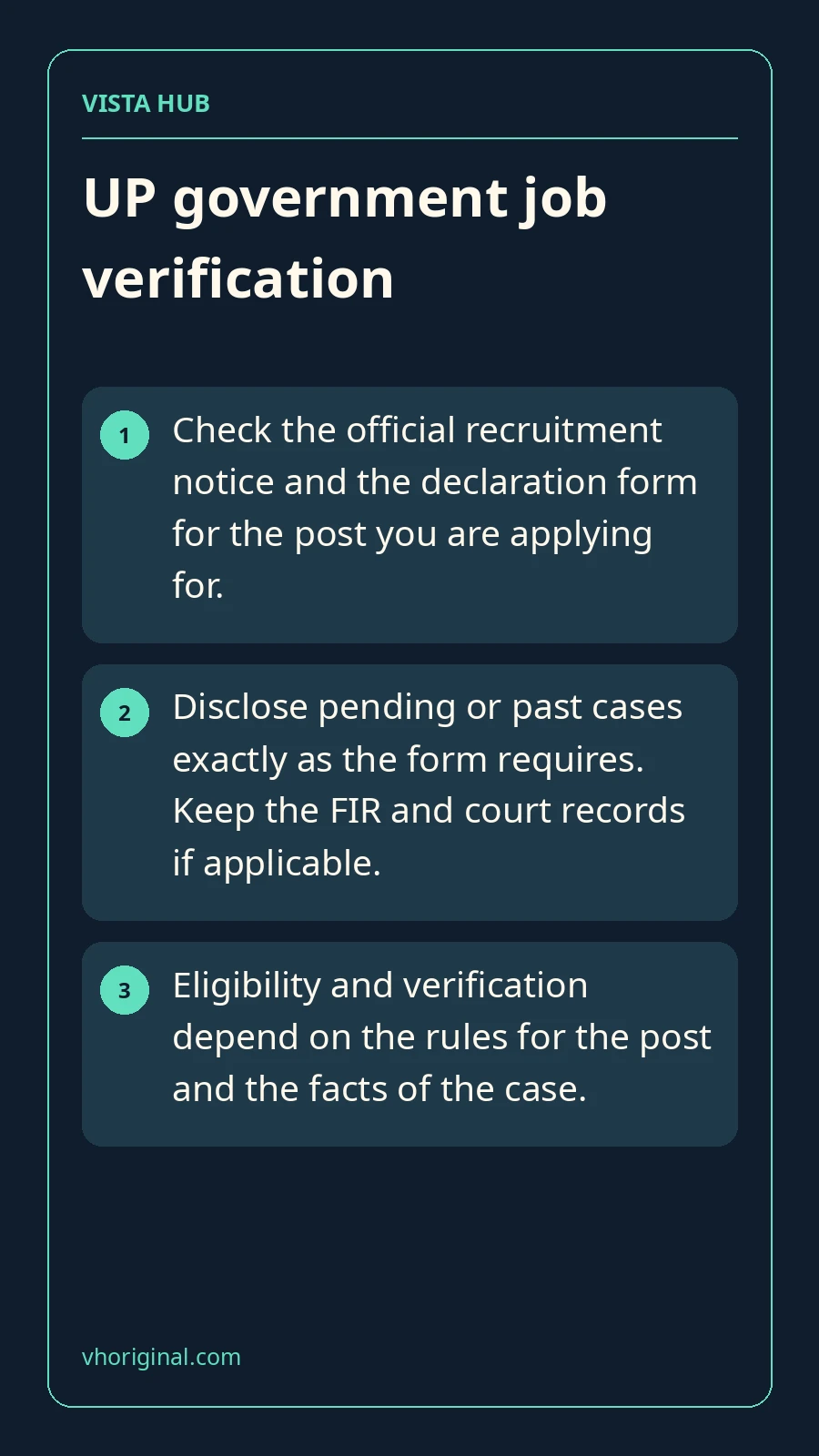
Reports emerging around October 29, 2026, highlight a consolidated policy for character and antecedent checks in UP’s direct recruitment. This policy requires candidates to disclose information regarding arrests, prosecutions, convictions, and their overall background. The scope of verification extends beyond mere participation in street protests to a broader framework assessing an individual’s history. Specifically, membership in an organisation whose stated aim is to change the existing social order through violence is a key point of scrutiny, as reported by The Indian Express. Therefore, interpreting this as a blanket ban on government jobs for critics of the government would be an oversimplification. The final decision rests on the specific order, recruitment conditions, and the facts of each candidate’s case.
Distinguishing Political Views from Violent Intent
A critical distinction has been drawn between holding political opinions, expressing disagreement with policies, and being a member of an organisation with violent objectives. Reports suggest that holding political views alone should not be grounds for disqualification. This aspect needs to be read in conjunction with the provisions concerning violent activities. However, this does not imply that all activities will go unchecked. The weight given to social media discussions, allegations, and documented evidence during verification will vary. A definitive outcome for any specific case cannot be predicted without examining the relevant records.
Impact of FIRs on Government Job Eligibility
An FIR (First Information Report), ongoing investigations, court proceedings, and convictions represent different legal stages. Candidates must respond truthfully and accurately to application and verification forms. Carefully read what the form asks: whether it pertains to arrest, a pending case, or a conviction. Avoid making assumptions when answering. While reports suggest that an unproven FIR may not automatically lead to disqualification, this does not guarantee selection for every candidate. The nature of the post, recruitment rules, court orders, and the specific circumstances of the case are significant factors. Misrepresentation on application forms and the existence of a criminal case are distinct issues.
Provisional Appointments Amidst Pending Verification
The updated reporting also mentions the possibility of provisional appointments based on self-declarations and undertakings, rather than unnecessarily delaying offer letters due to pending verification. This should not be misconstrued as ‘no police verification required.’ A provisional appointment is not the same as a completed process. Reports have also mentioned a 30-day timeframe for completing verification reports. This does not automatically mean permanent appointment on the 30th day. Candidates should check with the relevant department about the status of their verification and if any additional documents are required.
Guidance for Aspiring Candidates
Candidates preparing for government recruitment should maintain copies of their submitted applications and verification forms. If any case is pending, keep organised records of the case number, police station or court, and its current status. In cases of similar names or incorrect information, seeking official clarification can be helpful. Guessing ‘yes’ or ‘no’ is not advisable. It is essential to provide complete and truthful answers to all form questions. If any question is unclear, seek written clarification from the recruitment authority. If necessary, consult a qualified lawyer after showing them your documents. Relying on another candidate’s outcome found online as a precedent for your case is not a safe approach.
Beware of Viral Claims and Misinformation
Be cautious of exaggerated claims circulating online, such as “lifetime ban for every FIR,” “no jobs for political critics,” or “no verification needed anymore.” These are often oversimplified conclusions. When understanding the new policy, it’s vital to differentiate between eligibility, the process, and the final decision. The conditions under which an order is applied are more important than the headline. Screenshots of old orders, even with a new date, can circulate. If an order number, department, and issuing date are not visible, do not treat it as conclusive proof. Verify the situation through the official recruitment website, the appointing authority, or the official government gazette.
Frequently Asked Questions (FAQs)
Is every candidate who opposes the government deemed ineligible?
Available reports do not suggest such a broad interpretation. Peaceful political opinions and association with organisations having violent objectives are distinct. The final decision depends on the original rules and the specifics of each case.
What is the difference between an FIR and a conviction?
An FIR is a record of the initial information about a case, while a conviction is a judgment of guilt by a court. Recruitment forms may ask separate questions about both; it is crucial to state the correct situation.
Is a provisional appointment a final job offer?
It should not be considered a final, unconditional appointment. Verification, undertakings, and departmental conditions may still apply. Always read the actual text of the appointment letter.
Is this news only about UP Police recruitment?
The reporting refers to the broader recruitment system for government services in UP. For specific instructions applicable to a particular recruitment, refer to the notification from that department.
What the October 2026 Verification Policy Actually Requires
Fact-check updated 11 November 2026: The consolidated Uttar Pradesh policy reported in late October covers selected candidates for state departments and certain government-controlled bodies, not just UP Police recruitment. It asks candidates to disclose arrests, prosecutions, convictions, relevant pending or concluded criminal proceedings, dismissal from service and examination debarments when the prescribed verification form seeks those details. Omitting a material answer can create an independent problem even when a criminal accusation has not been proved. Keep copies of forms and answer each exact question truthfully; an FIR, a charge sheet, the framing of charges and conviction are different stages of law.
According to government clarifications reported by The New Indian Express on 29 October 2026, an FIR or pending investigation alone does not automatically disqualify an applicant. The nature of the alleged offence, current judicial stage, specific recruitment terms, and whether the candidate disclosed it accurately all matter. The government also distinguished peaceful expression of political opinions from organisations pursuing change by violent means. These rules should not be described as a blanket prohibition on dissent or protest.
Verification Timeline, Adverse Reports and the Candidate’s Response
Reports on the unified rules describe a 30-day target for district police and the Local Intelligence Unit to provide verification reports after receiving a formal reference. That is an administrative deadline, not a guarantee that every candidate’s appointment becomes permanent within 30 days. For many posts, a provisional appointment can be offered while checks continue, subject to an undertaking and later satisfactory verification. Sensitive posts may be subject to tighter approval and verification requirements. The particular vacancy notification and appointing department still control an applicant’s case.
When an adverse report is received, the policy described in the reporting provides an opportunity for the candidate to explain their position to the District Magistrate, including through online or in-person channels. A candidate should ask for the precise reason for an adverse finding, preserve all supporting records, and submit a factual response rather than relying on rumours. An acquittal, discharge or quashing order should be supplied accurately, together with the relevant dates and case identifiers. If a recruitment authority rejects a candidate, the available grievance process and court remedies depend on the actual order and applicable service rules.
A Practical Checklist Before Submitting Character Verification
- Read the application, self-declaration and verification form separately; they may ask different questions.
- Disclose information at the stage requested. Never guess that an FIR is equivalent to a conviction.
- Keep certified orders for acquittal, discharge, quashing, withdrawal or other final case outcomes.
- Use official department portals and record acknowledgement numbers for submitted documents.
- If your name resembles another person’s in police records, ask for a written correction or clarification through the recruiting authority.
- If a negative finding appears, respond to the documented issue with supporting facts and seek qualified legal advice if needed.
Further reporting: The Indian Express, 3 November 2026; PTI via The Week, 29 October 2026. The original government order and the notification of the relevant employer should take precedence over news summaries. This is informational, not personal legal advice.
Conclusion
The correct way to understand the new rules is to consider political opinions, association with violent organisations, criminal records, and the verification process as separate elements. This article provides a general interpretation based on available news reports and is not individual legal advice for any candidate’s specific case.
Related reading
- What to Do If Police Don't Register FIR in India? Understanding Zero FIR and Application Process
- How to remove name from false FIR: Section 482 CrPC quashing petition in High Court explained























Share Your Opinion
Comments are closed on this post.