 Vista
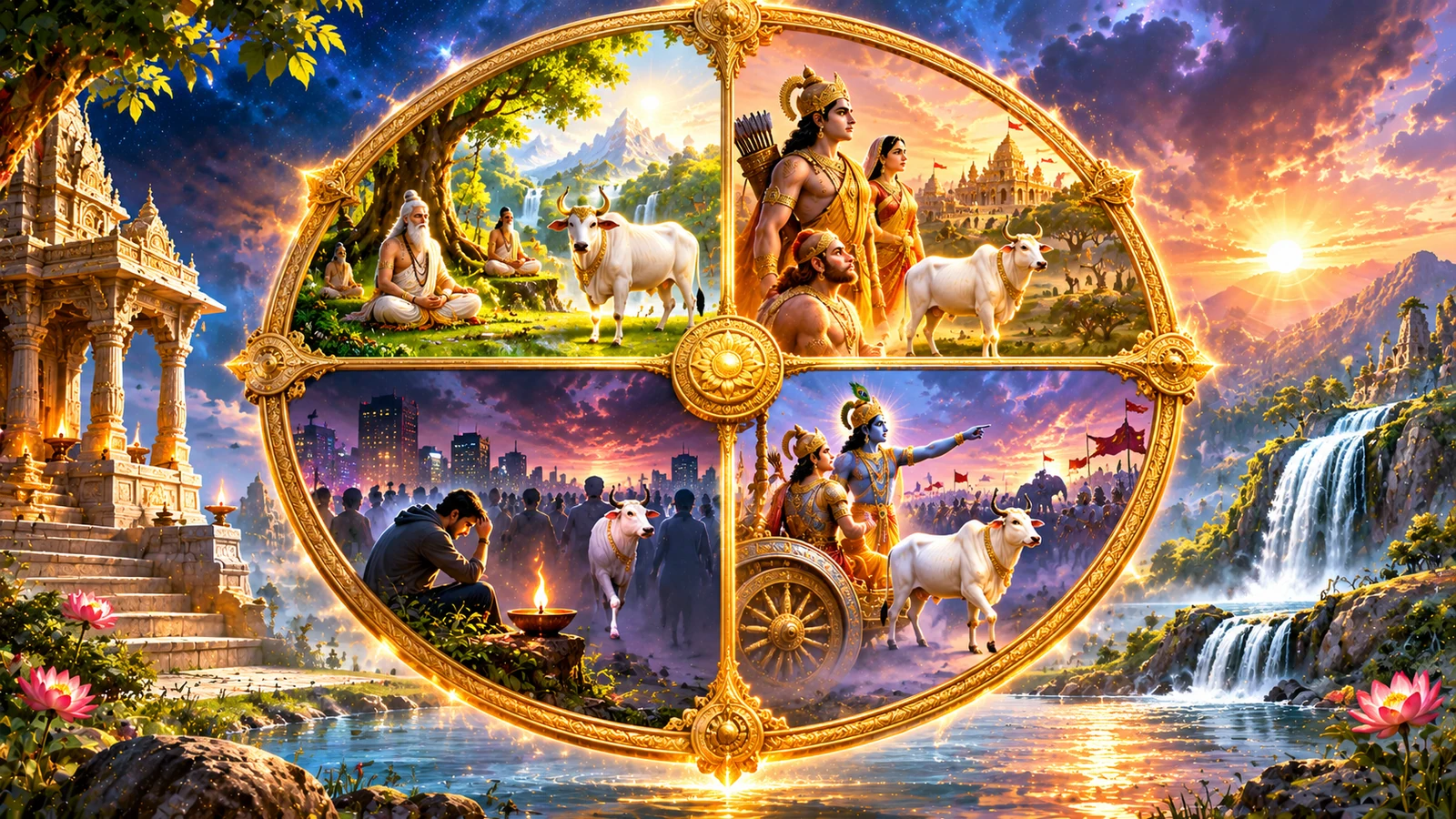
Quick answer: Hindu cosmology commonly describes four yugas in this order: Satya (or Krita), Treta, Dvapara and Kali. In a standard Puranic calculation, their respective lengths are 1,728,000; 1,296,000; 864,000; and 432,000 human years. Together they make a mahayuga or chaturyuga of 4,320,000 years. The ages also tell a moral story: dharma is depicted as increasingly difficult to sustain as the cycle advances. These are figures within a religious model of cosmic time, not independently verified dates for prehistoric human societies.
The names may be familiar from the Ramayana, Mahabharata, stories of Vishnu’s avatars, and questions such as “Which yuga are we living in?” What is less often explained is how the numbers are calculated, what the four-legged bull of dharma symbolizes, and why estimates of the end of Kali Yuga can be misleading. This guide answers those questions without confusing traditional belief, literary interpretation and modern historical evidence.
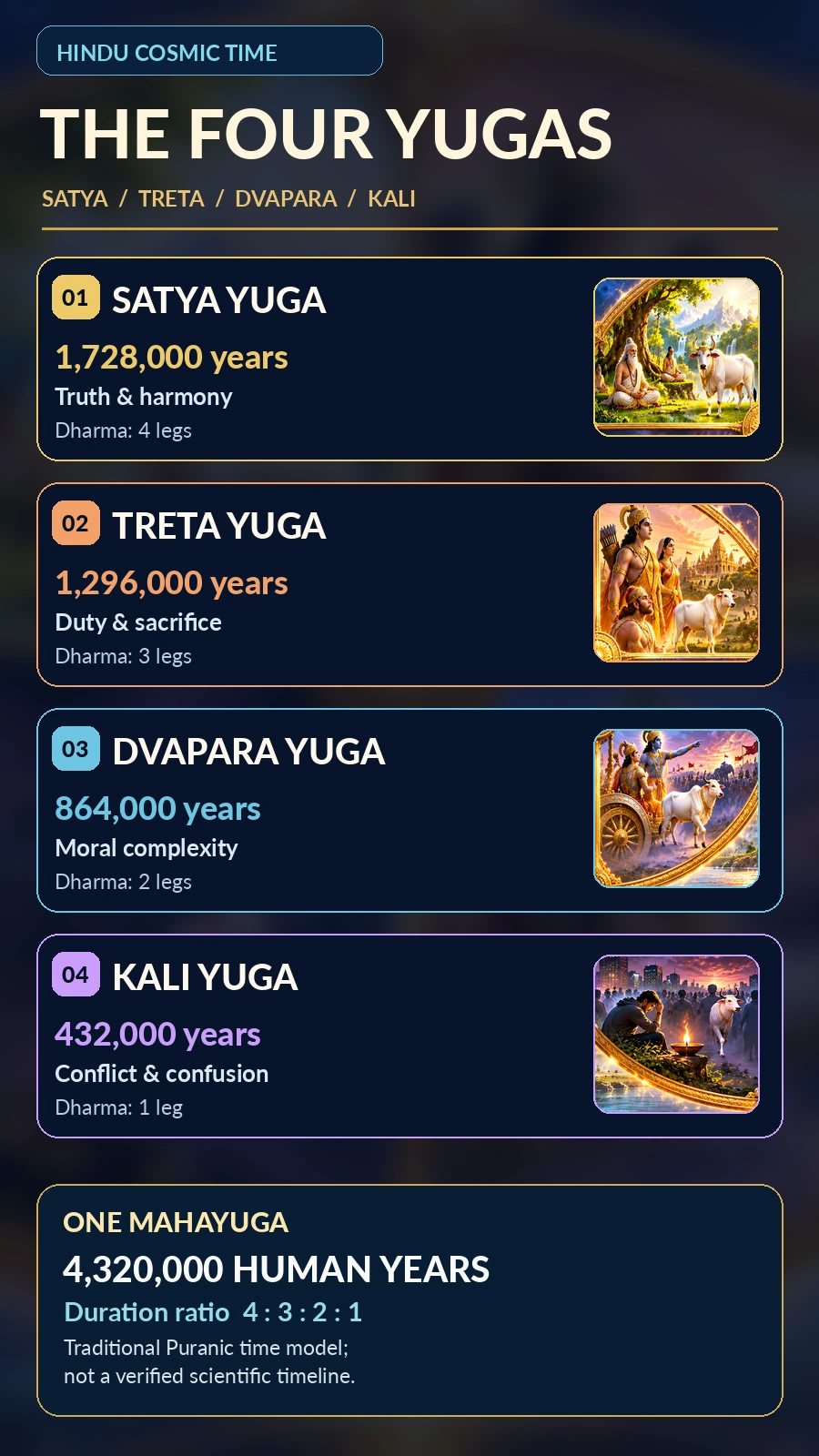
Four Yugas in Order: Duration Chart
| Yuga | Traditional human-year duration | Divine years, including transitions | Common symbolic theme |
|---|---|---|---|
| Satya Yuga / Krita Yuga | 1,728,000 | 4,800 | Truth, integrity and harmony |
| Treta Yuga | 1,296,000 | 3,600 | Duty, sacrifice and more complex social life |
| Dvapara Yuga | 864,000 | 2,400 | Conflict, competing duties and moral uncertainty |
| Kali Yuga | 432,000 | 1,200 | Strife, confusion and the challenge of protecting truth |
| One Mahayuga / Chaturyuga | 4,320,000 | 12,000 | A complete four-age cycle |
The 4:3:2:1 ratio is the easiest memory aid. These figures are given in familiar Puranic time calculations, including Bhagavata Purana 3.11.19 and Vishnu Purana 1.3. The “human years” column should not be mistaken for carbon-dated periods. The stories place readers inside a sacred, recurring view of time rather than a timeline established by geology or archaeology.
What Is a Yuga? Why Hindu Time Is Cyclical
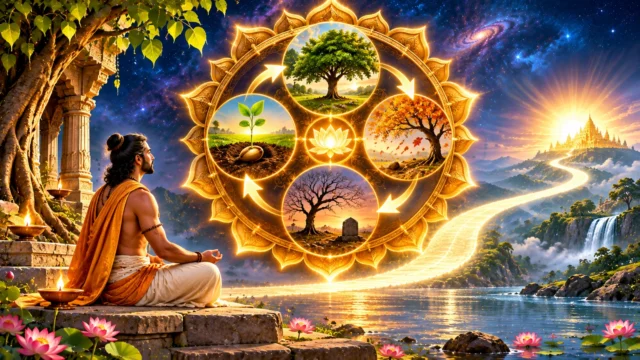
The Sanskrit word yuga can refer to an age or period, but its meaning depends on the text. In discussions of the four yugas, it refers to one of four major phases of a larger cosmic cycle. A mahayuga contains all four; broader Puranic calculations combine many such cycles into manvantaras and still larger periods. Therefore “Kali Yuga” does not simply mean “the modern age” in the way that a historian might speak of the industrial or digital age.
This is a crucial difference between mythological time and historical time. Historical claims are tested against inscriptions, physical remains, dated manuscripts and other evidence. A cosmological narrative may instead connect time with ethical order, divine manifestation and the recurring rise and decline of conditions for spiritual life. The two frameworks can be studied alongside each other without pretending that they answer the same question.
In many retellings, dharma—the complex idea of right conduct, duty and sustaining order—is personified as a bull. Its four legs symbolize austerity or disciplined restraint, cleanliness, compassion and truthfulness. Bhagavata Purana 1.17.24–25 uses the image to describe a decline from four supporting legs in Satya Yuga to one especially endangered leg in Kali Yuga. This is a religious and literary metaphor, not a numerical measurement of how ethical the people of any particular century actually are. The symbol invites self-examination rather than contempt for anyone born in a supposedly inferior age.
Satya Yuga: The First Age of Truth
Satya Yuga, also called Krita Yuga, occupies the largest share of the traditional cycle: 1,728,000 human years. Popular explanations call it the golden age because truth, self-discipline and harmony are said to be strong. Many accounts present spiritual understanding as relatively direct, with fewer obstacles created by greed, rivalry or deception. The four legs of the bull of dharma are intact in the famous symbolic image.
“Perfect age,” however, should not be read as a claim that historians have discovered an actual million-year human civilization with no conflict. The descriptions arise from sacred literature. Their value lies partly in establishing an ideal against which later characters and societies can be considered. Rather than seeing Satya Yuga as a date to insert into a school history chart, a reader can ask what a society centered on honesty and care would demand of its members.
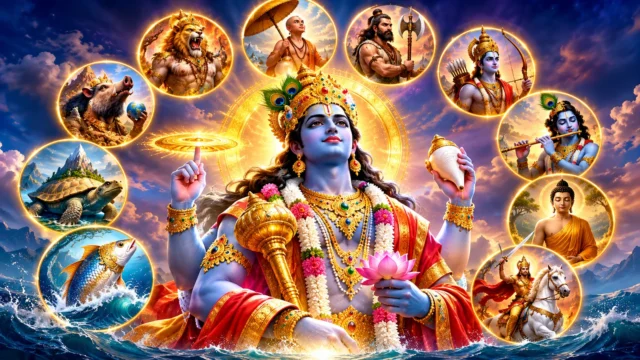
Vishnu-related traditions connect some early avatars, such as Matsya, Kurma, Varaha and Narasimha, with mythic events often placed in or near this early phase. The precise placement is not completely uniform across regional and devotional narratives. An article that presents every avatar as occurring on an astronomically verified date goes beyond what the stories establish. The chronological arrangement is useful for understanding tradition, not proof of a fossil record or a technology timeline.
Treta Yuga: Duty, Rama and the Costs of Choice
Treta Yuga follows Satya Yuga and lasts 1,296,000 human years in the standard Puranic scheme. Moral life is often portrayed as more complicated than in the first age. In the metaphor of the bull, dharma now stands on three legs rather than four. This should not be interpreted as saying that every person is 25 percent less virtuous. The fraction belongs to the imagery of a gradual weakening of ideal order.
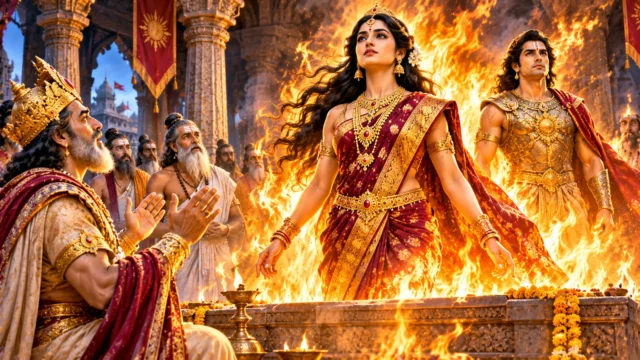
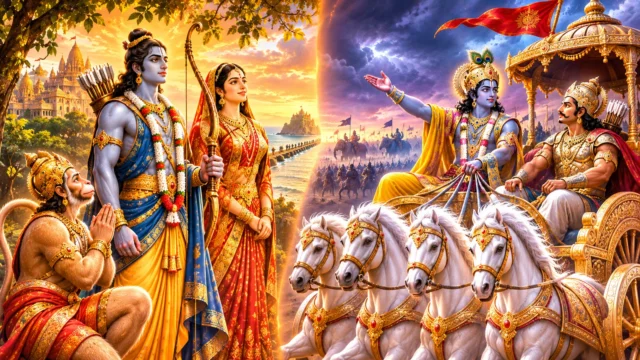
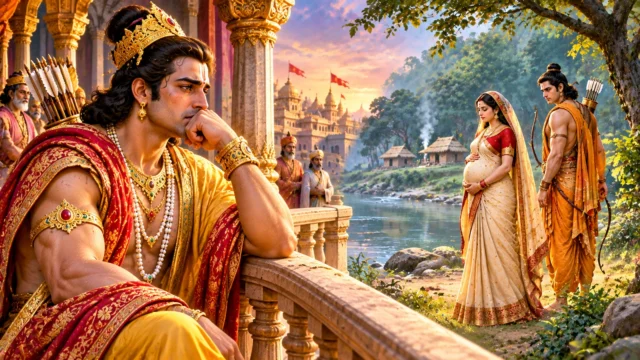
Treta Yuga is strongly associated in popular Hindu storytelling with Rama and the Ramayana. The epic explores duty through painful choices: royal responsibility, loyalty to family, exile, truthfulness, affection and political obligations do not always point in the same direction. Rama is celebrated as an exemplar of dharma in many traditions, yet his narrative also includes conflicts that readers and commentators have debated for generations. That tension makes the epic richer than a list of instructions for perfect behavior.
The Treta label can help new readers place the Ramayana within traditional cosmic chronology. It cannot, on its own, prove the dates of the events described in the epic. Different Ramayana traditions may also highlight different versions of an episode. The responsible way to explain the association is to write “traditionally located in Treta Yuga,” not to assert that a modern excavation has independently confirmed a precise year for every scene.
Dvapara Yuga: Krishna, Mahabharata and Moral Complexity
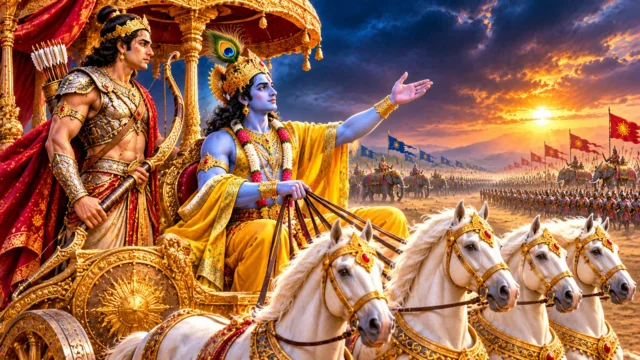
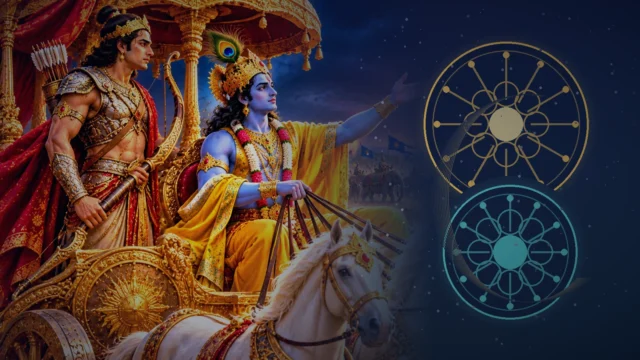
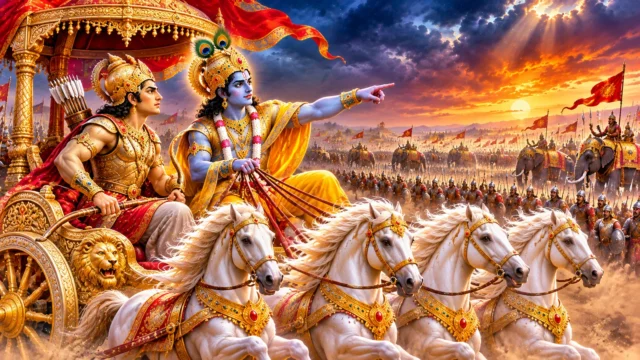
Dvapara Yuga, the third age, lasts 864,000 human years under the familiar 4:3:2:1 framework. The image of dharma is reduced to two legs. Its literary atmosphere is often described through competing obligations, political struggles and decisions in which every available option can carry a cost. The association most recognizable to global readers is Krishna and the Mahabharata, especially the Kurukshetra conflict.
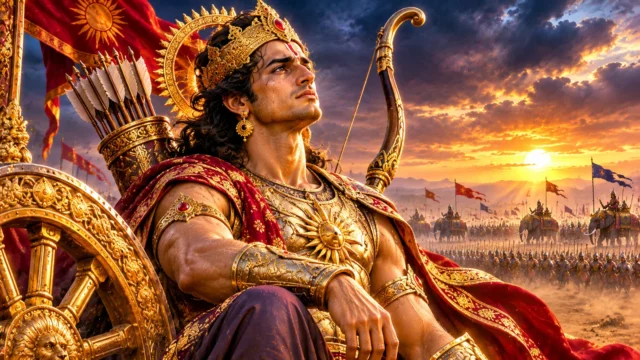
The Mahabharata is not merely a war story about an entirely good side defeating an entirely bad side. Its characters wrestle with vows, kinship, ambition, inherited injustice and the human consequences of duty. Arjuna’s anguish before battle and Krishna’s instruction in the Bhagavad Gita are among its most influential moments. Although the Gita discusses dharma and responsible action, it is not a direct textbook table of four age lengths. The yuga chronology is supported by the relevant cosmological passages in other texts.
Some conventional narratives place the transition from Dvapara to Kali around the departure of Krishna. The exact phrasing and chronological details vary by textual and calendrical tradition. There is no independent archaeological record establishing the conventional million-year durations of the four ages. You can admire the moral seriousness of the epic while remaining careful about the difference between a sacred chronology and a measured date in academic history.
Kali Yuga: The Fourth Age and Its Meaning Today
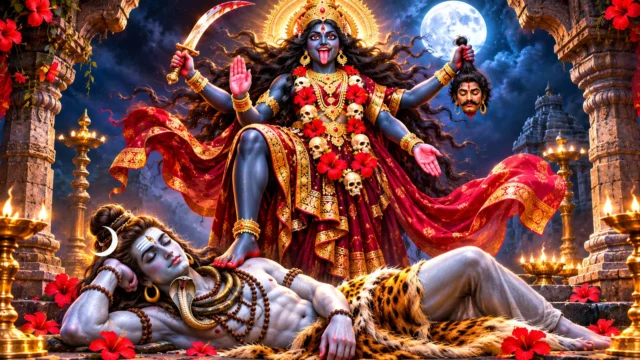
Kali Yuga is the fourth and shortest age in the standard cycle, with a duration of 432,000 human years. Traditional descriptions emphasize conflict, dishonesty, weakened institutions and the difficulty of maintaining dharma. “Kali” here is associated with strife or discord in the yuga narrative. It should not automatically be confused with Goddess Kali, whose name and devotional traditions have their own contexts. Similar spellings are not evidence that the age is named as a condemnation of the Goddess.
A memorable passage of the Bhagavata Purana presents dharma in the form of a bull standing on one leg, identified particularly with truth. The metaphor is deliberately dramatic: even when social trust weakens, truth still matters. It does not say that every contemporary person lacks compassion or that all earlier people were virtuous. Neither the internet nor a modern newspaper is needed to prove a literal Puranic date; people in many historical periods have complained about moral decline.
Kali Yuga is also interpreted as an era in which accessible devotional practices can matter greatly. Traditions differ in how they discuss prayer, remembrance, ethical action and spiritual community. One should not turn the descriptions of social decline into an excuse for fatalism. In an age portrayed as difficult, honesty, service and restraint can have heightened meaning precisely because they require effort.
When Did Kali Yuga Begin, According to Tradition?
A widely used Indian astronomical and calendrical era places its beginning in 3102 BCE. This is a traditional reference point used in calculations, not a date established through excavation of a recorded cosmic event. Historians of Indian astronomy have discussed how this epoch was calculated and employed in calendrical systems. For example, research on the Kaliyuga era published in the Journal of the Royal Asiatic Society explains its mathematical and historical context. A sacred time-reckoning can be important in culture and computation without functioning as independent proof that a supernatural transition physically occurred on that date.
By the Gregorian year 2026, the traditional epoch lies roughly 5,127 elapsed years in the past, depending on the exact date and counting convention. Against a 432,000-year model, that leaves approximately 427,000 years, not just a few months or decades. These are approximate deductions within the traditional system, and are not predictions validated by scientific forecasting. Readers should be suspicious of videos assigning an exact apocalypse to the current year on the basis of this scheme.
What Happens After Kali Yuga?
In a common cyclical account, the completion of Kali is followed by renewal and another Satya Yuga. Stories of the future Kalki avatar are associated with the restoration of dharma in various Vaishnava traditions. Details of renewal, the role of Kalki and the transitions between cycles differ among sources. A painting of Kalki on a white horse is religious iconography, not a photograph of a future event already observed.
The broader message is that moral decay does not have the last word. But the narrative should not be used to spread fear, sell predictions or promise a fixed date for dramatic events. A careful reader can study the symbol of renewal while recognizing that the future of human societies depends on many choices and material conditions.
How Are Yuga Lengths Calculated? Divine Years and Transitional Periods
The large numbers make more sense when the original units are explained. In the standard Puranic calculation, the four ages together contain 12,000 divine years. A divine year is counted as 360 human years. Multiplying 12,000 by 360 gives 4,320,000 human years. The four individual totals are 4,800, 3,600, 2,400 and 1,200 divine years respectively.
Each total also includes an opening twilight called sandhya and a closing twilight called sandhyamsha. Satya’s 4,800 divine years divide into 400 + 4,000 + 400; Treta’s 3,600 into 300 + 3,000 + 300; Dvapara’s 2,400 into 200 + 2,000 + 200; and Kali’s 1,200 into 100 + 1,000 + 100. This is why a webpage that quotes the “main age” while omitting both transitions may show a different figure. Before arguing that a number is wrong, check whether it includes the twilight periods and which textual interpretation it follows.
The overall 4:3:2:1 pattern is mathematically simple even though the resulting durations are vast. Some modern teachers and alternative cosmological interpretations propose different, shorter cycles. Those views should be attributed to their authors or schools, not silently substituted for the familiar Puranic calculation. The 432,000-year Kali duration used in this article follows the conventional scriptural model described above.
Myth, Evidence and the Most Common Misunderstandings
Myth: Scientists have verified a civilization lasting 1.728 million years as Satya Yuga. No accepted archaeological chronology demonstrates the four sacred ages as precisely bounded historical civilizations. These are figures from religious cosmology.
Myth: Kali Yuga will end in a specific year within the next decade. That claim does not follow from the standard 432,000-year duration and 3102 BCE reference point. Other claims need named sources and clear attribution rather than fear-based headlines.
Myth: The Bhagavad Gita alone supplies every yuga duration. The Gita includes important reflections on divine manifestation and dharma, but the detailed age arithmetic cited here comes from cosmological passages such as Bhagavata Purana 3.11 and Vishnu Purana 1.3.
Myth: “Kali Yuga” means “the time of Goddess Kali.” The name has a different context in the yuga narrative. Do not mix the age of discord with the worship of the Goddess on the basis of a similar English spelling.
Myth: A person living in Kali Yuga cannot be ethical. The bull-of-dharma story can be read as a reason to protect truth and compassion, not as a license to give up on them. The symbolic account is not a census of real people’s character.
Frequently Asked Questions
What are the four yugas in order?
Satya or Krita Yuga, Treta Yuga, Dvapara Yuga and Kali Yuga. This is the familiar order in the standard four-age Hindu cosmological cycle.
How long does each yuga last?
The commonly cited Puranic totals are 1,728,000, 1,296,000, 864,000 and 432,000 human years respectively, including transitional periods.
How many years are there in one mahayuga?
One mahayuga or chaturyuga contains 4,320,000 human years, equivalent to 12,000 divine years in this traditional calculation.
Which yuga are we in now?
In the widely followed traditional calculation, the current age is Kali Yuga. This is a religious-calendrical framework, not a scientific designation of the modern historical period.
Did Rama live in Treta and Krishna in Dvapara?
That is how popular traditional chronology usually places the Ramayana and Mahabharata narratives. It should not be confused with independently verified archaeological dates.
When will Kali Yuga end?
Under the 432,000-year model and the traditional 3102 BCE epoch, approximately 427,000 years remain as of 2026. This is an approximate result within the tradition, not a verified forecast.
What does the bull standing on one leg represent?
It symbolizes a weakening of dharma, with truthfulness especially stressed in the Kali Yuga passage of Bhagavata Purana 1.17. It is a moral image, not a literal statistic.
Conclusion: Read the Four Yugas as a Framework, Not a Countdown
The four yugas offer two useful perspectives at once. They describe an immense cyclic order of time—Satya, Treta, Dvapara and Kali—and they ask what happens to truth, duty and compassion when life becomes complicated. The standard durations form an elegant 4:3:2:1 ratio totaling 4.32 million years. Understanding the divine-year calculation and the symbolic decline of dharma helps prevent misleading claims about imminent endings or “scientifically proven” million-year civilizations. For further reading, compare a trusted translation of the relevant Purana with scholarly work on Indian calendrical history, and treat differences among traditions with care.
Sources and Further Reading
- Bhagavata Purana 3.11.19 — yuga durations.
- Vishnu Purana 1.3 — measures of time and transitions.
- Bhagavata Purana 1.17.24–25 — bull of dharma.
- Journal of the Royal Asiatic Society — the Kaliyuga era of 3102 BCE.
Editorial note (13 November 2026): Mythological ages and sacred chronology are reported as traditional teachings. Their durations and predictions are not claimed to be independently verified scientific history.
Related English Reading on Vista Hub
- Hindu cosmology and the Puranic creation cycle.
- The ten avatars of Lord Vishnu in order.
- Kurukshetra War rules and the 18-day timeline.









Share Your Opinion
Comments are closed on this post.