 Vista
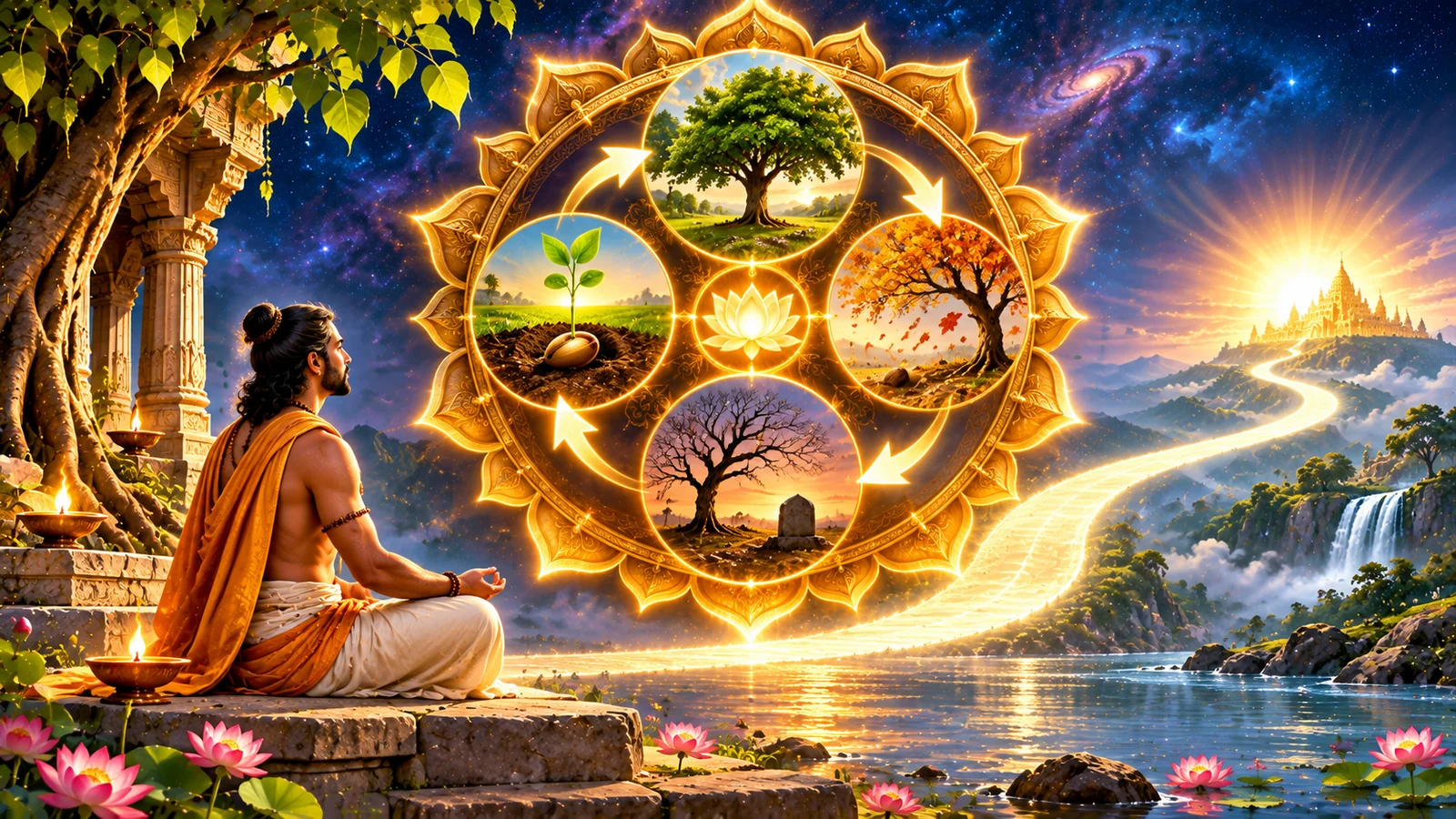
Reincarnation in Hinduism: A Clear Answer
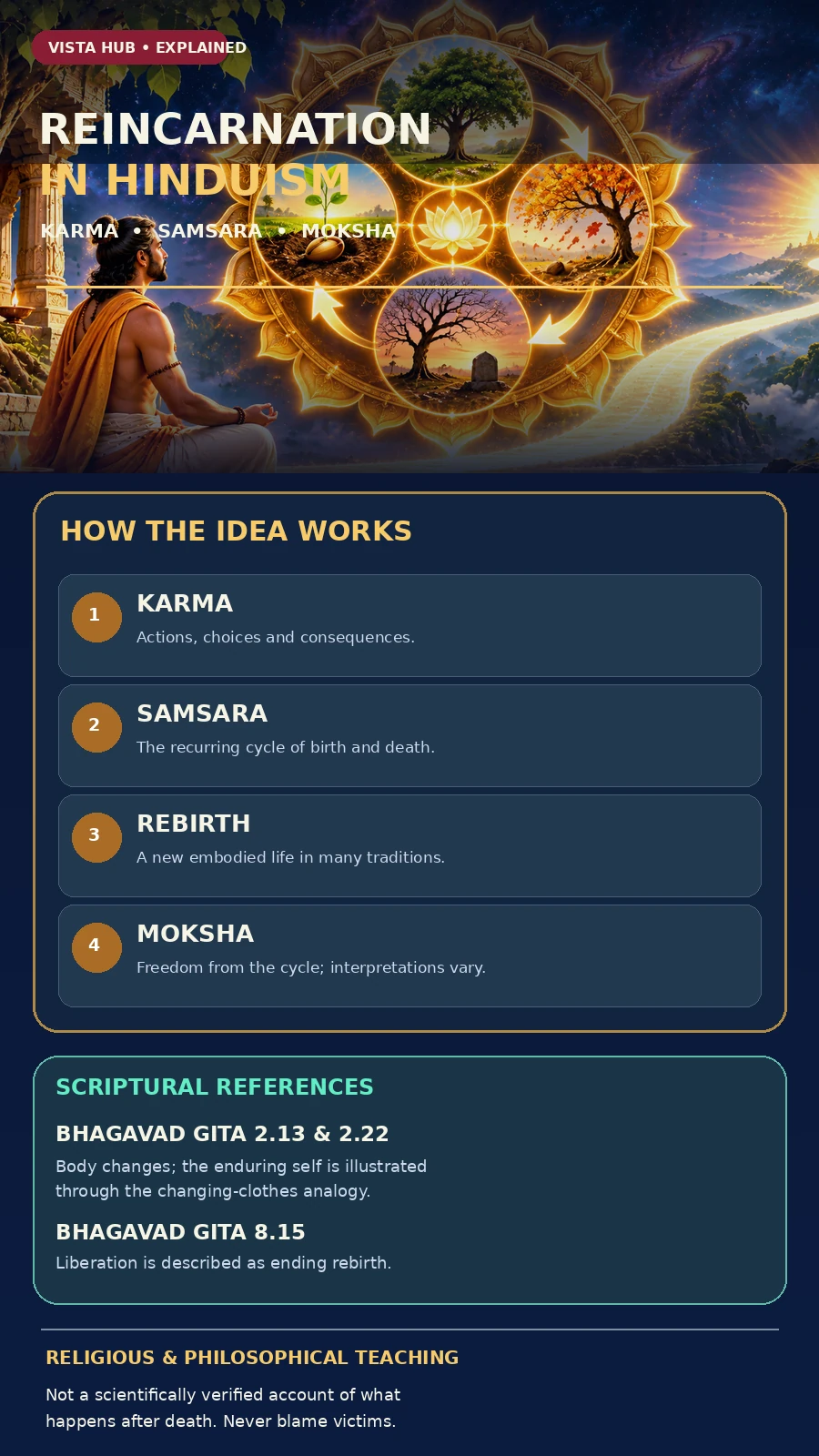
Reincarnation in Hinduism is the belief that an enduring self, often called the atman or jiva, continues beyond the death of one physical body and is associated with another embodied life. The repeating cycle of birth, death and rebirth is samsara; karma refers to action and its moral consequences; and moksha means liberation from bondage to that cycle. The words are closely linked, but they are not interchangeable. Hindu traditions disagree about the exact nature of the self, how karma operates and what liberated existence means. Therefore, the most accurate beginner’s explanation is a map of the ideas rather than a single mechanical description of where every person goes after dying.
This teaching is a religious and philosophical framework, not a scientifically established account of consciousness surviving biological death. It can help readers understand the Bhagavad Gita, Upanishadic discussions of the self and the ethical significance of actions. It must never become a reason to blame someone for poverty, illness, disability or violence by declaring that they are receiving punishment for an alleged previous life. Nobody can verify such a judgment about another person’s past. The central questions are more constructive: how should we act now, what keeps us attached, and what does freedom mean?
The Four Key Terms: Atman, Karma, Samsara and Moksha
Atman can mean the inner self in major Hindu philosophical contexts. In several schools, this self is not identical with the changing body or passing thoughts. Jiva often describes the living, embodied individual. Precisely how jiva and atman relate differs among Vedanta, Samkhya and other traditions. A quick online glossary might treat these Sanskrit terms as identical, but serious writing distinguishes everyday shorthand from the detailed doctrines of a school.
Karma literally concerns action and, in religious discussions, the consequences attached to actions, intentions and responsibility. It is not simply a cosmic machine that distributes instant rewards. Samsara names the continuing condition of embodied existence shaped by ignorance, attachment and karma in many traditions. Moksha is release from that binding condition. In a memorable summary, karma helps explain why the cycle continues, samsara is the cycle, and moksha is the possibility of freedom. That formula simplifies a rich philosophical landscape, but it gives new readers a reliable starting point.
Think about a person facing a difficult choice at work. Their present decision is an action, and its consequences matter to colleagues and family. That is a practical analogy for the ethical dimension of karma, not evidence that their future birth can be predicted. Samsara asks a broader question: why do craving, fear and mistaken identification repeat? Moksha asks what it would mean to be free of their deepest hold. The teaching connects action with reflection rather than excusing inaction or resignation.
What Happens to the Soul After Death According to Hinduism?
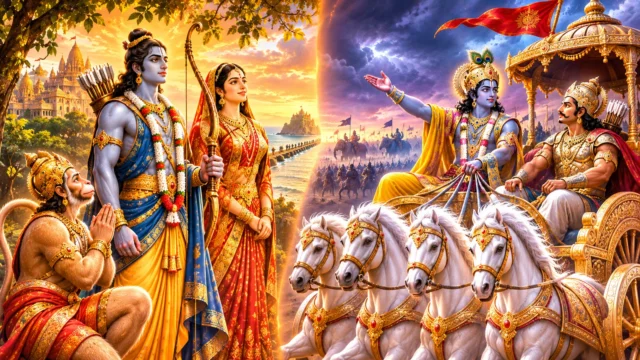
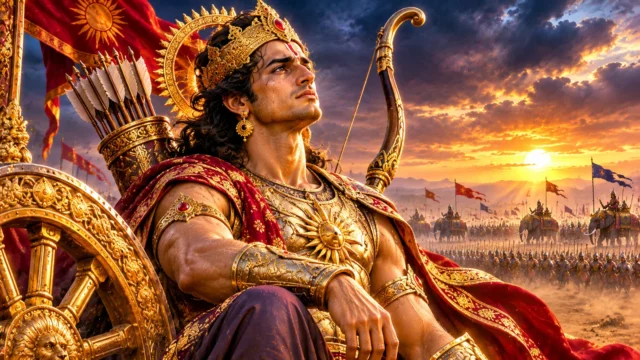
Many Hindu teachings distinguish the mortal body from an enduring self. In the Bhagavad Gita, Krishna addresses Arjuna’s grief by describing the embodied being as passing through childhood, youth and old age and then another embodiment (2.13). The famous changing-clothes image of verse 2.22 presents the replacement of worn garments as an analogy for leaving one body and taking another. These are theological comparisons within a dialogue about duty and mortality; they are not clinical descriptions of a measurable process at death.
Accounts of what follows death vary across texts and communities. Some discuss intermediate states, ancestors, ritual obligations or other realms; others concentrate on karma, realization or devotion without presenting a detailed timetable. The Garuda Purana is frequently mentioned online, but a dramatic television summary should not be treated as the compulsory teaching of all Hindus. There is no universally agreed number of days, route through the afterlife or one-size-fits-all map that every Hindu tradition requires.
This distinction also matters for people grieving a loved one. Families may find meaning in prayers, remembrance and customary rites, but speculation about the deceased person’s precise destination can add unnecessary distress. Spiritual interpretations are different from facts that medicine can test. When discussing death with a child or someone experiencing bereavement, it is kinder to say, “Different traditions believe different things,” than to present an elaborate post-death itinerary as a witnessed certainty.
How Does Karma Affect Rebirth?
In many Hindu explanations, actions and dispositions have effects beyond the immediate present. Classical philosophical accounts distinguish the consequences unfolding now from accumulated or newly generated karma, although classifications and vocabulary differ among schools. A popular Vedanta scheme describes sanchita as accumulated karma, prarabdha as the portion already bearing fruit, and agami as karma generated through present conduct. That terminology is a teaching framework, not a device for calculating someone’s next parents, social status or date of death.
The Bhagavad Gita’s moral emphasis also complicates a simplistic “good deeds buy a luxurious next life” interpretation. It teaches action with discernment and reduced attachment to results. Karma in this context concerns intention, responsibility and the tendencies cultivated through action. It does not replace normal explanations for social injustice, medical conditions, chance events or structural inequality. Telling a person harmed by abuse that they must have deserved it because of past karma is both unsupported and ethically dangerous.
Imagine someone who lies repeatedly and then finds that others no longer trust them. That consequence is visible and understandable without invoking a hidden previous life. Meanwhile someone may suffer despite acting with integrity. Hindu texts and thinkers have long discussed such complexities; the doctrine should not be used as permission to disregard unfair systems. A mature reading focuses on actions we can change, the harms we should repair and the compassion we owe one another now.
| Concept | What it means | What it does not mean |
|---|---|---|
| Atman / Jiva | Self or embodied individual, interpreted by school | Proven medical object |
| Karma | Action and moral consequences | Instant reward or automatic victim-blaming |
| Samsara | Cycle of birth and death | A scientifically mapped mechanism |
| Moksha | Freedom from binding rebirth | A guaranteed result from a paid ritual |
What Do the Bhagavad Gita and Upanishads Actually Say?
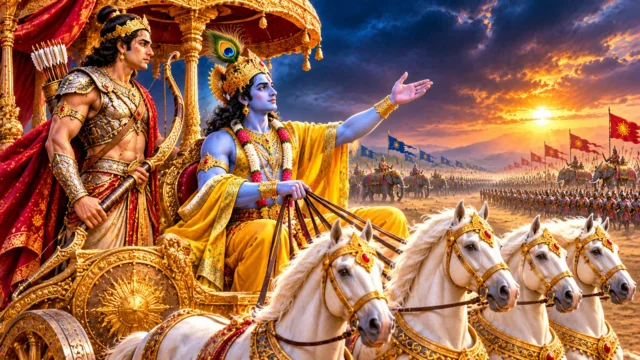
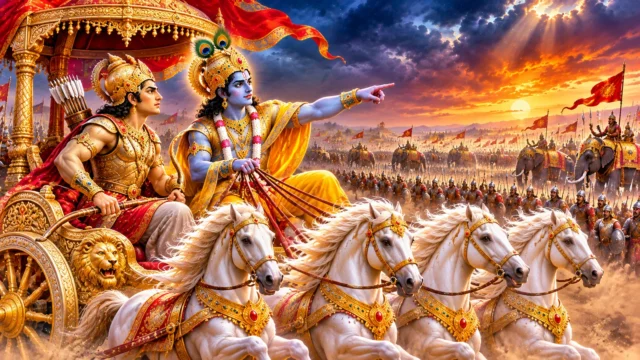
The Bhagavad Gita belongs to the Mahabharata and takes the form of a dialogue between Krishna and Arjuna. Its discussion of the self begins within Arjuna’s moral crisis on a battlefield. Verses 2.13 and 2.22 are especially relevant to rebirth because they contrast bodily change with continuity of the embodied self. Verse 8.15 describes the great souls who attain the highest goal as not returning to another birth. The Gita also discusses disciplined action, devotion, meditation and knowledge; reducing it to a promise of automatic reward after death overlooks much of its argument.
The Upanishads provide philosophical settings for questions about the self, ultimate reality, desire and liberation. Some teachings distinguish what changes from what is enduring; others ask whether the self can be fully understood as an object of ordinary experience. Philosophical schools later developed different answers to these questions. It is misleading to claim that every school accepts precisely the same account of a personal soul traveling intact from one body to another.
Translations matter. A Sanskrit term may be rendered as self, soul, consciousness or individual being according to philosophical context. Read the verse with surrounding lines and, ideally, more than one commentary. IIT Kanpur’s heritage edition includes multiple traditions for the Gita and shows why one verse can receive distinct interpretations. If a social post presents an exact quotation without a chapter or verse, verify it before repeating the claim. Careful source-checking respects the texts more than dramatic certainty.
Do All Hindu Philosophical Schools Explain Reincarnation the Same Way?
No. Advaita Vedanta, associated with Shankara, emphasizes nondual Brahman and the recognition of the self’s deepest identity with ultimate reality. From that perspective, ignorance and mistaken identification with limited individuality are central to bondage. Vishishtadvaita, associated with Ramanuja, understands individual selves in relation to the supreme Lord and emphasizes devotion and grace. Dvaita, associated with Madhva, maintains a distinction between the individual self and God. These schools share many scriptural reference points while differing substantially on the destination and meaning of liberation.
Other Hindu schools also offer distinctive explanations of self, causation and release. Yoga and Samkhya, for instance, employ the concept of purusha and distinguish awareness from material nature in ways that should not be flattened into a standard popular soul story. Traditions oriented around Shiva or the Goddess may articulate liberation using their own philosophical and devotional vocabulary. These differences are not mere spelling variations; they are substantive positions developed through centuries of argument.
It is also helpful not to confuse Hindu rebirth teaching with every other South Asian account. Many Buddhist schools accept rebirth while rejecting a permanent atman; Jainism has its own doctrine of jiva and karmic bondage. An introductory article about Hinduism should acknowledge such distinctions without pretending to speak for Buddhists or Jains. Even within Hindu families, practice and interpretation can vary. The question “What do Hindus believe?” often needs the follow-up “Which community, scripture and philosophical school?”
What Is Moksha and How Is It Different from Heaven?
Moksha is commonly described as release from samsara, not merely a better destination inside the same cycle. Enjoyment in a celestial realm may be temporary in some scriptural explanations, whereas liberation is a deeper change in the condition of bondage. Bhagavad Gita 8.15 speaks of reaching the highest perfection and not undergoing rebirth. That is a theological claim, not a claim that a telescope has located a place called moksha.
The means emphasized for liberation vary. Jnana yoga stresses transformative knowledge or insight; bhakti yoga stresses devotion and relationship with the divine; karma yoga concerns the disciplined performance of action without possessive attachment to its fruits; and meditation-centered approaches cultivate steadiness and self-understanding. These should not be presented as mutually exclusive boxes; the Gita repeatedly connects them. Neither a single online quiz nor a mechanical ritual guarantees an outcome that religious communities interpret in different ways.
For everyday readers, moksha raises a surprisingly practical question: can we become less ruled by fear, selfishness, contempt and compulsive comparison? Such growth is not the same as proving final liberation, but it is a humane way to understand why the tradition treats spiritual practice as something that transforms conduct here and now. A person can value compassion, study and self-discipline without claiming privileged knowledge about anyone else’s fate.
Is Reincarnation Scientifically Proven? Evidence and Limits
Reincarnation is an important religious and philosophical belief; the movement of an individual self between bodies has not been established as a reproducible scientific fact. Researchers and writers have discussed reports of children describing apparent past-life memories, but anecdotes, suggestibility, cultural context, memory errors and difficulties independently verifying every detail make strong conclusions controversial. No laboratory procedure can identify an atman, measure karmic balances or reliably predict a person’s next birth.
Near-death experiences, dreams and striking coincidences are also sometimes presented as conclusive proof. They can be meaningful experiences for the people involved, yet an unusual experience alone does not determine which metaphysical explanation is true. Science asks questions that can be tested with observations and methods; religious philosophy can address meaning, moral responsibility and liberation with different kinds of reasoning. Keeping those approaches distinct is more intellectually honest than insisting that one has already experimentally confirmed the other.
A careful writer can explain the belief respectfully while stating the evidence limits clearly. Avoid sensational headlines announcing that a named person has “proved rebirth” or that a child’s story reveals a criminal’s identity. Claims involving children should protect their privacy and emotional wellbeing. The healthy takeaway is curiosity with humility: learn what the scriptures say, recognize what modern research can and cannot show, and do not mistake certainty of feeling for independent verification.
Common Myths, Practical Lessons and Responsible Questions
Myth: Karma means fate cannot be changed. Many Indian thinkers instead leave room for present agency and disciplined choice. Myth: A person in difficulty must have been bad in a past life. That is an unverified accusation and no excuse for withholding care. Myth: Moksha is simply a place where everyone goes after death. The concept is generally a release from bondage and is explained differently among philosophical schools. Myth: The Gita provides an exact chart of every soul’s journey. Its teaching is richer and does not supply one universally fixed after-death itinerary.
A practical approach is to use the ideas as ethical questions rather than predictions. Before acting, ask what is compassionate and responsible. When a decision has harmed someone, acknowledge the harm and make amends where possible. When facing uncertainty, avoid pretending that you know a person’s invisible karmic history. Learn from your own choices, notice patterns that you can change and resist superstition marketed as spiritual certainty. These habits stand on their own value regardless of whether one accepts reincarnation as a religious belief.
It is also worth examining who gains when a spiritual claim is presented as unquestionable. Fear-based advertisements promising to reveal your previous life, erase karma instantly or guarantee liberation are commercial claims, not reliable interpretations of a complex tradition. If advice pressures you to pay large sums, abandon treatment or cut off supportive relationships, treat that as a warning sign. Genuine religious study and community support should not require surrendering your judgment or safety.
Frequently Asked Questions
What is reincarnation in Hinduism?
It is the belief, interpreted differently across Hindu traditions, that an enduring self is associated with repeated embodied lives until liberation from samsara.
What is the difference between karma and samsara?
Karma concerns actions and their consequences; samsara is the recurring cycle of birth, death and rebirth in which karma is often understood to play a role.
What is the meaning of moksha?
Moksha means liberation from bondage and repeated rebirth; traditions differ about how liberation is realized and experienced.
Which Bhagavad Gita verses discuss rebirth?
Verses 2.13 and 2.22 describe continuity of the embodied self through change, while 8.15 discusses freedom from another birth.
Does Hinduism say everyone remembers a previous life?
No. Most accounts do not claim that ordinary people reliably remember former lives. Claims of specific memories require careful evaluation and are not established proof.
Can good karma guarantee a wealthy next birth?
There is no reliable method of predicting a particular future life from someone’s actions, and that idea should never be used to justify inequality or blame vulnerable people.
Is reincarnation scientifically confirmed?
No reproducible scientific evidence has established the transfer of a permanent self between bodies. It remains a matter of religious belief and philosophical debate.
Conclusion: The Point Is How We Live Now
Reincarnation in Hinduism becomes clearer when four terms are kept distinct: atman or jiva concerns the self, karma concerns action and consequence, samsara names recurring embodied existence, and moksha is release from bondage. The Bhagavad Gita and Upanishadic traditions provide influential explanations, while different Hindu schools interpret their implications differently. A thoughtful approach neither ridicules belief nor exaggerates scientific evidence. More importantly, it refuses to turn karma into an excuse for cruelty. Whatever one’s convictions about another birth, compassion, honesty and responsibility are choices available in this one.
Sources and Reading
- Bhagavad Gita 2.13 — continuity of the embodied self
- Bhagavad Gita 2.22 — changing garments analogy
- Bhagavad Gita 8.15 — freedom from rebirth
- Stanford Encyclopedia of Philosophy — Personhood in Classical Indian Philosophy
- Stanford Encyclopedia of Philosophy — Naturalism in Classical Indian Philosophy
- Stanford Encyclopedia of Philosophy — Shankara and Advaita Vedanta
Related Reading on Vista Hub
- What happens after death: beliefs, philosophy and science
- Past-life claims and scientific perspectives
- The Mahabharata and the code of dharma
Reviewed 13 November 2026. This article explains religious and philosophical beliefs, not medically or scientifically verified events after death. No individual’s suffering can be proved to result from a past life.







Share Your Opinion
Comments are closed on this post.