 Vista
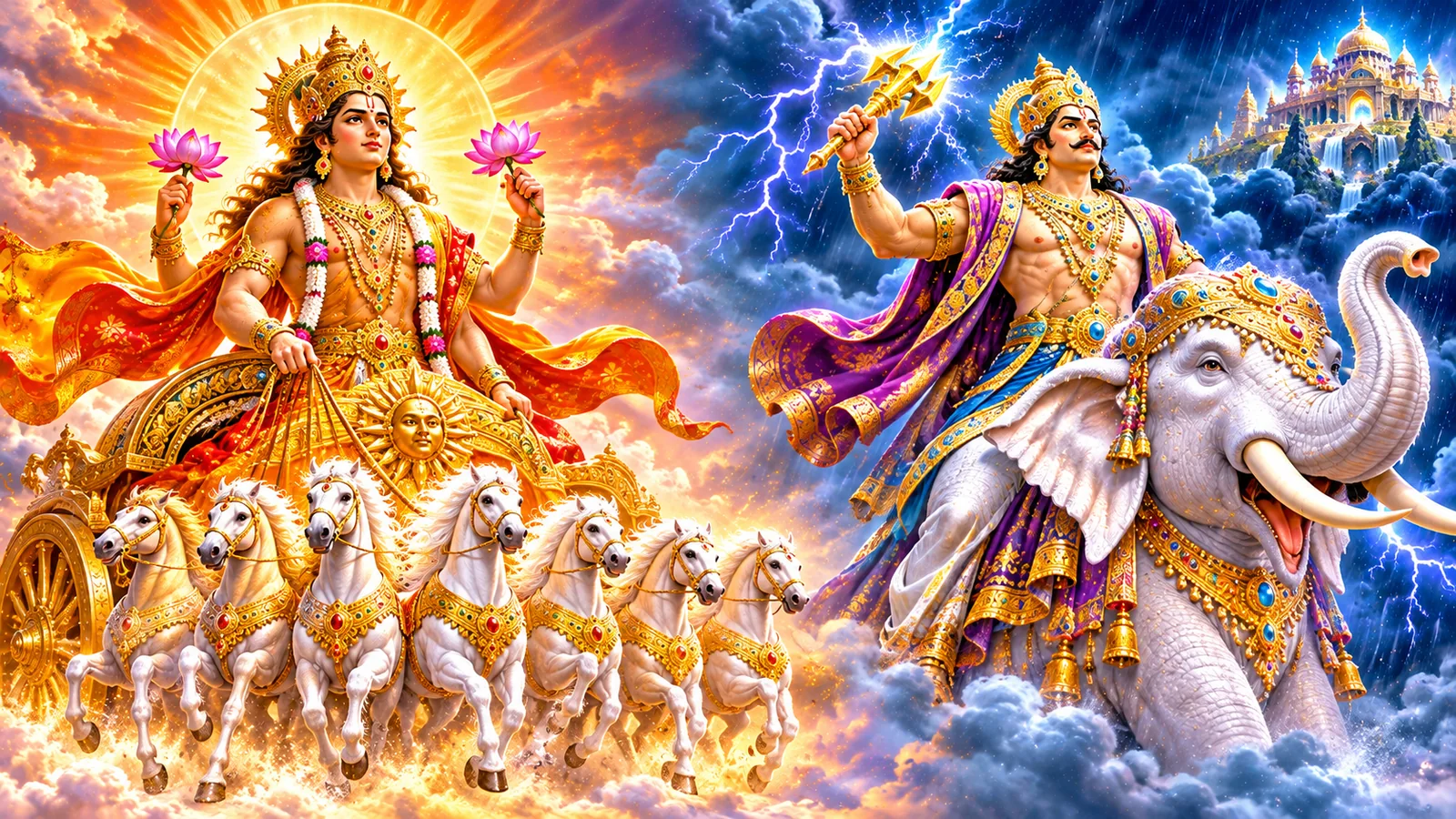
Quick answer: Surya is the Hindu Sun God, associated with sunlight, the daily passage of the sun, and the life-giving power of light. Indra is the celebrated Vedic storm deity and king of the devas, associated with the vajra thunderbolt, rain, and the defeat of Vritra. They are different divine figures, not two names for the same god. Importantly, Indra’s title as “king of the gods” describes his position in many Vedic and mythological stories; it does not mean every Hindu tradition regards him as the ultimate or supreme divine reality. To understand why these two names appear together, we need to look at their early hymns, later stories, symbolic images, and everyday worship.
Who Is Surya, the Sun God in Hindu Mythology?
Surya (Sūrya) is the divine personification of the sun in Hindu religious literature. A person seeing the name for the first time can remember a straightforward distinction: the visible sun is a heavenly body studied by astronomy, while Surya is a deity through whom religious poetry and art interpret the light that makes life possible. Ancient texts do not all speak about the sun in exactly the same voice. Vedic hymns may address Surya as the brilliant eye of the sky and describe his power to illuminate the world. Later artworks give him a recognizable human form, with crown, lotuses and a radiant halo.
Surya is commonly shown riding a chariot drawn by seven horses, sometimes represented as one horse with seven heads. The charioteer is often named Aruna. Museum descriptions confirm that the number of horses and details of the costume vary across periods: one should not assume that every surviving early sculpture matches the same modern calendar poster. The seven-horse image is important because it has become a familiar way of depicting the sun’s travel across the heavens. The horses have received symbolic interpretations involving rays, meters and the rhythm of time, but none is a single mandatory interpretation of every picture.
Surya’s importance is not limited to a mythic family tree. Sunrise is a daily experience, so solar worship can connect cosmic language with ordinary human routines. In different parts of India, Surya is honored through prayers, festival observances, temple images and salutations. The 13th-century Konark Sun Temple in Odisha is a prominent example of a monument conceived through the imagery of the solar chariot. Surya’s directness—sunlight arriving every morning—helps explain why the deity remains meaningful even as religious practices and visual styles evolve.
Who Is Indra, the King of the Devas?
Indra is one of the most prominent deities in the Rigveda, where he appears as a warrior and a bringer of storms. His signature weapon is the vajra, often rendered as a thunderbolt. In a famous Vedic myth, Indra defeats Vritra, a serpent- or dragon-like opponent linked with the obstruction of waters. The release of waters after the conflict has been read as a dramatic image of rain overcoming drought. It is a religious and poetic account, not a documented meteorological event or evidence that a literal supernatural creature once held back rivers.
In later epic and Puranic narratives, Indra is frequently described as Devaraja, the ruler of the devas, and associated with Svarga, the heavenly realm. His elephant mount is widely known as Airavata. Indra’s role is sometimes protective and generous, but stories also portray him as anxious about power, proud, jealous or in need of correction. That mixture does not make the tradition incoherent; it illustrates that a character with authority can still face moral consequences. If readers search “who is the king of the gods in Hindu mythology,” Indra is the conventional short answer in these stories. If they search “who is the supreme God in Hinduism,” the answer is more complicated and depends on the theological school.
Older Vedic poetry and later devotional Hinduism do not organize divine status in identical ways. Indra’s central role in many early hymns should not be erased, but it also should not be projected unchanged onto every form of present-day practice. A useful historical approach is to state which text and which period a claim describes rather than build an imaginary power-ranking chart of all deities.
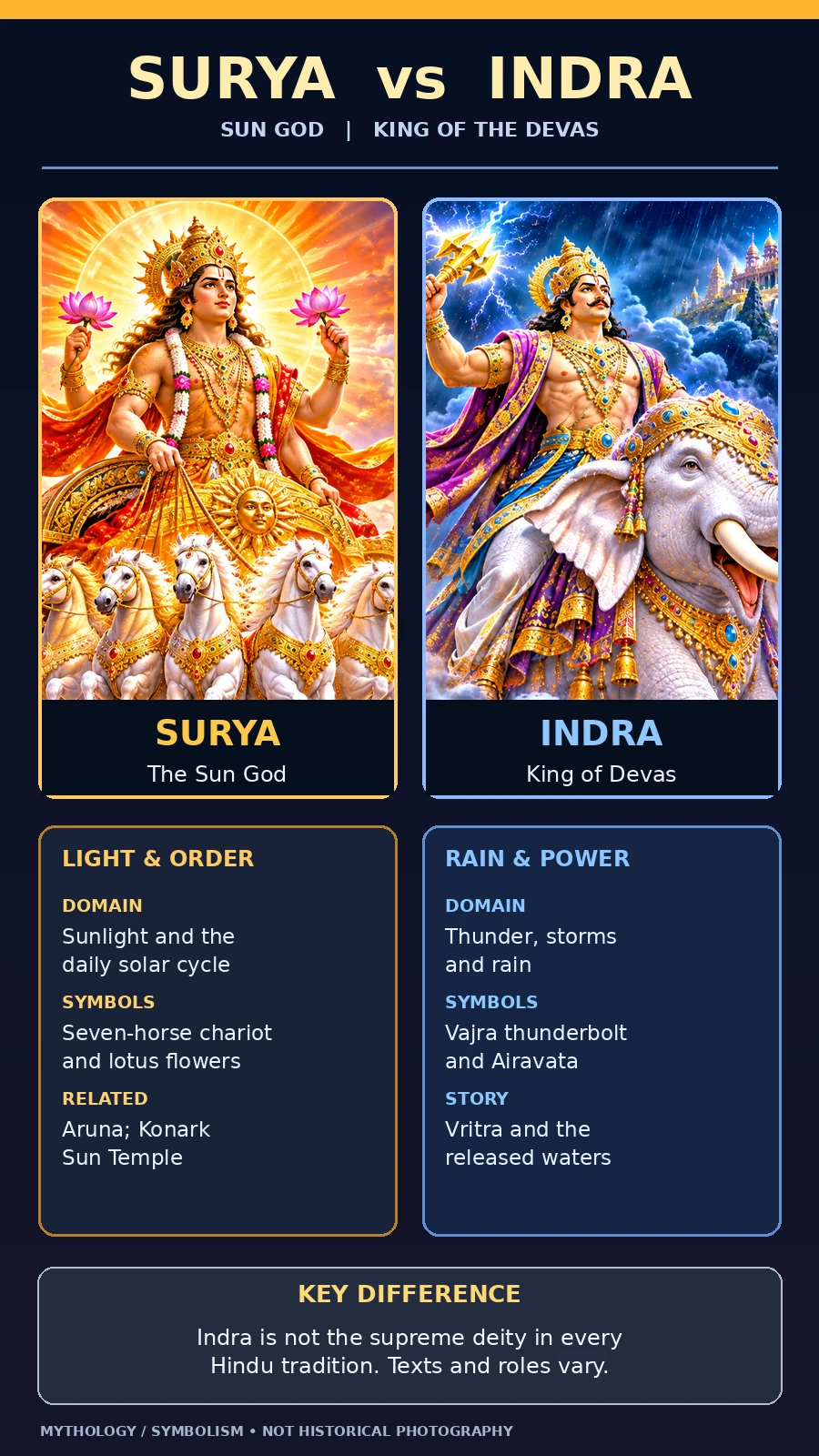
Surya vs Indra: The Most Important Differences
| Question | Surya | Indra |
|---|---|---|
| What is the most familiar role? | Sun deity, light and the solar course | Vedic storm deity, king of the devas in many narratives |
| What symbol is most recognized? | Solar chariot, lotuses, radiant disc | Vajra thunderbolt, elephant Airavata |
| Which natural phenomenon is emphasized? | Sunlight and the day | Storms, thunder and rain |
| Which companion is often named? | Aruna, the charioteer | Airavata, the elephant mount |
| Which story stands out? | The solar chariot’s movement across the sky | Indra defeating Vritra and releasing waters |
| Are they the same deity? | No | No |
The table summarizes familiar traditions, not a single ancient rulebook. Surya has associations with multiple divine figures across Vedic and later literature. Indra can appear in stories involving Surya, Vishnu, Krishna and many others. Religious iconography is not fixed everywhere: paintings, temple sculptures and manuscripts have their own conventions. This is why the most helpful SEO explanation puts the answer first, then gives enough context to avoid confusing an introductory comparison with an absolute theological statement.
Why Does Surya Ride a Chariot with Seven Horses?
A chariot crossing the sky turns the daily rising and setting of the sun into an image people can remember. In common depictions, seven horses pull Surya’s vehicle, and Aruna steers it. Art historians point out that older images sometimes show a different number of horses. The Los Angeles County Museum of Art describes a medieval image with seven horses and notes earlier solar imagery with four horses. Such variation tells us that artistic conventions developed over centuries rather than appearing in one final form at the beginning of history.
Some teachers connect the seven horses with seven rays, days, or Vedic meters. These are interpretations; a claim that an ancient stone sculpture “proves” the discovery of modern optics would go beyond the evidence. The light of the sun is physically measurable, but the horses are part of religious symbolism. Keeping those categories separate allows visitors and children to enjoy the visual metaphor without mistaking it for a laboratory diagram.
Two lotuses also appear in many Surya images. The lotus is a widely used sacred motif and can underscore radiance, purity and emergence. The detail of boots, crowns and dress has drawn scholarly attention because solar imagery interacted with artistic conventions from different regions. Looking closely at a sculpture can therefore teach not only theology but also art history: how artists represented movement, divinity, royal power and time before photographs existed.
Why Does Indra Carry the Vajra and Ride Airavata?
The vajra is Indra’s best-known attribute. In Vedic narratives, the thunderbolt is the decisive weapon against Vritra. A lightning flash is brief and forceful; as a symbol, it suits a deity connected with storms and dramatic intervention. The vajra also acquired different meanings in Buddhist traditions, so the same shape in a museum case does not automatically represent Indra in every artwork. Labels, accompanying figures and the object’s historical context matter.
Airavata, usually a grand white elephant in popular Hindu art, is another marker of Indra’s royal position. Some representations vary the elephant’s form or number of heads and trunks. An artwork of Indra riding an elephant communicates heavenly kingship, strength and rain-associated imagery; it should not be offered as proof of the existence of a physical celestial elephant. The Metropolitan Museum of Art has identified Indra in a South Asian bronze as a guardian of the east with a thunderbolt and elephant mount. That is valuable evidence of historical religious art, not evidence that the mythical journey occurred as a photographable event.
Indra’s heavenly court and title Devaraja may sound like absolute cosmic supremacy. But many Hindu stories deliberately portray him as a ruler whose authority is situated within a larger moral or divine order. A king can administer a heavenly realm without being the final metaphysical reality in every school of Hindu thought. That distinction is particularly helpful when readers compare Indra with Vishnu, Shiva or Devi.
The Vritra Story: Why Is Indra Connected with Rain?
One of Indra’s best-known deeds is the defeat of Vritra. In the Rigvedic account, waters are obstructed, and Indra’s forceful action releases them. Readers often compare this with the arrival of rain after a drought. That comparison is meaningful because rain has obvious consequences for farming, rivers and survival, but it remains an interpretation of poetry rather than a modern weather report. Texts vary in detail, and English translations may describe Vritra as a serpent, dragon or obstructing being.
The myth can be read on several levels. As a story, it gives the storm god a dramatic antagonist. As religious praise, it celebrates Indra’s strength and generosity. As symbolic literature, it links the movement of water with the restoration of life. Readers should resist the tempting claim that a specific ancient drought or flood has been proved merely because a hymn describes cosmic waters. A rigorous historical argument would need independent dated evidence, not just a resemblance between story and weather.
This tale also helps distinguish Indra from Surya. Indra acts through the storm and the release of water; Surya illuminates the world through the solar course. Of course sunshine and rainfall interact in nature, but that does not turn the two religious figures into one deity. Their imagery reflects different relationships between humans and the environment.
Is Indra the Most Powerful God in Hinduism?
“King of the gods” is not the same as “the one supreme God of all Hinduism.” Indra is a major figure in Vedic hymns and ruler of the devas in many later stories. However, Hindu religious thought includes multiple major traditions, including Vaishnava, Shaiva, Shakta, Smarta and philosophical schools that do not explain ultimate reality in identical terms. Some identify Vishnu or Krishna as supreme; others center Shiva or Devi; others discuss Brahman as ultimate reality beyond simple comparisons of personalities. It would be inaccurate to flatten this diversity into a universal league table.
The familiar Govardhan narrative involving Krishna and Indra is a useful example of shifting theological emphasis. Krishna protects the people from a devastating storm associated with Indra, and the story communicates ideas about pride, devotion and protection. In this narrative, Indra is important but not portrayed as beyond correction. The account belongs to a devotional narrative tradition; it does not establish a dated historical weather event. Interpret it first within its literary and religious framework.
Similarly, Surya is highly revered in solar devotional traditions but does not automatically become the supreme deity in every Hindu worldview. Readers can ask who a particular community worships, what a named text says, and what role an image depicts. Those questions produce a clearer answer than asking which god would win a fictional duel.
Surya, Savitr and the Gayatri Mantra: An Important Nuance
A frequent beginner question is whether every reference to the sun in a Vedic prayer means the deity Surya in precisely the same way. Not necessarily. Surya, Savitr (Savitṛ), and other solar-associated divinities appear in Vedic religious literature with overlapping yet distinguishable uses. The well-known Gayatri mantra in Rigveda 3.62.10 addresses Savitr. English introductions often summarize it loosely as a prayer to the sun, but naming Savitr helps avoid a misleading one-to-one identification.
This is not a reason to argue about which single English name is the “real” one. It is an example of how translation changes the level of precision. When someone asks “who is the sun god in Hindu mythology?” the useful general answer is Surya. When someone asks “which deity is named in the Gayatri mantra?” the more precise answer is Savitr. Both responses make sense when the questions are phrased clearly.
Surya is also associated in epic narrative with figures such as Karna, a central warrior of the Mahabharata. Those family relationships belong to specific religious stories, not to an astronomical model of the physical Sun. Explaining the difference supports readers who enjoy mythology while also valuing evidence and careful wording.
Myths vs Facts: What Can We Actually Verify?
Myth: The seven horses of Surya prove that ancient people possessed modern scientific instruments. Fact: Seven-horse chariot imagery is documented in religious literature and historical art, but a symbolic motif is not evidence of a particular modern scientific invention.
Myth: Indra being called king of the devas means no Hindu tradition honors any higher reality. Fact: His title belongs to Vedic and later mythological frameworks; theological traditions vary widely.
Myth: Airavata, Vritra and the celestial chariot are historically verified animals or vehicles. Fact: These belong to religious narratives and iconography. We can study the texts and sculptures without asserting physical verification.
Myth: Every ancient image shows Surya with exactly seven horses. Fact: Historical artwork differs by period and region; museum catalogs record variation.
A respectful article can call these narratives myths in the academic sense—traditional sacred stories—without using the word to mock believers. A source-supported fact about the existence of a sculpture or scripture is different from proving that every event depicted physically happened. Making that distinction protects reader trust.
What Do Surya and Indra Symbolize for Readers Today?
Surya’s imagery lends itself to ideas about regularity, visibility, life and time. Sunrise returns even after a difficult night; in devotional interpretation, this can represent renewal and discipline. Indra’s imagery emphasizes energy, the uncertainty of storms and responsibility attached to authority. A leader with great power may still need humility and correction. These are possible modern readings, not commandments extracted from one official verse.
For students, a comparison exercise could begin with two pictures: identify the chariot and lotuses of Surya, then the vajra and elephant of Indra. Next ask how sunshine and rainfall matter in agriculture. Finally discuss how ancient poetry used natural phenomena to imagine relationships between humans and the cosmos. The exercise connects visual literacy, mythology, language and environmental awareness without pretending that supernatural stories are scientific proof.
For global readers unfamiliar with Hinduism, these two figures also demonstrate why “Indian mythology” cannot be reduced to a handful of gods with fixed job titles. The traditions changed over time, and artwork reveals historical exchanges between regions. Learning a specific story can be the beginning of curiosity rather than a final verdict about every religious community.
Frequently Asked Questions
Who is the sun god in Hindu mythology?
Surya is the best-known Hindu Sun God. He is widely pictured with a radiant halo, lotus flowers and a chariot, frequently drawn by seven horses.
Who is the king of gods in Vedic mythology?
Indra is prominently celebrated in the Rigveda and called ruler or king of the devas in many religious narratives. His title does not settle every Hindu tradition’s view of ultimate divinity.
Are Surya and Indra the same deity?
No. Surya is primarily associated with the sun and light; Indra with thunderstorms, rain, the vajra and divine kingship.
Why does Surya have seven horses?
Seven horses are a familiar traditional image of the solar chariot. Different interpretations connect them with rays, meters or rhythms of time, while historical artworks do not all use the same number.
What is Indra’s weapon called?
Indra’s signature weapon is the vajra, commonly translated as a thunderbolt.
Which animal is Indra’s vehicle?
Airavata, usually depicted as a magnificent elephant in many later Hindu artworks, is Indra’s famous mount.
Is the Gayatri mantra addressed to Surya or Savitr?
The Vedic mantra names Savitr. Popular descriptions often call it a solar prayer, but the precise Vedic name is important.
Conclusion: Two Deities, Two Distinct Roles
Surya and Indra belong to the same broad world of Hindu sacred literature but express different themes. Surya is the Sun God associated with light and the solar course; Indra is the thunderbolt-bearing Vedic storm deity and king of the devas in many narratives. Their symbols—horses and lotuses for Surya, vajra and Airavata for Indra—make that difference visible. A careful explanation respects devotional stories, identifies the textual context, and does not confuse religious art with historical or scientific evidence.
Sources and Further Reading
- Getty Research Institute — Surya (Hindu deity)
- Getty Research Institute — Indra (Hindu deity)
- LACMA — The Sun God Surya, circa 1075
- Asian Art Museum — Surya, the Hindu Sun God
- The Metropolitan Museum of Art — Indra, Lord of the Gods
- PBS — The Story of India: Indra
Editorial note (12 November 2026): Accounts of divine events are presented as religious mythology and tradition. Museum records verify historical artwork, not the literal occurrence of mythic episodes. Symbolic interpretations may vary among schools and regions.













Share Your Opinion
Comments are closed on this post.