 Vista
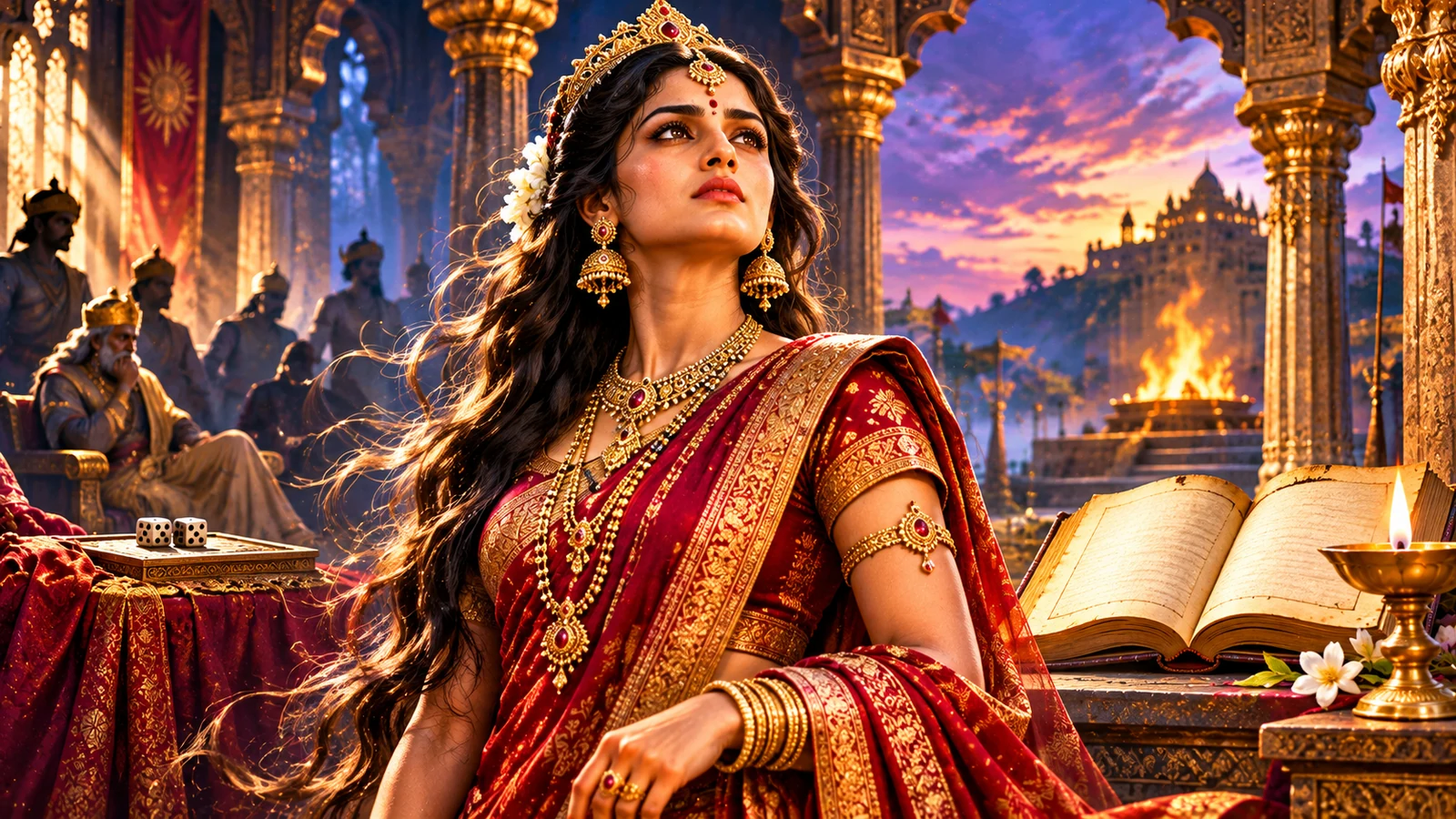
If you want to read the Mahabharata from Draupadi’s perspective, begin with two distinctive novels: The Palace of Illusions by Chitra Banerjee Divakaruni and Yajnaseni: The Story of Draupadi by Pratibha Ray. Both give a speaking, thinking inner life to the woman also called Panchaali and Krishnaa. They are not editions of the original Sanskrit epic. They are literary retellings that interpret the inherited story through a different narrative voice. This distinction is especially important for readers researching the dice-game assembly, Draupadi’s marriage, her friendship with Krishna, or her relationship to Karna. A scene that appears in a modern novel is not automatically a claim about what every ancient version says.
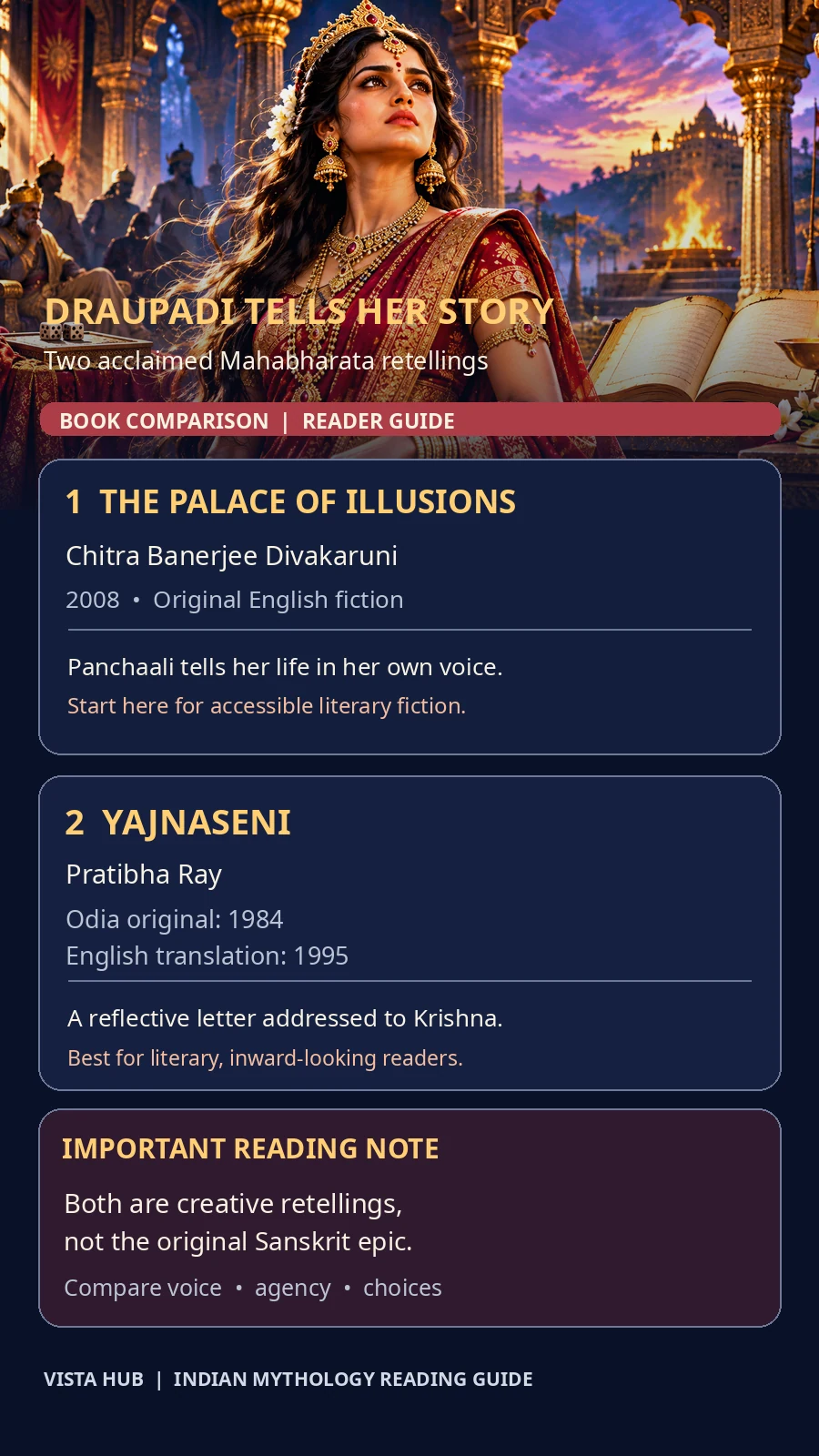
The best choice depends on the reading experience you want. Divakaruni’s 2008 novel is a fluent, imaginative, originally English-language narrative with a vivid first-person heroine. Ray’s novel was originally written in Odia in 1984 and is available in Pradip Bhattacharya’s English translation, first published in 1995. Its reflective, epistolary design places the narrator’s conscience and suffering at the center. Read either on its own; read both to see how one epic figure can inspire substantially different fiction.
What Does a Draupadi-Point-of-View Retelling Actually Change?
A conventional quick summary of the Mahabharata often follows dynastic conflict: the Pandavas lose their kingdom, endure exile, win allies and face the Kauravas in a catastrophic war. Such a summary is not false, but it places political and military actions in the foreground. A story narrated by Draupadi changes the questions. Instead of beginning with who won a debate or a battle, the reader asks who had the authority to make decisions, who was asked to obey, what public humiliation did to a person, and how a queen understood the obligations imposed on her. This change of viewpoint makes familiar events feel newly difficult without requiring the central sequence to disappear.
A retelling can give Draupadi remembered conversations, private doubts, arguments and longings. Authors use these imaginative elements to connect incidents that the epic narrates more briefly. That does not mean the invented thoughts are ancient evidence; it means fiction offers a lens through which to debate character, power, ethics and gender. The same scene can seem triumphant from a warrior’s perspective and profoundly costly from the perspective of someone who must live with its consequences. A careful reader values that expansion while recognizing the difference between literary invention and the source tradition.
The Palace of Illusions: A Modern English-Language Draupadi
Published in 2008, Chitra Banerjee Divakaruni’s The Palace of Illusions is one of the clearest recommendations for a reader seeking an accessible, contemporary novel narrated by Panchaali. The author’s own description presents the book as a woman-centered reimagining that begins with Draupadi’s extraordinary birth, passes through her marriage to the five Pandavas, and follows exile, political struggle and war. Panchaali does not merely appear when a famous incident requires her: she tells the story and interprets the people around her. The book allows room for ambivalence, affection, jealousy, friendship, self-assertion and judgment. The author’s book page identifies its central perspective and thematic choices.
One notable element is the novel’s treatment of Panchaali’s complicated relationship with Krishna and an imagined attraction to Karna. The author has explained that she developed the attraction imaginatively while working with epic traditions and later interpretations. Readers looking for evidence of a canonical romance must therefore check the specific text rather than borrow the novel’s internal monologue as a quotation from Vyasa. The novel is still valuable precisely because it tests how a familiar character might feel when custom and reputation compete with her own wishes. Its brisk, dramatic voice may appeal to new readers more than a scholarly translation with extensive notes.
Choose this novel if you enjoy character-driven fiction and want a coherent first encounter with a woman’s internal narrative. Its strength is not that it replaces the Mahabharata but that it reveals which questions are concealed when an epic is reduced to kings, armies and weapons. Remember that an emotionally convincing interpretation is still a creative interpretation.
Yajnaseni by Pratibha Ray: An Odia Literary Reimagining
Yajnaseni: The Story of Draupadi comes from a different literary context. Pratibha Ray wrote the original novel in Odia in 1984; the English-language edition translated by Pradip Bhattacharya was published by Rupa in 1995. Library records describe the work as an epistolary novel about Draupadi, and scholarly discussions describe her reflections in the form of a communication to Krishna. Those publication and translation details matter: it is inaccurate to call Ray’s novel an original 1995 English book, just as it would be inaccurate to attribute the translation to the original novelist. The Indiana University library catalogue documents the English edition.
Where The Palace of Illusions can feel like a contemporary first-person epic novel, Yajnaseni invites a sustained encounter with memory, duty, shame, devotion, public judgment and the price of decisions made by others. It is particularly rewarding for readers interested in the ethical pressure placed on Draupadi as wife, queen and political figure. A reflective form can make the narrative feel more inward than a fast-paced adventure. It is not, however, an academic critical edition of the Sanskrit Mahabharata. Ray selects, interprets and reshapes meaning like any novelist who writes from an inherited literary world.
Because English readers encounter the work through translation, editions and wording can vary. Check for Ray’s name as author and Bhattacharya’s as translator when selecting a copy. If you already know the epic’s major events, you may particularly appreciate how the novel revisits them as moral memories rather than as a sequence of spectacles.
The Palace of Illusions vs Yajnaseni: A Quick Comparison
Both books belong on a Draupadi-reading shortlist, but it helps to compare their aims instead of searching for a universal winner. The first is generally a good entry point for someone who likes modern English literary fiction; the second may appeal to a reader who wants a contemplative treatment and the additional texture of an Odia literary work translated into English. Neither can be treated as a verbatim record of Draupadi’s personal speech. Their different styles demonstrate why “the woman’s perspective” is not a single voice: two authors can begin with the same epic figure and emphasize different emotional, philosophical and narrative possibilities.
The comparison also clarifies a frequent online search error. A book titled Yajnaseni is not simply an alternative title or a sequel to The Palace of Illusions. These are independent novels by different writers. Equally, a review that calls one work feminist, devotional or revisionist is providing an interpretation, not an official genre label accepted by every reader.
| Criteria | The Palace of Illusions | Yajnaseni |
|---|---|---|
| Author | Chitra Banerjee Divakaruni | Pratibha Ray |
| Publication | Original English novel, 2008 | Odia original, 1984; English translation, 1995 |
| Narrative | Panchaali’s first-person literary fiction | Reflective, epistolary narration |
| Best for | Accessible modern fiction | Introspective literary reading |
| Important note | Creative retelling, not Sanskrit source | Translation of an original Odia novel |
The Epic Scenes That Feel Different in Draupadi’s Voice
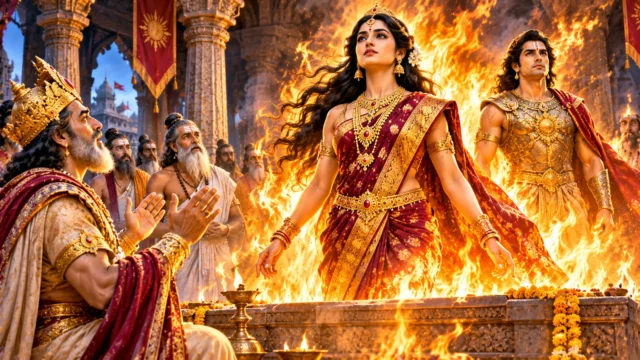
Draupadi’s fire-associated birth is a striking beginning because it introduces destiny before personal choice. A reader who knows only that she emerged from a sacrificial rite may not have asked what it means to inherit a purpose chosen before she could consent. Her marriage to the five Pandavas raises another set of questions. Different traditions discuss this marriage through duty, previous births, divine arrangements and social expectations. A fictional narrator can examine the practical and emotional strain that a bare list of husbands cannot express.
The dice-game episode in the Sabha Parva becomes especially difficult when approached through her questions about whether a person who has lost himself can stake another person. It is a scene about political legality, bodily dignity and the failure of people in power to intervene. For a modern reader, the issue is not a sensational description of public humiliation; it is the moral force of a woman refusing to surrender the legitimacy of her question. Later exile turns victory and defeat into the ordinary experience of loss, endurance and responsibility.
During the war, Draupadi’s position also exposes the human cost of grand claims about justice. Her loved ones fight, she lives with bereavement, and the outcome cannot be understood only through casualty lists or heroic awards. The point is not that Draupadi alone caused the war. That familiar reduction blames a woman for an intricate conflict involving succession, rivalry, coercion and decisions by powerful men. Strong retellings invite readers to notice precisely that unfair simplification.
Is Draupadi’s Love for Karna Part of the Original Mahabharata?
This is one of the questions that searchers most often carry from a modern novel into a mythological discussion. The Palace of Illusions develops Panchaali’s secret attraction to Karna as part of its literary design. Divakaruni has discussed that creative choice in interviews. However, the attraction should not be announced as an uncontested fact established by every ancient Sanskrit recension. The Mahabharata has a large textual and regional history, while novels and performance traditions expand what particular figures might have felt.
A careful formulation is: “Divakaruni imagines a complicated attraction between Draupadi and Karna.” That statement credits the novelist and avoids misleading readers. It is equally important not to flatten all versions of Draupadi’s swayamvara into one simplistic account of whether Karna was rejected and why. Scenes may differ in wording and emphasis across translations and retellings. For a separate character study, read Vista Hub’s analysis of Karna in the Mahabharata; do not use fiction alone to settle disputed epic details.
This distinction is useful beyond Karna. Private conversations, reconstructed motives, romance and inner narration can feel plausible, but plausibility does not turn a novelist’s imagined moment into a primary-source quotation. Appreciating imaginative writing and respecting textual accuracy are compatible.
Feminist Retelling, Devotional Novel or Historical Source?
The phrase “feminist retelling” often appears around Draupadi-centered novels because these works foreground a woman’s agency in a story commonly summarized through male heirs and warriors. They question rules about marriage, obedience, reputation and decision-making. Yet each author has a distinctive artistic purpose and does not need to express the same politics as every critic. Some passages may be read through devotion, some through ethical struggle, and others through social critique. A thoughtful recommendation explains the book’s viewpoint instead of using “feminist” as either an automatic compliment or insult.
Neither novel is a scientific or archaeological proof of the Mahabharata’s events. Neither substitutes for studying the Sanskrit epic through careful translations, commentaries and relevant academic scholarship. The distinction between sacred narrative, literary adaptation and historical evidence should be clear on a site for international readers. You can respect an epic as religiously and culturally meaningful while being precise about what a twentieth- or twenty-first-century novelist has added. That precision gives readers a better appreciation of the craft involved.
Which Book Should You Read First? A Practical Reading Order
For someone new to the story, start with a short, dependable overview of the Mahabharata’s principal characters. Knowing the relationship between the Pandavas and Kauravas, the dice game, exile and Kurukshetra will make both novels easier to follow. Then read The Palace of Illusions if you want a flowing English-language story that builds emotional intimacy quickly. Read Yajnaseni next if you want to compare voices and reflect on duty, memory and spiritual friendship.
For a more literary reader, reverse that order: begin with Yajnaseni, then see how Divakaruni reframes comparable events. Students preparing an essay can maintain a three-column notebook: “event in an epic translation,” “scene in Ray,” and “scene in Divakaruni.” Note which material is established narrative, which is newly imagined interiority, and which is your own interpretation. That simple exercise produces a stronger comparison than repeating promotional summaries.
These books contain themes of public humiliation, conflict, gendered power, war and grief; they are better discussed with context than treated as carefree children’s fairy tales. For younger readers, begin with an age-appropriate Mahabharata adaptation before moving to an adult literary novel. Readers who want to understand Draupadi’s origin separately can also consult Vista Hub’s article on Draupadi’s fire birth.
How to Choose an Edition and Avoid Confusing Book Titles
Book-shopping pages sometimes mix distinct editions, translations, summaries and adaptations. Before choosing a copy, verify author, language and publisher rather than relying only on the word “Draupadi” in a cover design. The Palace of Illusions is by Chitra Banerjee Divakaruni and was first published in 2008. Yajnaseni is by Pratibha Ray; the Odia original preceded the English translation by Pradip Bhattacharya, published in 1995 by Rupa. Page counts differ between editions and formats, so they are not reliable permanent identifiers on their own.
If you are researching a quotation, record the translation, publisher, year and page number from the copy you actually used. A book summary in a blog or video can be useful for orientation but should not be treated as an exact quotation source. Also avoid unauthorized free-PDF links. Public library catalogues, legitimate publishers and booksellers are better routes to the editions described here. If your goal is academic research, read an epic translation alongside the novel and write clearly which source is being cited.
Frequently Asked Questions About Draupadi Retellings
Which novel tells the Mahabharata from Draupadi’s point of view?
The Palace of Illusions by Chitra Banerjee Divakaruni and Yajnaseni by Pratibha Ray are two important choices.
Is The Palace of Illusions based on a true historical diary?
No. It is a fictional interpretation of the Mahabharata narrated by Panchaali, not an ancient diary or an eyewitness historical document.
Who wrote Yajnaseni and who translated it?
Pratibha Ray wrote the Odia original; Pradip Bhattacharya translated the English-language edition published by Rupa in 1995.
Does The Palace of Illusions show Draupadi loving Karna?
It includes an imagined attraction. This is a significant feature of Divakaruni’s novel, not a universal fact to attribute to every version of the original epic.
Are Yajnaseni and The Palace of Illusions the same book?
No. They are separate novels by different authors, from different languages and publication periods.
Which is easier for an English-language beginner?
Many newcomers may prefer the flowing modern-English narrative of The Palace of Illusions. Yajnaseni is valuable for a more reflective reading experience.
Can these novels replace reading the Mahabharata?
Not for textual or scholarly study. Use them as creative companions to a trustworthy translation or critical discussion of the epic.
Is The Forest of Enchantments another Draupadi retelling?
No. Divakaruni’s The Forest of Enchantments focuses on Sita’s viewpoint in the Ramayana, not Draupadi’s in the Mahabharata.
Conclusion: Read Draupadi as a Voice, Not Only a Symbol
The most rewarding feature of modern Mahabharata retellings is not an attempt to prove which heroine is “right.” It is the opportunity to hear complex questions from a character too often reduced to a plot device. The Palace of Illusions offers an engaging modern-English Panchaali; Yajnaseni invites a deeper encounter with memory, conscience and devotion through an Odia literary classic in translation. Begin with the book that fits your reading style, then compare both with the epic itself. You will gain not a single final answer about Draupadi, but a more accurate picture of how literature keeps asking new questions of an enduring story.
Sources and edition notes
- Chitra Banerjee Divakaruni — The Palace of Illusions (author site)
- Pan Macmillan — The Palace of Illusions
- Indiana University Library — Yajnaseni bibliographic record
- Pradip Bhattacharya — Yajnaseni edition and translator
- Chitra Banerjee Divakaruni interview about literary invention
Editorial note: This article distinguishes the Sanskrit epic, regional traditions and modern fictional retellings. Edition details checked November 13, 2026.















Share Your Opinion
Comments are closed on this post.