 Vista
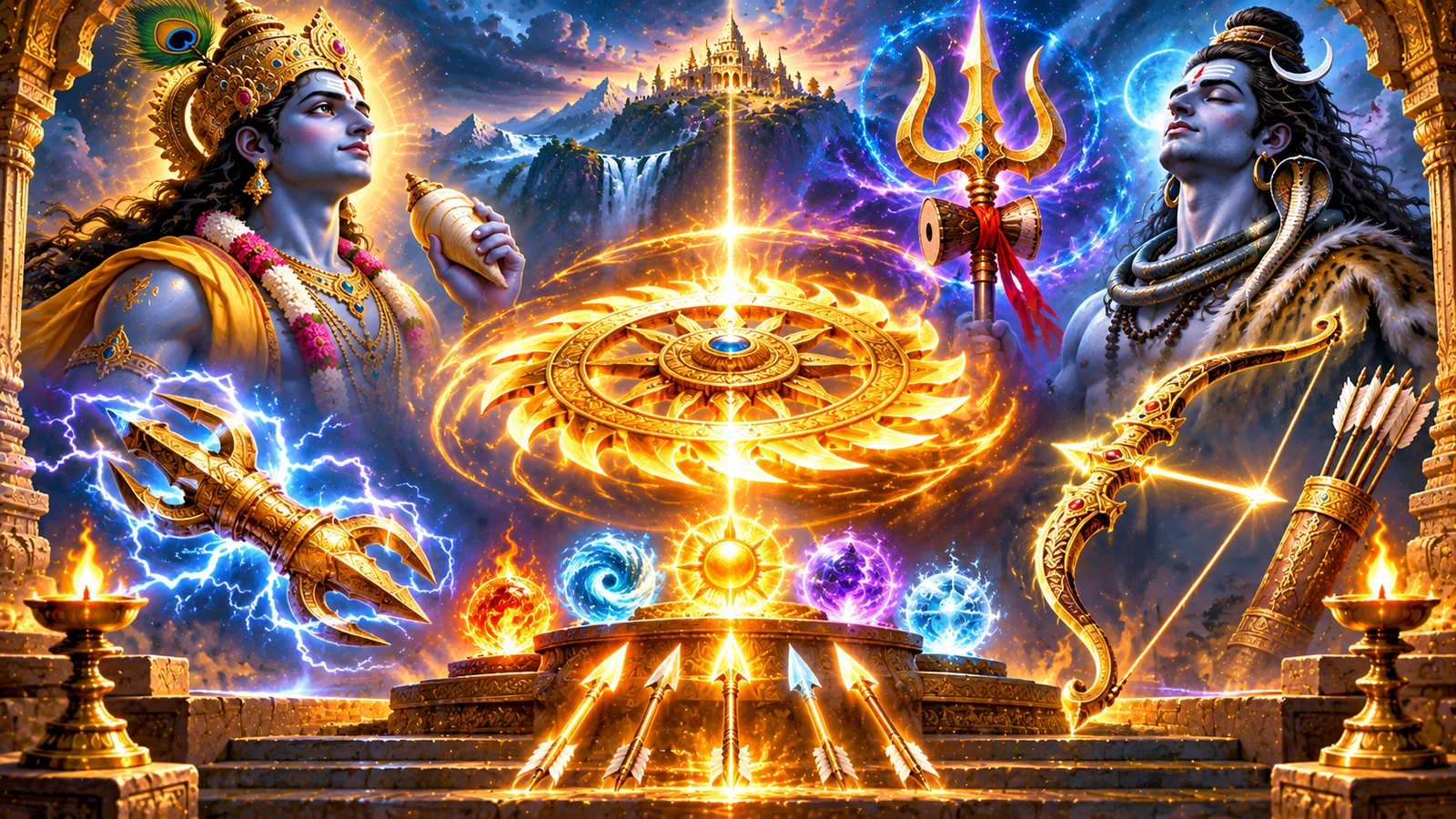
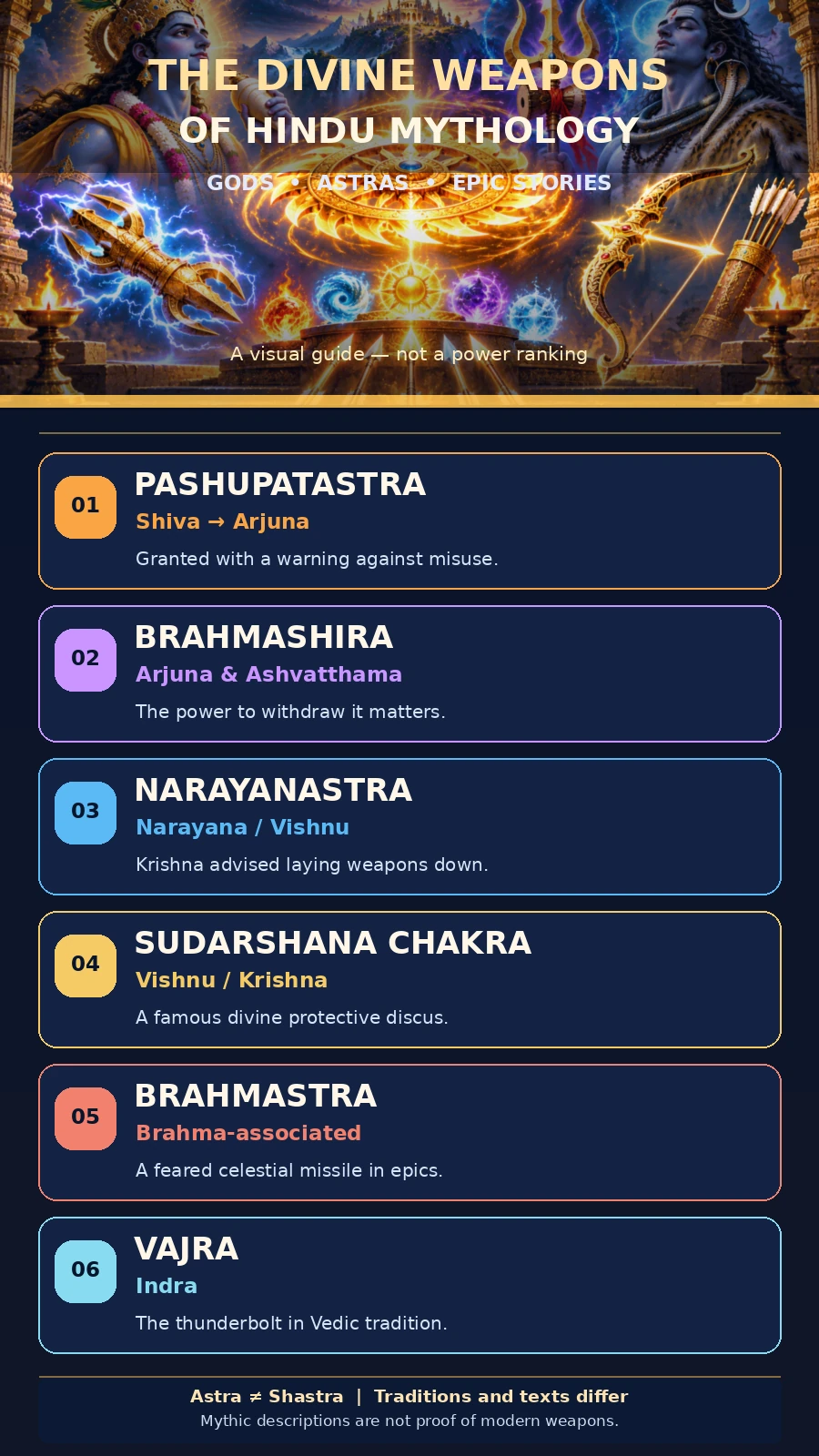
The Brahmastra, Brahmashira, Pashupatastra, Narayanastra, Sudarshana Chakra and Indra’s Vajra are among the most formidable divine weapons described in Hindu religious literature. Yet there is no universal, scripture-approved ranking of the ‘number one’ weapon. Different texts praise different deities, and an astra in one story cannot be judged by a video-game power chart from another. The best answer depends on whether we mean a cosmic weapon associated with a god, a weapon bestowed on a human warrior, or an instrument that can be used under strict conditions. This guide explains famous celestial weapons in the Ramayana, Mahabharata and Puranic traditions, who is associated with each one, and what makes their stories memorable. It also distinguishes religious imagery from unsupported claims about historical missiles or nuclear technology. The most striking lesson is that the power to recall a weapon can matter as much as the power to release it.
Astra vs Shastra: Why the Difference Matters
In familiar Sanskrit epic vocabulary, a shastra is an ordinary or hand-held weapon such as a sword, mace or bow, while an astra is often portrayed as a weapon invoked or empowered through sacred knowledge, sometimes with a mantra. Usage is not perfectly rigid across every language, period or retelling. The bow Gandiva is a remarkable weapon and remains a bow; a celestial missile launched from a bow is an astra. Shiva’s trishula and Vishnu’s chakra are prominent divine attributes whose stories do not neatly fit a single category in every source. If a social-media list says all twelve items are identical types of magical rockets, it is flattening real differences. Epics also stress who is qualified to wield a weapon, which adversary may be targeted, and whether the weapon can be recalled. Those limitations are essential to the stories. A devastating instrument used against a weak enemy is not simply an impressive demonstration; it can be a violation of dharma. Different versions of the epics sometimes provide different names or details, which is why linking a claim to its particular passage is better than inventing a universal specification sheet.
The Famous Divine Weapons: Origins, Powers and Important Stories
1. Brahmastra — the Fearsome Celestial Missile
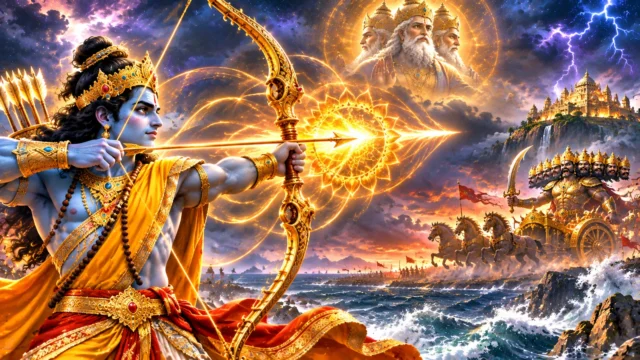
The Brahmastra is traditionally connected with Brahma and appears in epic warfare as an exceptionally destructive invoked weapon. Its effects are described through radiance, fire, devastation and dread, with details differing between passages and adaptations. Rama and other epic heroes are associated with knowledge of powerful astras, and the Mahabharata contains an important encounter involving Ashvatthama and Arjuna after the main war. Do not automatically treat every occurrence of the name Brahmastra as interchangeable with Brahmashira: texts and popular retellings distinguish them with different levels of precision. Most importantly, the descriptions are literary and religious. They are not archaeological verification of an ancient atomic bomb.
2. Brahmashira or Brahmashirastra — Power That Must Be Restrained
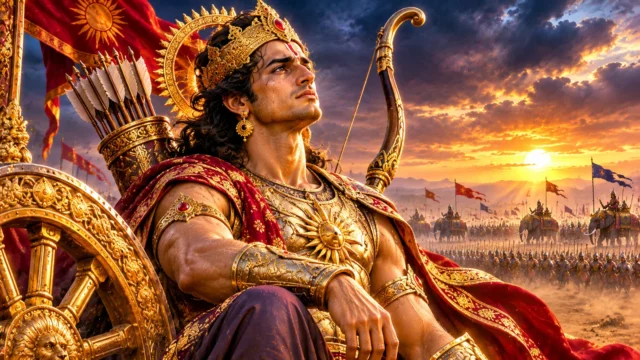
The Brahmashira episode in the Sauptika Parva of the Mahabharata is among the clearest warnings about uncontrolled power. Arjuna and Ashvatthama confront an escalation with devastating potential. Sages intervene to prevent harm. Arjuna is able to withdraw the weapon, but Ashvatthama cannot withdraw his in the same way. The episode’s moral weight falls on restraint, skill and the consequences of anger. The Sanskrit spelling may appear as Brahma-shiras, Brahmashirsha or Brahmashirastra in English transliteration. Instead of asserting a simple numerical hierarchy over all other weapons, readers should follow the precise incident and source.
3. Pashupatastra — Shiva’s Terrible Gift to Arjuna
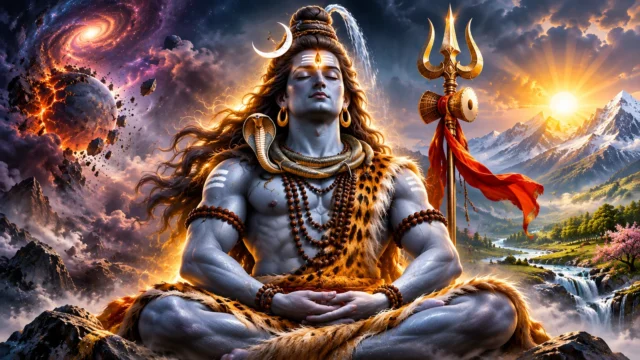
In the Vana Parva, Arjuna undertakes severe austerities and encounters Shiva in the form of a Kirata, a hunter. After the encounter, Shiva bestows the Pashupata weapon upon him. The text presents its potential as extraordinarily dangerous and warns against reckless use. That caution is not a tiny footnote: it defines the responsibility attached to the gift. Pashupata belongs to a Shaiva setting, where Shiva’s sovereignty and power provide the narrative frame. The encounter also tests Arjuna’s humility. In good explainers, the question is not whether Arjuna instantly gained permission to destroy any opponent, but why an extraordinary ability was accompanied by a strict ethical limit.
4. Narayanastra — the Weapon That Defied Resistance
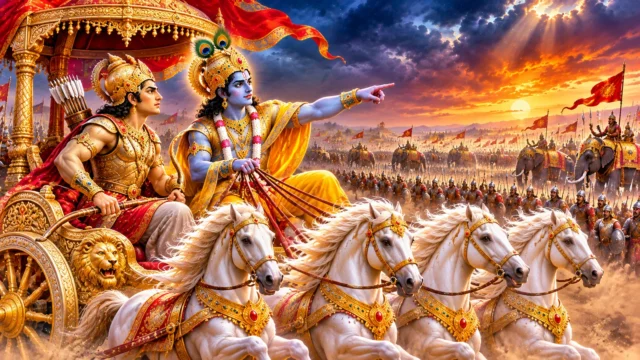
Associated with Narayana or Vishnu, the Narayanastra appears memorably in the Drona Parva when Ashvatthama employs it. The Pandavas face a terrifying assault. Krishna advises the warriors to lay down their arms and stop resisting; continued aggressive opposition worsens the danger, especially for Bhima before he is brought to safety. The reversal makes this weapon distinctive: more force is not the route to survival. The story is frequently summarized as ‘only surrender can defeat it,’ but that slogan makes sense inside a particular epic narrative, not as a scientific law. It also illustrates the difference between having great physical strength and having wise counsel at the right moment.
5. Sudarshana Chakra — Vishnu’s Divine Discus
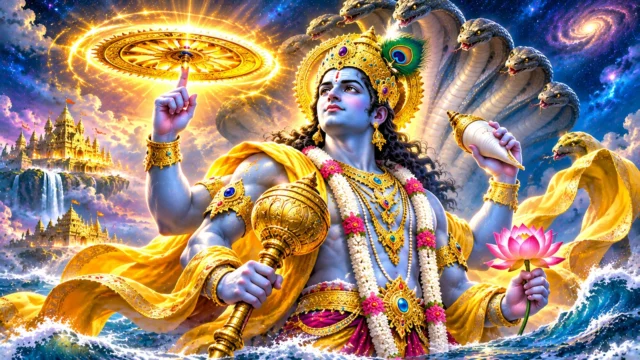
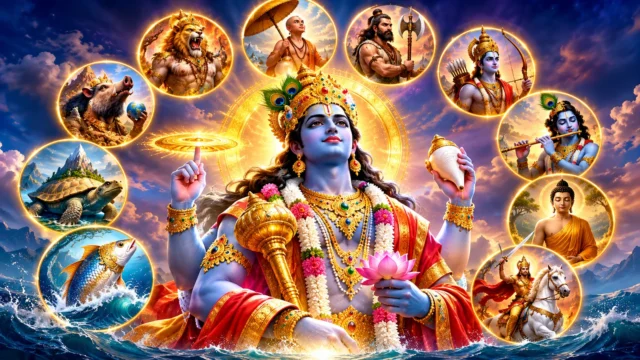
The Sudarshana Chakra is the radiant discus associated with Vishnu and, in many stories, Krishna. It appears in iconography as one of Vishnu’s familiar attributes alongside the conch, mace and lotus. Devotional traditions also understand Sudarshana as divine protection and a manifestation of sacred power. Story-specific descriptions of its movement, purpose and effects vary. A viral clip that calls it a ‘laser-guided ancient machine’ goes beyond the evidence. Its circular design is not a blueprint for a recovered historical device. The chakra deserves a separate article about symbolism and narrative appearances, because its importance extends well beyond combat.
6. Vajra — Indra’s Thunderbolt
The Vajra is the renowned weapon of the Vedic deity Indra, associated with lightning, thunder and his struggle against Vritra. The Rigveda’s hymns praise Indra in language shaped by sacred poetry and the world of Vedic ritual. Later tellings attach additional stories to the origins and meaning of the thunderbolt. It is best not to stitch together every later legend and present the result as a single unchanged Vedic account. In iconography, the Vajra can have different artistic forms. It symbolizes decisive divine force within its textual setting; that does not make Indra and another mythology’s thunder god identical personalities.
7. Agneyastra — the Weapon of Fire
Agneya astras are associated with Agni and are described as producing fire or heat in battle. Their significance often comes from the confrontation between elemental forces. A warrior may need knowledge, timing and a suitable response rather than simply another stronger flame. Descriptions are embedded in epic storytelling, so there is no fixed technical temperature or blast radius to cite. Calling Agneyastra ‘a flamethrower invented in antiquity’ is a modern comparison, not a textual or archaeological fact. More interesting is how the weapon brings the feared and revered power of fire into a narrative about combat and self-control.
8. Varunastra — the Counterforce of Water
Varuna is associated with cosmic order and waters in important Vedic and later traditions. The Varunastra is commonly described in epic-derived lists as a water-related celestial weapon, sometimes invoked in response to an overwhelming fire weapon. The idea that fire and water can answer each other makes dramatic sense within a story, but readers should be careful not to claim every epic edition presents one identical pair of combat scenes. The symbolism also reminds us that successful defense may depend on the nature of the threat, not on a universal ranking of strength.
9. Vayavyastra and Nagastra — Wind and Serpent Motifs
The Vayavyastra draws on the association with Vayu, the wind deity, and is commonly described in epic weapon lists as producing fierce winds. Nagastra refers to serpent-associated missiles or motifs in various narratives; the exact form and episode should be identified before stating an effect as universally fixed. Popular depictions show enormous snakes filling a battlefield, but those illustrations are modern artistic interpretations. Wind and serpent imagery draw on the natural world, familiar fears and the sacred language of the epics. A strong article can describe the motif without falsely claiming every picture depicts one verified ancient weapon.
10. Trishula, Gandiva and Other Famous Arms
Shiva’s trishula is a trident deeply associated with his iconography and interpreted through several symbolic triads, including time and cosmic processes. Gandiva is the celebrated bow wielded by Arjuna, not a synonym for every celestial arrow shot from it. The Kaumodaki mace of Vishnu and the Pinaka bow associated with Shiva are other well-known sacred arms. Their place in religious art can be as significant as a battlefield feat. Keeping a distinction between a personal emblem, a physical weapon and an invoked astra improves accuracy and prevents misleading ‘top ten’ rankings.
Divine Weapons Comparison: A Quick Reference Table
| Weapon | Primary association | Recognizable feature in stories |
|---|---|---|
| Brahmastra | Brahma / trained epic heroes | Terrifying celestial missile |
| Brahmashira | Arjuna and Ashvatthama episode | Retracting an unleashed weapon matters |
| Pashupatastra | Shiva; bestowed on Arjuna | Extremely restricted, dangerous gift |
| Narayanastra | Narayana; used by Ashvatthama | Armed resistance worsens danger |
| Sudarshana Chakra | Vishnu / Krishna | Radiant protective discus |
| Vajra | Indra | Thunderbolt and Vritra story |
| Agneyastra | Agni | Fire-associated astra |
| Varunastra | Varuna | Water-associated response |
| Vayavyastra | Vayu | Wind-associated effect |
| Gandiva | Arjuna | Famous bow, not itself every astric missile |
This is a reader’s guide to traditional associations, not a damage ranking. In particular, Sudarshana Chakra, Trishula and Gandiva are not all the same category as an invoked astra. Some headings reflect broad traditions rather than one verse that uses every term. If you need a quotation for a school project, look up the relevant passage and translation rather than citing the table as a primary text.
Three Epic Moments That Explain Why the Weapons Matter
First, Shiva’s encounter with Arjuna during the forest exile brings together power, austerity and humility. Arjuna seeks strength for an approaching conflict, yet gaining the Pashupatastra requires more than an ordinary transaction. The divine gift has conditions. Readers who focus only on whether this is the strongest weapon miss the story’s concern with discipline. The Vana Parva’s Kirata episode is one of the better starting points for direct reading.
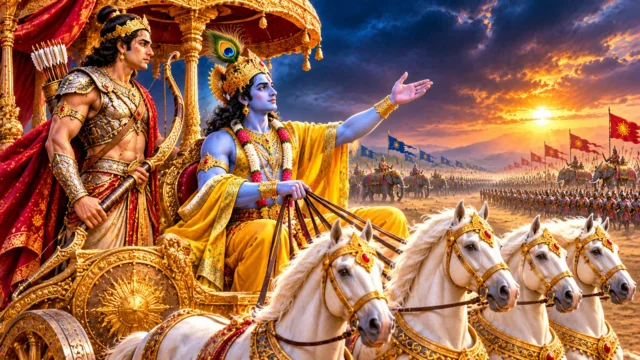
Second, the Narayanastra episode during the Kurukshetra conflict turns expectations upside down. A mighty army, trained to meet force with force, survives only when Krishna instructs it to abandon resistance. Bhima’s refusal exposes the danger of reacting through pride. The text is not simply praising passivity in every situation; it illustrates how context and sound judgment can change the right action.
Third, the postwar confrontation between Arjuna and Ashvatthama in the Sauptika Parva raises the stakes still further. The sages insist on withdrawal rather than annihilation. Arjuna’s capacity to recall his weapon contrasts with Ashvatthama’s inability. Here the real measure of greatness is not a spectacular explosion but the prevention of catastrophe. These are religious-literary narratives, not reports of recovered military hardware. All three incidents place ethical restraint at the center of exceptional power.
Is Brahmastra a Nuclear Weapon? Myths, Claims and Evidence
A common search question is whether the Brahmastra was an atomic bomb, whether the Sudarshana Chakra was an ancient flying machine, or whether India’s epics record technology equal to modern guided missiles. These are hypotheses and analogies sometimes circulated online, not findings established by archaeology or physics. Ancient poetry uses vast imagery—blinding radiance, cosmic fire, shaking earth—to communicate terror, divine scale and moral danger. Similar descriptions occur in many world literatures. To identify a historical nuclear device, researchers would need independently verifiable physical evidence, clear dating, a plausible technological context and repeatable analysis. An epic’s dramatic wording alone is insufficient. Respect for Hindu literature does not depend on presenting every mythic image as modern engineering. Readers can appreciate its artistic intelligence, sophisticated ethical questions and religious meaning without invented measurements, fake quotations or claims of archaeological proof that have not been demonstrated.
Why the Strongest Weapon Is Not Always the Best Choice
Epic heroes often face a problem harder than aiming a weapon: deciding whether they should use it. A powerful attack may also threaten allies, bystanders or the wider world. Knowledge of countermeasures, disciplined retreat, protection of civilians and an ability to halt escalation can all be more important than raw force. The familiar stories of Pashupatastra, Narayanastra and Brahmashira offer distinct illustrations. The Pashupata is bestowed with a warning; the Narayanastra is answered by relinquishing aggression; and the Brahmashira crisis is interrupted when sages call for restraint. These are not interchangeable rules of war, but they do challenge the assumption that the greatest warrior is simply the person who destroys most. The same caution applies when readers compare characters across the Ramayana and Mahabharata. Both epics discuss dharma as a difficult judgment exercised within relationships and obligations, not as a universal switch labeled ‘use the biggest weapon’.
Frequently Asked Questions About Hindu Divine Weapons
Which is the most powerful weapon in Hindu mythology?
No single universally accepted ranking exists. Brahmastra, Brahmashira, Pashupatastra, Narayanastra and Sudarshana Chakra are prominent examples in different sacred narratives.
Who gave Arjuna the Pashupatastra?
In the Mahabharata’s Vana Parva, Shiva grants it after testing Arjuna in the Kirata episode, with an emphasis on restraint.
What is the difference between Brahmastra and Brahmashira?
These names are often distinguished in epic discussions, particularly the Sauptika Parva episode. Their exact relationship and descriptions vary across texts and retellings.
How was Narayanastra stopped?
Krishna instructed the Pandava fighters to put down their weapons and cease resistance; continuing armed defiance intensified their danger in the Drona Parva account.
Is Sudarshana Chakra Vishnu’s weapon?
Yes. It is a famous divine discus associated with Vishnu and Krishna in Hindu iconography and devotional narratives.
Was the Brahmastra a real nuclear bomb?
There is no credible archaeological evidence that an epic description proves the existence of an ancient nuclear weapon. It is described within sacred literature.
What is the difference between an astra and a shastra?
An astra is commonly depicted as an invoked or empowered missile; shastra often refers to a hand-held weapon. Usage varies, and some famous sacred arms have special categories.
Conclusion: Power, Purpose and Responsibility
Divine weapons in Hindu mythology are compelling because they join vivid supernatural imagery with hard moral choices. Shiva’s Pashupata, Vishnu’s Sudarshana Chakra, Indra’s Vajra, and the Brahmashira and Narayanastra episodes belong to different narrative and theological settings. They can be compared, but not responsibly reduced to an invented power score. Read the relevant passage, distinguish one tradition from another, and ask why a hero is trusted—or warned—not to use a particular weapon. The most lasting lesson is that power becomes meaningful only when paired with judgment and restraint.
Further reading and source passages
- Mahabharata, Vana Parva, Ch. 41 — Pashupata gift
- Mahabharata, Sauptika Parva, Ch. 15 — withdrawal of Brahmashira
- Mahabharata, Sauptika Parva, section 14 — Ganguli translation
- Mahabharata, Drona Parva — Narayanastra account
Related Vista Hub articles
- Kurukshetra War: Rules and 18-Day Timeline
- Karna in Mahabharata: Character Analysis
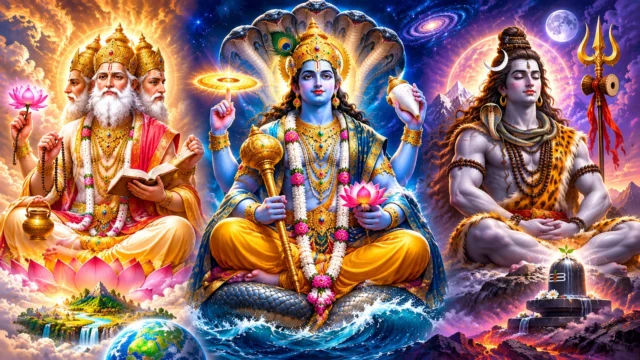
- Brahma vs Vishnu vs Shiva: Trimurti Explained
Mythological narratives are religious and literary sources, not proof of surviving ancient nuclear or guided weapons. Updated: 13 November 2026.


Share Your Opinion
Comments are closed on this post.