 Vista

Quick answer: If you loved The Immortals of Meluha by Amish Tripathi and want books like it, start with The Secret of the Nagas if you have not finished the Shiva Trilogy. For a new series with similar world-building, try Ram: Scion of Ikshvaku. For mythological fiction by other authors, Asura: Tale of the Vanquished, Ajaya: Roll of the Dice, The Krishna Key and The Hidden Hindu offer noticeably different reading experiences. The best next book depends on what impressed you: the divine figure reimagined as a human hero, the philosophy and political decisions, epic-scale action, or the mystery. This guide separates direct sequels from unrelated novels so that you do not buy the wrong volume or expect a modern fictional retelling to be a historical source.
Why Readers Search for Books Like The Immortals of Meluha
The Immortals of Meluha opens the Shiva Trilogy with an imaginative world where Shiva is written as a protagonist within a fictional society. The emotional pull comes from friendship, decision-making, competing ideas of a good society and the sense that a familiar divine name can be approached through a novel’s human-scale drama. This is not the same experience as reading a translation of a sacred text. The modern author invents dialogue, institutions, technologies and plot connections. A good recommendation should identify which of those features a new book shares rather than simply placing every Indian mythological title on one undifferentiated list. An epic translation may offer primary-text context; a retelling may emphasize a neglected character; a thriller may use mythological clues; and a series sequel actually continues the same plot. Readers should know the difference before choosing.
Finish the Shiva Trilogy Before Starting an Unrelated Story
The official three-book sequence is The Immortals of Meluha → The Secret of the Nagas → The Oath of the Vayuputras. If book one is fresh in your mind, continuing that series offers the highest degree of familiarity. An apparent recommendation list may place its own volume two alongside unrelated alternatives, but doing so without a clear label is misleading. The second and third books are linked installments; they carry forward relationships and mysteries already established. The Ram Chandra Series is a separate fictional universe by the same author. It begins with Ram: Scion of Ikshvaku, followed by Sita: Warrior of Mithila, Raavan: Enemy of Aryavarta and War of Lanka. Its story structure uses interconnected character viewpoints. If you own an omnibus or boxed set, check the contents before purchasing individual volumes twice.
12 Books Like The Immortals of Meluha — Spoiler-Light Recommendations
01. The Secret of the Nagas — Amish Tripathi
Type: Direct sequel / Shiva Trilogy Book 2. This is the natural first answer for anyone who has finished The Immortals of Meluha but has not completed the trilogy. It is the second volume, not a different author trying to imitate the first book. The characters, political conflicts and unresolved questions move forward, with the Nagas becoming more important to the story. The appeal is continuity: familiar emotional stakes, a larger mystery and a world whose first impressions are challenged. Read it for an actual continuation, not simply because its cover resembles Meluha. Do not start here if you have forgotten major events in book one; a short refresher helps. The official Shiva Trilogy order confirms that this volume comes directly after The Immortals of Meluha. Avoid online recaps that spoil later revelations before you open it.
02. The Oath of the Vayuputras — Amish Tripathi
Type: Direct sequel / Shiva Trilogy Book 3. The third Shiva Trilogy volume is for readers who want closure rather than a new universe. It follows the first two books and resolves the long narrative built around Shiva, power, choices and the meaning of evil. Because it is the finale, a reader who skips The Secret of the Nagas may miss relationships and decisions that explain the stakes. The book also shows that a story framed around a revered figure can be a work of modern imagination, not an ancient source text. Pick it after book two, especially if what kept you reading Meluha was the larger moral question, not just the battles. We recommend it as the next numbered volume, not as an independent answer to “books similar to Meluha.”
03. Ram: Scion of Ikshvaku — Amish Tripathi
Type: Ram Chandra Series Book 1 / reimagining. After the Shiva Trilogy, this is the closest change of setting without losing Amish Tripathi’s broad approach to mythological fiction. It opens his Ram Chandra Series and reframes familiar epic figures in a carefully constructed political and social world. Readers who loved Meluha’s kingdoms, ethical arguments and humanized characterization are likely to recognize that style. The setting and central conflict are different, so expecting Shiva in a new costume is the wrong approach. The Ram Chandra books use interwoven character narratives, and their official reading order matters. Start with this volume before Sita and Raavan’s individual stories if you prefer to follow the publisher’s order. It is not a literal translation of Valmiki’s Ramayana and should never be cited as if it were.
04. Sita: Warrior of Mithila — Amish Tripathi
Type: Ram Chandra Series Book 2 / character reimagining. A reader who appreciated Meluha’s reworking of a well-known divine personality may be interested in how Sita is reimagined here. This is book two of the Ram Chandra Series, with a strong emphasis on her agency, training and choices within the author’s invented continuity. It is not a continuation of The Immortals of Meluha. Compared with the Shiva Trilogy, the appeal is character focus and the chance to reconsider assumptions about a familiar epic figure. Because the series interlocks, reading Ram: Scion of Ikshvaku first is the cleanest starting point. As with all modern retellings, choices made for plot and characterization should not be presented as facts established by every Ramayana tradition. Select this if active protagonists matter more to you than one endlessly expanding war.
05. Raavan: Enemy of Aryavarta — Amish Tripathi
Type: Ram Chandra Series Book 3 / antagonist perspective. The third Ram Chandra book explores Raavan’s personal path inside the same reimagined universe. It works for readers drawn to Meluha’s political intrigue, conflicting motives and questions about how power distorts judgment. An antagonist-centered story is not automatically an argument that the figure is innocent; fiction often makes a character comprehensible without excusing their actions. Readers should follow the series order and distinguish this novel from devotional or textual accounts of Ravana. The author then brings the strands together in War of Lanka, book four, so there is a clear direction if you become invested. Choose this title when morally complicated personalities interest you more than straightforward hero-versus-villain battles. Its reward lies in perspective, not in offering historical proof about ancient kingdoms.
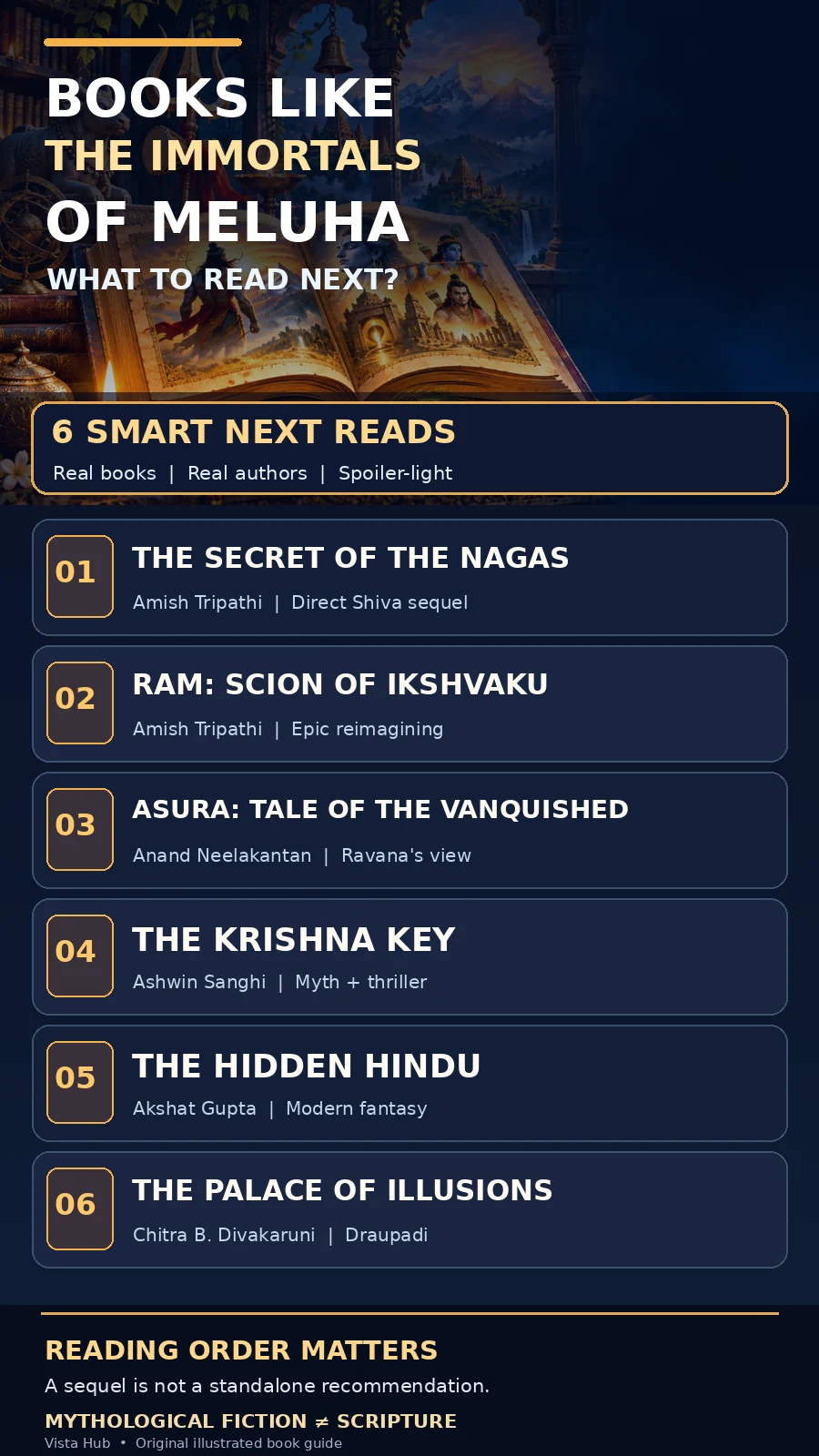
06. Asura: Tale of the Vanquished — Anand Neelakantan
Type: Standalone novel / Ravana and the defeated. If you loved Meluha for its refusal to settle every moral question in the first chapter, try Anand Neelakantan’s Asura. The Ramayana is retold from Ravana’s side and through a common Asura’s experience, challenging the familiar habit of hearing only the victors. The narrative’s attraction is social perspective, resentment, ambition and the costs of conflict; it is not a sequel to the Shiva Trilogy. Expect a different narrative voice and tone rather than Amish’s exact pacing. Readers who prefer an uncomplicated heroic lead may find the approach demanding, whereas readers curious about who gets to write a story may find it particularly rewarding. The publisher and author describe it as mythological fiction; do not mistake its invented viewpoints for a recovered original version of the epic.
07. Ajaya: Roll of the Dice — Anand Neelakantan
Type: Ajaya Series Book 1 / Kaurava perspective. Move from Ramayana to Mahabharata with Ajaya: Roll of the Dice. The book foregrounds the Kaurava side and rethinks Duryodhana’s role within the author’s fictional framework. For readers who liked Meluha’s clashes of values, this is a strong match: characters argue from competing loyalties and a familiar epic can seem very different when the viewpoint moves. This is the first Ajaya volume; its continuation is Ajaya: Rise of Kali. It is not a direct record of what historical people said or believed. Some readers will disagree with the author’s sympathies, and that disagreement is part of the experience. Pick it if you want large stakes, political relationships and a fresh point of entry into Mahabharata, rather than only supernatural battles.
08. The Krishna Key — Ashwin Sanghi
Type: Standalone contemporary mythological thriller. Not everyone wants another epic-length retelling. Ashwin Sanghi’s The Krishna Key brings Krishna-associated mythology into a more contemporary suspense format. Its appeal is clue-hunting, intersecting narratives and questions that move quickly across historical and modern settings. Compared with Meluha, the emphasis shifts from steadily building a single imaginary civilization to uncovering a mystery. That makes it especially useful for readers who finished the Shiva Trilogy and now want a thriller without abandoning Indian mythological references. Take its historical speculation as part of a novel, not as independent archaeological research. Sanghi lists the book in his Bharat Collection. Choose this one if a puzzle is more compelling to you than a thousand-page succession of royal conflicts.
09. The Hidden Hindu — Akshat Gupta
Type: Modern mythology, mystery and speculative fiction. Akshat Gupta’s The Hidden Hindu combines a present-day setting with immortality, secret identities and references to epic characters. The publisher positions it as science-fiction meeting Indian mythology; that label helps set expectations. You will not find the same structure as Meluha’s ancient kingdom. Instead, you get an unfolding mystery centered on Om Shastri and a search that connects modern events with claims about earlier ages. It can suit readers who enjoyed the secrets and reveal-driven portions of the Shiva Trilogy more than its battlefield sequences. The Hidden Hindu is also a trilogy, so check which volume and edition you are buying. Claims about long-lived characters or ancient abilities belong to the story, not to established scientific findings. For a fast modern hook, it is one of the clearest alternatives.
10. The Palace of Illusions — Chitra Banerjee Divakaruni
Type: Standalone literary Mahabharata retelling. For a change from male-centered kingship and war, read The Palace of Illusions. Chitra Banerjee Divakaruni tells a modern literary reimagining of the Mahabharata through Panchaali, or Draupadi. Relationships, personal losses, ambition and the consequences of political decisions come into focus through her voice. Compared with Meluha, the storytelling is more inward-looking and less oriented toward building a new system of armies or weapons. Yet readers who enjoyed the moral ambiguity of Amish’s novels may appreciate how familiar events change when one person’s experience guides the account. This is a novel, not a scholarly translation of Vyasa’s epic. Its imaginative choices are deliberate; distinguish what the author adds from what a particular ancient text says. Pick it for emotion, character and literary texture.
11. Karna’s Wife: The Outcast’s Queen — Kavita Kane
Type: Standalone Mahabharata character novel. Kavita Kane’s novel approaches the Mahabharata through Uruvi, a woman closely linked with Karna in the author’s fictional interpretation. The premise offers a character-led view of social status, loyalty, love and the painful consequences of alliances. Readers who liked the ethical arguments in Meluha but want a more personal story can find a different rhythm here. Unlike a straightforward war chronicle, the narrative asks how major decisions affect people who are not controlling the battlefield. The publisher’s description makes clear that this is a fictional retelling; do not confuse Uruvi’s complete characterization with an identical account in all ancient epic traditions. It also pairs well with a factual explainer about Karna if you want to separate literary invention from the wider Mahabharata narrative.
12. Vanara — Anand Neelakantan
Type: Standalone Ramayana reimagining / Baali and Tara. Vanara turns attention to Baali, Sugreeva and Tara within a Ramayana-inspired tale of family conflict, love and rivalry. For Meluha readers, its strongest resemblance is not the setting but the invitation to reconsider motives behind a widely known confrontation. The writer, Anand Neelakantan, gives especially prominent space to characters who may be comparatively less explored in conventional short summaries. You should expect a character-driven and often tragic drama rather than another self-contained trilogy about divine weapons. Penguin’s description specifically places Baali at the center of the retelling. Reading it alongside a trusted Ramayana translation can make the difference between epic source and imaginative reconstruction clearer. Pick Vanara if you want a change from royal capitals without leaving the moral conflicts of mythological fiction.
Quick Comparison: Which Meluha Alternative Fits Your Mood?
| What you want | Best starting point | Why it fits |
|---|---|---|
| The actual next Shiva story | The Secret of the Nagas | Official book two; continue before book three |
| Amish-style epic reimagining | Ram: Scion of Ikshvaku | New series with linked viewpoints |
| A rival character’s perspective | Asura / Ajaya | Ravana or Kaurava-centered fiction |
| A modern clue-based mystery | The Krishna Key | Contemporary thriller structure |
| Immortals and modern fantasy | The Hidden Hindu | Series with mythology and speculation |
| Literary emotional depth | The Palace of Illusions | Panchaali’s narrative perspective |
Suggested Reading Paths After Meluha
Path A — stay with Amish: complete the three Shiva Trilogy books, then enter the Ram Chandra Series in its published order. This preserves continuity and reduces accidental spoilers. Path B — explore the other side: start with Asura for a Ravana-centered Ramayana, then try Ajaya for a Kaurava-centered Mahabharata. The interest here is the political and human cost of the epic rather than whether a particular character wins. Path C — solve a mystery: try The Krishna Key for contemporary investigation, then The Hidden Hindu for speculation and mythology-inspired secrets. Path D — choose a character’s inner life: read The Palace of Illusions, followed by Karna’s Wife. None of these paths is a measured ranking or a guarantee that a reader will love a title; they are practical routes based on genre features.
Mythological Fiction Is Not a Translation of Scripture
This matters especially for international readers who first encounter Shiva, Rama, Krishna, Ravana or Draupadi through a novel. The Immortals of Meluha is a modern fictional reinterpretation, not evidence that the historical Shiva led the exact civilization depicted. The other novels on this list similarly invent scenes, motives and dialogue. The Palace of Illusions is a literary retelling from Panchaali’s viewpoint; Asura and Ajaya deliberately foreground alternative perspectives. If you are researching traditional versions, turn separately to critical editions, qualified translations and reputable scholarship. Fiction is valuable for storytelling and reflection, but a citation about a sacred text should not rely solely on an author’s invented plot. The cover art in this guide is original conceptual art, not a reproduction of an actual publisher’s cover.
How to Choose the Right Edition and Avoid Spoilers
Before buying or borrowing, check four practical details: the author, the series number, the language/translation, and whether it is an individual volume or boxed set. Titles sold under different covers may represent the same work. A Hindi-language reader should verify whether a Hindi edition actually exists for the exact title rather than assume every English novel has been translated. Availability, price, page count and cover design can change by retailer and edition, so avoid treating an old product listing as permanent. Read the publisher’s synopsis instead of a spoiler-heavy fan summary. For a library request, quote the full book title and author; for a gift, ask whether the recipient has completed The Immortals of Meluha and the entire Shiva Trilogy first.
Frequently Asked Questions
What should I read immediately after The Immortals of Meluha?
The Secret of the Nagas is the direct second book. Read The Oath of the Vayuputras third.
Which series is most like the Shiva Trilogy?
Amish Tripathi’s Ram Chandra Series has a related epic reimagining style, but different characters and narrative structure.
Are The Immortals of Meluha and The Hidden Hindu connected?
No. They are separate fictional works by Amish Tripathi and Akshat Gupta respectively.
Which similar book has a modern thriller setting?
The Krishna Key by Ashwin Sanghi is a contemporary mythological thriller. The Hidden Hindu mixes modern mystery with speculative mythology.
Which books tell the epic from another character’s point of view?
Asura, Ajaya, The Palace of Illusions and Karna’s Wife all foreground perspectives that differ from the most familiar summary.
Do these novels follow the original Ramayana and Mahabharata exactly?
No. They are modern fictional retellings, not line-by-line translations or historical records.
Are these books available in Hindi?
Some have translations or regional editions, but language availability varies. Verify the exact edition before ordering.
Can I start with The Oath of the Vayuputras?
It is better to read the first two Shiva Trilogy volumes before the finale to understand the story.
Final Recommendation
If you still have not finished the Shiva Trilogy, the smartest next read is The Secret of the Nagas. If you already finished it, choose by experience rather than by an arbitrary ranking: Ram: Scion of Ikshvaku for another immersive epic, Asura for a rival viewpoint, The Krishna Key for mystery, and The Palace of Illusions for literary characterization. That combination offers real variety while keeping the mythological imagination that made Meluha memorable. Keep a separate distinction between modern storytelling and the older religious literature it draws upon.
Helpful Related Reading on Vista Hub
- Karna in Mahabharata: his choices and tragic final battle
- Ramayana vs Mahabharata: key differences
- Kurukshetra War: rules and the 18-day timeline
Book and Author Sources
Book identities and series order checked against these author/publisher pages; book plots are discussed without copying their text.
- Official Shiva Trilogy box set
- Official Ram Chandra Series box set
- Anand Neelakantan author profile
- Ashwin Sanghi official book list
- The Hidden Hindu publisher page
- The Palace of Illusions author page
- Karna’s Wife publisher page
- Vanara publisher page
Editorial update: 13 November 2026. This is an independent, spoiler-light editorial guide, not a paid ranking; prices, editions and translations can change. Modern mythological fiction is not scriptural evidence.



Share Your Opinion
Comments are closed on this post.