 Vista
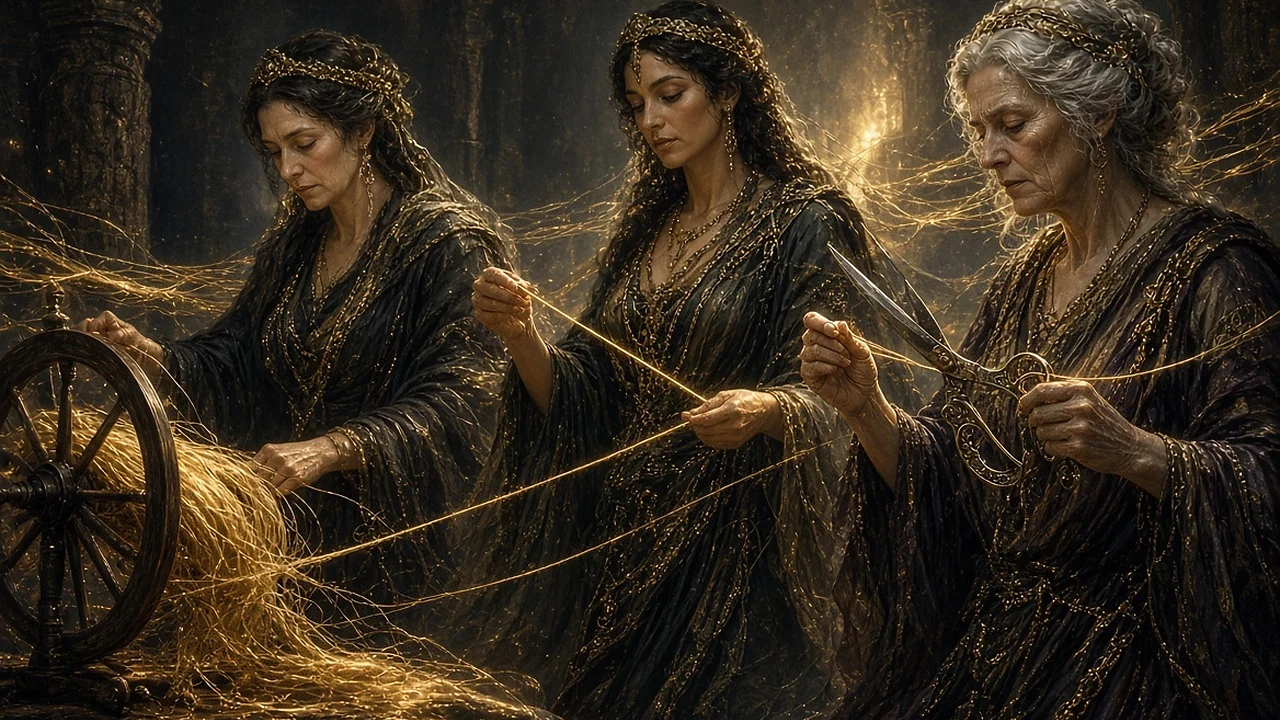
The Three Fates in Greek mythology, called the Moirai, are divine figures associated with the allotment of human destiny and the length of life. Their most familiar names are Clotho, Lachesis and Atropos. In the widely recognized thread-of-life image, Clotho spins, Lachesis allots or measures, and Atropos brings the allotted span to an end, often pictured with shears. But ancient Greek sources do not all tell the same story about their parentage or the exact duties of each sister. In Hesiod’s Theogony, the Moirai appear as children of Night (Nyx) in one passage and as children of Zeus and Themis in another. Plato’s Republic Book 10 gives yet another setting: the daughters of Necessity, singing of past, present and future while souls choose their next lives. The Roman counterparts are commonly called the Parcae.
Who are the Moirai, the Three Fates?
The Greek noun moira is connected with a share, portion or allotment. As the plural Moirai, the word names powers associated with what is assigned to a person’s life. The number three and their familiar names are prominent in influential Greek traditions, but the broader idea of fate can also appear as a singular divine power or an impersonal portion. This is why modern charts showing three women with matching faces and matching costumes should be treated as symbols, not photographs of a fixed historical religious scene.
The Fates matter because ancient stories often ask whether a person can avoid an appointed death or change what has been allotted. Heroes may fight bravely and gods may intervene, yet the narrative still returns to limits and consequences. Their power is not identical to that of Hades, who rules the underworld, or Thanatos, who personifies death. The Moirai express the apportionment of destiny, including what life contains before death arrives.
What does Clotho do? The Spinner
Clotho is commonly called the Spinner, the Fate who begins or spins the thread associated with a living person’s existence. Her name is connected with Greek words for spinning. In traditional modern illustrations, she holds a spindle or distaff, the tools that produce thread from wool or fiber. Spinning makes a useful metaphor because an apparently small, fragile material becomes a continuous line that can stand for the time through which a life unfolds.
Readers should not assume that every early text gives Clotho a personal assignment to attend an exact delivery date in a human hospital. The strong image of the spinner develops through poetry, interpretation and art. In Plato’s Myth of Er, Clotho participates in turning a great cosmic spindle and sings of the present, which is a more elaborate philosophical role than a simple picture of a woman working at a domestic loom. The image can communicate the idea of life’s beginning without becoming a biological theory of birth.
What does Lachesis do? The Allotter
Lachesis is often called the Allotter, associated with drawing or assigning the portion that belongs to a life. Later summaries sometimes explain this as measuring the thread, determining its allotted length before the final cut. That is an effective educational symbol, although the precise division of tasks into three modern job descriptions is not stated identically in every ancient poem. The name evokes the idea of an assigned lot or share.
In the Myth of Er at the end of Plato’s Republic, a figure associated with Lachesis presents souls with choices among different lives. A divine announcement emphasizes that a person must take responsibility for the life selected. Lachesis also sings of the past. This philosophical story complicates the simplistic idea that people are depicted as having no meaningful choice at all. The concept of destiny does not exclude discussions of judgment and moral responsibility in every Greek text.
What does Atropos do? The Unturnable
Atropos has a name commonly interpreted as the Unturnable or Inflexible. In the familiar thread symbolism, she ends the span that has been allotted, represented in later artwork by cutting the thread with shears. The cut marks the boundary of mortal life. Yet ancient artistic attributes vary: not every sculpture shows the three with spindle, measuring rod and scissors. Some give different staffs, rolls or instruments, and the association with one specific tool should be labeled a conventional artistic rendering.
In Plato’s Republic, Atropos sings of the future and participates in making the souls’ chosen allotments firm. That role emphasizes the irreversibility of what has been determined. She is not described as a warrior who personally murders every human being with a blade. The thread is a symbol of destiny rather than a literal cord attached to each living person, and the philosophical text uses a cosmic spindle instead of a scene of three seamstresses cutting cloth in a room.
Who were the parents of the Three Fates?
The correct answer depends on which ancient source is being discussed. In Hesiod’s Theogony, around lines 217–222, Nyx (Night) gives birth to the Moirai, named Clotho, Lachesis and Atropos. The same work later describes Zeus and Themis as parents of the Moirai, around lines 901–906. An educational website that says “Hesiod unquestionably gives only Zeus and Themis as their parents” would therefore ignore an entire relevant passage of that very poem.
In Plato’s Republic Book 10, around 617c, the Fates are described as daughters of Necessity (Ananke). These accounts can reflect different genealogical and philosophical settings rather than a modern family’s standardized pedigree. Source comparison is more valuable than pretending the inconsistency can be solved by deleting one version. Readers searching for “Who is the mother of the Three Fates?” should be shown the competing traditions with clear attribution.
What is the thread of life in Greek mythology?
The thread of life is a metaphor linking spinning and weaving to the passage of human existence. It offers three recognizable moments: beginning, allocation and ending. The metaphor is powerful because a thread can be drawn out, measured and finally cut. Later artists and storytellers use a spindle, a measuring instrument and scissors to make those ideas immediately visible. For a 9:16 educational poster, these attributes can explain the general concept without lengthy captions.
The thread is not a claim that medical researchers could discover an actual supernatural fiber connected to a person’s body. Greek poets used many images of necessity, portion and divine decision. Some sources emphasize weaving, others lots, and Plato describes a cosmic spindle whose turning relates to the universe. The familiar picture is a helpful **summary of traditions**, not evidence that all authors and centuries taught exactly the same machinery of fate.
Could Zeus control or change the Fates?
There is no single answer across all Greek poetry. Zeus is the chief Olympian ruler and frequently acts as guardian of order, while the Moirai determine or embody what is allotted. In Homer’s Iliad, Zeus can deliberate over the death of a beloved son, Sarpedon, yet other divine figures question the consequences of upsetting the appointed course. The scene shows that divine power and destiny are presented through drama rather than an explicit universal rule of mathematics.
Some traditions portray fate as a principle even gods must respect; others strongly connect its administration with Zeus’s authority. In Hesiod, Zeus honors the daughters of Themis, but the alternative genealogy through Nyx changes the surrounding emphasis. Plato’s philosophical myth adds still another framework of Necessity and individual choice. Therefore online statements such as “Zeus always commands Atropos to cut the thread” or “Zeus can never intervene in any destiny story” go further than the range of sources supports.
What does Plato’s Myth of Er say about the Three Fates?
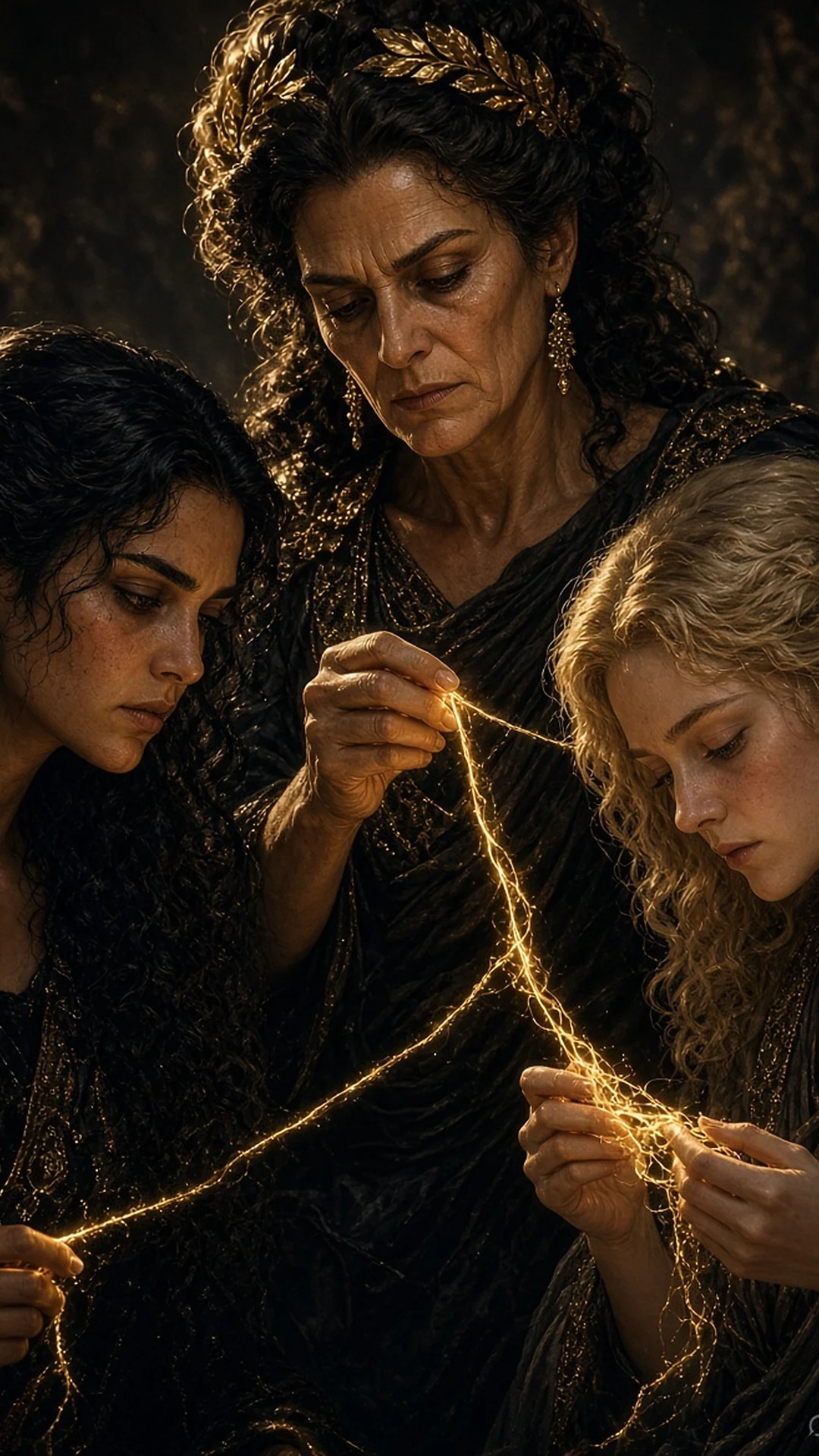
At the end of Plato’s Republic Book 10, a man named Er reports a vision of the afterlife. Souls encounter the cosmic spindle of Necessity, accompanied by Sirens and the three Fates. Lachesis sings of the past, Clotho of the present, and Atropos of the future. This is a specific philosophical scene, not a line from Hesiod’s divine birth genealogy. The three are identified as daughters of Necessity in this account.
The souls draw lots and encounter patterns of possible lives. They must make choices, and the process ultimately confirms the destiny selected. The philosophical point includes responsibility: the chooser cannot simply blame the gods for every foolish decision. This makes the narrative particularly interesting when discussing fate versus free will. It does not prove Plato literally saw a cosmic machine after his death; he used a story in a philosophical dialogue to explore justice and human choice.
Are the Fates the same as Keres, Erinyes or Hades?
The Moirai should not be confused with every supernatural being associated with death. Keres are figures tied to deadly destruction and violent death in some Greek sources. Erinyes, or Furies, are linked with pursuing serious wrongdoing and certain violations of family order. Hades rules the underworld, while Thanatos personifies death. These characters may overlap in imagery or appear in related poems, but they do not all perform the same task.
Distinguishing them gives readers a cleaner family of concepts: the Fates allot, Thanatos represents the event of dying, Hades governs the realm, and the Erinyes can pursue wrongdoers. Ancient literature is flexible, so even this guide is not a mechanical map valid without exceptions in every text. It is nonetheless more accurate than an image labeling three armed monsters “Clotho, Lachesis, and Hades,” or making all afterlife figures the same person.
Three Fates versus Roman Parcae
The Roman counterparts of the Greek Moirai are commonly called the Parcae. Roman traditions often name the three Nona, Decima and Morta, though those names and functions developed in their own cultural setting. Roman poetry also uses Latin terms for fate and draws on Greek imagery. This pairing belongs to the broad process through which Greek and Roman divine identities were interpreted together, not to a universal assertion that the historical rites of every sanctuary matched exactly.
For a comparison page the simplest relationship is Moirai = Greek; Parcae = Roman. But the source-specific detail matters if a reader is translating a particular ancient poem. The Greek names Clotho, Lachesis and Atropos are still the best starting point for the familiar thread imagery, while Roman equivalents explain why Latin-language stories may use different names for similar roles.
What do the Three Fates mean today?
Modern novels, films and games use the Three Fates to symbolize inevitability, the passage of time and the limits of control. Their scissors and thread are visually simple but emotionally effective: one picture can suggest life’s beginning, course and ending. A phrase such as “the Fates decided” remains a literary way of talking about events that feel unavoidable. It is not a scientifically testable prediction method or a claim that three actual people can forecast when a particular individual will die.
Another useful reading is that a person’s life is shaped by both circumstances and choices. Plato’s version especially emphasizes choosing among possible lives, while other Greek stories stress forces beyond human control. The apparent tension is part of what makes these figures compelling. A balanced interpretation should invite readers to compare the sources rather than falsely insisting that every Greek poet agreed on a single doctrine of free will.
Three Fates: source and symbol comparison
| Figure/source | Common meaning | Important nuance |
|---|---|---|
| Clotho | Spinner of the life thread | Plato associates her with the present |
| Lachesis | Allotter or measurer | Plato associates her with the past |
| Atropos | Inflexible ending/cutting | Plato associates her with the future |
| Hesiod c.217 | Nyx as mother | One genealogy |
| Hesiod c.901 | Zeus and Themis as parents | Alternative genealogy |
| Plato Republic 10 | Daughters of Necessity | Philosophical afterlife story |
| Roman Parcae | Roman fate figures | Different names and cult context |
Five FAQs about the Three Fates
What are the names of the Three Fates?
Clotho, Lachesis and Atropos are the most familiar Greek names of the Moirai.
What does each Fate do?
In conventional thread imagery Clotho spins, Lachesis allots or measures, and Atropos ends the allotted span.
Who are their parents in Greek mythology?
Hesiod gives Nyx in one passage and Zeus with Themis in another; Plato calls them daughters of Necessity.
Could Zeus overrule the Fates?
Greek sources differ in how divine authority and allotted destiny interact; no single absolute rule fits them all.
What are the Three Fates called in Roman mythology?
The Parcae, often associated with the names Nona, Decima and Morta.
Primary sources and conclusion
For both Hesiodic genealogies consult Hesiod, Theogony around 217–222 and 901–906. For the philosophical vision read Plato, Republic Book 10, Myth of Er (around 617c). For collected classical passages and attributes see Theoi’s Moirai source collection. Conclusion: the Three Fates embody allotted life and destiny, but their genealogies and roles change across myth, poetry and philosophy. Updated 14 November 2026. Poster uses conventional symbolic attributes.


Share Your Opinion
Comments are closed on this post.