 Vista

Hera in Greek mythology is the queen of the Olympian gods and a major goddess of marriage, family, royal dignity and the lives of women. She is both the sister and the wife of Zeus and a daughter of the Titans Cronus and Rhea. Her famous symbols include a royal sceptre, crown, cow and peacock, although the peacock’s mythic associations developed through particular stories and visual traditions. Modern retellings often reduce Hera to a jealous wife who persecutes Zeus’s lovers and children. Her anger plays a major role in myths about Heracles, Io, Leto and the Trojan War, but that is not the entirety of her religious importance. Ancient Greeks also honored her in major sanctuaries, including those connected with Argos and Samos.
Who was Hera, the Greek queen of the gods?
Hera occupies a central position in the Olympian divine family. As queen, she expresses dignity, marriage and the social and religious status of legitimate union. Her power is not merely a prize given to whoever marries Zeus. The goddess had independent religious significance in different Greek communities, including prominent temples, festivals and images. A reader searching “Who is Hera?” needs to understand her divine domain before encountering the more dramatic quarrels that made her famous in epic poetry and later drama.
Hera’s myths are complex because they place an important protector of marriage in a household repeatedly troubled by her husband’s relationships. Greek poets use that tension to create stories about jealousy, divine authority and the vulnerability of mortals caught between gods. It is reasonable to discuss Hera’s harsh actions in those narratives, but misleading to present the goddess as a one-dimensional villain whose worshippers had no positive reason to honor her. Her religious identity and her role in particular myths are related but not identical subjects.
Who were Hera’s parents and siblings?
In Hesiod’s Theogony, Hera is a child of Cronus and Rhea. Her siblings are Hestia, Demeter, Hades, Poseidon and Zeus. Cronus swallows children because he fears a prophecy that one will overthrow him, and the youngest, Zeus, escapes after Rhea substitutes a wrapped stone. Eventually Zeus helps the swallowed siblings return and leads the younger divine alliance to victory over the opposing Titans. Hera therefore belongs to the same generation as Zeus even though the two are also married in the familiar Olympian genealogy.
For modern readers the sibling-marriage relationship may seem unusual, but mythic divine families should not be treated as models for human marriage law or behavior. Ancient poets represented divine genealogy differently from ordinary human genealogy. The important point for the plot is that Hera’s authority arises from her place in a powerful family whose members rule major regions of the cosmos. Her siblings’ domains matter: Poseidon is associated with the sea, Hades with the underworld and Demeter with agriculture.
Why did Hera marry Zeus and become queen?
Hesiod presents Hera as Zeus’s wife after earlier unions and significant divine family events. The marriage connects the head of the new Olympian order with a goddess closely associated with marriage itself. Other Greek stories develop the courtship, the wedding and the tensions between the two in different ways. There is no need to invent a universally recognized historical wedding date or claim that one ancient author recorded every detail of their relationship.
In literature their marriage is anything but uncomplicated. Zeus pursues other gods and mortals, and Hera often resists or retaliates. Her actions may be severe, especially when they affect people with little control over the conflict. Yet ancient Greeks could still turn to Hera in matters of marriage and women’s lives. A divine character’s epic quarrels do not exhaust the meaning of worship offered at her sanctuaries. This is particularly important when translating a mythology article into modern language that naturally encourages psychological labels for every character.
What were Hera’s powers and sacred symbols?
Hera is connected to the institution of marriage, queenly authority and the social roles that surround family. She can intervene in divine politics, frustrate her rivals and support or obstruct heroes. Her most recognizable royal attribute is the sceptre, sometimes paired with a crown or diadem. The cow or heifer is a prominent sacred animal in early descriptions, where Homer uses an epithet commonly rendered “ox-eyed” in relation to Hera.
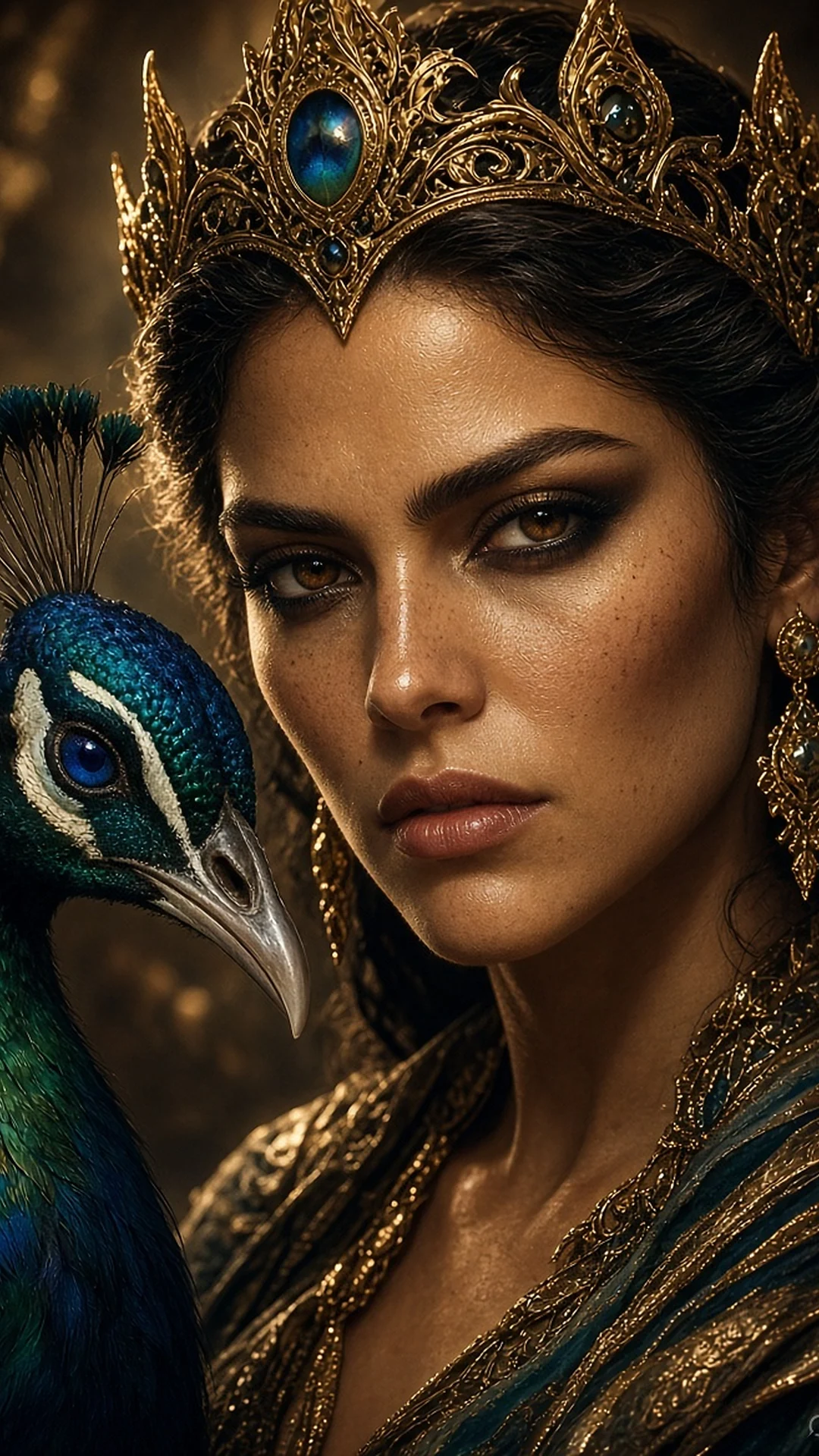
The peacock is especially popular in later art, and the bird’s tail is linked with the eyes of Argus in the Roman poet Ovid’s story of Io. Other animals and plants, including the cuckoo and pomegranate, appear in specific traditions. It would be incorrect to assume that every early Greek vase shows Hera riding a peacock simply because the peacock is the most recognizable modern symbol. A credible illustration identifies the godly queen through attire, royal setting and documented attributes.
Who were Hera’s children: Ares, Hebe and Eileithyia?
Hesiod’s Theogony, around line 921, names Ares, Hebe and Eileithyia as children of Hera and Zeus. Ares is associated with violent war, Hebe with youth and Eileithyia with childbirth. This family gives Hera connections to conflict, renewal and women’s reproductive lives. The children should not be confused with every child Zeus has by other goddesses or mortals, an extensive group of heroes and divine figures often responsible for the stories about Hera’s anger.
Hephaestus has an especially interesting birth tradition. In Hesiod, Hera bears the great craftsman god without union with Zeus, amid conflict with her husband. Other accounts describe his parentage differently, sometimes including Zeus as his father. Therefore a one-line list that declares both versions universally true misses the most useful fact: the early sources differ. The Hephaestus episode is a good example of Hera’s active presence in divine succession stories rather than a passive role as Zeus’s spouse.
Why did Hera oppose Heracles or Hercules?
Heracles, more familiar to some English speakers as Hercules, is a son of Zeus and the mortal Alcmene. Hera’s hostility toward him is one of the best-known threads of the heroic cycle. Stories connect her interventions with his difficult birth, dangers in infancy and the misfortunes that eventually lead to his extraordinary labours. In some versions serpents are sent against him as a baby; elsewhere divine madness plays a tragic part in the sequence of events that results in his service under Eurystheus.
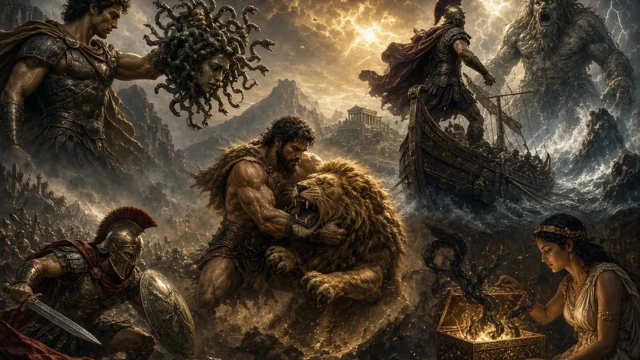
The twelve labours include defeating the Nemean Lion and Hydra, capturing the Cretan Bull and Cerberus, and obtaining the golden apples of the Hesperides. These tasks belong to Heracles’s larger heroic story, not a list of twelve personal commands that Hera issues in exactly the same manner in every ancient work. Her influence may be felt, but the immediate ruler setting the labours in the well-known cycle is Eurystheus. A complete Hera article should introduce the conflict without copying the entire long Heracles biography.
Hera, Io and Argus: why is the peacock associated with her?
One important myth concerns Io, a mortal woman whose fate becomes entangled with Zeus’s pursuit and Hera’s reaction. Io is transformed into a cow or heifer in famous versions and placed under the watch of Argus Panoptes, a guardian with many eyes. Zeus sends Hermes to deal with Argus, and the watchman is killed in the traditional story. The consequences for Io include persecution and a long journey, which should not be softened into a happy romance without acknowledging the woman’s suffering.
In Ovid’s Metamorphoses Book 1, the Roman goddess Juno places Argus’s many eyes upon the feathers of her bird, providing an explanation for the peacock’s remarkable tail. That is a later Roman literary account linked with Hera’s Greek counterpart, not proof that every early Greek storyteller explained the peacock in precisely the same terms. This is why artwork showing Hera with a peacock can be visually recognizable while still requiring source context in an educational caption.
Hera, Leto and the birth of Apollo and Artemis
Leto, who bears Apollo and Artemis to Zeus, appears in traditions where Hera’s opposition makes the birth or the search for a safe place difficult. The island of Delos becomes important in the birth stories, especially for Apollo. Different authors describe Hera’s interventions and the help offered by other divine figures in different ways. The conflict is another example of Hera acting against the consequences of Zeus’s relationships, and the resulting difficulties for a mother and children can be severe.
However, it would be wrong to conclude that Hera has no concerns for mothers or that Eileithyia, associated with childbirth, is never part of her divine household. Mythic conflicts present particular dramatic episodes, while Hera’s wider religious identity includes marriage and women’s life transitions. A balanced article neither hides her opposition to Leto nor treats it as the whole definition of her worship.
What did Hera do in the Trojan War?
In the Judgment of Paris, Hera competes with Athena and Aphrodite for recognition as the fairest. Paris, the Trojan prince, ultimately favors Aphrodite in a famous telling. Hera’s anger toward Troy becomes part of her involvement in the legendary war. In Homer’s Iliad, she generally supports the Achaeans or Greeks against the Trojan side, while Apollo and Aphrodite frequently favor the Trojans in particular episodes. The gods do not stand above the conflict as completely neutral observers.
Iliad Book 14 offers an especially vivid example of Hera’s strategy. She seeks help from Aphrodite to obtain a charm or girdle associated with desire, then uses attraction and the support of Sleep (Hypnos) to distract Zeus. Her aim is to influence the course of events while the king of the gods is unaware. The episode demonstrates intelligence and political maneuvering, not merely uncontrolled jealousy. It should also be kept distinct from the Trojan Horse scene, which belongs to the broader war cycle rather than the ending of the Iliad.
Why was Hera worshipped at Argos and Samos?
Hera had longstanding religious importance at Argos in the Peloponnese and on the island of Samos. Their sanctuaries, often called Heraia or Heraions, are important for the study of Greek religion and archaeology. Temple remains and offerings demonstrate that communities invested resources and attention in the goddess. This evidence concerns historical worship, not the literal truth of every supernatural quarrel in a literary account.
Different local festivals and cult titles emphasize Hera’s roles in marriage, status, maturation and community. Those features are easy to miss when a website copies only the most dramatic story of Zeus’s infidelity. The places are useful for understanding why a goddess with occasionally harsh literary actions could be a respected religious patron. Her importance was embedded in social life and sacred spaces long before modern entertainment turned her into a recurring antagonist.
Greek Hera versus Roman Juno
Juno is Hera’s conventional Roman counterpart. Like Hera, she is associated with marriage, but Roman Juno also has distinctive civic and state-related identities. The Roman goddess was not merely a Greek picture with a Latin label. Roman poets, including Virgil and Ovid, adapted Greek mythic figures to tell stories about Rome’s legendary past. Juno’s opposition to the hero Aeneas in the Aeneid belongs to that Roman literary world.
Comparing Hera with goddesses of marriage in other religions is a question of themes, not straightforward historical identity. A shared role in family protection does not erase differences in sacred texts or worship. A source-based introduction should begin with the Greek family genealogy and the documented religious role, then move to Roman adaptations when readers specifically ask about Juno.
Myth versus fact: is Hera only a jealous wife?
Hera does act jealously and sometimes cruelly in famous stories about Zeus’s other relationships. That part should not be denied. Yet she is also queen of Olympus, a goddess of marriage and a major focus of ancient worship. Both facts can be true within the Greek literary and religious tradition. Labeling her permanently “the evil goddess” distorts the evidence by treating the most sensational episodes as an exhaustive account of her identity.
Ancient religious stories often portray gods exercising enormous power with complicated moral consequences. A modern reader can question Hera’s treatment of Io or Heracles without rewriting the literature or assuming that ancient worshippers admired every action of every god. The best interpretation connects her role as royal spouse, her independent cult significance and the choices poets assign her in specific narratives.
Hera facts and myth timeline
| Topic | Key fact | Source context |
|---|---|---|
| Family | Child of Cronus and Rhea | Hesiod, Theogony |
| Marriage | Sister and wife of Zeus | Greek divine genealogy |
| Children | Ares, Hebe, Eileithyia | Theogony 921 onward |
| Hephaestus | Born to Hera alone in Hesiod | Other traditions vary |
| Heracles | Hostility and trials | Heroic myth cycle |
| Io and peacock | Argus’s eyes | Ovid, Metamorphoses 1 |
| Trojan War | Supports Achaeans | Homer, Iliad |
| Roman name | Juno | Roman religion and poetry |
Five FAQs about Hera
Who were Hera’s parents?
Cronus and Rhea; her siblings include Zeus, Poseidon, Hades, Demeter and Hestia.
Who was Hera’s husband?
Zeus, king of the Olympians, who was also her brother in the familiar divine genealogy.
What was Hera the goddess of?
Marriage, queenly authority and aspects of women’s family and social lives.
Why did Hera hate Heracles?
In myth, her hostility is tied to Heracles being a son of Zeus and the mortal Alcmene, though details vary by author.
What is Hera’s Roman name?
Juno, whose Roman cult and civic importance developed in distinctive ways.
Ancient sources and conclusion
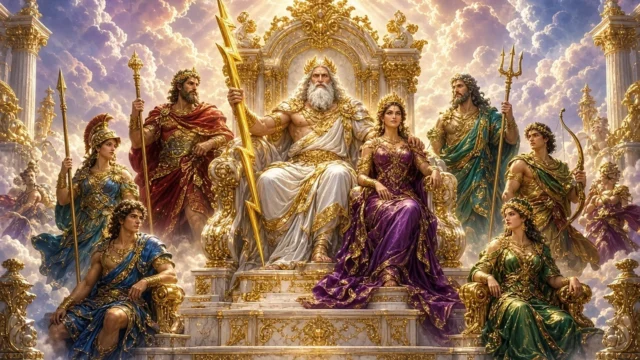
For Hera’s marriage and children read Hesiod, Theogony 921–929; for divine political strategy see Homer, Iliad Book 14; for the Io–Argus peacock link read Ovid, Metamorphoses Book 1; and for cult details see Theoi’s Hera source collection. Conclusion: Hera’s identity includes marriage, queenship and influential worship, alongside difficult mythological conflicts. Updated 14 November 2026. The poster is an illustrative artwork.


















Share Your Opinion
Comments are closed on this post.