 Vista

Pandora’s Box story is a famous Greek myth about the arrival of suffering among humans, but the popular English title conceals an important detail: in Hesiod’s Works and Days, Pandora opens a large storage jar, or pithos, not the small box shown in many modern illustrations. Troubles escape into the world, while Elpis—often translated as Hope, but also understood as Expectation—remains beneath its lid. The story belongs to a larger conflict involving Zeus, Prometheus and the theft of fire. It is not a historical account of the scientific origin of illness, and its message is more complicated than the familiar slogan “never be curious.”
What is the original Pandora’s Box story?
To understand the myth, start with the Greek poet Hesiod, whose Works and Days discusses human labor, fairness, hardship and survival. In the passage around lines 42–105, the poet describes a time before ordinary human life was filled with the troubles he knows. But the plot begins earlier, with conflict between Zeus and the Titan Prometheus. Prometheus outwits Zeus over sacrifice, and fire becomes a point of contention. Zeus withholds fire; Prometheus steals it back for humans. Zeus then arranges another response that changes mortal life.
Hesiod’s narrative is a Greek poetic explanation of how suffering and hard work came to characterize the human condition. It gives us evidence about ancient storytelling and social assumptions, not about what caused real diseases in medical history. A responsible retelling also notices that the poem treats the first woman through a deeply gendered and often hostile lens. Presenting this ancient viewpoint accurately does not require endorsing its assumptions about women today.
Why did Zeus create Pandora after Prometheus stole fire?
Prometheus, whose name is associated with forethought in later explanation, takes fire for humanity after Zeus has concealed it. Fire can represent cooking, craft, survival and the boundary between human skill and divine authority. The gods’ response is not just another fight with the Titan. In Works and Days, Zeus orders the creation of a woman who will be presented as an attractive gift while also bringing serious consequences. The deception depends on the contrast between the outward appearance of a blessing and its hidden danger.
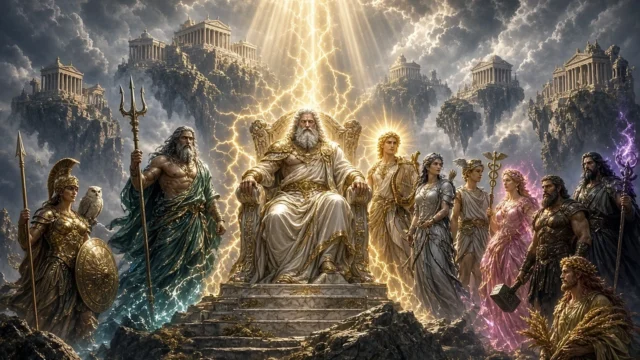
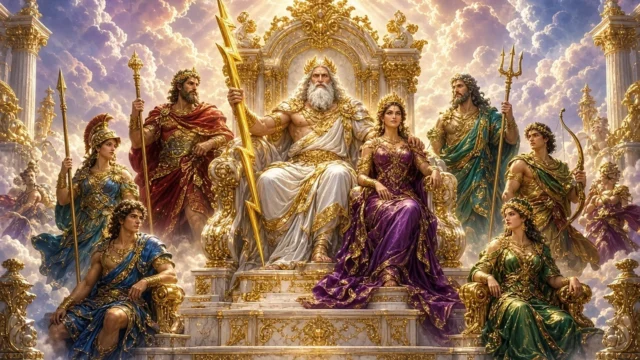
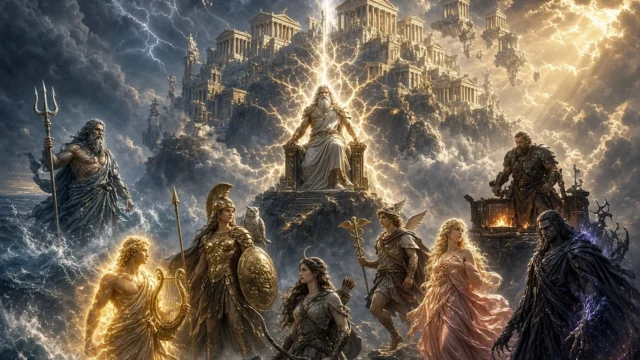
The divine craftsman Hephaestus fashions a woman’s form. Athena contributes skills and adornment, while Aphrodite and Hermes provide other qualities in the wider description. The gifts are part of the explanation of her name Pandora, commonly translated as “all-gifted” or “all-endowed,” although discussion of the name has a wider scholarly history. It is misleading to present her as a random ordinary woman who happens upon a dangerous container. Her appearance is carefully planned in Zeus’s response to Prometheus.
Who were Epimetheus and Prometheus in Pandora’s story?
Two brothers have different roles. Prometheus warns his brother Epimetheus not to accept a gift from Zeus, because it may bring harm. Epimetheus accepts Pandora despite the warning. Hesiod emphasizes that Epimetheus recognizes the consequences too late. In the conventional interpretation, the brothers’ names evoke forethought and afterthought, though names and etymologies should not be substituted for the poem itself. The narrative makes short-term appearances and long-term consequences its central tension.
Calling Pandora solely an intruder who ruins a perfect world erases the larger chain of decisions. Zeus devises a countermeasure after Prometheus steals fire; many gods contribute to its preparation; Epimetheus accepts the gift despite being warned; and Pandora’s act with the container introduces troubles among humans. A fair summary describes the agency and responsibility the text actually assigns rather than blaming every hardship on one woman’s supposed personality. Ancient literary framing and a modern ethical assessment can be distinguished.
Was it a box or a jar? The Greek word pithos explained
The answer to this frequent question is straightforward. Hesiod’s Greek text refers to a pithos, a large jar used for storage. Such vessels were practical containers in ancient Mediterranean life. The familiar expression “Pandora’s box” gained currency in later retellings and translations, often linked to a Renaissance confusion with a smaller container. Modern English dictionaries preserve the idiom, but the distinction matters when identifying what Hesiod describes. A realistic educational poster should show a large jar rather than claim that a little jewelry box appears in the oldest passage.
That does not mean every modern illustration using a box is automatically worthless. Images can be adaptations or symbolic shorthand. The problem arises when the artwork is presented as a precise rendering of the ancient source. In a visual guide, the image caption can identify the pithos, explain the later “box” expression and let the reader understand both without misunderstanding the original Greek vocabulary.
What escaped from Pandora’s jar?
Hesiod says that before the act humans had lived away from the hard work, miserable diseases and other evils now experienced. When the lid is lifted, harmful things disperse across earth and sea; illnesses come silently to people. The poem does not supply a fixed inventory of seven named demons, colored spirits or specific modern diseases. Many contemporary videos and pictures invent a visually satisfying lineup of “greed, jealousy, anger, plague” and present it as the exact list from Hesiod. That should be treated as a modern visualization rather than a quotation from the poem.
It is better to describe the main categories that Hesiod emphasizes—pain, sickness, hardship and countless troubles—without manufacturing numbers. The myth dramatizes the human experience of living in a world where suffering cannot be entirely escaped. That narrative theme makes it easy to understand why the story has been retold for centuries, even by readers who do not share the poem’s religious worldview.
Why did Hope stay inside Pandora’s jar?
This is the most interesting and least settled question in the story. The Greek term Elpis usually becomes “Hope” in English translations, but it can also mean expectation or anticipation. Hesiod says Elpis remains inside under the jar’s rim because the lid is closed before it can escape, in accordance with Zeus’s plan. The poem does not provide one universally accepted explanation of whether this is good news or bad news for humanity.
One reading is that hope remains preserved for people as a consolation despite suffering. A different interpretation asks whether it is withheld from the world, or whether Elpis is an uncertain expectation rather than a reliably beneficial gift. Ancient Greek interpretation and modern scholarship continue to discuss the point. The responsible conclusion is that the text says Elpis remains; claiming that Hesiod explicitly taught a single simple message such as “hope is all we have left” goes beyond what the passage settles.

How is Pandora described in Theogony versus Works and Days?
Hesiod also discusses the first woman’s creation in the Theogony, but its context and emphasis differ from Works and Days. The Theogony connects the crafting of a beautiful woman with the continuing trouble associated with the female race as Hesiod depicts it. Works and Days develops the narrative of Pandora’s arrival and, especially, the jar. It is therefore careless to refer to both texts as though every detail of the lid and Elpis appears in precisely the same passages.
Later Greek and Roman authors, translators, artists and storytellers developed new emphases, including stories in which the contents or meaning of a container differ. A children’s book may soften the hostile description of womanhood or introduce a stronger moral of optimism. That is a legitimate adaptation if presented honestly. A source-based explainer needs to say what Hesiod records and which meanings are modern interpretations, without hiding the ancient poem’s troubling social attitudes.
What does “opening Pandora’s box” mean today?
In modern English, to open Pandora’s box means to take an action that unexpectedly releases many problems, complications or consequences that are difficult to control. For instance, a company might discover that a hurried software change creates security problems across several systems. A family might revisit an unresolved dispute and find that it sparks many new disagreements. The idiom is about unintended cascading consequences, not about the literal existence of a supernatural container.
The expression is useful because it captures an experience that still feels familiar: one seemingly small action can have effects far beyond expectations. But a person using the idiom is not making an assertion that Zeus exists or that diseases originated from a jar. The story is ancient; the metaphor is modern and practical. Readers can learn the vocabulary while appreciating the historical distinction between the poem and its later English title.
Pandora’s Box story: five common questions
Was Pandora’s Box actually a box?
No. Hesiod describes a large storage jar called a pithos; “Pandora’s box” is the familiar later name.
Who created Pandora?
In Hesiod’s story, Zeus orders her creation and several gods contribute attributes, with Hephaestus shaping her form.
Why did Epimetheus accept Pandora?
He disregarded Prometheus’s warning against accepting a gift from Zeus and understood the danger only afterward.
What remained inside the jar?
Elpis, often translated Hope or Expectation, remained under the lid. Its precise significance is debated.
Did Pandora cause real diseases?
No scientific evidence supports the supernatural event. It is an ancient mythic explanation of hardship, not medical history.
Sources, context and conclusion
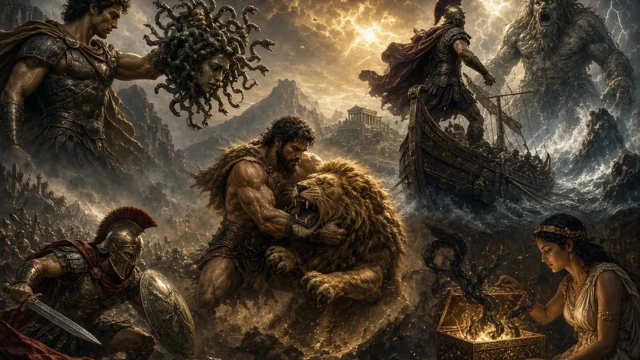
The central primary text is Hesiod, Works and Days 42–105; compare Hesiod, Theogony for the related creation story and Harvard Center for Hellenic Studies translation for wording around Elpis. Conclusion: the famous “box” is a jar, Elpis stays within it, and Pandora’s role belongs to a wider sequence involving Zeus, Prometheus and Epimetheus. Updated 14 November 2026. The poster is artistic, not documentary.

















Share Your Opinion
Comments are closed on this post.