 Vista

Greek mythology is the collection of traditional stories through which ancient Greek communities described gods, heroes, monsters, the beginnings of the cosmos and the choices people make. It is not a single sacred book or a scientifically verified history. Readers encounter different versions in poetry, theatre, religious customs and later Roman literature. The simplest way to begin is to know the main sources, understand how the generations of deities relate, and then follow individual stories without assuming that every poet told them identically.
What is Greek mythology, and where did it come from?
The word “mythology” covers a network of narratives rather than one plot. Some explain why Zeus rules the sky or why Demeter is associated with growing crops; others follow human heroes who must decide whether to pursue glory, protect family, obey a god or resist fate. Ancient Greece was made up of communities with distinct local traditions, and storytelling changed across centuries. A statue of Athena in Athens, a hymn performed at a sanctuary and a scene in Homer could emphasize different aspects of the same deity. That variation is part of the tradition, not an error that has to be erased.
The stories are worth reading for their literary influence and for the questions they raise. They can reflect ancient attitudes toward kingship, hospitality, marriage, warfare and the boundary between mortality and divinity. They are not laboratory explanations for storms or evidence that monsters literally walked the earth. Modern readers can appreciate them without accepting supernatural events as established facts. A good guide distinguishes what an ancient text actually states from a modern interpretation or a scene invented for a film.
Where should beginners start? Homer, Hesiod and other sources
Two names provide a strong foundation. Hesiod gives a structured account of divine generations in the Theogony and tells stories concerning Prometheus and Pandora in Works and Days. Homer, the traditional author of the Iliad and the Odyssey, concentrates on heroes, war, travel and divine involvement in human decisions. The Iliad concerns a short period in the Trojan War, not the whole war from its beginning to the wooden horse. The Odyssey follows Odysseus’s difficult return home after that conflict.
The Homeric Hymns describe particular gods, including Demeter, Apollo and Hermes. Tragedians such as Sophocles and Euripides explored familiar figures through new dramatic situations. Mythographers, notably the work traditionally attributed to Apollodorus, collected many episodes in a convenient sequence. Roman writers such as Ovid, Virgil and Apuleius developed further versions centuries later. That means a striking detail in a popular retelling may come from a Roman author rather than from Homer. When researching any single myth, ask: Which author, which work, and which passage?
From Chaos to Olympus: how the divine generations unfold
In Hesiod’s account, Chaos appears first; Gaia (Earth), Tartarus and Eros follow among the earliest beings. It is important not to turn this sequence automatically into a simple parent-child chart: appearing after Chaos does not necessarily mean Gaia is described as Chaos’s daughter. Gaia brings forth Ouranos (Sky), and their descendants include the Titans, the Cyclopes and the Hundred-Handers. Cronus, one of the Titans, overthrows his father Ouranos, only to fear that his own children will overthrow him in turn.
Cronus swallows several children born to Rhea. Rhea saves the infant Zeus through deception. When Zeus grows up, his siblings are released, and a conflict between generations eventually establishes Olympian rule. In the Titanomachy, Zeus and his allies defeat the opposing Titans. Readers should not mistake this legendary divine succession for a timeline of real geological events or a claim about when Earth formed. Other Greek cosmogonies, including Orphic traditions, do not reproduce Hesiod’s story in exactly the same way.
Who are the major Greek gods and goddesses?
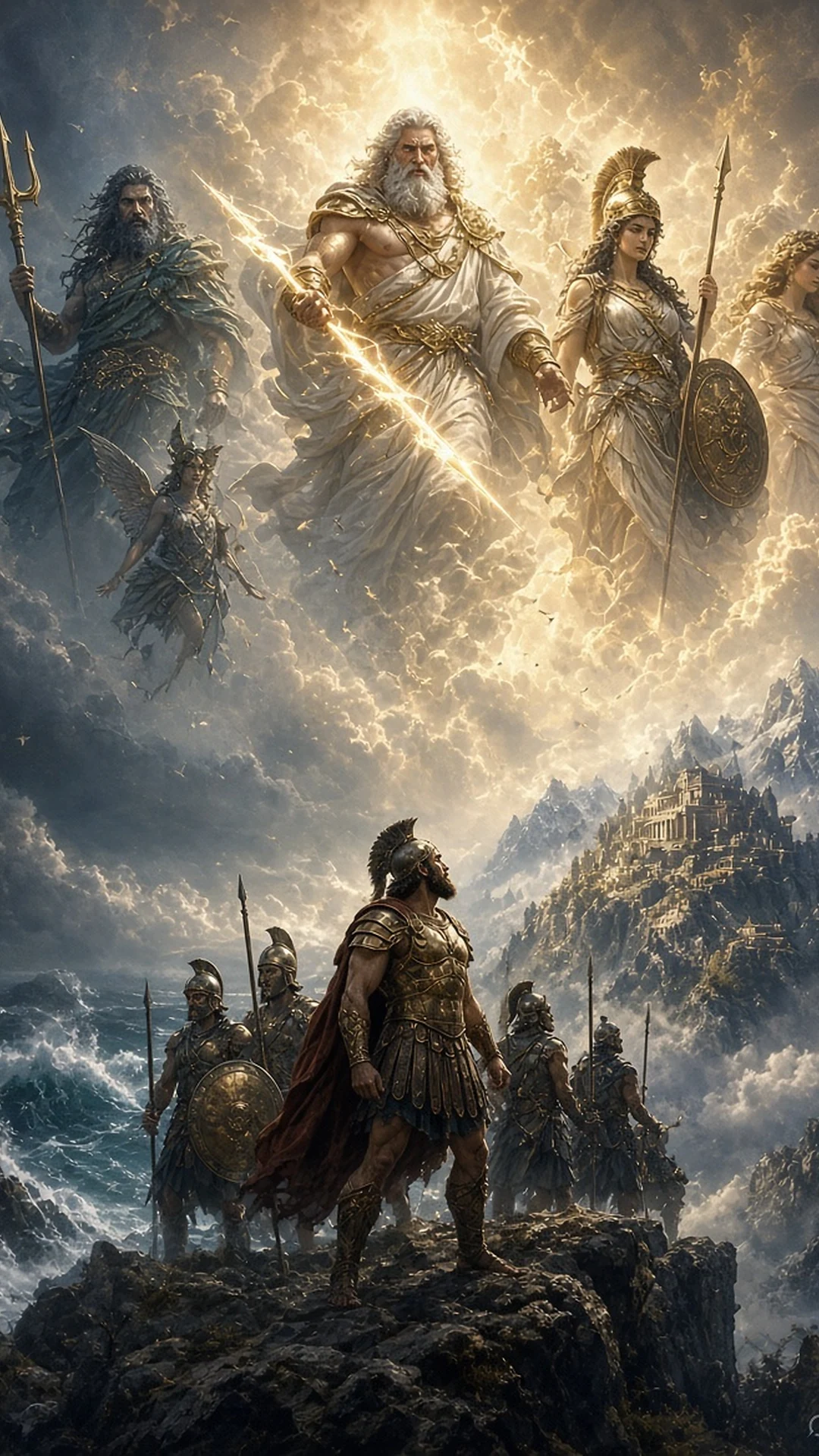
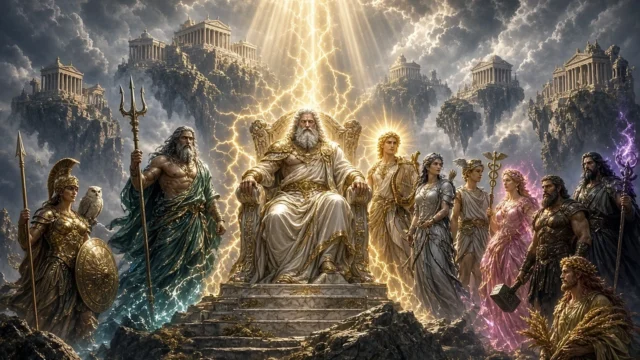
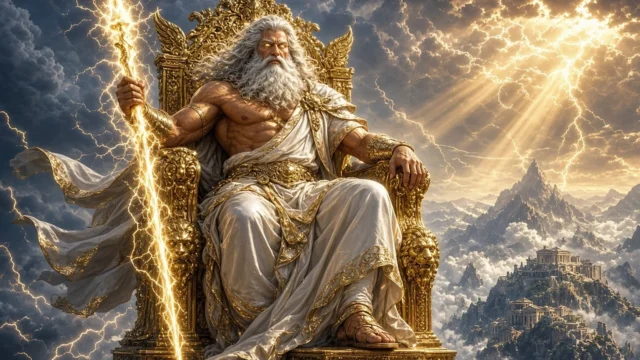
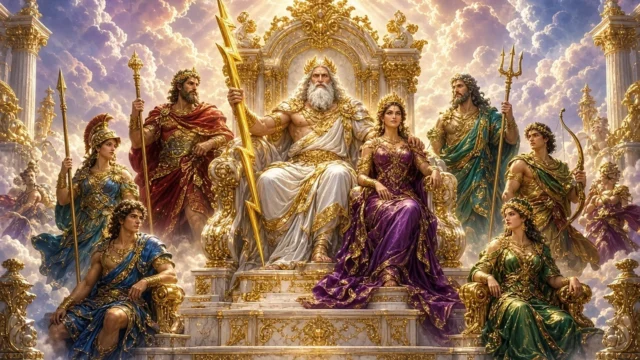
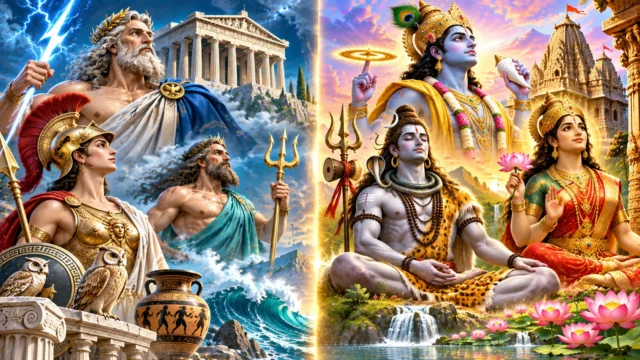
Zeus is king of the Olympians and is closely linked with thunder, the sky and authority. Hera is associated with marriage and queenship. Poseidon rules the sea and is also linked with earthquakes and horses. Demeter concerns crops and fertility of the land. Athena represents wisdom, crafts and strategic warfare; Ares is associated with the violent side of war. Apollo is important for music, prophecy, healing and archery, while his twin Artemis is linked with hunting and wild animals.
Aphrodite is associated with love and beauty; Hermes with messages, travel and boundaries; Hephaestus with craft and metalworking; and Dionysus with wine, theatre and ecstatic religious experience. Hestia is another major deity, associated with the household hearth, and sometimes appears in traditional groupings of twelve in place of Dionysus. The expression “twelve Olympians” should therefore not be treated as a permanently identical list in every ancient source. Hades, brother of Zeus and Poseidon, rules the underworld; he is not usually included among the twelve resident Olympians and should not be equated with the Christian Devil.
Heroes, monsters and the stories people remember
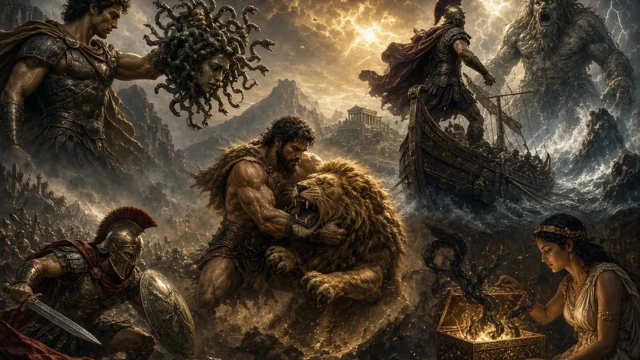
Greek mythology extends far beyond the gods on Olympus. Perseus encounters Medusa, a mortal member of the Gorgon sisters, and receives help from Athena and Hermes in later accounts of his quest. Heracles, known in Roman tradition as Hercules, undertakes extraordinary labours involving creatures such as the Nemean Lion and the Hydra. Theseus enters a labyrinth to confront the Minotaur, while Achilles faces a choice between long life and lasting fame in the Trojan tradition. These figures are not interchangeable: each belongs to a distinct set of stories, relationships and source texts.
Odysseus is known for endurance and resourcefulness as he tries to return to Ithaca. His journey brings him near the Cyclops Polyphemus, the enchantress Circe and the dangerous Sirens. Other memorable narratives include Pandora’s jar, Prometheus stealing fire and Icarus flying with wings fashioned by Daedalus. These episodes can be read as stories about curiosity, pride, ingenuity or loss, but a moral interpretation is not always the same thing as what the oldest surviving version explicitly says.
Greek and Roman mythology: similar characters, different sources
Many familiar Roman names correspond to Greek deities: Zeus is usually paired with Jupiter, Hera with Juno, Poseidon with Neptune, Athena with Minerva, Aphrodite with Venus and Ares with Mars. Heracles is the Greek form of the name commonly rendered Hercules in Roman tradition. Such pairings help a beginner follow books and films, yet they do not make ancient Greek and Roman cults identical. Roman authors often used their own cultural setting, interests and vocabulary when retelling or adapting Greek material.
One example is Medusa: the surviving early Greek account in Hesiod and the transformation narrative told by the Roman poet Ovid are not the same origin story. Another is the popular image of Achilles being invulnerable except at his heel: that detail does not appear in Homer’s Iliad as the familiar later story tells it. These differences are reasons to name sources precisely rather than present a smooth, invented “official” version.
What can Greek myths tell us today?
Greek myths continue to influence fiction, drama, painting, games and everyday expressions. “Achilles’ heel” names a point of weakness; “Pandora’s box” suggests a decision that brings unexpected troubles, although the original Greek object was a storage jar or pithos. Stories about Sisyphus or Narcissus also travel into philosophy and psychology through later interpretation. However, popularity does not prove ancient stories literally occurred or establish a universal lesson. Their value often lies in how different readers debate the characters’ decisions.
For Indian readers, a respectful comparison can highlight shared narrative questions—divine authority, cosmic order, heroic duty and the afterlife—while preserving the distinctive texts and religious contexts of each tradition. Zeus and Indra share certain thunder and kingship themes, but that does not demonstrate that they are the same deity. Our existing Greek vs Hindu mythology comparison discusses similarities and important limits in greater depth. The best next step is to explore an individual Greek character or a specific version of one famous story.
Five frequently asked questions
Is Greek mythology a true historical record?
No. These are traditional narratives and religious-literary materials. Researchers can study the surviving texts, art and historical practice, but the supernatural events are not established historical facts.
Who is the king of Greek gods?
Zeus holds kingship over the Olympian gods in the familiar Hesiodic and Homeric tradition, especially after the succession struggles against the Titans.
Which books introduce Greek mythology?
Begin with a reliable translation of Hesiod’s Theogony, then selected stories in Homer’s Iliad and Odyssey. A guided reference can help explain unfamiliar names without pretending every version agrees.
Are Greek and Roman gods the same?
Many are identified with counterparts, but their worship, stories and literary emphasis can differ. A text by Ovid is not automatically an early Greek source.
Is Hades one of the twelve Olympians?
Hades belongs to the same divine family, yet he rules the underworld and normally falls outside the canonical group of twelve Olympians living on Olympus.
Sources and conclusion
Read the ancient texts and reference guides alongside any modern retelling: Hesiod’s Theogony, Perseus Digital Library, and Encyclopaedia Britannica’s Greek mythology overview. Conclusion: start with the ancient source, identify the characters, then follow the story with its variations in view. Updated 14 November 2026. Illustrations are artistic interpretations, not archaeological evidence.




Share Your Opinion
Comments are closed on this post.