 Vista
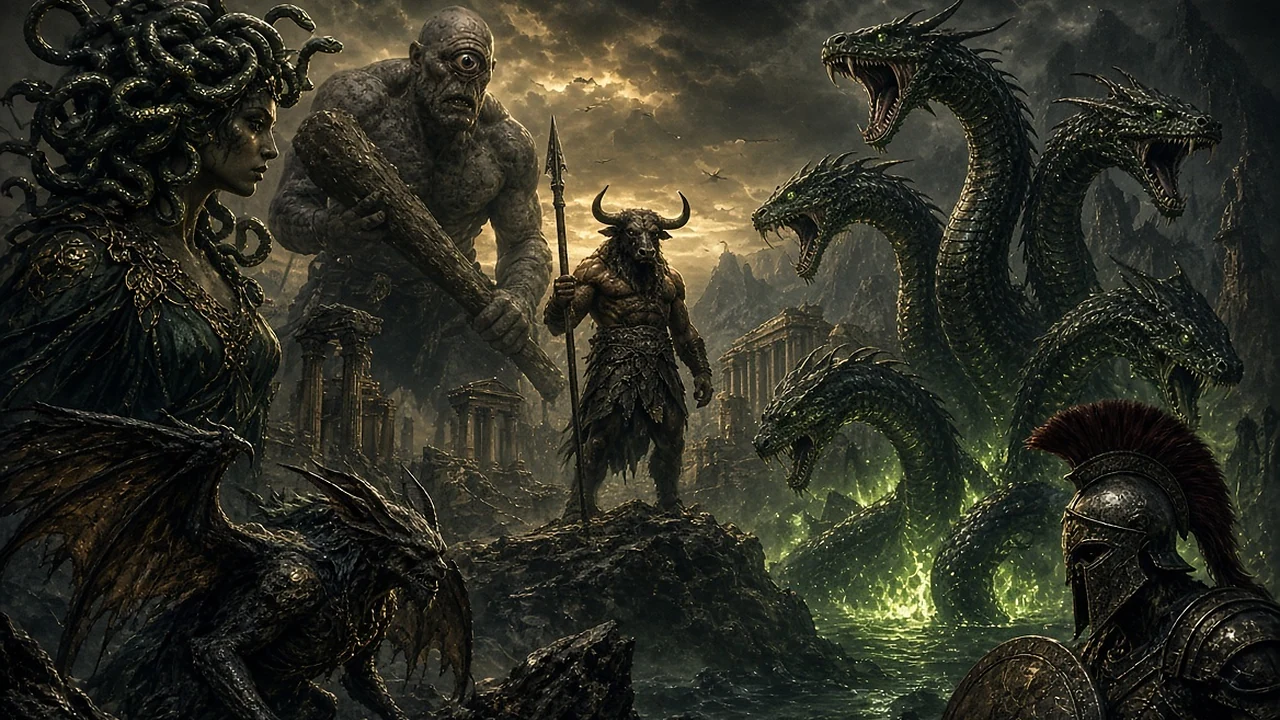
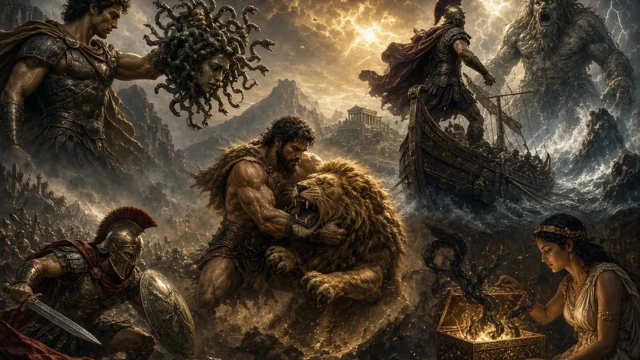
Greek mythology monsters include the snake-haired Medusa, the many-headed Hydra, the bull-headed Minotaur, the fearsome Chimera and Cerberus, the hound guarding the underworld. Ancient stories also feature Cyclopes, Sirens, Scylla, the Sphinx, Typhon and numerous other extraordinary beings. They are not all identical “evil monsters”: some guard sacred places, some are dangerous opponents in heroic quests, and others possess mixed or even helpful qualities. Their appearances and family connections can vary among Homer, Hesiod, Apollodorus and later writers. This guide identifies the major creatures, the heroes who encounter them and the source traditions behind their most famous scenes.
What counts as a monster in Greek mythology?
The ancient Greek imagination contains many beings that do not fit modern categories. A Gorgon may have terrifying animal features and a supernatural gaze; a Cyclops is a one-eyed giant; a centaur combines human and horse anatomy; and a Siren can have a birdlike form in early art despite later mermaid imagery. A monstrous appearance does not by itself give every creature the same origin, personality or moral role. Some are offspring of gods or primordial figures, while others belong to local traditions.
For reliable details, the Theogony of Hesiod offers important genealogies, Homer presents monsters within epic journeys, and the Library of Apollodorus collects many heroic episodes. Roman retellings and modern films add further layers. When two sources disagree on the number of heads or the appearance of wings, the responsible approach is to name the version rather than claim that a fantasy illustration has established the real anatomy of an extinct animal. Mythological creatures are part of literature and religion, not documented zoological species.
1. Medusa and the Gorgons — a deadly gaze
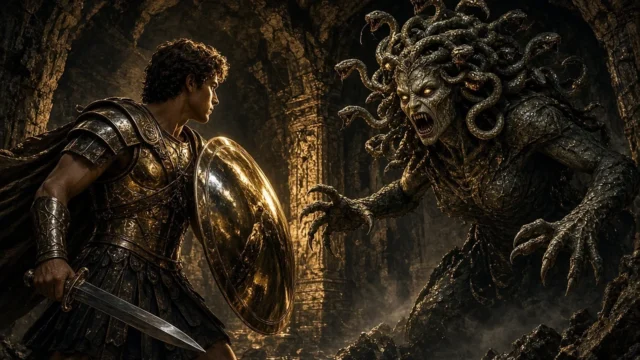
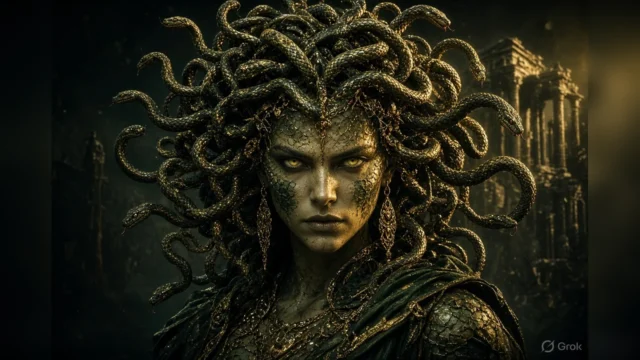
Medusa is one of three Gorgon sisters: Stheno, Euryale and Medusa. In Hesiod’s genealogy, Medusa is the mortal sister, which makes the encounter with Perseus possible. Later developed stories describe Gorgons with serpent-like hair and a gaze that petrifies those who look at them. Perseus avoids seeing her directly by using the reflection in a shield in Apollodorus’s account, then beheads her while her sisters sleep.
Early Greek texts do not all describe Medusa as a beautiful woman transformed after a curse. The famous temple incident appears in the later Roman poet Ovid, and should be separated from Hesiod’s account. In the monster catalog, the Gorgons’ key role is the deadly threat to the hero. The separate Medusa origin and Perseus-quest articles can explore the competing texts and full narrative without repeating every detail here.
2. The Lernaean Hydra — regrowing heads
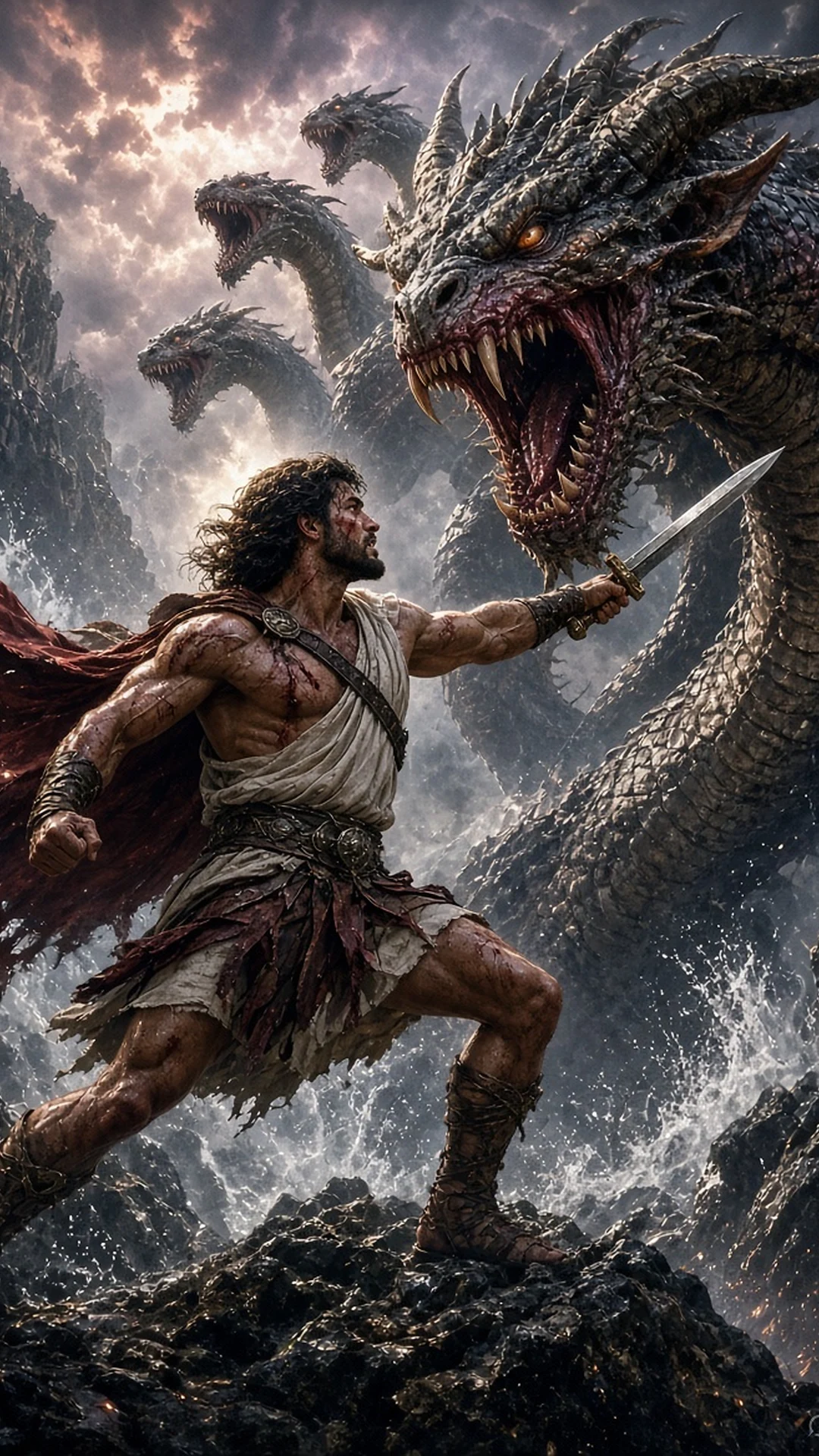
The Hydra lives near Lerna and is one of the most dangerous opponents of Heracles, also called Hercules in Roman-influenced English. Its heads regrow when cut, making an ordinary attack ineffective. In Apollodorus, Iolaus, Heracles’s nephew, helps cauterize the necks with fire so that new heads cannot emerge. The hero secures the immortal head, but Eurystheus later disputes whether the labour counts because Heracles accepted help.
Retellings disagree on the exact number of heads; the defining narrative point is the multiplying danger. A poster showing precisely nine heads may represent a particular conventional image, not a universal ancient anatomical fact. The Hydra illustrates how mythic challenges often demand new methods: cutting blindly makes the problem grow, while cooperation and strategy change the outcome.
3. The Minotaur — half bull, half human in the labyrinth
The Minotaur is usually described as having the body of a human and the head of a bull. It is connected to King Minos, Pasiphaë and the extraordinary Cretan Bull in the myths of Crete. Minos has the creature confined in the Labyrinth, a complex maze associated with the craftsman Daedalus. In a famous story, young Athenians are sent as tribute, and Theseus enters the maze to kill the creature.
Ariadne, daughter of Minos, helps Theseus leave the labyrinth by giving him a thread. Thus the legend is not only about a strong hero defeating a terrifying being; the escape route is essential. The Minotaur is not the same animal as the Cretan Bull caught by Heracles in a separate labour. Those two stories share a Cretan setting but contain distinct characters and different narrative functions.
4. Cerberus — guardian of the underworld
Cerberus, also spelled Kerberos, is the formidable hound guarding the realm of the dead ruled by Hades. The familiar form has three heads, although ancient descriptions and artistic depictions can differ, including additional serpent-like features. His task concerns the boundary between the dead and living. It is more accurate to call him a guardian than to portray him as the ruler of the underworld or the personification of death.
For his final labour, Heracles descends into Hades’s realm to bring Cerberus to Eurystheus and later returns the hound. This extraordinary feat is a defining moment in the labours, but it is not evidence that a real three-headed dog existed. Cerberus’s appearance makes an attractive artistic subject because a single figure can express the danger of crossing into the world of the dead.
5. Chimera — a lion, goat and serpent together
The Chimera or Chimaera is a composite fire-breathing creature, usually depicted with a lion’s body or head, a goat’s component and a snake or dragon tail. The exact arrangement varies by writer and artist. Its most famous opponent is the hero Bellerophon, who is associated with riding the winged horse Pegasus. In the familiar narrative, Bellerophon approaches from the air and defeats the monster.
The Chimera’s appearance is the origin of the English word chimeric for something fantastical or composed of unlikely parts. It should not be confused with the Hydra, whose heads regrow, or with Typhon, a separate primordial adversary of Zeus. The difference in shape matters to educational images: using a many-headed snake picture for the Chimera would muddle two distinct legends.
6. Cyclopes — not all one-eyed giants are the same
The singular is Cyclops and plural Cyclopes. Homer’s Polyphemus is the one-eyed giant who traps Odysseus’s crew in a cave and eats several sailors. Odysseus blinds him, escapes beneath sheep and then reveals his identity, prompting Polyphemus to appeal for revenge from his father Poseidon. This episode comes from Odyssey Book 9 and focuses on hospitality, cunning and the cost of boasting.
Hesiod describes another important group of Cyclopes associated with early divine generations and with providing thunder and lightning to Zeus. These should not be treated as a single identical group of shepherds from Polyphemus’s island. A beginner who learns that all Cyclopes must be cruel cannibals misses a major role they play in the succession and weapons of the Olympian gods.
7. Sirens — the voices that endangered sailors
In the Odyssey, the Sirens sing with such irresistible allure that sailors risk destruction by listening. Odysseus wants to hear them but protects the ship by putting wax in the crew’s ears and having himself tied firmly to the mast. The story distinguishes curiosity from preparation: Odysseus may listen only because he arranges not to act on the temptation. Later texts and modern art often picture Sirens as fish-tailed mermaids.
Early Greek artistic traditions commonly show bird-women instead. It is therefore misleading to declare that the Homeric Sirens were certainly identical to the modern Disney-style mermaid. The creature’s signature in the epic is its dangerous voice, not an unchanging set of anatomical features. This is an important note for readers interested in authentic Greek-myth-inspired wallpapers or visual projects.
8. Scylla and Charybdis — danger on both sides
On Odysseus’s voyage, Scylla and Charybdis lie near a narrow route at sea. Scylla is a monstrous being associated with multiple heads or necks and a threat to passing sailors. Charybdis is a terrifying swallowing and expelling force in the water, commonly represented as a whirlpool. The navigator must choose between hazards rather than discover a magically risk-free path. The episode has become a metaphor for choosing between two serious dangers.
It is not necessary to present Charybdis as a human-shaped monster in the oldest Homeric story; the key role is the dangerous water. Several later authors give new genealogies or visual descriptions for Scylla. Comparing these accounts demonstrates how the same narrative place can gather different mythic explanations while preserving the original theme of a difficult choice.
9. The Sphinx — a monster defeated by an answer
The Greek Sphinx is famously associated with Thebes and the hero Oedipus. She is portrayed with composite features, commonly a human head, lion’s body and wings. Her challenge is a riddle, whose familiar form asks about a creature that travels on four legs in the morning, two at noon and three in the evening. Oedipus identifies the answer as a human being, recognizing the metaphor of infancy, adulthood and old age.
The victory differs from Heracles wrestling a lion or Bellerophon fighting the Chimera. Here understanding a question is the decisive force. Ancient variants preserve different wording and circumstances, and Greek depictions of the Sphinx should also be distinguished from the different historical and artistic traditions of Egyptian sphinx imagery. The shared term does not make every monument or myth identical.
10. Typhon and Echidna — ancestors of monsters
Typhon (Typhoeus) is a colossal and terrifying opponent of Zeus in Hesiod’s Theogony. In important genealogical traditions he is linked with Echidna, a creature combining a woman’s upper body with a serpent-like lower form, and with the ancestry of several famous monsters. Parentage varies between sources, so a single neat monster family tree should clearly name the writer on which it relies.
Typhon is not simply another member of the twelve Olympians or a synonym for the Giants of a different conflict. His scale makes him relevant to stories about how Zeus establishes and defends cosmic order. Echidna’s role explains why diverse monsters share relationships in some genealogies, although modern lists sometimes overstate exactly which creature descended from which parent. The most reliable approach is to start with Hesiod and note variants instead of filling every missing link.
11. Nemean Lion, Stymphalian Birds and other labours
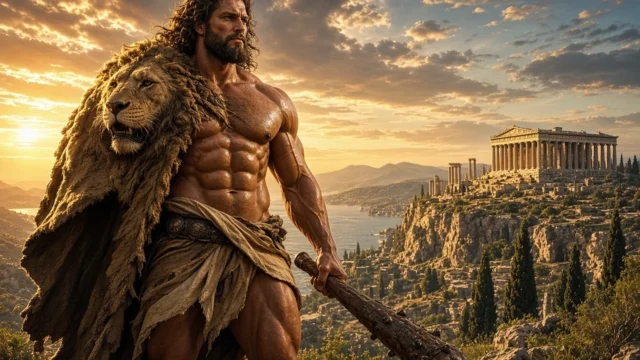
Several creatures appear as part of Heracles’s twelve labours. The Nemean Lion has a hide that resists ordinary weapons and must be overcome through close struggle. The Stymphalian Birds threaten a region around a lake and require a different approach involving noise, flight and archery in traditional accounts. The Cretan Bull and the boar of Erymanthus are formidable animals that Heracles must capture, rather than simply kill.
These tasks show why grouping all mythical animals under “monsters” is useful for a reader but imperfect academically. Some are supernatural hybrids, others extraordinary beasts or sacred animals whose appearance may be close to real species but whose narrative qualities are impossible. They play different roles in the hero’s trials. In particular, a Ceryneian Hind sacred to Artemis should not automatically be treated as an evil creature because a hero was ordered to capture it.
12. Centaurs, Harpies and the guardian dragon
Centaurs combine human and horse features in Greek art and literature. Some appear as dangerous or disorderly figures, but Chiron is celebrated as a wise teacher and healer. He demonstrates why body shape cannot determine whether a mythological creature is morally good or bad. Harpies are winged figures connected with snatching or tormenting in particular adventures; later stories give varying appearances and relationships.
A dragon or giant serpent guards the Golden Fleece in the story of Jason and the Argonauts, while another protects the golden apples of the Hesperides. These guardians belong to different quests and should not be swapped simply because both are large snake-like creatures. In a source-based creature list, the exact mythical setting is as important as the visual silhouette. That is why this catalog names the relevant heroes and separates the major story cycles.

Quick Greek monsters chart: creature, hero and story
| Creature | Distinctive feature | Hero or setting |
|---|---|---|
| Medusa | Gorgon with petrifying gaze | Perseus |
| Hydra | Regrowing heads | Heracles, Iolaus |
| Minotaur | Bull-headed humanoid | Theseus, Cretan labyrinth |
| Cerberus | Underworld guardian hound | Heracles, Hades |
| Chimera | Lion, goat, serpent composite | Bellerophon, Pegasus |
| Cyclops Polyphemus | One-eyed giant | Odysseus |
| Sirens | Irresistible song | Odysseus |
| Scylla and Charybdis | Sea hazard and swallowing water | Odysseus |
| Sphinx | Composite figure with riddle | Oedipus |
| Typhon | Colossal foe of Olympian rule | Zeus |
| Golden-Fleece dragon | Serpent guarding a prized object | Jason and the Argonauts |
Are Greek monsters based on real animals?
Some myths may use recognizable animal features—lions, snakes, birds, horses or bulls—but there is no scientific evidence that creatures such as Medusa or the multi-headed Hydra existed with the supernatural powers ascribed to them. Artistic traditions explain why a mixture of familiar forms can create an extraordinary figure. Historians can study objects, texts and cult practices; biologists identify actual species through physical evidence. Both approaches are useful when their questions are kept distinct.
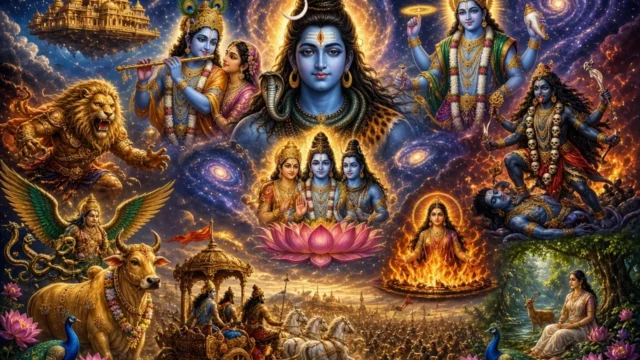
For readers comparing Greek and Indian traditions, both contain powerful mixed-form beings, but visual resemblance alone cannot establish identical origin, theology or history. Our already published Greek vs Hindu mythology guide explores broader parallels cautiously. There is no need to label every Greek creature an “asura” or map each one to a specific Indian figure.
Greek mythology monsters: FAQs
What are the most famous Greek mythology monsters?
Medusa, Hydra, Minotaur, Cerberus, Chimera, Cyclops, Sirens, Scylla, Sphinx and Typhon are among the best known.
Which hero defeated the Minotaur?
Theseus, assisted by Ariadne’s thread, in the Cretan labyrinth.
Did Hercules kill the Hydra alone?
In Apollodorus’s account he was helped by Iolaus, and that assistance mattered when the labour was judged.
Are Greek Sirens mermaids?
Sirens are known for dangerous song and often appear as bird-women in early art; fish-tailed images are later developments.
Is Cerberus the god of death?
No. Cerberus is the guardian hound of the underworld. Hades rules that realm, while Thanatos represents death in another role.
Ancient sources and conclusion
For ancestry use Hesiod, Theogony; for the labours and the Minotaur consult Apollodorus, Library Book 2 and Book 3; for epic sea creatures see Homer, Odyssey Book 12; and compare the Theoi Greek mythology bestiary. Conclusion: Greek monsters are a remarkably varied set of threats, guardians and wondrous beings. Reading each with its hero and original source makes the creatures more interesting and prevents the same fantasy picture from replacing every ancient tale. Updated 14 November 2026. Posters are imagined art.



Share Your Opinion
Comments are closed on this post.