 Vista

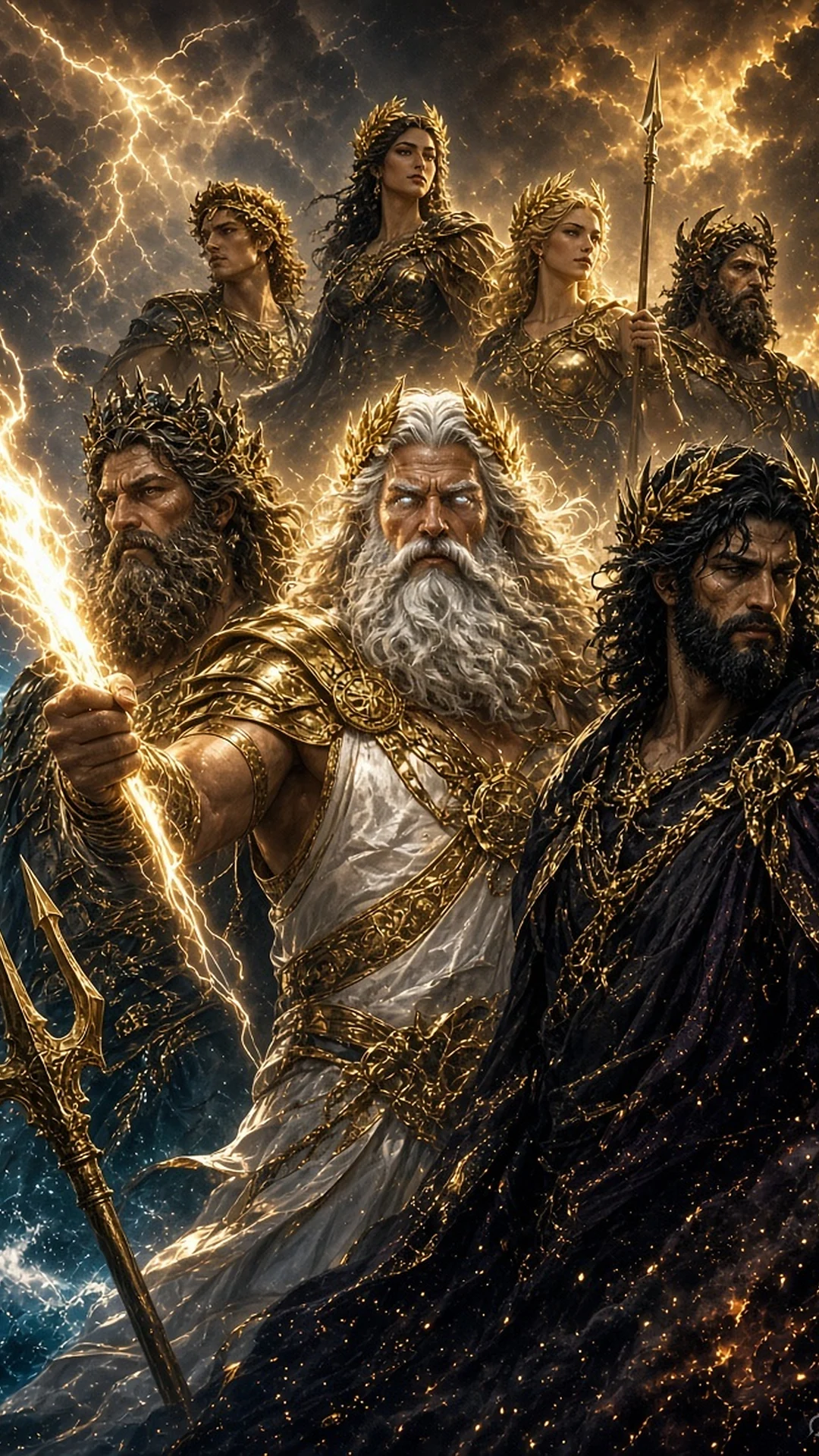
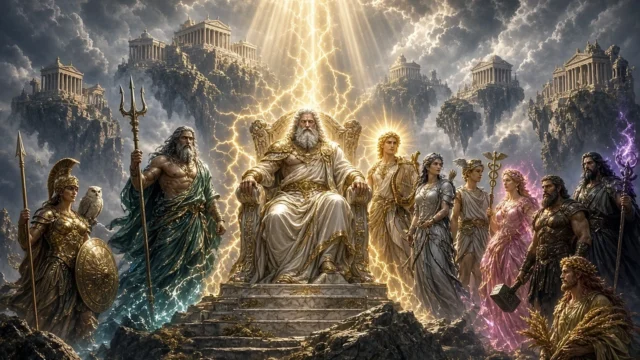
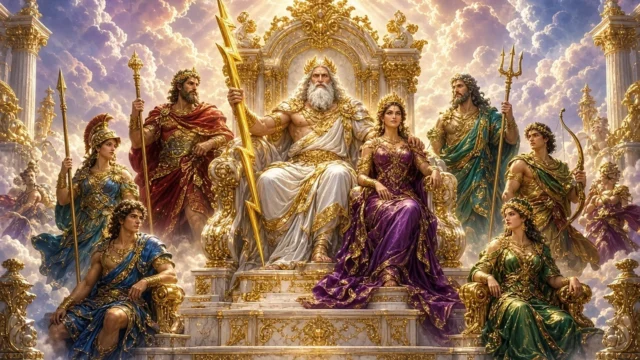
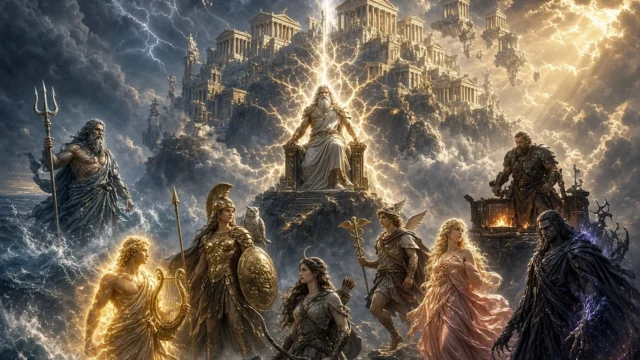
Who is the most powerful Greek god? In the familiar Olympian order, Zeus has the strongest claim to supreme kingship after the struggle with the Titans. However, ancient Greek mythology does not provide an official top-ten ranking with measurable power levels. Poseidon rules the sea, Hades governs the underworld, Athena excels in strategy and Apollo commands prophecy and other formidable abilities. A useful comparison must therefore distinguish overall authority, command of a particular domain, influence over mortals, and extraordinary feats. This guide offers a transparent, interpretive list rather than pretending Homer or Hesiod published a universal leaderboard of the gods.
How can we compare the strongest Greek gods fairly?
Modern searches for “most powerful Greek gods ranked” often mix a film character’s strength, a video-game ability and an ancient literary claim. These are different kinds of evidence. Hesiod’s Theogony tells of generations of gods and Zeus’s eventual rule; Homer’s Iliad shows deities in argument and conflict; the Odyssey and Homeric Hymns emphasize different aspects of divine power. No one poem offers a numerical ranking assigning every deity a score for speed, damage or magical energy.
We will therefore compare four things: who exercises supreme authority; what sphere each god controls; how they act in memorable stories; and how much their influence depends on a particular source. The order below is an editorial explanation organized around those criteria, not a claim that Athena must always defeat Ares in every conceivable duel. Local religious practice can elevate a different god’s importance for a particular community without overthrowing Zeus’s central role in the familiar epic genealogy.
1. Zeus — the strongest claim to overall Olympian authority
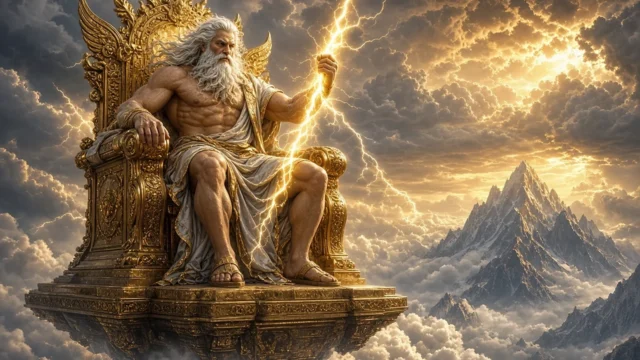
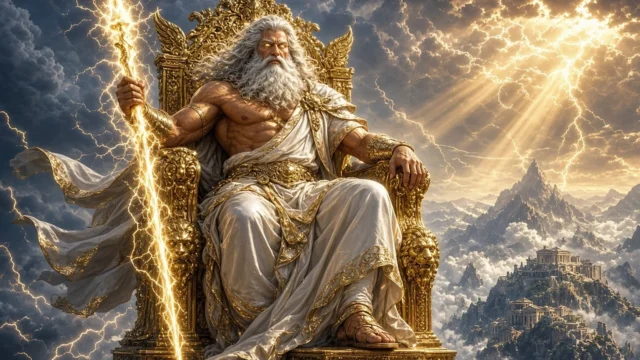
Zeus is the son of Cronus and Rhea and becomes ruler after the succession struggle against the Titans. Hesiod describes his alliance with powerful older beings, including the Hundred-Handers and Cyclopes; the latter are associated with the thunder and lightning that become his signature weapons. The victory establishes the new order. Zeus appears as the king to whom other gods make arguments and against whose wishes they sometimes act. That position gives him a convincing claim to supreme Olympian authority, even if every source does not narrate his power in precisely the same way.
His powers include storm and sky imagery, the thunderbolt, authority over oaths and aspects of justice. In the Iliad, he can press a major claim to strength and leadership, though other gods dispute his decisions. It would be an exaggeration to say Zeus creates every deity or controls every narrative outcome without difficulty; his own story begins with a prophecy that threatened him as an infant. His greatness emerges through conflict, family relationships and political alliances, not merely a bigger weapon.
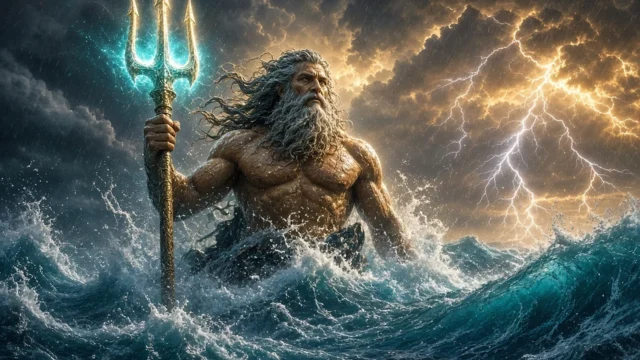
2. Poseidon — unparalleled command of the sea and earthquakes
Poseidon is Zeus’s brother and the ruler of the sea. The Iliad describes the three divine brothers’ allocation of domains, and Poseidon insists that his portion grants substantial honor. His trident is widely recognized, and he is known as an earth-shaker because earthquakes are among his traditional associations. In the Odyssey, his anger toward Odysseus becomes a serious obstacle, extending a hero’s journey over years of danger.
Poseidon is therefore one of the most powerful gods within a particular field: marine travel, waves, seafaring and ground-shaking force. The comparison with Zeus depends on the question asked. In the familiar order Zeus holds kingship, while Poseidon’s authority over the sea is significant and not merely symbolic. A generic statement that one could always destroy the other ignores both the literary context and Poseidon’s insistence on the share obtained through the divine allotment.
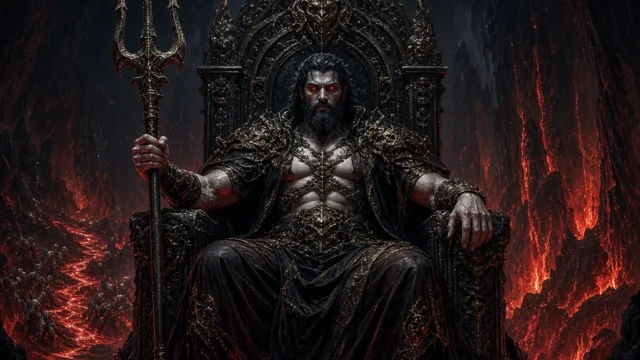
3. Hades — ruler of the underworld, not the god of evil
Hades shares the same parents as Zeus and Poseidon and receives rule over the realm of the dead. That domain is immense: it concerns the boundary separating the living from the departed and is the setting for stories involving Persephone, Heracles, Orpheus and Odysseus. The head of Cerberus and the invisibility cap associated with Hades are familiar images, but those symbols do not define all his authority. His world is complicated and varies in the descriptions of different ancient authors.
Hades normally does not appear in the fixed popular roster of twelve resident Olympians because his domain lies beneath the earth, but that does not make him unimportant. He is not the Greek version of the Christian Satan. Ranking him as simply weaker than all the Olympians because he lives below would be a category error: where a god rules is not identical to the extent of his authority. His position among the three divine brothers warrants separate consideration.
4. Athena — strategic power, intelligence and protection
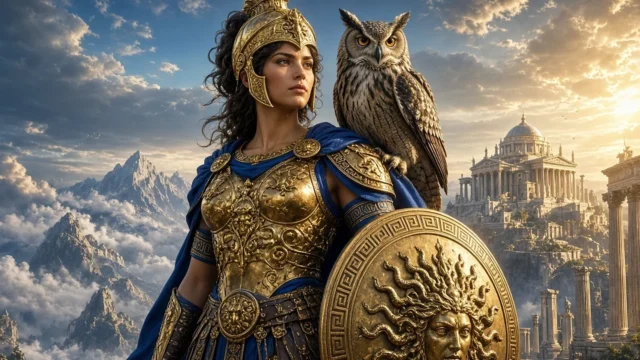
Athena has no need for an invented ability to split planets to be influential. She is goddess of wisdom, crafts, the protection of cities and strategic warfare. In Greek heroic narratives she guides Odysseus and assists Perseus. Her support can change the outcome of an adventure without requiring her to personally defeat every opponent. The owl, aegis and olive tree symbolize different dimensions of her identity.
In Homer, Athena and Ares are both connected with battle but differ in their portrayal. Athena represents planning and skill, while Ares is more associated with the furious violence of war. Calling Athena “more powerful” is reasonable only if the criterion is strategic effectiveness in episodes where she succeeds. It is not an eternal fact that the Greeks ranked her fourth or gave her a strength score higher than every other god. She shows why intelligence itself is a form of narrative power.
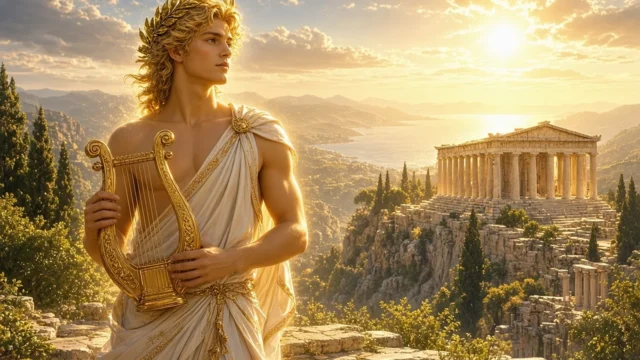
5. Apollo — prophecy, archery, healing and divine punishment
Apollo, son of Zeus and Leto, combines seemingly different domains: music, prophecy, healing, archery and the sending of disease in certain myths. The Iliad begins with a plague sent by Apollo after Agamemnon insults his priest Chryses. His shrine at Delphi makes him central to questions about oracles and religious decision-making. These capabilities extend beyond simple close-combat strength.
The link between Apollo and sunlight deserves care: Helios is a separate solar deity in important early Greek sources, while Apollo gains solar associations in later literary periods. A fantasy chart that lists “the power of the entire sun” for every appearance of Apollo would flatten those distinctions. His extraordinary power is most convincingly demonstrated by prophecy, the reach of his arrows and the influential religious institutions associated with his worship.
6. Hera and Demeter — power over marriage, kingship and harvest
Hera is queen of the Olympians, associated with marriage and royal authority. Her place is not determined only by her marriage to Zeus: she possesses an important sphere of worship and acts as a powerful agent in epic stories. She supports or opposes heroes, intervenes in divine disputes and sometimes acts against Zeus’s wishes. Her anger toward Heracles is central to versions of that hero’s sufferings. A list based only on battle weapons would miss her influence on whole narrative cycles.
Demeter has power that directly concerns human survival: grain, fertility of cultivated land and the productivity of agriculture. In the Homeric Hymn to Demeter, her grief and resistance over the loss of Persephone create a crisis for human crops, forcing a divine settlement. That episode makes her importance unmistakable. She is not automatically less consequential than a warrior god merely because she is represented with grain rather than a spear.
7. Artemis, Ares and Hephaestus — different strengths
Artemis, sister of Apollo, is associated with hunting, wild animals, youth and boundaries of the wilderness. Her bow expresses dangerous reach, and stories often portray severe consequences for those who violate her sanctity. Her importance to cult practice and to stories of nature and childbirth cannot be measured using combat scenes alone. She is not just Apollo with different clothes; their roles overlap in some areas but differ substantially.
Ares, god of violent war, is a son of Zeus and Hera in the familiar genealogy. His martial force matters in the Iliad, but the poem also shows him wounded and humiliated, making an undefeated warrior image inaccurate. Hephaestus, meanwhile, can forge astonishing armor and divine objects, including the shield of Achilles. His mastery of craft makes the other gods and heroes more powerful through technology and skill. Neither fits comfortably into a simple list based on who throws the biggest thunderbolt.
8. Aphrodite, Hermes and Dionysus — influence beyond weapons
Aphrodite is associated with love, desire and beauty. In the story cycle leading toward the Trojan War, her promise to Paris has consequences for kingdoms and armies. Her influence is not measured by physical force, and Hesiod and Homer differ over her divine parentage. Hermes shapes events through messaging, cunning, travel and guiding souls. He assists heroes and even mediates between gods who otherwise stand in conflict.
Dionysus is associated with wine, theatre, transformation and ecstatic ritual. In the tragedy Bacchae, associated with Euripides, the consequences of denying his divinity become devastating. This narrative power can overwhelm a human community without resembling Zeus’s weather control. All three deities show that influence over mortal behavior may be more consequential in a story than brute force, and their importance depends on the particular poem, play or cult tradition.
What about Cronus, Typhon, Gaia and Heracles?
Not every formidable mythic figure is a current Olympian. Cronus is the Titan father of Zeus who once held power before being overthrown. Gaia is a primordial embodiment of Earth and ancestor of major divine families. Typhon, or Typhoeus, is an enormous adversary of Zeus associated with a terrifying cosmic struggle. His might is described by Hesiod, but his presence as an enemy does not make him one of the reigning Olympian twelve.
Heracles is a heroic son of Zeus whose incredible labours and later apotheosis bring him near the divine order. Nevertheless, he starts as a hero with a mortal mother, not one of the original twelve. If we add Titans, Giants, heroes and primordial beings to the same numbered list, we must first decide whether we are ranking all mythical beings, all worshipped gods or the familiar Olympian group. Without that decision a “strongest god” article changes its rules mid-way through.
Comparison table: authority, domain and limitation
| Deity | Characteristic power | Important limitation of a ranking |
|---|---|---|
| Zeus | Olympian kingship, lightning, sky | Supreme authority is not identical to omnipotence |
| Poseidon | Sea, earthquakes, horses | Domain authority differs from overall kingship |
| Hades | Rule over the underworld | Not normally one of twelve resident Olympians |
| Athena | Wisdom and strategic warfare | Intelligence is not a numerical strength score |
| Apollo | Prophecy, music, archery, healing | Solar links vary across periods and texts |
| Demeter | Crops and agricultural life | Survival influence is not a combat feat |
| Hera | Marriage, queenly authority | Major divine influence beyond weapons |
| Artemis and Ares | Hunting and violent warfare | Different narrative and religious roles |
| Hephaestus | Divine craftsmanship | Creates tools used by others |
| Aphrodite, Hermes, Dionysus | Desire, cunning, transformation | Change events without a direct duel |
Is Zeus stronger than Poseidon or Hades?
If the question means “Who is the recognized ruler of Olympus after Titanomachy?” the answer is Zeus. If it means “Whose power matters most in the sea?” Poseidon is the relevant ruler. If it means “Who governs the dead?” Hades is the answer. A direct hypothetical fight has no single source-backed, universally binding result. Ancient poems may show temporary disputes, compromises and constraints, but not a game system that guarantees who wins every imagined battle.
This distinction also prevents careless comparison with Indian divinities. Zeus and Indra share limited thunder-related themes, but such parallels do not make their texts, worship or powers the same. For cultural context our published Greek vs Hindu mythology comparison discusses similarities with limits. This article remains focused on Greek evidence rather than made-up cross-religious strength battles.
FAQ: the most powerful Greek gods
Who is the strongest Greek god?
Zeus has the strongest claim to overall Olympian authority in the familiar Hesiodic and Homeric order, but “strongest” depends on the criterion.
Is Poseidon stronger than Zeus?
Poseidon has great authority over the sea, but Zeus is king of the Olympians. No universal numeric fight result is given in ancient texts.
Why is Hades powerful if he is not one of the twelve?
Hades governs the realm of the dead; absence from the resident Olympian list does not erase his cosmic domain.
Is Athena more powerful than Ares?
Some myths favor Athena’s strategic ability over Ares’s violence, but a fixed universal ranking is not an ancient doctrine.
Is Typhon a Greek god?
Typhon is a colossal mythic opponent of Zeus in Hesiod, not a member of the familiar ruling twelve Olympians.
Sources and conclusion
Consult Hesiod, Theogony for divine succession and Typhon; Homer, Iliad Book 15 for the divine brothers’ domains; Homeric Hymn to Demeter for Demeter’s influence; and Theoi’s Olympian gods overview. Conclusion: Zeus rules the Olympians, but different gods have extraordinary powers within their own spheres. Any numbered ranking is a modern interpretation, not an official ancient chart. Updated 14 November 2026. Visuals are conceptual artwork.







Share Your Opinion
Comments are closed on this post.