 Vista
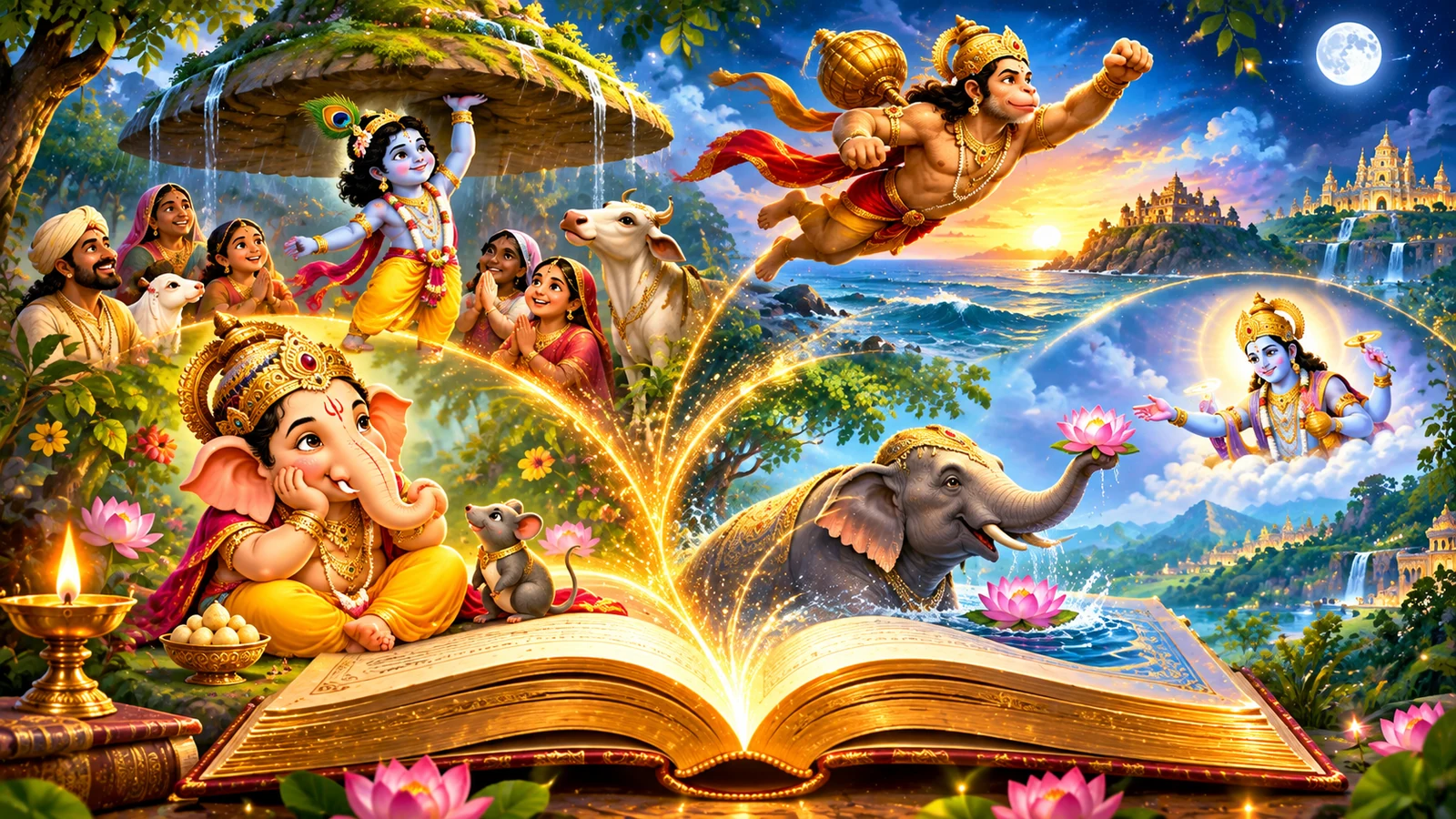
Looking for Indian mythology stories for kids in English that are short enough for bedtime but meaningful enough to remember? Start with these eight easy retellings. They feature Krishna, Hanuman, Ganesha, Dhruva, Gajendra, Vamana, Shabari and Sudama. Every story has a beginning, a challenge, a resolution and one simple conversation prompt. Most take about three to five minutes to read aloud.
These are original, child-friendly adaptations of traditional Hindu narratives, not translations of scripture or accounts proven by archaeology. Details differ across texts and communities. We identify the best-known source traditions and distinguish a later popular detail when it matters. You don’t need to believe every story literally to enjoy its lessons about friendship, humility, courage, generosity and kindness.
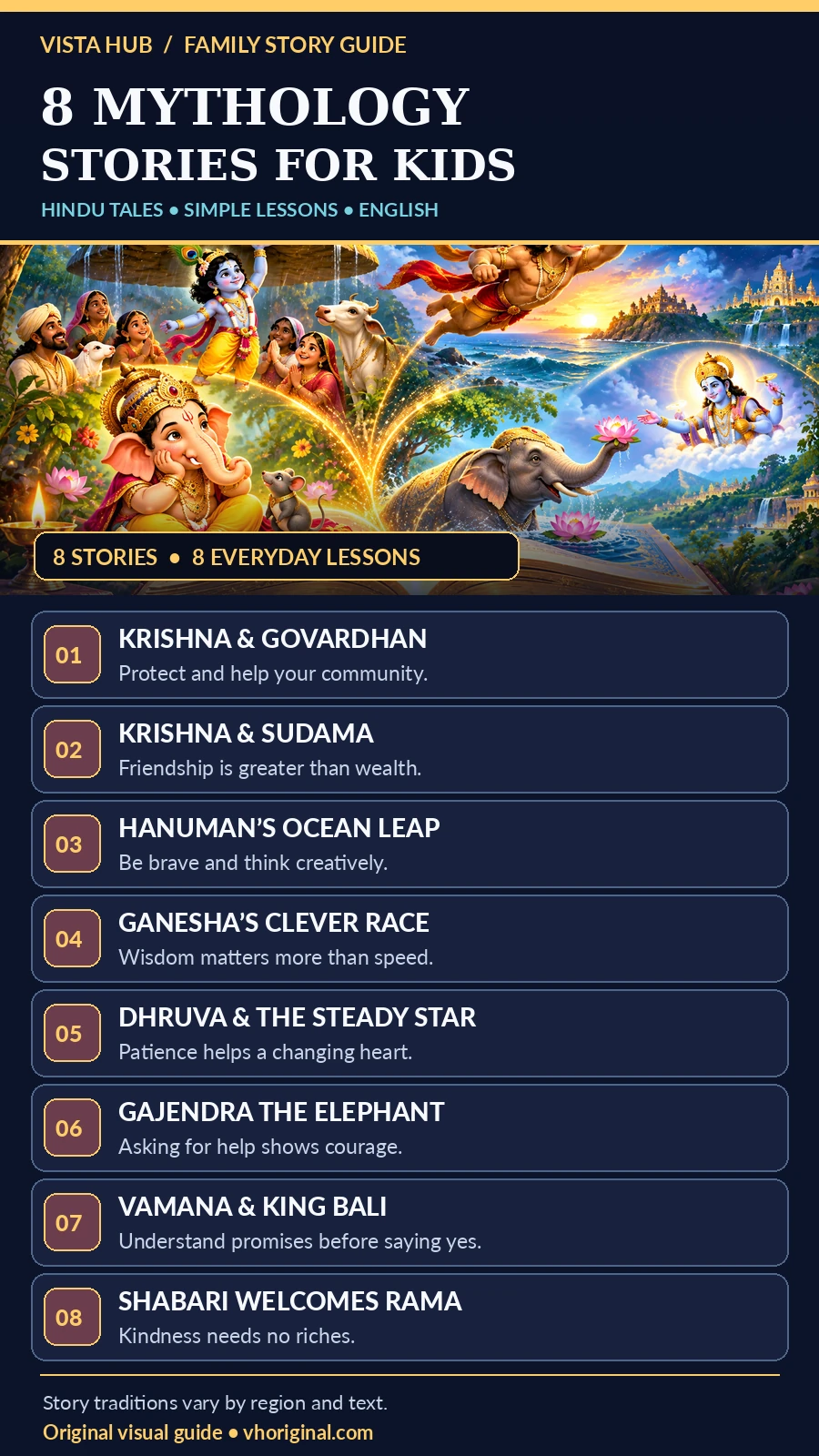
Quick Story Guide: Which One Should You Read Tonight?
| Story | Main character | Easy lesson | Approximate read-aloud time |
|---|---|---|---|
| Krishna and Govardhan Hill | Krishna | Protect others; work together | 3–4 minutes |
| Sudama Visits Krishna | Sudama and Krishna | True friends care, not compare | 3 minutes |
| Hanuman’s Ocean Leap | Hanuman | Courage plus clever thinking | 3–4 minutes |
| Ganesha’s Clever Race | Ganesha and Kartikeya | Wisdom matters more than speed | 3 minutes |
| Dhruva and the Steady Star | Dhruva | Patience and a changing heart | 3–4 minutes |
| Gajendra Calls for Help | Gajendra the elephant | Asking for help is brave | 3 minutes |
| Vamana and King Bali | Vamana and Bali | Keep promises thoughtfully | 3–4 minutes |
| Shabari Welcomes Rama | Shabari and Rama | Welcome everyone with respect | 3 minutes |
1. Krishna and Govardhan Hill: The Mountain That Became a Shelter
In a village surrounded by green fields, families looked after their cows and prepared a festival. Young Krishna noticed that everyone was worried about pleasing a powerful rain god. He asked a simple question: why not also thank the hill, forests, cows and land that helped the village live?
The villagers listened. But, according to the story in the Bhagavata Purana, Indra grew angry and sent heavy rain toward the community. Clouds covered the sky. Water ran through the paths, and the frightened villagers gathered their children and animals.
Krishna did not tell them to run off alone. Instead, the story says, he lifted Govardhan Hill and held it like a vast umbrella. Families, calves and neighbors found shelter together beneath it. The storm continued, but their fear slowly eased. When Indra finally understood his pride, the rain stopped.
Afterwards, imagine the village returning home: wet sandals, relieved smiles, cows calling, and neighbors helping one another clean their doorways. The most memorable part isn’t just the magical mountain. It is the picture of a whole community protected together.
Moral: When trouble comes, protect one another and remember the people and natural world that support you.
Ask a child: What could you do if a neighbor needed help during heavy rain?
Tradition: Srimad Bhagavatam, Book 10, chapter 25. The hill-lifting is a devotional narrative, not a geological event established by science.
2. Krishna and Sudama: A Small Gift and a Big Friendship
Once, two boys studied together under the same teacher. One was Krishna; the other, remembered in popular tellings as Sudama or Kuchela. Years passed. Krishna became a ruler in Dvaraka, while his friend lived with very little.
Sudama wanted to see Krishna again but felt awkward. What gift could he take to a royal palace? His household managed to put together a small bundle of flattened rice. It looked tiny beside the treasures of a king, yet Sudama carried it carefully.
At the palace, Krishna recognized his old friend. He welcomed Sudama warmly and treated him as an honored guest, not as someone less important because of his plain clothing. Sudama felt so happy that he hardly knew how to ask for assistance. Krishna noticed the modest rice and accepted it with affection.
Sudama returned home with memories of laughter, kindness and the feeling of being understood. In the devotional tale, he also discovers that his family’s circumstances have changed for the better. The heart of the story, however, is simpler than a miraculous reward: the friend with a little gift is still worthy of a great welcome.
Moral: Friendship is measured by care and respect, not wealth or expensive presents.
Ask a child: How would you make a friend feel welcome if they arrived without a gift?
Tradition: Bhagavata Purana 10.80–81. Specific names and details vary in regional retellings.
3. Hanuman’s Ocean Leap: A Brave Journey with Clever Choices
Rama and his friends were searching for Sita. Across a huge sea lay Lanka, and someone needed to cross the water to find news of her. Hanuman had great strength, but the size of the ocean looked daunting even to the strongest traveler.
His companions reminded him of his abilities and his mission. Hanuman gathered his courage, stood upon a mountain and leapt into the sky. Below him, waves rolled like moving hills. Above him, clouds streamed past.
Soon a friendly mountain named Mainaka rose from the water to offer rest. Hanuman thanked him, but explained that the task was too important to delay. Next came Surasa, who tested him by opening a huge mouth in his path. Instead of trying to win by becoming bigger and bigger forever, Hanuman suddenly made himself tiny, slipped through and continued. He combined courage with imagination.
The crossing involved other danger in the epic, but for a young listener we can keep our attention on his safe arrival. At last the distant shore appeared. Hanuman had not crossed merely to show off: he had traveled because another person needed help.
Moral: A brave person thinks carefully, accepts support and remembers the reason for the journey.
Ask a child: When is being clever more useful than being strong?
Tradition: Valmiki Ramayana, Sundara Kanda, opening sarga. This version softens dangerous encounters for younger readers.
4. Ganesha’s Clever Race: The World Can Be Close to Home
A popular story tells of two brothers, Ganesha and Kartikeya, who were offered a challenge: travel around the world. Kartikeya was swift and ready for a long adventure. He set off eagerly, expecting that speed would win.
Ganesha looked at the enormous world. Mountains, rivers, fields and oceans stretched farther than he could see. He could have rushed off immediately. Instead, he considered what the journey might mean. He approached Shiva and Parvati, his parents, and walked respectfully around them.
Why would he do that? In this telling, Ganesha explains that his parents are his whole world because they have loved, taught and cared for him. He has completed his journey in a different way. The parents appreciate his understanding. Some versions speak of a reward connected with marriage; in South Indian family and temple traditions a fruit of wisdom becomes the prize.
The story doesn’t mean that travel, sport or Kartikeya’s determination is foolish. It gently suggests that the fastest answer isn’t always the wisest, and that people at home should not be taken for granted.
Moral: Think about what a challenge really asks; cherish those who care for you.
Ask a child: Can two people solve the same problem in different, sensible ways?
Tradition: Shiva Purana, Rudra Samhita, Kumara Khanda, chapters 19–20, with related regional variants. The fruit-of-wisdom form belongs particularly to later South Indian traditions.
5. Dhruva and the Steady Star: A Child Learns Patience
Dhruva was a young prince who felt deeply hurt when he thought he did not belong beside his father. Adults around him were caught in arguments and favoritism, and the child could not understand why affection seemed unfair.
His mother, Suniti, helped him search for a more steady source of hope. Dhruva left to seek Vishnu. Along the way, the wise Narada guided him toward reflection and discipline. In traditional tellings his practice is intense; that is not an instruction for children to leave home, fast or perform severe austerities.
Imagine a kinder adaptation for family reading: every morning, Dhruva notices his restless thoughts, breathes slowly, remembers what he values and grows a little more patient. Over time his wish changes. Instead of thinking only about how to gain a place above someone else, he begins to care about inner peace and devotion.
In the sacred narrative Vishnu appears and Dhruva becomes associated with the fixed star, Dhruvaloka, a symbol of steadfastness. The star in the sky gives listeners a memorable image: something steady amid the movement around it.
Moral: Hurt feelings deserve compassion, and patience can help us choose a better response.
Ask a child: Who is a trusted adult you can talk to when you feel left out?
Tradition: Bhagavata Purana 4.8–12; the simple breathing example above is a modern teaching analogy, not a quote from the text.
6. Gajendra the Elephant: It Is Brave to Ask for Help
In a forest beside a lake lived a mighty elephant named Gajendra. One day he entered the water with his herd. The lake looked peaceful, full of lilies and cool water. Then a crocodile caught him, and the elephant struggled to get free.
Gajendra tried to use his strength. The longer he struggled, the more tired he became. His companions could not solve the problem for him. For a story read to young children, there is no need to dwell on the frightening details. What matters is the moment when the strong elephant realized that strength alone was not enough.
He remembered the divine and prayed for help. In the Bhagavata Purana, Vishnu hears his appeal and rescues him. The frightened herd is able to breathe again. In the story’s devotional meaning, calling sincerely for help is an act of trust, not weakness.
For real life, adults can connect this tale to practical safety: if you are caught in danger, shout for a responsible adult, lifeguard or emergency service and follow safety instructions. Never enter deep water to act out the story.
Moral: Everyone sometimes needs help, including the strongest person in the room.
Ask a child: What words would you use to ask a trusted grown-up for help quickly?
Tradition: Bhagavata Purana 8.2–4. The story includes stronger conflict in the original; this retelling is deliberately gentle.
7. Vamana and King Bali: A Promise of Three Steps
King Bali was famous for giving gifts to visitors. One day a small visitor named Vamana came to him and asked for something surprising: just as much land as he could measure in three steps.
Bali was amused. Why ask for only three steps when a generous king could offer far more? He agreed. Then, in the sacred tale, Vamana revealed an immense cosmic form. One step crossed the earth; another reached the heavens. There was nowhere left for the third.
What would Bali do now? He had spoken a promise, but the request was far greater than he imagined. Rather than pretend that he never made it, Bali bowed his head and offered that as the place for the final step. In the story, his steadfastness becomes central to his relationship with Vishnu.
Children may wonder whether every promise must be followed even if it is unfair or unsafe. The important modern distinction is that nobody should keep a promise that puts them in danger. The story’s religious meaning concerns honesty, humility and letting go of pride; it is not permission for someone to trick a child.
Moral: Take your words seriously, but ask for help before agreeing to anything unsafe.
Ask a child: Why is it smart to understand a promise before saying yes?
Tradition: Bhagavata Purana, Book 8, chapters 18–23; details differ across Vaishnava traditions.
8. Shabari Welcomes Rama: Kindness Does Not Need a Palace
Shabari lived simply near the forests around Lake Pampa. She had served wise teachers and cared for their hermitage for years. When they left, they told her that Rama would one day visit. Shabari kept her home ready with patient attention.
At last Rama and Lakshmana arrived while searching for Sita. They were travelers far from home, tired by a difficult journey. Shabari welcomed them with respect. She offered the forest food she had gathered and showed them the place where she had lived and served.
Many children hear a later popular version in which Shabari tastes berries first to choose the sweetest for Rama. That beloved detail belongs to later devotional retellings, not to Valmiki’s account of the meeting. Both versions communicate hospitality, but it is useful to know that books preserve different versions of a story.
Shabari’s hut was not grand, and her gifts were not expensive. Still, her welcome mattered. She offered what she could with an open heart, and her guests treated her with dignity.
Moral: Kindness can be offered in any home; every person deserves respect.
Ask a child: What small act would make a visitor feel safe and included?
Tradition: Valmiki Ramayana, Aranya Kanda, sarga 74; later devotional traditions add further details.
How Parents and Teachers Can Use These Short Hindu Mythology Stories
For children aged roughly six to twelve, a short mythological tale works best as an invitation to wonder, not a test about who can memorize the most names. Choose one story, read it in three or four minutes, and pause to ask what the character wanted, what became difficult, and which choice changed the ending. Invite the child to disagree about the moral or invent a kinder alternative response. The stories were developed in religious contexts, so introduce them respectfully as traditional narratives, not as universally accepted facts about every Hindu school.
You can turn the stories into small, screen-free activities. Draw a mountain-shaped umbrella after Krishna’s tale; make a thank-you card for a friend after Sudama’s visit; draw three stepping-stones after Bali; or create a list of trusted adults after Gajendra. Do not reenact the risky parts. Adults can mention that the episodes are not identical in every manuscript, region or family telling, and that an illustrated image is an artistic interpretation, not a historical photograph.
For bedtime, Krishna and Sudama or Shabari make calm choices. Hanuman and Ganesha suit lively classroom discussions. Dhruva’s story can help a child name the feeling of exclusion; the right response is supportive conversation, not imitating the epic’s severe austerities. In a mixed-belief classroom, explain that stories can teach empathy even when listeners hold different religious views.
Myth, Scripture and Folk Retelling: A Useful Difference
The Ramayana and Bhagavata Purana provide important sources for several of the episodes above. But the story told by a grandparent may include details added by poets, temple traditions or regional folklore. That does not make the family experience meaningless; it means the telling has a history. Shabari’s tasted berries, for example, are a later popular detail. Ganesha’s race is told with different rewards in different traditions. When explaining these to children, say, “In one familiar telling…” rather than pretending that every Hindu text says the same thing.
Similarly, the values listed here are conversation starters, not the only possible meaning of a sacred narrative. A theological interpretation may emphasize devotion to Vishnu or Shiva, while a child’s classroom discussion may emphasize friendship or patience. Those layers can coexist if they are identified honestly. This page does not claim that supernatural events were established by modern scientific methods.
Frequently Asked Questions
Which Indian mythology stories are best for very young children?
Start with Krishna and Sudama’s friendship, Ganesha’s clever race or Shabari’s hospitality. Use shorter sentences and avoid frightening scenes for preschoolers. A caregiver should decide what is suitable for a particular child.
Can I tell these Hindu mythology stories in English at school?
Yes, as literature and cultural heritage when presented respectfully, with room for children of different beliefs to participate. Explain that these are traditional narratives and invite discussion rather than requiring religious agreement.
Are these exact translations of the Ramayana or Puranas?
No. They are concise original adaptations for children. Relevant source traditions are noted after each story, and regional versions can differ.
What is the moral of Krishna and Sudama’s story?
It highlights friendship without judgment about money, clothing or status. Krishna’s warm welcome is more important for a child’s lesson than the miraculous change in Sudama’s house.
Which story teaches courage and intelligence together?
Hanuman’s ocean crossing does. He is bold, but he also uses good judgment and changes size in the Surasa episode instead of relying only on force.
Is Shabari’s tasted-berries episode in Valmiki Ramayana?
No. Valmiki’s Aranya Kanda describes her offering forest food and hospitality; the tasting detail became popular in later devotional and folk traditions.
What should children learn from King Bali’s promise?
A useful modern lesson is to be honest and thoughtful about promises while knowing that children’s safety comes first. Children should never feel pressured to accept an unsafe demand.
Are these stories historical or scientific facts?
They are religious and literary narratives. People understand them devotionally and symbolically in different ways; the supernatural episodes are not established scientific accounts.
Conclusion
The best short Indian mythology stories for kids are the ones children want to tell again. Krishna’s shelter, Sudama’s gift, Hanuman’s leap, Ganesha’s idea, Dhruva’s patience, Gajendra’s appeal, Bali’s promise and Shabari’s welcome give families eight different ways to talk about living thoughtfully. Read one tonight, ask a real question, and allow the child to find a lesson of their own.
Editorial note: Adaptations prepared for educational and family reading; sources and regional variations noted below. Updated 13 November 2026. No story here is a recommendation to fast, travel alone, enter dangerous water or take physical risks.
Read More on Vista Hub
- 10 Avatars of Lord Vishnu: Names and Stories
- Ramayana vs Mahabharata: How the Epics Differ
- Best Indian Mythology Books in English for Beginners
Primary Text Traditions & Further Reading
- Bhagavata Purana 10.25: Krishna and Govardhan
- Bhagavata Purana 10.80–81: Krishna’s friend
- Ramayana Sundara Kanda: Hanuman’s leap
- Shiva Purana: Ganesha’s race (regional variants noted)
- Bhagavata Purana Book 4: Dhruva
- Bhagavata Purana 8.3: Gajendra
- Bhagavata Purana 8.20: Vamana and Bali
- Ramayana Aranya Kanda: Shabari



















Share Your Opinion
Comments are closed on this post.