 Vista
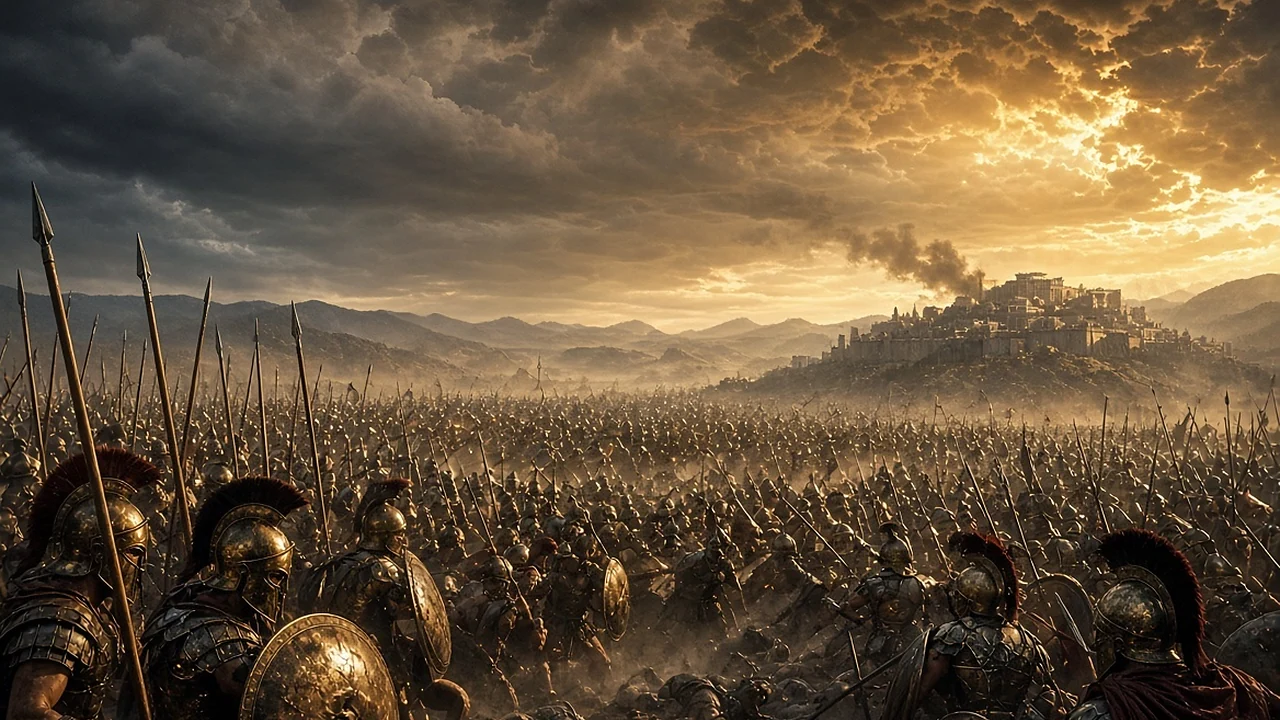
The Trojan War explained is a legendary conflict between a Greek or Achaean expedition and the city of Troy, also called Ilios. The story is famous for Helen and Paris, the warriors Achilles and Hector, the intervention of Greek gods and the enormous wooden Trojan Horse. But no single surviving ancient work narrates every familiar scene from beginning to end. Homer’s Iliad concentrates on the wrath of Achilles during part of the war, the Odyssey recalls the wooden horse and the homecoming of Odysseus, and Virgil’s later Roman Aeneid gives a memorable account of the city’s fall. Archaeology supports the existence of an ancient city at Troy, not the literal truth of every detail in these myths.
What was the Trojan War and why is it famous?
In Greek myth, a coalition of Greek kings and warriors crosses the Aegean to attack a wealthy fortified city in northwestern Anatolia. Their opponents include King Priam, his son Hector and another son Paris. The famous heroes and gods choose sides, and the siege is commonly presented as lasting ten years. These figures appear throughout Greek literature, vase painting, drama and later Roman epic. The story has become an enduring way to explore honor, anger, family loyalty, destruction and the treatment of enemies.
The word “Trojan” does not mean that the entire surviving text of the Iliad is narrated from the defenders’ perspective or that every Trojan was a villain. Homer gives moving scenes to heroes on both sides, especially Hector and his family. The Greeks themselves also quarrel and behave brutally. A faithful summary needs room for both heroism and the human costs of warfare. It should identify what occurs in Homer’s poem and what belongs to other traditions.
What caused the Trojan War? Paris, Helen and the judgment
One famous pre-war sequence begins with a divine dispute over beauty. A golden apple and a contest involving Hera, Athena and Aphrodite lead to a judgment by Paris, a Trojan prince. In familiar versions Aphrodite promises him the love of Helen, who is married to the Spartan ruler Menelaus. Helen then goes to Troy with Paris, described as an abduction in some sources and in more complex terms in others. Menelaus and his brother Agamemnon gather allies to seek her return and confront Troy.
These background events are not all performed as scenes in Homer’s Iliad. The poem presumes an audience familiar with a wider legend. Versions of Helen’s departure, the judgment and her presence at Troy vary; some traditions even imagine a phantom Helen rather than the real woman at Troy. Treating every character’s motive as fixed by one original ancient book erases the complexity of the tradition. The safest opening sentence calls the cause a legendary sequence involving Paris, Helen, divine rivalry and Greek claims of honor, then names the source of any detailed version.
Who fought in the Trojan War? Main heroes and their sides
On the Greek side, Agamemnon is a leading commander, Menelaus is Helen’s husband, Achilles is an exceptionally powerful fighter, Odysseus is celebrated for planning, and Ajax is known for battlefield strength. Their relationships are not always harmonious. The quarrel between Achilles and Agamemnon changes the balance of the war and becomes the driving subject of the Iliad. Achilles’ friend Patroclus plays a crucial part in his decision to return to combat.
On the Trojan side, Priam is the aging king; Hector is the city’s leading warrior and husband of Andromache; and Paris is associated with Helen and the origins of the conflict. The royal prophetess Cassandra appears in wider Trojan mythic traditions, and Aeneas becomes particularly important in Roman literature. Their identities matter because modern summaries sometimes confuse Hector and Paris, or assume Aeneas was one of the Greek invaders. Different poets emphasize different participants, including allies from beyond Troy itself.
The Iliad summary: Achilles, Agamemnon and Patroclus
Homer’s Iliad begins not with Paris meeting Helen but with Achilles’ anger. A conflict involving Agamemnon, captives and the priest of Apollo leads to a crisis in the Greek camp. Achilles considers his honor insulted and withdraws from fighting. The Trojans gain ground, and the Greek forces suffer. Other heroes fight important battles, while gods intervene, persuade and sometimes directly protect favored warriors. The poem is not an impartial history report, nor does it cover every year of the siege.
When the Greek position becomes desperate, Patroclus goes into battle wearing Achilles’ armor. He fights successfully but is ultimately killed by Hector. Achilles is devastated and driven to return. He obtains new armor linked with the divine smith Hephaestus and seeks Hector. Their confrontation becomes a climactic scene that illustrates the poem’s concern with fame, fate, grief and the destructiveness of vengeance. Without the Patroclus episode, a summary that jumps from a quarrel to the duel misses the emotional heart of the epic.
Achilles vs Hector: who won the famous duel?
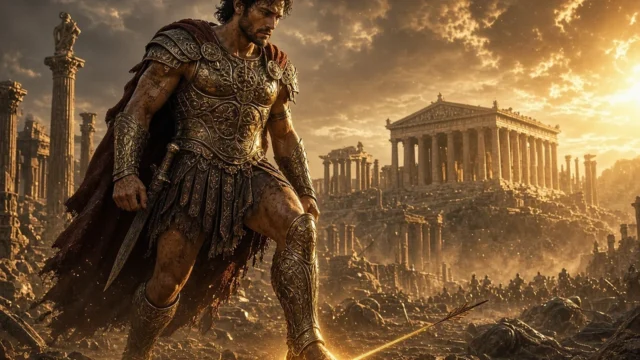
In Iliad Book 22, Hector faces Achilles outside Troy after a pursuit near the city walls. The gods influence events, including Athena’s deceptive intervention, and Achilles ultimately kills Hector. The dying Hector foreshadows Achilles’ own later death involving Paris and Apollo, but that later event is not narrated as part of the surviving Iliad plot. Achilles then dishonors Hector’s body, a brutal act that the poem does not hide. Modern illustrations often focus on gleaming armor and heroic poses, but the text also forces the audience to confront cruelty and grief.
In Book 24, Hector’s father Priam goes to the Greek camp to ask Achilles to return his son’s body. The meeting invites sympathy across enemy lines and becomes one of the poem’s most moving passages. Achilles agrees, and the Iliad concludes with Hector’s funeral. That ending is essential: the poem does not finish with the wooden Trojan Horse rolling through the gates and setting the city on fire. The difference is not pedantic; it is necessary to summarize the actual text correctly.

What happened after the Iliad? Achilles’ death and the fall of Troy
The wider Trojan epic cycle contains events beyond Homer’s surviving Iliad. Later traditions describe further fighting, including the appearance of other allies, the death of Achilles and disputes over his arms. Achilles’ death is commonly connected with an arrow shot by Paris and assistance from Apollo. The famous image of a perfectly protected hero with one exposed heel belongs to a later developing tradition, not the full explanation supplied by Homer. That distinction is important when using the Trojan War to explain the English phrase “Achilles’ heel.”
The legendary fall of Troy occurs after the phases covered in the Iliad. The Greeks cannot simply take the walls through ordinary force, so a deceptive strategy involving a wooden horse becomes central to the popular ending. Different ancient accounts preserve different details about how the horse was built, why it was brought inside the city and who warned against it. The Odyssey refers to the horse; Virgil’s Aeneid Book 2 gives the familiar later Roman narrative in much greater dramatic detail.
Trojan Horse explained: how did the wooden horse work?
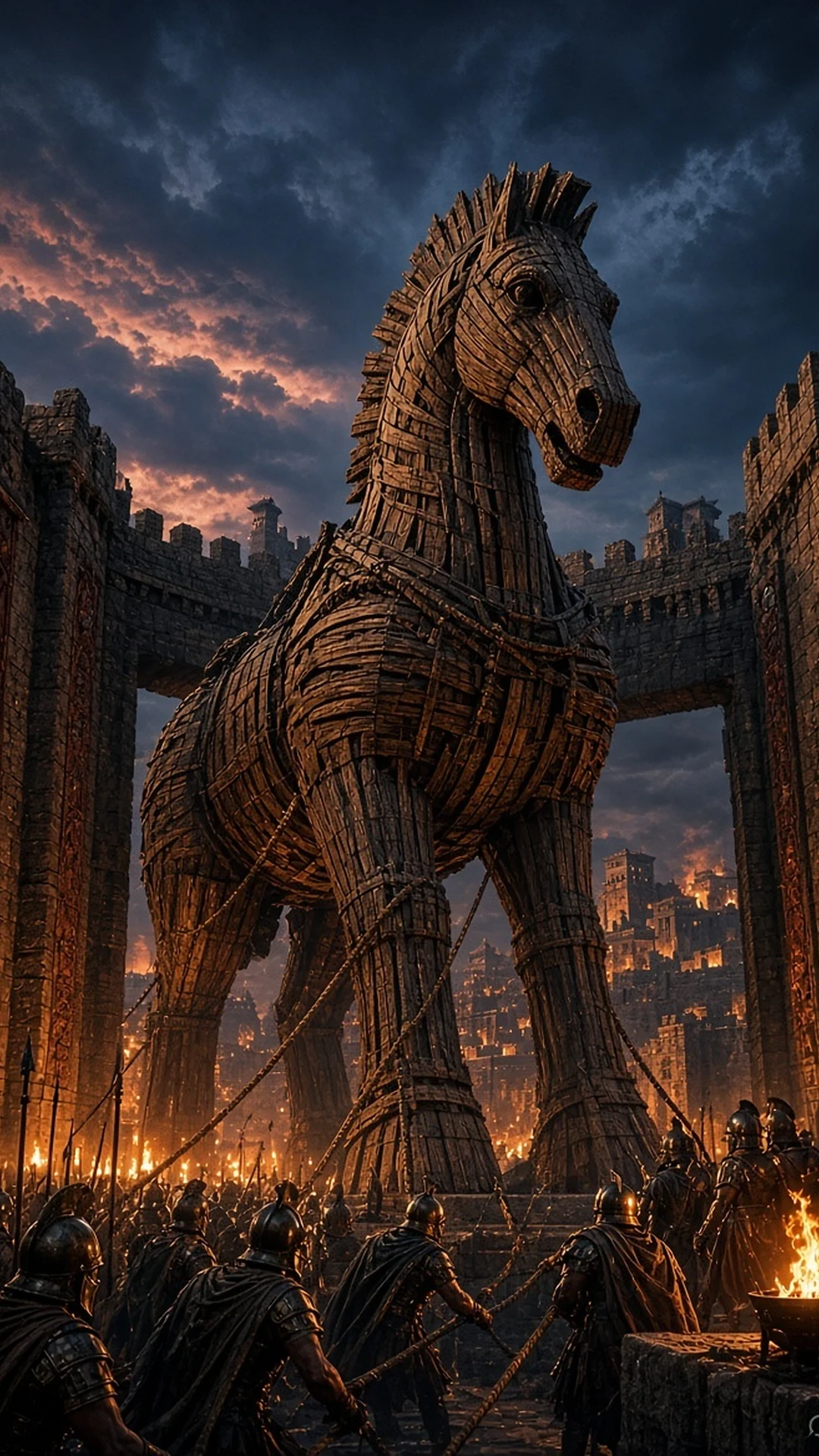
The Trojan Horse is a large hollow wooden construction hiding selected Greek warriors. In Odyssey Book 8, a bard sings of a horse made by Epeius with Athena’s assistance and filled with soldiers, while Odysseus leads the trick. The Trojans bring it inside their walls; when the defenders are vulnerable, Greeks emerge and the city is taken. That is a substantial mention of the horse in Homer’s work, but it is in the Odyssey, not a full episode enacted in the Iliad.
Virgil’s Aeneid Book 2 follows the Trojan character Aeneas’s recollection of the destruction. It features scenes involving Sinon, warnings and the catastrophe after the horse enters the city. Some details, such as the role of the priest Laocoon and his fate, are particularly associated with later literary versions. Writers should specify whether they are discussing Homer’s shorter recollection, the fragmentary Greek epic cycle or Virgil’s Roman retelling rather than cite “Homer” for every component.
The horse also gives us a modern cybersecurity term: a “Trojan” program appears helpful or harmless while concealing malicious behavior. That analogy belongs to modern technology; it does not imply that the ancient story described computers. An article can explain the connection without allowing the popular metaphor to replace the history of the literary narrative.
Was the Trojan War real? Myth versus archaeology
Excavations at Hisarlik in modern northwestern Turkey have revealed the remains of the ancient city identified with Troy, including settlements and destruction layers from different periods. That finding establishes that the location was real and historically significant. It does not prove that Achilles, Hector and Helen fought or lived exactly as the poems describe, nor does it verify a literal wooden horse. The British Museum has summarized this distinction clearly in its exhibition materials on Troy: archaeology can demonstrate a real city and the possibility of Late Bronze Age conflict without establishing the specific poetic war as fact.
There were plausible geopolitical tensions between communities in the Aegean and Anatolia during the Late Bronze Age, but scholars debate how those historical backgrounds relate to later epic. The poems as preserved were composed and transmitted long after the period often associated with the legendary war. Their purpose includes storytelling, memory and cultural identity rather than producing a modern military archive. A responsible headline can promise the “full myth explained” and still tell readers precisely what is not known about real history.
Who won the Trojan War, and what happened next?
In the familiar legendary outcome, the Greek attackers capture and destroy Troy following the deception of the horse. Yet the victory carries enormous suffering for both attackers and defenders. Surviving Trojan stories describe deaths, enslavement and displacement. In Roman tradition Aeneas escapes and becomes linked to a narrative about the origins of Rome. Among the returning Greeks, Odysseus experiences a prolonged journey before reaching Ithaca, which is told in the Odyssey. Other heroes’ homecomings form separate traditions.
This aftermath shows why “who won?” is only one part of the story. The Trojan War illustrates the cost of revenge and the unstable nature of glory. Readers seeking a careful comparison with the Mahabharata or other epics should compare literary themes, not claim that the characters or wars are historically identical. Our Greek vs Hindu mythology guide explains the limits of such comparisons.
Five Trojan War FAQs
Why did the Trojan War start?
In the common mythic cycle, the departure or abduction of Helen with Paris, following the divine judgment involving Aphrodite, leads Greek leaders to attack Troy.
Who killed Hector?
Achilles kills Hector in Homer’s Iliad, Book 22.
Does the Iliad contain the Trojan Horse story?
Not as the famous full narrative. The horse is mentioned in Homer’s Odyssey and developed in later texts, including Virgil’s Aeneid.
Who won the Trojan War?
The Greeks capture Troy in the familiar mythic conclusion, but it is not a verified modern historical battle record.
Is there archaeological proof of the Trojan Horse?
No. The site of Troy is archaeological reality, while the literal horse and the epic’s precise battles remain unproven.
Primary sources and conclusion
Read Homer, Iliad Book 22 for Hector’s duel, Book 24 for Priam’s visit, Odyssey Book 8 for the wooden horse, Virgil, Aeneid Book 2 for the later Roman account, and the British Museum’s Troy: Myth and Reality exhibition text for the archaeological distinction. Conclusion: the Trojan War is a linked tradition of many poems and retellings, not one episode that Homer tells from start to finish. Updated 14 November 2026. Images represent legend, not photographs of real incidents.














Share Your Opinion
Comments are closed on this post.