 Vista
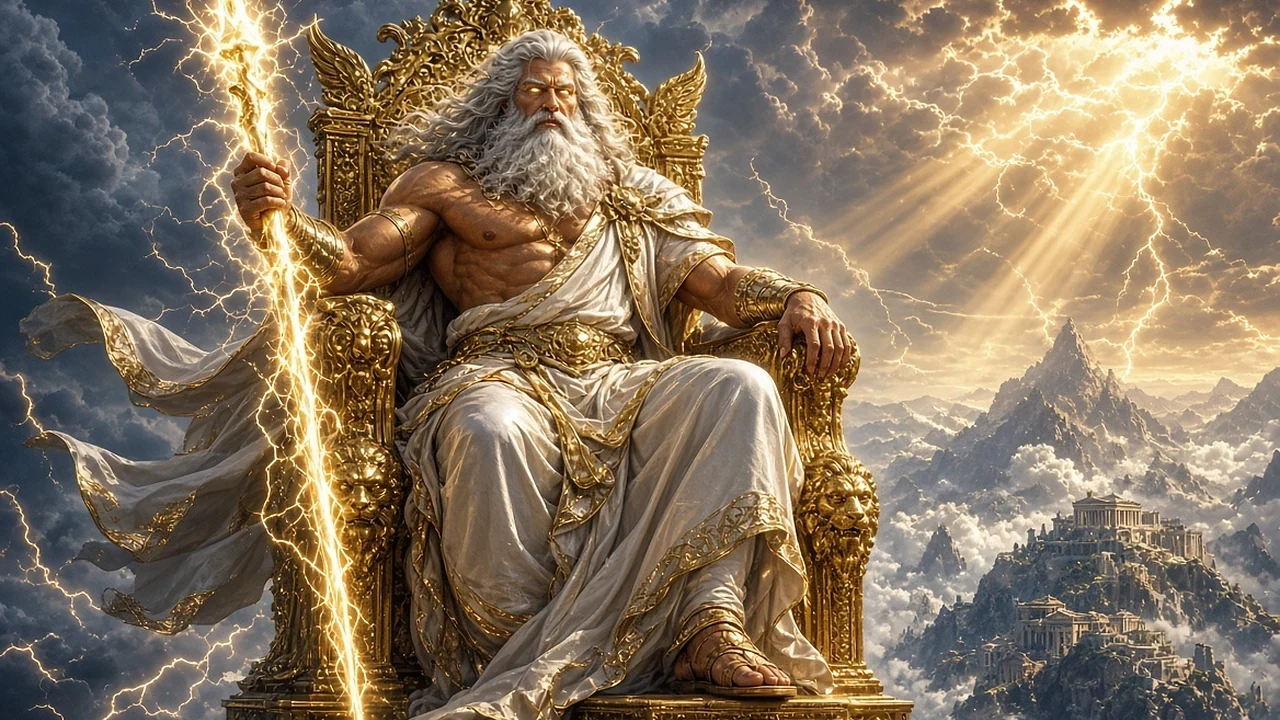
Zeus in Greek mythology is the king of the Olympian gods, associated with the sky, thunder, justice, oaths and royal authority. Yet he did not rule from the beginning of the universe. According to Hesiod, Zeus was the youngest child of the Titans Cronus and Rhea. His mother saved him from a father who swallowed his offspring, and he later led a struggle that ended Titan rule. His story therefore begins not on a throne but with a hidden infant and a dangerous prophecy. Here is his family, rise, powers and major stories, with the difference between early Greek texts and later legends explained.
Who was Zeus and why was he king of the gods?
The name Zeus is central to the Olympian order familiar from Homer and Hesiod. His epithets connect him with thunder, the protection of guests and strangers, the sanctity of oaths and the responsibility of rulers. He is often shown as an adult bearded man holding a thunderbolt or sceptre, with an eagle nearby. Those images convey kingship, but ancient poems do not depict him as a flawless superhero who succeeds at everything without opposition. Other deities argue with him; mortals suffer the effects of divine disputes; and questions about fate and justice are not always resolved in a way modern readers consider fair.
Zeus is the Greek figure widely identified with Jupiter in Roman religion. Both are connected with thunder and supreme divine authority, but the equation should not erase local Greek customs or the specific Roman institutions associated with Jupiter. In a source-based article, it is more helpful to name the text and episode than to assume every Greek and Roman story is exactly the same.
How Zeus was born: Cronus, Rhea and the stone
Hesiod’s Theogony, lines 453 onward, names the children of Cronus and Rhea as Hestia, Demeter, Hera, Hades, Poseidon and Zeus. Cronus fears a prophecy that a child will overthrow him just as he overthrew his father Ouranos. Instead of protecting his family, he swallows the children when they are born. Rhea is overwhelmed by grief. Before Zeus’s birth, she asks Gaia and Ouranos for help in preserving the child.
Rhea hides the baby Zeus in Crete and presents Cronus with a large stone wrapped as an infant. Cronus swallows the stone without noticing the deception. Zeus survives, grows to adulthood and eventually brings about the release of his siblings. The stone is subsequently associated with a sacred place at Delphi in Hesiod’s narrative. There are several local Cretan traditions about the cave, the child’s caretakers and his protection; the details of those later local accounts should not be presented as a single scene narrated by every early poet.
This episode gives the succession myth its dramatic logic. The father swallows children to avoid losing power, but that fearful action sets the story of his overthrow in motion. Zeus’s victory is not simply a contest between a good child and a bad parent; it reflects a Greek poetic theme in which one cosmic ruling generation replaces another.
Titanomachy: how Zeus defeated the Titans
Once Zeus has freed his siblings, the conflict for rule intensifies. Titanomachy is the name commonly used for the battle between the Olympian alliance and the opposing Titans. Hesiod describes fierce warfare lasting ten years. The Cyclopes and Hundred-Handers play crucial roles on Zeus’s side. The Cyclopes provide his signature thunder and lightning; the Hundred-Handers help overwhelm the opponents through their extraordinary strength. Zeus’s authority therefore comes through alliances as well as power.
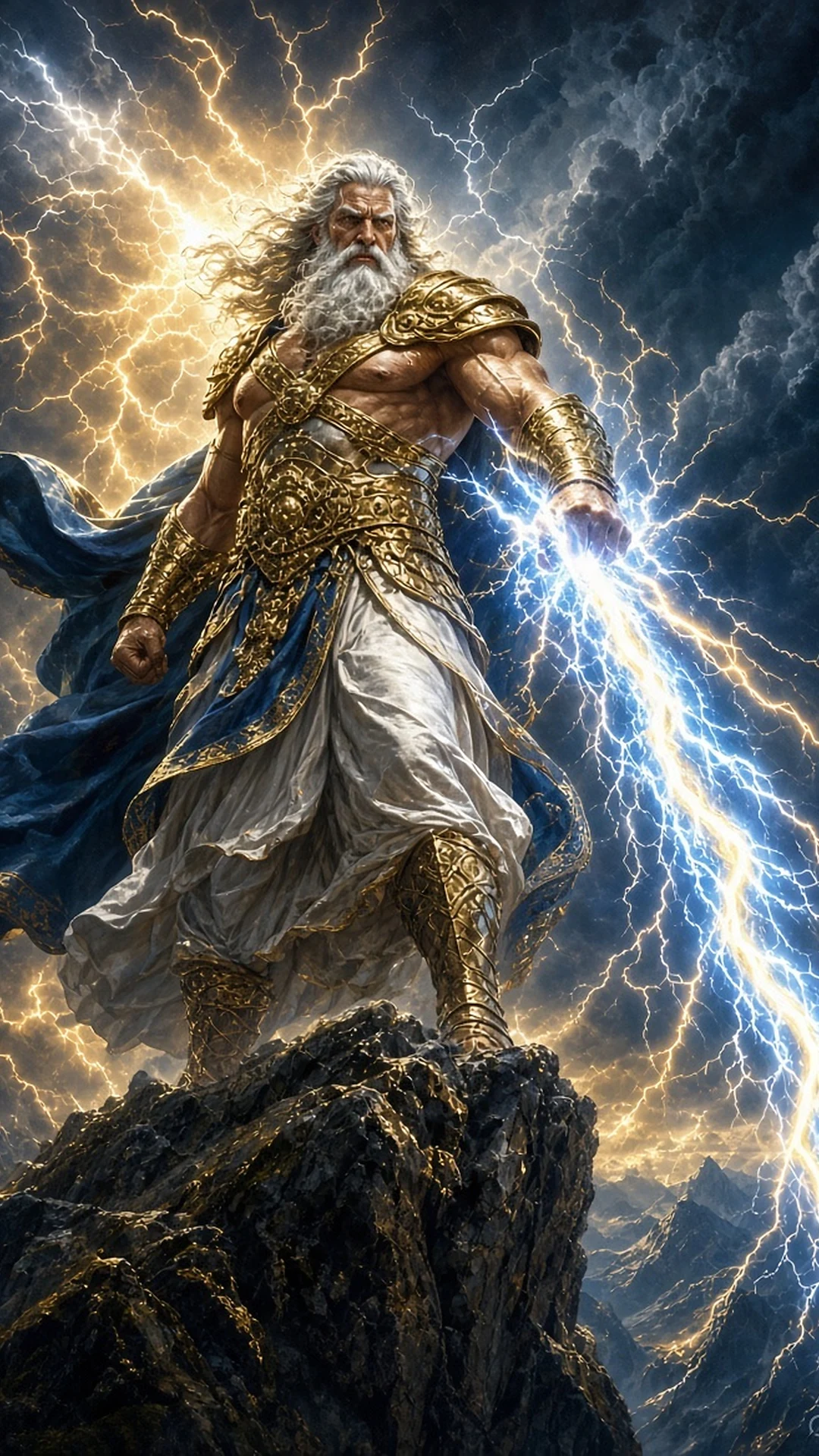
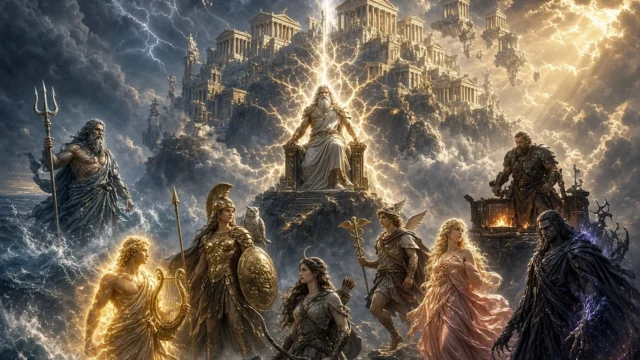
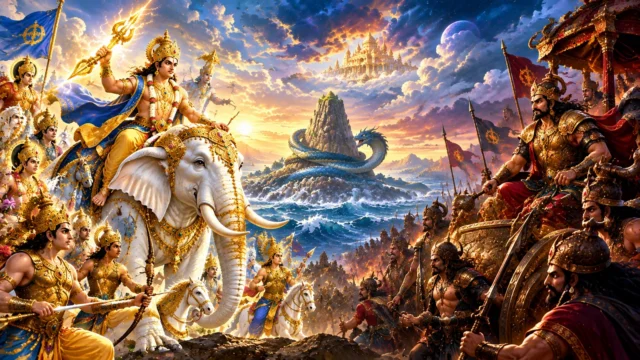
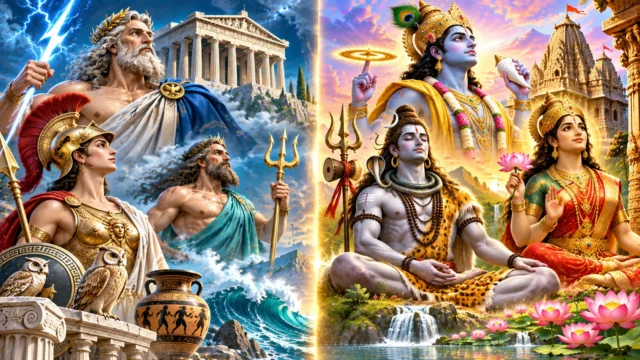
The defeated Titans are confined to Tartarus in the traditional account. The conflict is not the same as the Gigantomachy, the later battle against Giants, which many modern summaries accidentally combine with Titanomachy. Nor is every Titan automatically an enemy: the genealogies contain many divine figures with distinct roles. For the central succession story, Hesiod’s Theogony is the most useful starting text. A dramatic modern illustration of Zeus throwing lightning should be treated as artistic storytelling, not as an ancient photograph of a historical battle.
What were Zeus’s powers and symbols?
Zeus’s thunderbolt is his most distinctive weapon and a symbol of authority over the sky. He is connected with storms and weather, but his domain includes much more than meteorology. In different cult titles he appears as a protector of hospitality, the guarantor of sworn promises and a figure invoked for justice and the legitimacy of kingship. These functions are reflected unevenly across genres: a hymn, tragedy and epic battle scene need not emphasize the same aspects of the god.
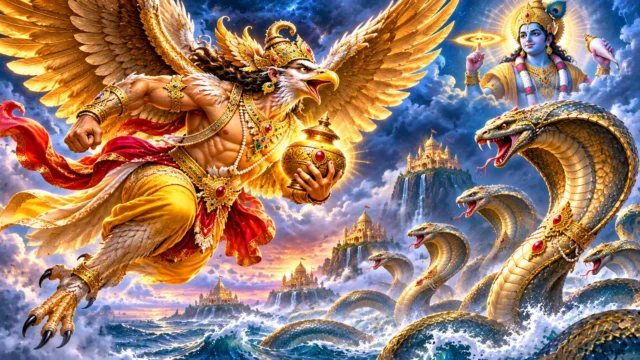
Other recognizable attributes include the eagle, sceptre, throne and occasionally the aegis. The eagle is not the Hindu Garuda, even though both are notable divine bird images in separate cultural traditions. Artists also use Mount Olympus, clouds and radiant light as visual shorthand. Some of these are modern design conventions rather than details fixed by a single ancient passage. Readers who want to identify Zeus in Greek art should look for a combination of context and attributes rather than relying on a beard alone, since Poseidon and other gods can look similar.
Zeus’s brothers, sisters, wife and famous children
The six children of Cronus and Rhea are all part of his immediate family: Hestia, Demeter, Hera, Hades, Poseidon and Zeus. After divine succession, Zeus, Poseidon and Hades have major domains. In Iliad 15, Poseidon speaks of the division by lot: Zeus has the sky, Poseidon the sea and Hades the realm below, while earth and Olympus remain common. That is more precise than saying Zeus owns every place while his brothers have none. Zeus’s position as king exists alongside the recognized power of other gods.
Hera is Zeus’s wife and also his sister in the mythological genealogy. Their children include Ares, Hebe and Eileithyia in Hesiod. Zeus’s unions with other partners connect him with numerous important figures. Athena is associated with Metis; after Zeus swallows Metis, Athena emerges from his head. Apollo and Artemis are children of Zeus and Leto, Hermes is a son of Zeus and Maia, and Dionysus is linked with Zeus and Semele. The heroes Perseus and Heracles have Zeus as their divine father and mortal mothers in major traditions. These relationships explain why individual myths continually return to Zeus, even when the hero has a story of their own.
What did Zeus do in famous Greek mythology stories?
Zeus appears as ruler, father, judge and sometimes a source of conflict. In the Iliad he weighs the fortunes of opposing warriors while other gods try to influence the war. His relationship with Hera becomes part of the larger struggle between divine interests. In the Prometheus tradition, Zeus withholds fire from humans and later punishes Prometheus for defying him; the creation of Pandora also belongs to that cluster of stories. These are not all simple lessons that Zeus was benevolent or cruel. Greek literary accounts can portray divine authority as powerful, unpredictable and morally difficult.
His association with Athena is particularly notable because wisdom, swallowed knowledge (Metis) and the emergence of a fully armed daughter are combined into one origin narrative. His role in the rise of the Olympians, his actions toward mortals and his many relationships are handled differently by different authors. Reading one comic or film will rarely provide the exact textual version. The safest question is not “What did Zeus always do?” but “How does Hesiod or Homer describe Zeus in this episode?”
Did Zeus die, and is Zeus the same as Indra?
In the mainstream Homeric and Hesiodic tradition, the Olympian gods are immortal and Zeus does not have an ordinary death scene. Accounts of a tomb of Zeus in Crete appear in local lore and in comments by ancient authors, notably the poet Callimachus who rejects such a claim while praising Zeus’s immortality. A Cretan tomb tradition therefore cannot be turned into proof that all Greeks believed Zeus died. A separate article can explore this specific question and its sources in more detail.
For readers familiar with Hindu mythology, Zeus and Indra share selected themes involving thunder and heavenly rule, yet the stories arise in distinct religious and literary settings. Similarity does not establish identity. Our existing Greek vs Hindu mythology comparison explains where broad comparisons help and where they become misleading.
Five frequently asked questions about Zeus
Who were Zeus’s parents?
In Hesiod’s Theogony, Zeus is the youngest child of the Titans Cronus and Rhea.
What is Zeus the god of?
He is the king of the Olympians and a god of the sky and thunder, with wider associations including oaths, hospitality and authority.
Who gave Zeus his thunderbolt?
In Hesiod’s account, the Cyclopes provide Zeus with thunder and lightning after he releases them from confinement.
Are Zeus, Poseidon and Hades brothers?
Yes. The three are children of Cronus and Rhea, and they occupy different major domains in the divine order.
Did Zeus ever die in standard Greek mythology?
No. Zeus is immortal in standard Olympian mythology; stories of a Cretan tomb belong to a particular local tradition rather than an accepted general death narrative.
Sources and conclusion
For his early life and divine succession, see Hesiod, Theogony 453–506 and later passages. For the brothers’ domains, see Homer, Iliad Book 15. For collected ancient testimonies, see Theoi’s Zeus reference. Conclusion: Zeus rose from a threatened infant to ruler through survival, family alliances and a legendary war; his power is immense, but the ancient texts show a complex figure, not a flawless modern superhero. Updated 14 November 2026. Mythological images are illustrations, not historical evidence.










Share Your Opinion
Comments are closed on this post.