 Vista

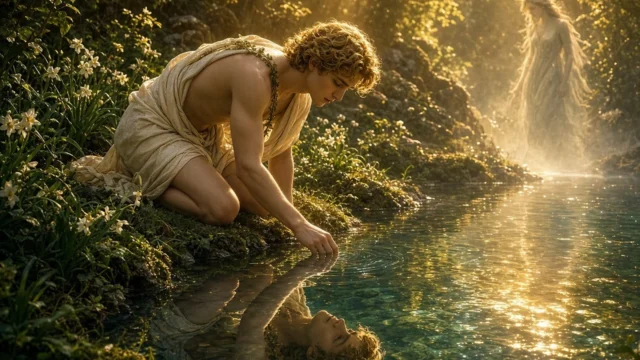
Eros and Psyche, also known as Cupid and Psyche, is a mythic love-and-trials story in which a princess falls in love with a mysterious husband she must not look at, loses him after breaking that condition, and completes four extraordinary tasks set by the goddess of love. The most complete surviving ancient telling is in Apuleius’s Latin novel Metamorphoses, also called The Golden Ass, Books 4.28–6.24, written in the Roman era. It is not the same book as Ovid’s Metamorphoses. In the tale, Psyche’s beauty angers Venus (Greek Aphrodite), but her son Cupid (Greek Eros) falls in love with her instead. After a secret marriage, an oil lamp exposes Cupid and he flees. Psyche must sort mixed grain, gather golden wool, fetch water from a deadly river and visit the underworld. The story ends with her rescue, divine marriage and their daughter Voluptas, or Pleasure.
Where does the original Cupid and Psyche story come from?
The extended narrative appears inside the novel of Lucius Apuleius, an author writing in Latin during the second century CE. The work’s main character, Lucius, has been changed into a donkey; the tale of Cupid and Psyche is told within that larger adventure. That literary frame matters: it is a story within a Roman-era novel drawing on Greek-connected myths, rather than a complete original chapter of Homer’s Iliad. Greek Eros and Latin Cupid or Amor are widely associated figures, as are Aphrodite and Venus, Zeus and Jupiter, and Persephone and Proserpina.
The names Metamorphoses can cause confusion because both Ovid and Apuleius used that title for different Latin works. Ovid’s fifteen-book poem includes many transformations, but the complete familiar four-trial romance of Psyche belongs to Apuleius. Earlier Greek art and traditions show Eros and Psyche together, yet that does not mean every episode of the later novel has an identical surviving early Greek text. Correct attribution helps readers trace the story rather than recycle a false quote.
Who was Psyche, the princess whose beauty angered Venus?
Psyche is the youngest of three daughters of a king and queen. Her beauty becomes so remarkable that crowds begin to treat her almost as though she were Venus herself. The elder sisters find husbands, but Psyche’s extraordinary reputation creates difficulties for her own marriage. The goddess Venus resents the attention being diverted from her worship and asks her winged son Cupid to make the mortal woman fall for someone unworthy or miserable.
There is an irony in this plan: Cupid, who normally makes others desire, becomes the one who falls in love. The tale does not simply say that Psyche makes a rational choice after meeting a friendly god in public. She is placed in a situation she does not understand, where powerful divine figures shape her future. The story is popular as a romance, but readers should also recognize its themes of unequal power, family interference, fear and a young woman’s attempts to recover agency.
Why was Psyche taken to a mountain to marry a monster?
Her parents consult an oracle about her marriage, and the answer predicts a terrifying, more-than-human husband. Psyche is dressed for a dreadful bridal journey and left on a rocky height, with her family grieving as though they had attended a funeral. Instead of being destroyed by a visible monster, she is carried by the gentle wind Zephyrus down to a marvelous palace with invisible attendants and extraordinary wealth.
The oracle’s frightening language builds suspense because Psyche and her family do not yet know the husband’s identity. Modern retellings sometimes remove this unsettling beginning and introduce Cupid as a prince arriving openly with roses. That changes the story’s emotional structure. In Apuleius the palace seems safe and luxurious, yet Psyche still lacks vital knowledge about the person she is expected to trust. The tension between comfort and uncertainty prepares the later lamp scene.
Who was Psyche’s invisible husband?
A voice visits her in darkness. Her unseen husband is kind in some respects and arranges for her needs to be met, but he insists that she must not look upon his face. His identity is Cupid or Eros, the winged god of desire. The prohibition produces a difficult situation: Psyche enjoys affection and the palace’s comforts while being asked to accept a relationship whose most basic facts are hidden from her. The novel uses uncertainty to make the story exciting and to test the couple’s trust.
Cupid warns Psyche that her sisters may stir doubt and harm the relationship. When the sisters visit, their envy of the mysterious palace and her circumstances contributes to their increasingly dangerous advice. It would be too simple to call the restriction a model for healthy modern marriage: an ancient fairy-tale condition is not a universal rule that partners should hide their identities. A thoughtful retelling can explain what the characters believe while leaving room for readers to question the demands placed upon Psyche.
Why did Psyche look at Cupid with an oil lamp?
Psyche’s sisters make her fear that the unseen husband may be a serpent or monster intending to harm her. They urge her to bring a lamp and blade into the chamber while he sleeps. Overcome by curiosity and fear, she lights the lamp and sees the beautiful winged Cupid. She realizes that the supposed monstrous husband is the god of love himself. In the famous moment, hot oil from the lamp drops onto Cupid and wakes him.
Cupid is hurt by the discovery and leaves. In the story, he also suffers a physical burn and emotional wound from the broken secrecy. Psyche realizes too late that her sisters’ counsel and her own anxiety have destroyed the fragile arrangement. The narrative is not identical to Orpheus and Eurydice, where looking back breaks a condition on leaving the underworld. Both explore forbidden sight, but the characters, consequences and source texts are different. Psyche’s journey is only beginning when Cupid flies away.

How did Psyche begin her search and reach Venus?
After Cupid leaves, Psyche wanders in search of him, facing rejection and uncertainty. She attempts to seek support from goddesses such as Ceres and Juno, but they are unwilling to challenge Venus directly. Eventually she presents herself to Venus, who is furious at the woman her son loves. The goddess imposes apparently impossible labor rather than offering an immediate reconciliation. The sequence makes Psyche an active protagonist: she searches, suffers, accepts dangerous tasks and often survives because she listens to helpers.
The exact supernatural help changes from one ordeal to another. This is not a tale in which Psyche becomes a warrior by acquiring an enchanted sword. Her victories often depend on patience, recognizing limits and accepting advice from beings more familiar with the terrain. The trials are also not historical rites that a modern visitor can physically complete. They belong to the symbolic world of a Roman-era literary fairy tale and should be illustrated as mythic scenes.
Trial 1: How did ants help Psyche sort mixed grain?
Venus gives Psyche a huge, confused heap of different seeds and grains and orders her to sort them into separate piles within an unreasonable time. Faced with the task, Psyche is overwhelmed. A colony of ants comes to help, swiftly dividing the seeds by type. By the time Venus returns, the impossible sorting has been accomplished. The goddess is not satisfied; she suspects the achievement came from another’s assistance rather than from Psyche’s unaided hands.
The scene is useful because it shows the contrast between a ruler’s overwhelming command and the power of many small workers cooperating. A modern reader may see a lesson about collective effort, but it should be identified as interpretation, not a directly quoted ancient management theory. Apuleius’s actual scene involves creatures responding to Psyche’s trouble. The challenge does not end her journey, because Venus responds by escalating the danger.
Trial 2: How did Psyche collect the golden fleece?
For the second task, Venus demands wool from fierce golden-fleeced sheep living beside a river. The animals are dangerous when approached directly, and Psyche is unsure how she can survive. A speaking reed advises her to wait until the heat of the day passes and the sheep calm down. She can then gather tufts of golden wool caught on the branches and thorny bushes rather than attack the animals.
This is not the same as Jason’s quest for the Golden Fleece, another famous Greek story. Psyche is gathering wool from dangerous sheep in Apuleius; Jason seeks a particular legendary fleece as part of the Argonaut story. The resemblance of the phrase makes an easy SEO mistake. Here the help comes from a reed and a change in timing. Psyche succeeds through observation and patience rather than defeating a flock in battle.
Trial 3: Who collected water from the River Styx?
Venus next demands a vessel of deadly water from a dangerous, high source associated with the rivers of the underworld, including the Styx. The cliffs and hostile setting make the assignment nearly impossible for a human traveler. A powerful eagle associated with Jupiter comes to her aid, carries the vessel and obtains the water. Psyche can bring it back without climbing the deadly route herself.
The scene reinforces the idea that the greatest task is not always solved by direct personal force. Earlier the ants and reed helped with more ordinary materials; now a bird connected with the high god can cross a dangerous boundary. The geography is supernatural. One should not identify it with an actual bottled spring that visitors can locate by following the novel as though it were a hiking map. Apuleius is creating mythic obstacles, not giving a geological survey.
Trial 4: What was inside Proserpina’s box?
The final famous task requires Psyche to journey into the underworld and ask Proserpina (Greek Persephone) for a portion of beauty to take back to Venus. Desperate and uncertain, Psyche receives advice from a speaking tower on the route, including what to carry for the ferryman Charon and the guard dog Cerberus. The instructions help her pass safely and return with a sealed box. She is warned not to open it.
On her way back, Psyche wonders whether a little divine beauty might help her win Cupid again. She opens the container, but instead of a visible cosmetic powder she releases an overpowering death-like sleep and collapses. This is a distinct box story from Pandora’s jar, which appears in Hesiod. Confusing the two merely because both involve opening a container destroys the literary context. Psyche’s final danger arises from an attempt to improve her appearance through something she does not understand.

How did Cupid rescue Psyche, and what happened afterward?
When Cupid recovers from his lamp injury, he finds Psyche lying motionless. In Apuleius, he removes the sleep and returns it to the box, then wakes her with a gentle prick from his arrow. A modern version may replace this with a magical kiss, but that should not be presented as the exact action in the Adlington translation of the original narrative. Cupid tells Psyche to complete the delivery and takes his case to Jupiter (Zeus).
Jupiter decides to resolve the conflict by bringing Psyche into the divine family. She is granted immortality and joins Cupid in a marriage celebrated among the gods. The story ends with the birth of a daughter, Voluptas, whose name is associated with pleasure or delight. This ending transforms a relationship shaped by secrecy and hostile interference into a public union. It does not mean every obstacle was caused by Psyche alone; Venus and other powerful figures play major roles throughout.
What does Eros and Psyche mean: love and the soul?
The Greek word psyche can mean soul or breath of life, while Eros is associated with desire or love. Later interpreters understandably see their union as an allegory about the soul’s journey through suffering toward love. Such readings have influenced artists, philosophers and writers. However, the novel’s full emotional and social context should not be reduced to a single formula in which every detail secretly represents one modern psychological concept.
Readers can also explore the role of curiosity, trust and the help offered by unexpected allies. Psyche’s ability to complete the tasks depends on ants, a reed, an eagle and guidance from a tower; she does not conquer every danger alone. The story’s power lies in those memorable changes of scale, from tiny seeds to the underworld. It is a literary myth, not evidence that a real princess undertook physically verifiable journeys beyond death.
Eros and Psyche timeline and four trials
| Stage | Event | Helper or lesson |
|---|---|---|
| Beauty | Psyche draws the attention of Venus | Divine jealousy |
| Oracle | Psyche is left on a mountain | Zephyrus carries her |
| Palace | Secret husband visits at night | Cupid is concealed |
| Lamp | Psyche looks at him | Cupid leaves |
| Trial 1 | Sort mixed grain | Ants |
| Trial 2 | Gather golden fleece | Reed |
| Trial 3 | Fetch dangerous water | Eagle |
| Trial 4 | Bring Proserpina’s box | Speaking tower |
| Ending | Cupid rescues, Jupiter grants immortality | Marriage and Voluptas |
Five FAQs about Eros and Psyche
Who wrote the full Eros and Psyche story?
The famous extended version is in Apuleius’s Latin The Golden Ass, Books 4–6, not Ovid’s Metamorphoses.
Why did Psyche use a lamp to look at Cupid?
Her sisters persuaded her to fear that her unseen husband was a monster, and she looked while he slept.
What were Psyche’s four trials?
Sorting grain, collecting golden fleece, obtaining deadly river water and bringing a box from Proserpina in the underworld.
How did Cupid wake Psyche?
He removed the death-like sleep and pricked her with the tip of an arrow in Apuleius’s account.
Did Eros and Psyche have a child?
Yes. The narrative ends with a daughter named Voluptas, or Pleasure.
Primary sources and conclusion
Read Apuleius, The Golden Ass, Books 4–6, in Harvard’s William Adlington translation. A second edition is available through Wikisource’s Apuleius text. The earliest different status of Eros as a primordial deity appears in Hesiod’s Theogony. Conclusion: Psyche’s four trials, Cupid’s rescue and the divine marriage form an unforgettable Roman-era expansion of the Greek-connected theme of Love and Soul. Updated 14 November 2026. Images are myth-inspired interpretations.



























Share Your Opinion
Comments are closed on this post.