 Vista
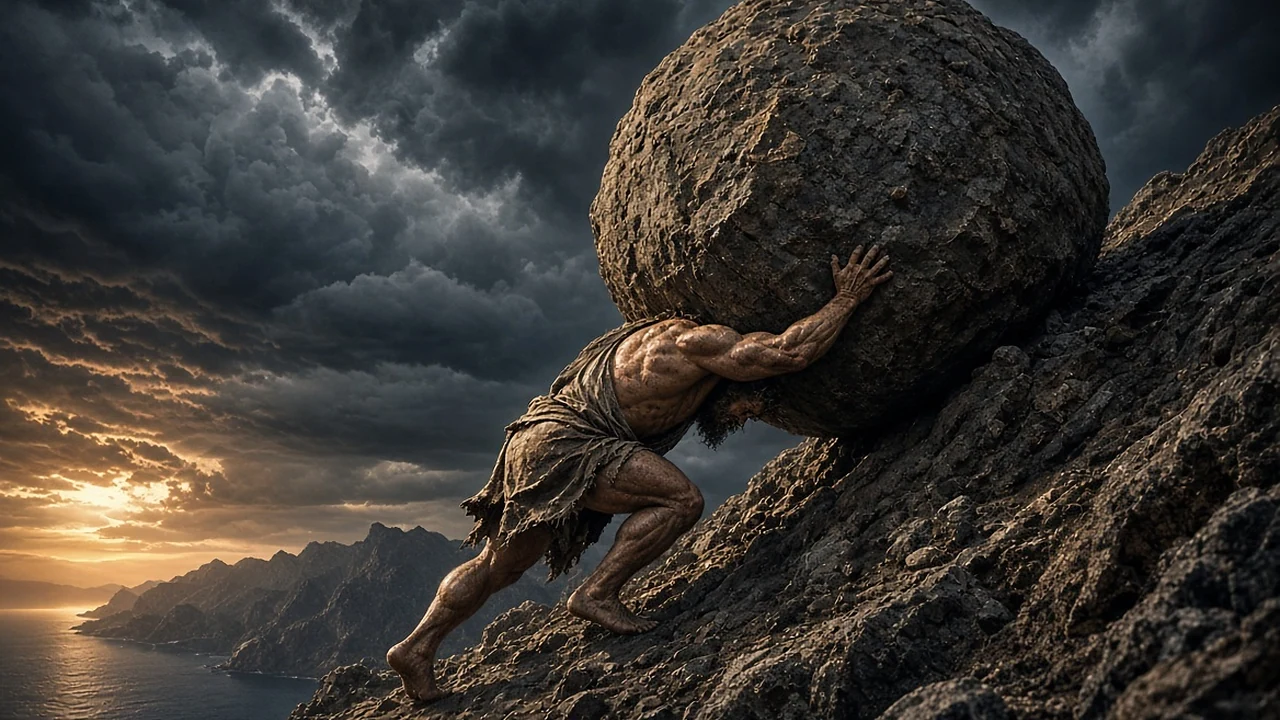
Sisyphus story is the Greek myth of a cunning king condemned to push a massive boulder uphill forever. Whenever the stone nears the summit, it slips back down, forcing him to repeat his exhausting work. The unforgettable punishment appears in Homer’s Odyssey Book 11, where Odysseus sees Sisyphus among the dead. But Homer does not present the entire chain of offenses that later writers attach to the penalty. Other traditions describe a ruler who revealed Zeus’s secret, bound Death (Thanatos) and tricked the rulers of the underworld into allowing him to return temporarily to life. The story is also important in modern philosophy because Albert Camus used Sisyphus as a symbol in his 1942 essay on absurdity. Ancient myth and later interpretation should be distinguished.
Who was Sisyphus in Greek mythology?
Sisyphus is a legendary king associated with Ephyra, a name connected with the later city of Corinth. In Apollodorus, Library 1.9.3, he is a son of Aeolus and the husband of Merope, a daughter of Atlas. Their family has connections to the broader heroic world, including a line leading toward Bellerophon, the hero famous for defeating the Chimera. Those relationships place Sisyphus in the genealogies of Greek myth rather than in the Olympian generation of Zeus.
He is remembered more for intelligence used in deceptive ways than for a famous military victory. Different stories portray him bargaining, spreading information or finding loopholes in divine rules. His cleverness is both his defining talent and the source of serious conflict. This makes him a useful contrast with heroes such as Perseus and Theseus, whose legends focus on dangerous quests. Sisyphus’s myth is about a man who tries to escape the limits of mortality and ends up trapped in an endless task.
What punishment did Sisyphus receive in the underworld?
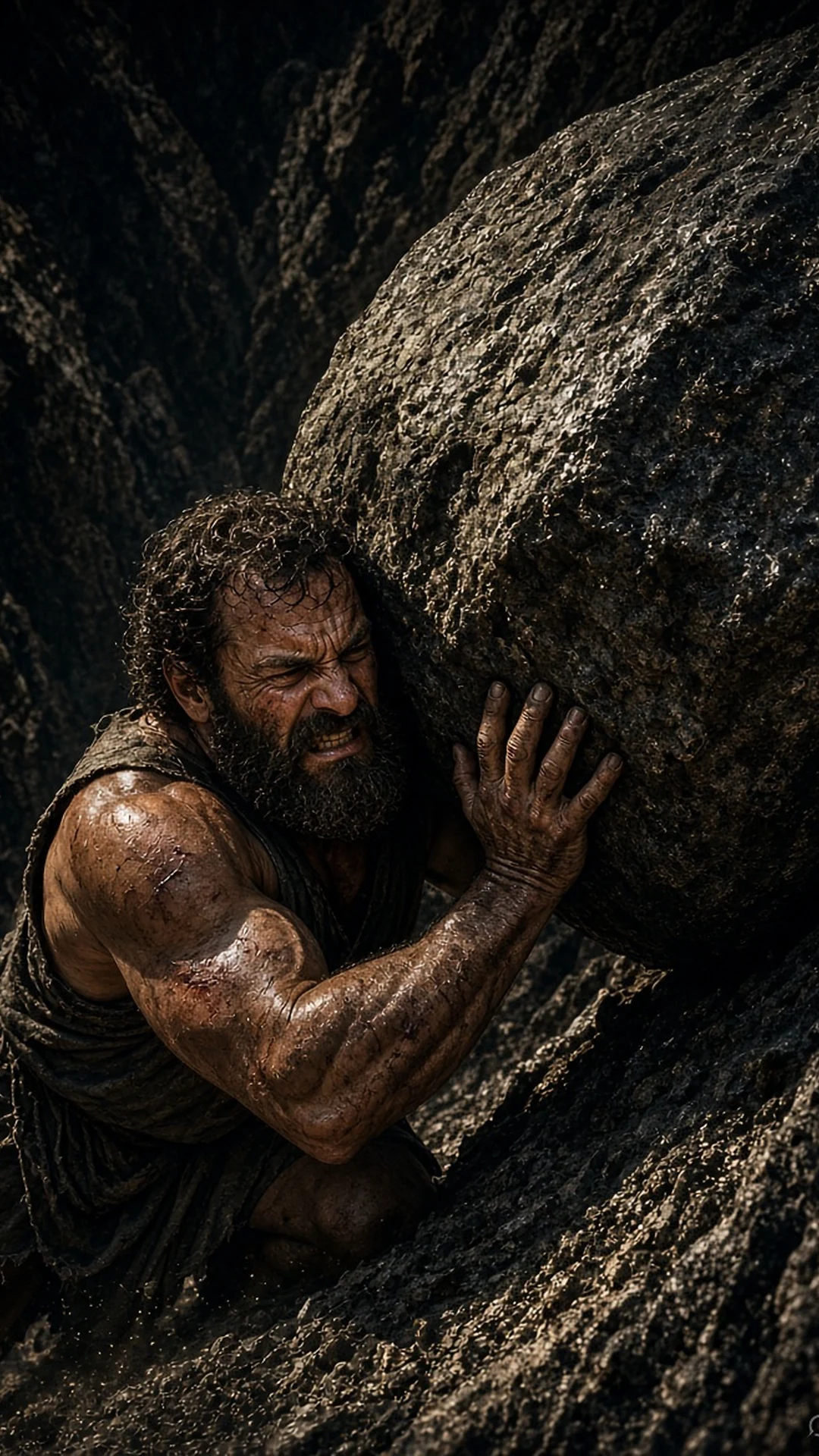
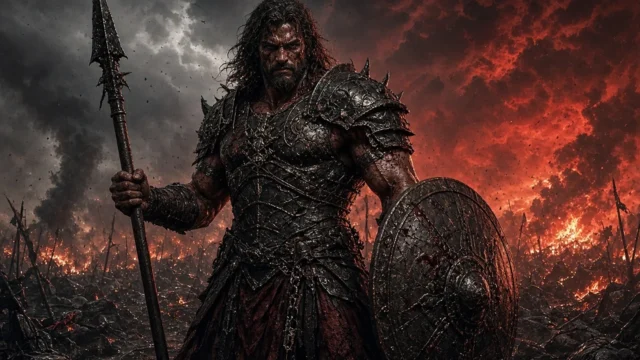
In Homer’s Odyssey Book 11, Odysseus sees Sisyphus struggling with an enormous stone. He braces it with hands and feet and pushes toward the crest of a hill. Just as he is about to achieve the goal, the stone’s weight turns it backward and it rolls down the slope. Sisyphus must start again. Homer emphasizes the strain, sweat and dust that rise from the suffering man’s body. The image of never finishing makes the punishment different from a single painful blow.
The special cruelty lies in the repeated defeat of his apparent progress. Sisyphus can approach the top, but the end of the task is always taken away. A modern image of a giant sphere rolling down a steep slope communicates the idea, though the ancient text does not specify the exact diameter, shape or material of the stone. It is a supernatural punishment, not a verified workplace accident or a geological explanation for rocks on a real hill.
Why was Sisyphus punished? The short answer
The simplest answer is that later Greek traditions portray Sisyphus as a crafty ruler who repeatedly challenged the gods’ order, including the boundary between life and death. But readers should not attribute every detail of that explanation directly to Homer’s Odyssey 11. Homer describes the boulder scene without giving the full familiar modern narrative of his tricks. The reasons are pieced together from other accounts, scholia and later mythographical or dramatic traditions.
That difference is especially important for accurate educational writing. A phrase such as “Homer says Zeus sent Thanatos and Sisyphus handcuffed him” may sound convincing, but it mistakenly merges a later story with the earliest famous depiction of the punishment. The source-based approach is to say: Homer shows the punishment; other traditions explain earlier acts of deception. This gives readers a clear answer while respecting the variety of ancient evidence.
How did Sisyphus reveal Zeus’s secret?
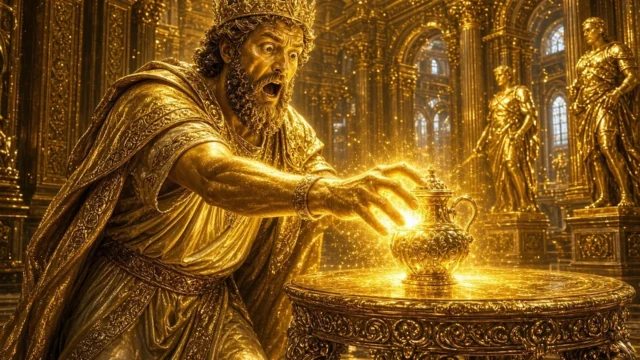
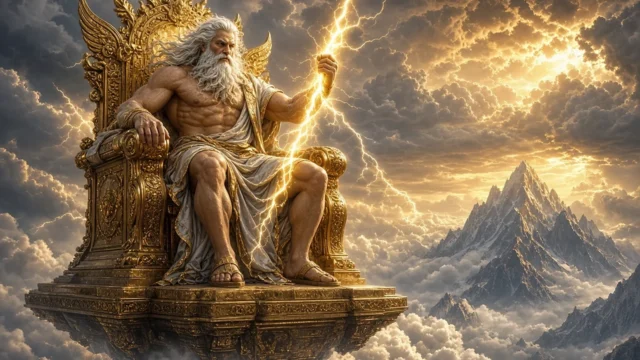
One important cycle concerns Zeus, the river god Asopus and his daughter Aegina. Zeus is said to have carried Aegina away, and Sisyphus knows something about what happened. In versions of the tale he provides information to Asopus in return for a useful reward, often associated with a water supply for his city. The ruler’s act is not simply harmless gossip: he gives away information about Zeus’s actions in a situation where the king of the gods does not welcome interference.
The exchange links Sisyphus’s calculating character with the practical interests of his city. Water mattered greatly in an ancient settlement, and some versions explain a local spring through this legendary bargain. These details appear in traditions beyond the concise scene in Homer. It would be inaccurate to say all surviving Greek writers describe the transaction in exactly the same way, or that a real spring proves Zeus abducted a historical person named Aegina. The tale uses a natural place to frame a myth about divine secrets.
How did Sisyphus trick Death, or Thanatos?
In a well-known later narrative, Zeus sends Thanatos, the personification of Death, to seize Sisyphus. Instead, the king manages to bind Thanatos, preventing death from carrying out its work. In that version, people stop dying in the usual way, producing a crisis in the balance of the world. The war god Ares ultimately releases Thanatos, and Sisyphus is taken toward the underworld. The story dramatizes the disastrous consequences of trying to outsmart a fundamental condition of mortal life.
This account is preserved through later literary testimony, including discussion connected with lost plays of Aeschylus and their ancient fragments. It should not be presented as though the full scene is written out in Homer’s boulder passage. Thanatos is also not identical to Hades: Hades is ruler of the underworld, while Thanatos is a figure associated with death itself. The distinction helps keep Greek myths clear when discussing the king’s extraordinary tricks.
How did Sisyphus escape the underworld a second time?
Another part of the later legend describes Sisyphus instructing his wife Merope not to perform the normal funeral rites or offerings after his death. Once in the realm below, he complains that his wife has neglected the responsibilities owed to him. He persuades the authorities to let him return briefly to the world of the living so he can supposedly correct the situation. But after returning, he refuses to go back when the agreed time is over.
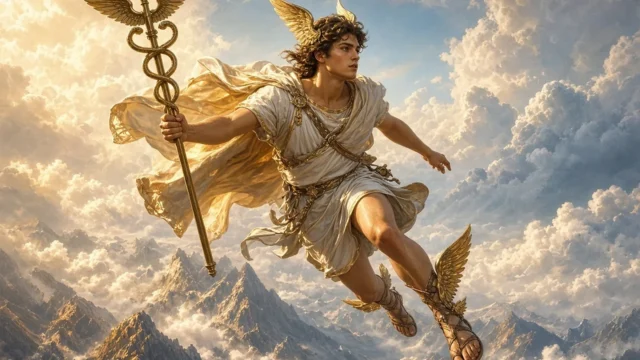
Eventually the gods reclaim him, and some versions have Hermes escort him back. The trick is significant because the king does not simply overpower Hades through strength; he exploits the value placed on ritual obligations and a ruler’s expectation that promises will be honored. The episode also demonstrates that being clever is not necessarily wise. Sisyphus wins temporary freedom but creates a larger challenge to divine authority and mortality.
Did Zeus personally invent the boulder punishment?
Modern retellings commonly present the boulder as the direct punishment imposed by Zeus for Sisyphus’s defiance. That is a reasonable summary of a widespread later interpretation, but not every ancient surviving passage spells out one single courtroom-style judgment scene. The earliest celebrated description in Homer focuses on what Odysseus witnesses in the underworld, while later material supplies competing explanations of the offense. Therefore the phrase “punished for cheating death” is helpful as a general retelling only when the source difference is acknowledged.
The myth is not a proof that ancient Greek people held a uniform criminal code for all legendary kings. The punishment’s image is what survived most powerfully: effort that promises completion but never achieves it. Some readers focus on its cruelty, while others see a caution against arrogance. It is possible to discuss both without claiming that an ancient poet published a precise list of legal charges and sentences.
Sisyphus versus Tantalus and Ixion: different eternal punishments
The Greek underworld contains other memorable examples of repeating suffering. Tantalus struggles to reach food or water that remains out of reach in famous accounts. Ixion is associated with a turning wheel. Sisyphus’s punishment differs because his effort brings the stone almost to a goal before it slips back. These figures are not interchangeable, even though they appear together in later descriptions of the dead and their sufferings.
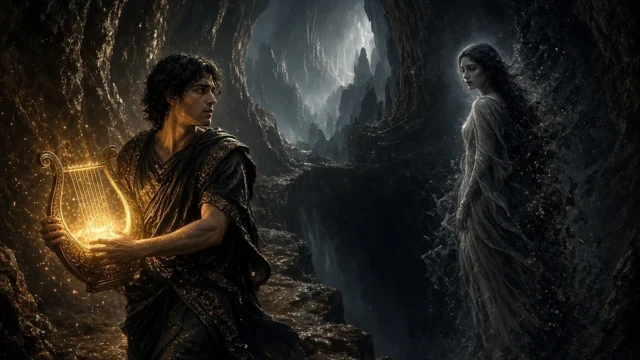
In Ovid’s Metamorphoses Book 10, the music of Orpheus briefly moves the underworld so powerfully that the torments pause: Sisyphus can rest on his stone. This is part of Orpheus’s story about recovering Eurydice, not evidence that Sisyphus’s sentence permanently ends. The detail links two familiar myths without merging their main plots. Readers looking for the story of the heavy boulder should start with Homer; those interested in the musician’s descent can follow Ovid.
What did Albert Camus mean by the Myth of Sisyphus?
In 1942, the French writer and philosopher Albert Camus published The Myth of Sisyphus, an essay using the ancient image to consider the absurd: the tension between human demands for meaning and a world that does not offer a guaranteed final answer. The repeated climb becomes a way of asking how a person responds to work and existence that may not provide a perfect resolution. Camus’s modern philosophical project is not the same text as Homer’s ancient epic.
One striking aspect of the essay is its attention to the moment when Sisyphus walks back down after the stone has fallen. A person may recognize the situation and still continue living and acting. Some readers take from this the possibility of conscious defiance or a self-chosen response. It is not accurate to say Homer explicitly taught Camus’s twentieth-century philosophy; the novelist and essayist gave a new interpretation to a much older literary image.
What does “Sisyphean task” mean in everyday English?
A Sisyphean task is a job that seems endless or futile because progress repeatedly disappears and must be recreated. Examples might include cleaning an area that is immediately made dirty again, repeatedly fixing a process without addressing its cause, or doing work that resets before completion. The expression refers to the myth’s endless stone-rolling, not to a literal punishment from a god in modern life.
The idiom can be useful, but it should be used with care: some repeated work is valuable, such as caring for a loved one or maintaining public services. The analogy is strongest when the effort is forced into an unproductive loop, not merely whenever a person has routine duties. The myth opens a larger question about changing the system that makes work seem futile. That practical reading is modern, whereas the ancient plot concerns a specific punished king.
Is Sisyphus the same as Atlas or Prometheus?
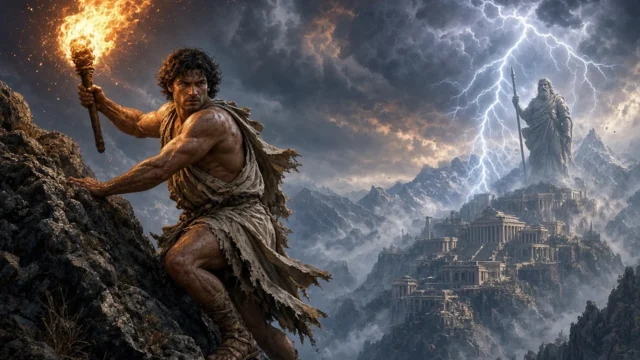
No. Atlas is associated with bearing the heavens in a major Greek tradition; that is not the same as pushing Sisyphus’s stone. Prometheus suffers a separate punishment involving an eagle and his liver after the theft of fire. Sisyphus is a legendary ruler who repeatedly tries to evade divine authority and finally pushes the same stone toward an unreachable summit. Their images can look similar in stylized fantasy posters, but their stories and primary sources are different.
It is also misleading to say Sisyphus pushed the entire planet Earth. Homer’s scene describes a large stone, not the Earth, moon or celestial sky. If an illustration shows a figure carrying a globe on his shoulders, it may be borrowing an Atlas-like visual instead. For accurate image SEO, the ALT description should mention a man pushing a boulder up a hill, which directly represents the Sisyphus myth.
Sisyphus story timeline and source map
| Stage | Event | Where it comes from |
|---|---|---|
| King | Sisyphus associated with Ephyra/Corinth | Apollodorus |
| Secret | Information about Zeus and Aegina | Later traditions |
| Death trick | Thanatos bound and released by Ares | Later fragments and summaries |
| Funeral trick | Return obtained through neglected rites | Later variants |
| Punishment | Boulder repeatedly rolls down | Homer, Odyssey 11 |
| Later philosophy | Camus interprets endless work | 1942 essay |
Five FAQs about Sisyphus
What was Sisyphus’s punishment?
He had to push a heavy boulder uphill forever, only for it to roll back before completion.
Why was Sisyphus punished?
Later traditions connect it to deception against the gods, including cheating or binding Death; Homer mainly describes the punishment itself.
Was Sisyphus a Greek god?
No. He is a legendary mortal king associated with Ephyra and Corinth.
Who was Thanatos in the Sisyphus story?
Thanatos personifies death; Hades is the separate ruler of the underworld.
What does Sisyphean mean?
It describes an apparently endless, frustrating task where hard-won progress repeatedly disappears.
Original sources and conclusion
The foundational boulder scene is Homer, Odyssey 11.593–600. The genealogy and sentence also appear in Apollodorus, Library 1.9.3. For later traditions involving the trapping of Death and return from Hades see Aeschylus, fragments and commentary on Sisyphus. Conclusion: the eternal boulder is ancient; the elaborate reasons for it belong to several traditions, while Camus supplies a much later philosophical reading. Updated 14 November 2026. Image is symbolic.







Share Your Opinion
Comments are closed on this post.