 Vista
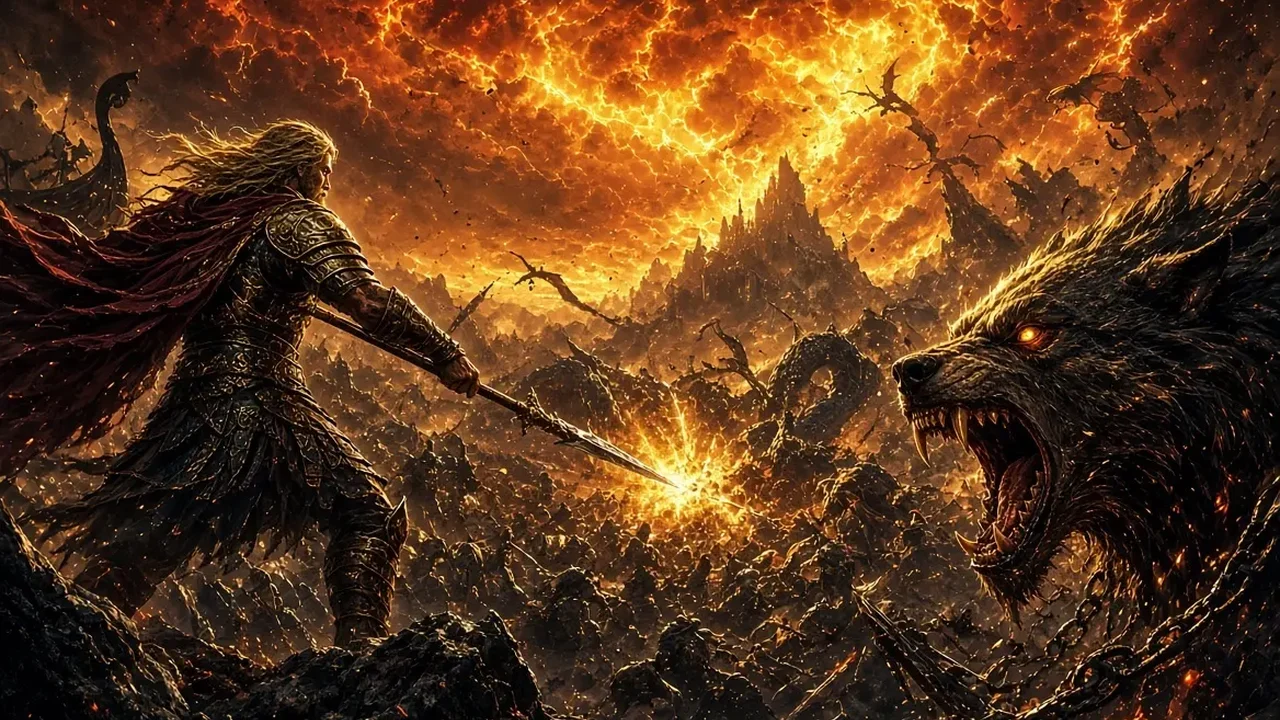
Ragnarök in Norse mythology is the foretold crisis in which the gods and their enemies fight, major figures die, and the world is consumed by destructive forces before a renewed world appears. Among its best-known events are the Fimbulwinter, the breaking of Fenrir’s bonds, Heimdall’s sounding of Gjallarhorn and the final struggles of Odin, Thor, Loki and their adversaries. Odin is swallowed by Fenrir, Thor kills Jörmungandr but dies from its venom, and in Snorri’s account Loki and Heimdall kill one another.
Searching for ‘What is Ragnarok?’, ‘Ragnarok Norse mythology timeline’, ‘Which Norse gods die?’, or Ragnarok images and wallpapers? This guide follows the broad sequence in the Poetic Edda and Prose Edda, while marking details that come from particular versions. It also explains why Ragnarök is not simply an eternal ending and why a superhero film or video-game adaptation cannot replace the medieval sources.
What Does Ragnarok Mean?
The Old Norse term Ragnarök is commonly connected with the fate or destiny of the divine powers. Popular descriptions often translate it simply as ‘the end of the world,’ which captures the scale of the catastrophe but leaves out the renewal that follows. The narratives are not presented as a single modern screenplay with a fixed release date or precisely numbered chapters. Poetic allusions and later prose explanations work together to give readers an outline of approaching doom.
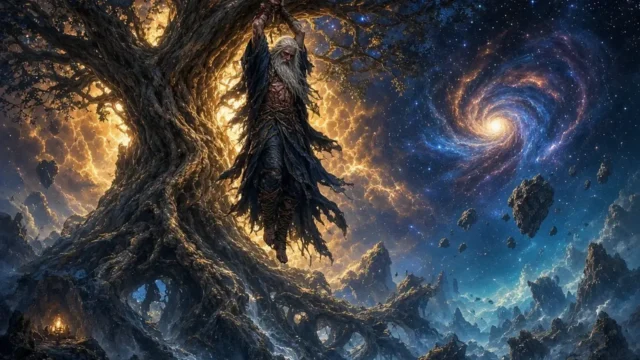
One reason Ragnarök is so memorable is that the gods do not fight unaware. There are prophecies and signs, and the characters confront a future they cannot fully escape. Odin’s search for knowledge becomes especially poignant in this setting. In some stories he knows significant things about the danger to come yet remains bound by the same fate that concerns everyone else. Thus the event is not only a battle, but a myth about destiny, resistance and what survives after catastrophe.
Fimbulwinter: The First Warning Signs
Fimbulwinter, a terrible sequence of winters, precedes the final upheaval in familiar accounts. Seasons and social order break down, and destructive violence spreads among people. The myth uses climatic and moral collapse to signal that the usual order is coming apart. Scenes of snow-covered settlements under an ominous dark sky are visually effective, but they are an artistic way to communicate the narrative rather than evidence for a dated prehistoric weather event.
Another dramatic sign involves the cosmic wolves connected with the sun and moon. Different names appear across the traditions, and summaries sometimes confuse Fenrir with the wolves pursuing celestial bodies. A careful explanation does not automatically treat every wolf as one identical character. For readers asking what happens before Ragnarök, the correct sequence begins with warnings and disturbances, then proceeds to the breaking of bonds and gathering of combatants.
Fenrir Breaks Free and Jormungandr Rises
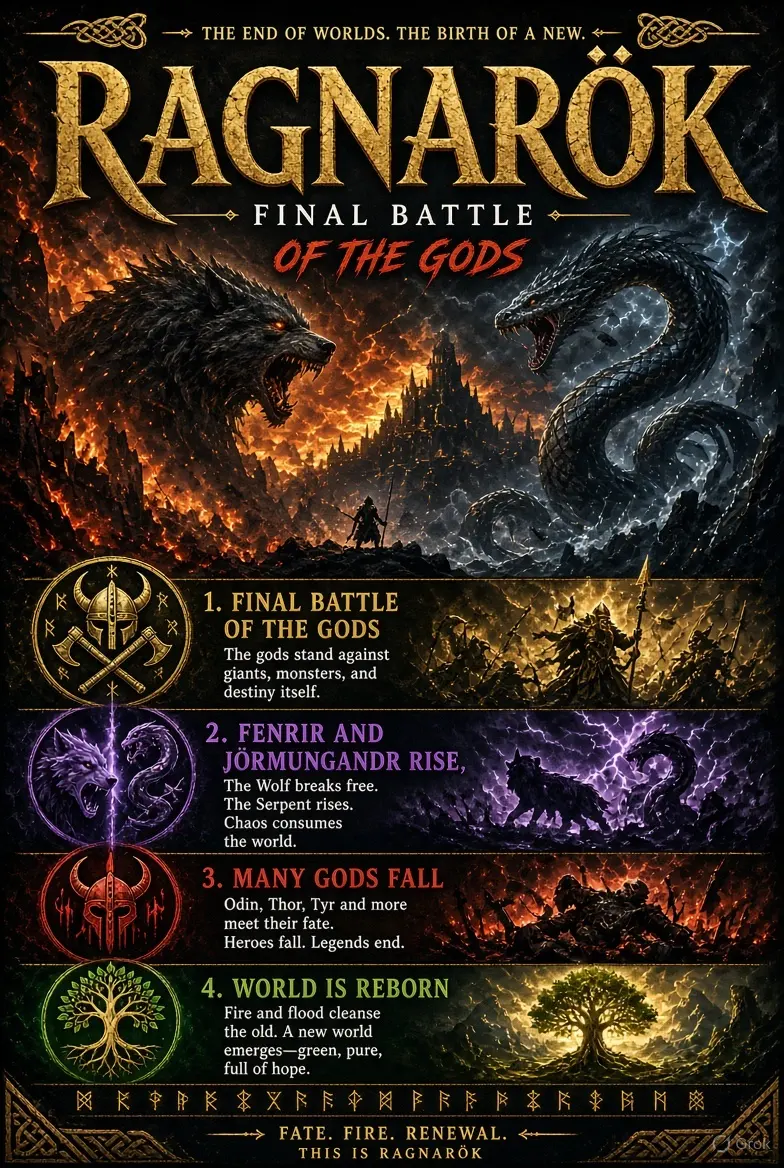
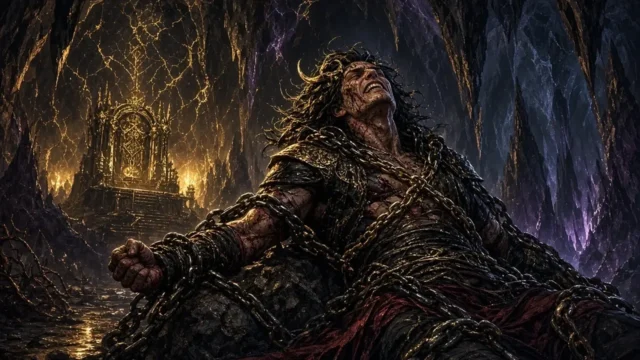
Fenrir’s escape completes an earlier story. The wolf was bound with Gleipnir after the god Týr placed his hand in its mouth as a pledge and lost it when the gods refused to release their captive. At Ragnarök, his bonds finally break. The world serpent Jörmungandr also emerges in cosmic turmoil, threatening the world that it encircles. These two figures belong to the family of Loki and Angrboða, and each has an established role in the final encounters.
Fenrir’s freedom and the serpent’s arrival represent threats that even the gods’ previous actions have not permanently eliminated. This is why understanding the binding of Fenrir enriches the end-time story: a decision made much earlier returns at the worst possible moment. Artwork may show a single gigantic wolf beside a sea serpent, but a useful caption should distinguish who each creature is and which god it will confront.
Heimdall, Gjallarhorn, Naglfar and Surtr
Heimdall, the watcher associated with the bridge Bifröst, sounds Gjallarhorn to announce the crisis in familiar accounts. The ship Naglfar is connected with the gathering enemies, and Surtr comes from the fiery realm associated with Muspell. The image of an approaching fire giant with a blazing sword is one of the most striking motifs in the final battle. Yet not every colorful illustration of a horn, bridge and ship can be tied to a single line of ancient poetry.
The names and movements of the combatants vary somewhat in poetic and prose descriptions. It helps to think of these sources as overlapping views rather than one flawlessly consistent map. In an informational timeline, say what the event is, who is involved and which text supplies the detail. Avoid imaginary ’10:00 AM’ battle schedules or claims about a definite historical year for Ragnarök. It is a mythological sequence, not an event in a modern calendar.
Who Kills Odin? Fenrir and Vidar
Odin faces the wolf Fenrir and is swallowed. His son Víðarr subsequently kills the wolf and avenges him. This is among the clearest, most frequently asked questions about Ragnarök, partly because Odin is otherwise described as exceptionally wise and powerful. The end shows that foreknowledge and authority cannot guarantee survival when the cosmos itself collapses. The scene is often illustrated as an impossible difference in scale between an old god and a gigantic wolf.
Do not confuse Fenrir’s death with Thor’s final battle. Fenrir’s story centers on Odin and Víðarr; Thor has a different enemy. Some modern films and games use their own genealogy, timelines or dramatic reversals. Readers are welcome to enjoy those versions, but the source-based account should state the older outcome first and then explicitly label later alterations as adaptations.
How Does Thor Die? Jormungandr’s Venom
Thor confronts Jörmungandr, the world serpent. He kills it, but the creature’s venom kills him as well after he takes nine steps away. The cruel irony is that the god of immense strength wins the physical contest and still cannot escape the fatal consequences. His death has a different emotional force from Odin’s defeat: a victory becomes a tragedy almost immediately.
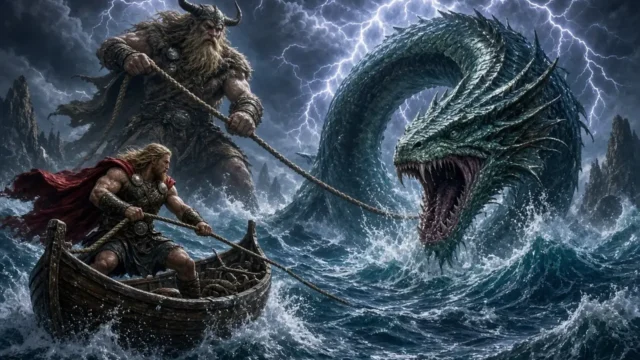
Another episode in Norse myth describes Thor fishing for the serpent alongside the giant Hymir. That is not the final Ragnarök confrontation. Good article illustrations can distinguish the earlier fishing adventure from Thor’s last fight using the setting and caption. A user searching ‘Who killed Thor in Norse mythology?’ deserves the direct answer—Jörmungandr’s poison—without having to click through a misleading headline about Thor versus Zeus.
Loki, Heimdall, Freyr and Surtr: Other Final Duels
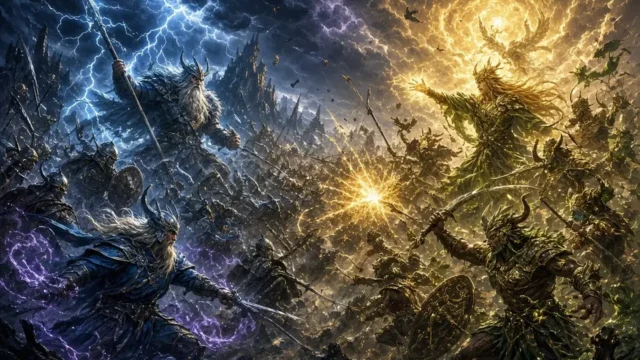
In Snorri’s version, Loki and Heimdall kill each other. Freyr confronts Surtr and falls; the loss of Freyr’s sword is relevant background in a familiar account. Týr and the hound Garmr also fight to mutual destruction. These episodes show that Ragnarök is not one duel between a chosen hero and a main villain. It is a network of fated clashes that draws in gods, giants, monsters and other beings.
There is a danger in turning that network into a ‘strongest god wins’ ranking. Ancient sources are interested in prophecy, sacrifice and cosmic transition rather than measurable combat power. They do not give numerical hit points, damage values or official versus rankings. A comparative chart can still be useful if it lists combatants and outcomes without inventing precise strengths or pretending every version of the tradition tells the same sequence.
Does the World End Forever? Survivors and Rebirth
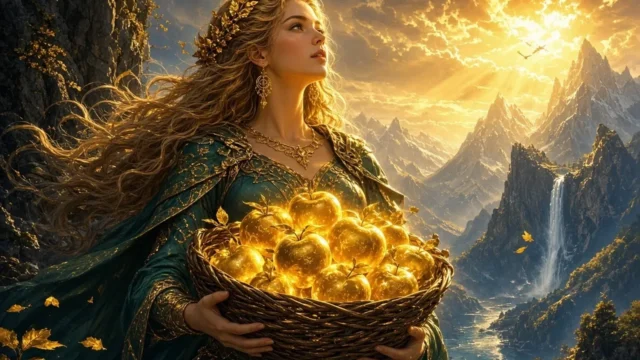
After destruction and fire, the sources speak of the world arising again. The landscape becomes green, some divine figures return or survive, and new life follows catastrophe. Baldr and Höðr appear in accounts of the world after the battle; Víðarr and Váli are among surviving figures, while Thor’s sons Magni and Móði take possession of Mjölnir. A human pair, Líf and Lífþrasir, is also connected with the renewal of humanity.
This ending matters. Calling Ragnarök ‘the apocalypse where everybody dies’ misses the part of the myth that transforms loss into continuity. The theme is not that nothing remains, but that a world changes and begins again. Different passages do not always align perfectly, so a careful guide presents the broad picture and admits the limits of the record. In fantasy illustrations, the scene after the fire deserves as much attention as the flaming battlefield.
Is Ragnarok in Marvel and God of War the Same Story?
Modern films, comics and video games borrow characters such as Thor, Loki, Odin and Surtr and rearrange events to suit their fictional worlds. A character may survive, change sides or have different relatives. This creative borrowing helps popularize Norse mythology but can make it difficult to know which details are ancient. Readers asking ‘Is Ragnarok real?’ or ‘Does Marvel follow the mythology?’ should understand that the surviving medieval stories are literary sources, while modern franchises are adaptations.
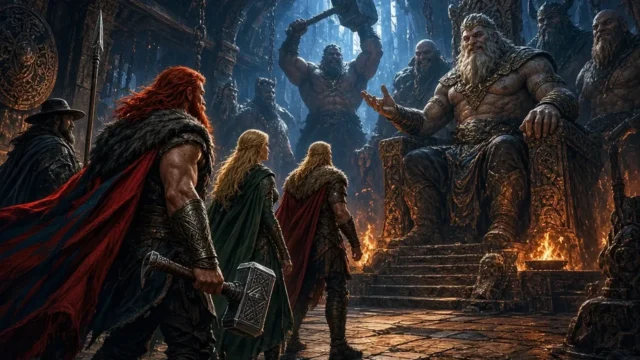
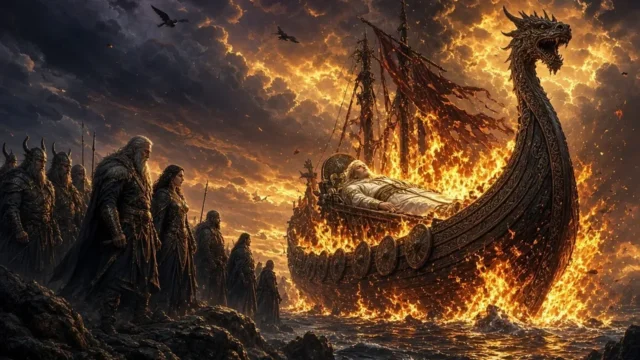
The most reliable starting points are the poem Völuspá, material in Vafþrúðnismál and the account in Snorri’s Gylfaginning. Their medieval written forms preserve older and sometimes differing traditions. Our colorful Ragnarök images are artistic interpretations of such stories, not photographs of an actual event. Use them to recognize the characters and their roles, then check names and outcomes in the sources.
Frequently Asked Questions
What is Ragnarok in Norse mythology?
The prophesied destruction and renewal of the mythological world involving major gods, monsters and giants.
Which god dies to Fenrir?
Odin is swallowed by Fenrir; Odin’s son Víðarr later kills the wolf.
How does Thor die at Ragnarok?
Thor kills Jörmungandr, but the serpent’s venom kills him after nine steps.
Does Loki die at Ragnarok?
In Snorri’s account Loki and Heimdall kill each other.
Does anybody survive Ragnarok?
Yes. The sources describe surviving gods, returning figures and the human pair Líf and Lífþrasir in a renewed world.
Conclusion
Conclusion: Ragnarök brings together the stories of Odin, Thor, Loki, Fenrir and Jörmungandr in one cosmic crisis. The battles are famous, but the rebirth afterward is equally important. The most helpful approach is to read each scene with its source in mind and treat dramatic artwork as a guide to the imagination, not proof of a literal event.
Sources: World History Encyclopedia; Oxford — Snorra Edda; Scholarly edition of Gylfaginning. Reviewed 14 November 2026. Artwork depicts myths, not historical events.






Share Your Opinion
Comments are closed on this post.