 Vista

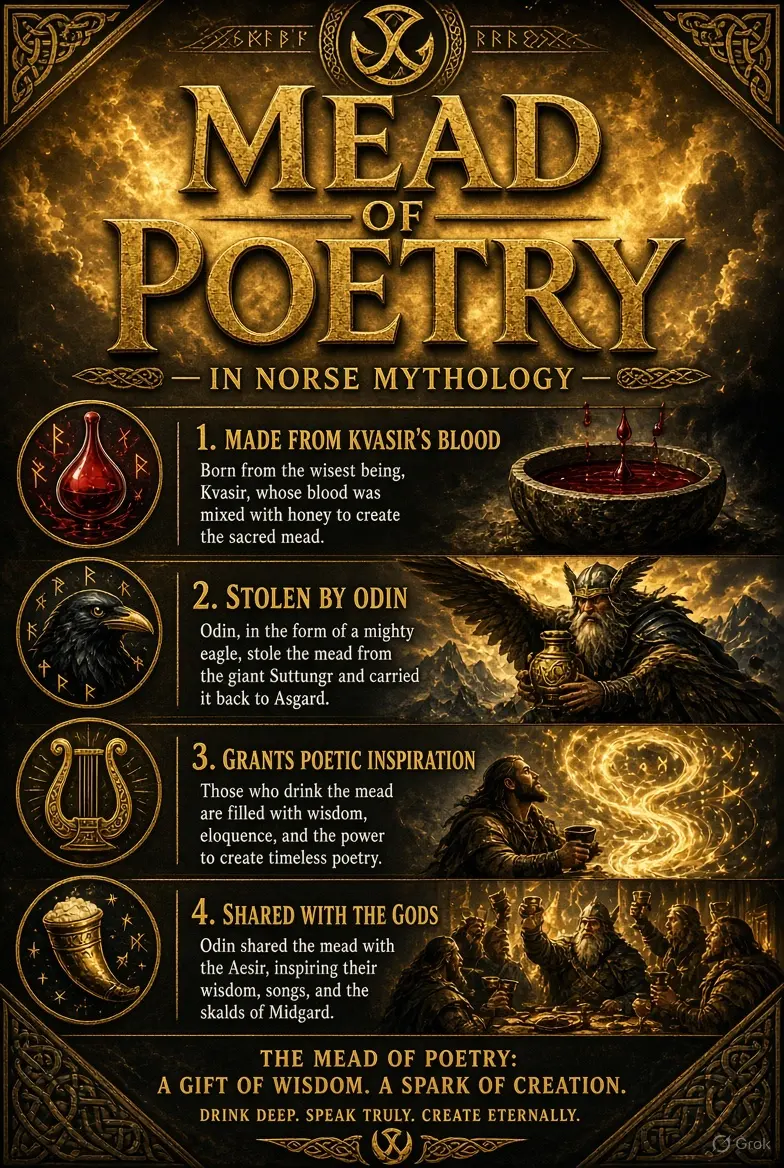
The Mead of Poetry is an extraordinary drink in Norse mythology said to grant poetic skill and wisdom to those who taste it. In Snorri’s Skáldskaparmál, the exceptionally wise Kvasir is murdered by dwarfs who mix his blood with honey to create the mead. The drink eventually comes into the possession of the jötunn Suttungr. Odin seeks it, approaches under the name Bölverkr, reaches Gunnlöð in the mountain Hnitbjörg and escapes with the mead in eagle form. The tale links poetry, violence, bargaining and deception rather than simply prescribing a beverage recipe.
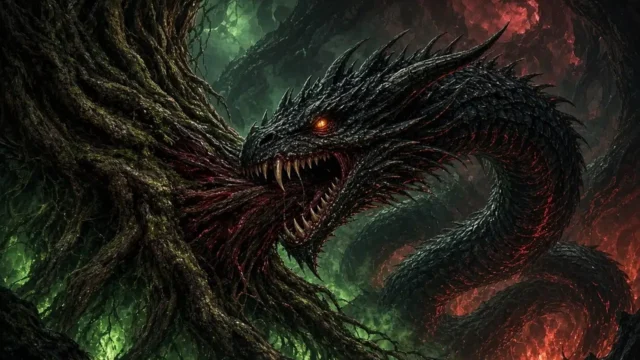
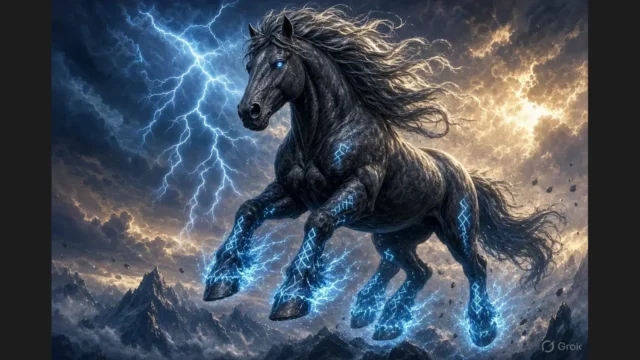
This guide explains Mead of Poetry Norse mythology, Kvasir’s disputed origins, who the dwarfs were, why Suttung possessed the mead, Gunnlöð’s role, Odin’s transformation and how the drink became connected with talented and mediocre poets. The artwork is fantasy-inspired; no physical elixir is proven to grant literary genius.
What Is the Mead of Poetry?
Mead is an alcoholic drink historically associated with fermented honey, but the mythical Mead of Poetry is not merely a remarkable brand of ordinary beverage. In the Prose Edda, it contains the blood of Kvasir and grants skill in poetry or wisdom to whoever drinks it. This is supernatural storytelling, not a medical or educational claim about alcohol improving cognitive performance. Ordinary intoxication can impair judgment, and the myth should not be marketed as an instruction to drink alcohol to write better. The narrative asks where poetic inspiration comes from and why it is treated as a valuable possession that powerful figures seek. An illustration may show glowing liquid in ornate jars, but the exact color, chemical contents, and amount are not preserved as reproducible ancient recipes. The best beginner explanation identifies the drink as a magical substance connected with words and knowledge, while recognizing that its origin story involves death and morally complex actions.
Kvasir: How Did He Become So Wise?
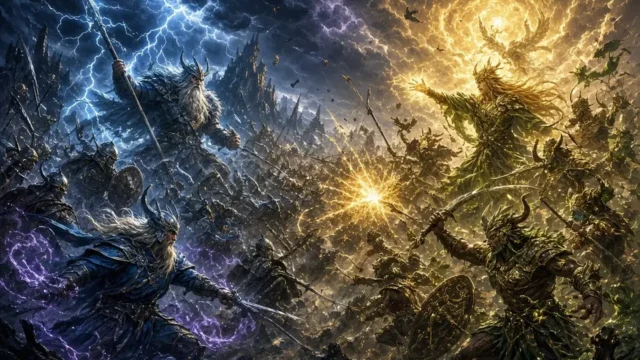
In Skáldskaparmál, the gods of the Æsir and Vanir establish peace and create Kvasir from their combined spittle. He becomes extraordinarily wise and travels answering difficult questions. Yet Ynglinga saga preserves a different account in which Kvasir is an exceptionally intelligent hostage sent from the Vanir to the Æsir. These versions should not be silently merged. It would be misleading to claim one origin is identically stated in every medieval source. The overlap is that Kvasir is associated with great wisdom and a wider network of relations among the divine groups. When an article about the Æsir–Vanir War links to the Mead of Poetry, this is an excellent point of connection. A source-aware poster can say ‘Skáldskaparmál: born from the peace-making spittle’ and add that another prose version differs. The unusual event is part of a myth, not an early scientific experiment demonstrating how human intelligence can be manufactured.
Why Do the Dwarfs Fjalar and Galar Murder Kvasir?
Kvasir’s travels bring him to two dwarfs named Fjalarr and Galarr. They kill him, collect his blood and mix it with honey. The resulting mead is stored in vessels named Són and Boðn and a kettle called Óðrerir in the familiar Prose Edda account. When asked what happened, the dwarfs deceptively claim that Kvasir was overwhelmed by his own wisdom, a grim joke at the center of the tale. A simple summary might describe the dwarfs as skilled craftsmen seeking knowledge, but it is important not to erase the actual murder or give their actions a heroic motive unsupported by the narrative. Kvasir does not voluntarily donate a few drops of blood to help the gods. A factual infographic can identify the pair and the vessels, but should not turn the gruesome episode into a safe brewing recipe. These details show how the story binds creativity to exploitation and deceit.
Gilling, His Wife and the Transfer to Suttungr
The same dwarfs later kill the jötunn Gilling and, according to Snorri, his wife as well. Gilling’s son Suttungr is enraged and traps the dwarfs on a dangerous rock exposed to the sea. To save themselves they offer him the Mead of Poetry as compensation for the deaths. This is how the magical drink passes from the dwarfs to Suttungr. Some retellings skip the second killing and say Odin simply steals the mead from its original makers. That loses an important link in the chain of ownership and guilt. The episode is full of violence and bargaining, and not all parties behave honorably. An accurate timeline can trace the drink from Kvasir’s death to the dwarfs and then to Suttungr without inventing a peaceful sale or a modern contractual deed. The mead becomes a coveted treasure precisely because no one can obtain it without danger.
Where Is Hnitbjörg, and Who Is Gunnlöð?
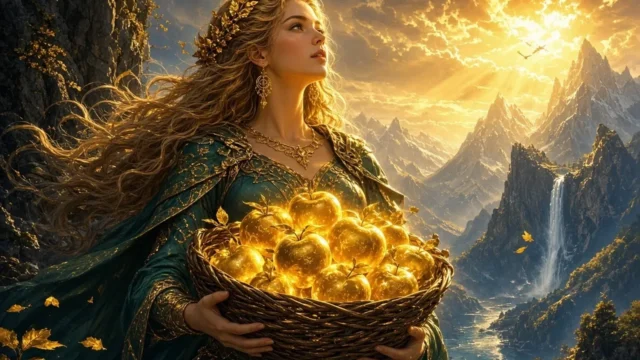
Suttungr places the mead inside Hnitbjörg, a mountain or rock setting in the story, and entrusts its protection to his daughter Gunnlöð. Her role is central to Odin’s eventual access: she is not merely a decorative woman standing beside a treasure. The Prose Edda describes Odin reaching her after a difficult approach. In Hávamál, Odin’s words create another literary perspective on his encounter with her and its emotional consequences. Modern art often portrays Gunnlöð as a golden-haired giantess holding a glowing cup, but no one medieval source gives a universally fixed appearance for her. Describing her as Suttungr’s daughter and guardian of the mead is secure. Calling her Odin’s queen or pretending every version portrays their encounter as a simple fairytale romance is not. A responsible article should be alert to the power, seduction and deception within the story instead of making a forced happily-ever-after ending.
Odin Becomes Bölverkr and Makes a Bargain with Baugi
Odin does not simply walk through the mountain gate using a magic key. He adopts the name Bölverkr and engineers an encounter with workers employed by Baugi, Suttungr’s brother. After manipulating the situation, he offers to work in return for access to the drink. Baugi eventually helps him approach the hidden mountain. Odin uses a drill called Rati to make a passage through the rock, and he changes into a snake to enter. This intricate sequence combines trickery, labor, risk and transformation. Modern summaries often shorten it to ‘Odin teleports into the cave’, but that erases several memorable source details. A useful poster can show the disguise, drill, snake form and guarded mead in small labeled panels, without presenting the visuals as a historical diagram of an actual mine. For readers interested in Odin’s powers, the episode illustrates cunning rather than a standardized list of video-game spells.
Gunnlöð, the Three Drinks and Odin’s Escape
Inside Hnitbjörg, Odin spends three nights with Gunnlöð, after which she grants him three drinks of the mead. Odin uses those drinks to empty the vessels entirely, rather than taking three ordinary mouthfuls. He then escapes by changing into an eagle. Suttungr pursues him in eagle form as Odin flies toward Asgard. The gods have prepared containers for the recovered mead and Odin deposits it there. Some of the liquid falls behind him during the chase; Snorri uses this to explain a lesser share of inspiration available to poor poets. It is a strange and morally uneasy story: Odin acquires creative power through cleverness and an exploitative encounter, not purely by teaching and study. An educational article should be careful not to romanticize deceiving Gunnlöð or pretend the text describes a modern consensual contract with fully understood consequences. A cinematic eagle escape can be used as art, with its source explicitly named.
Why Is Odin Associated with Poetry and Wisdom?
Odin is repeatedly connected with knowledge acquired at great cost. Other myths describe him seeking the wisdom of Mímir, sacrificing himself on Yggdrasil to gain runes and asking dangerous questions of prophetic beings. The Mead of Poetry fits this pattern: he gains a precious form of inspiration by crossing boundaries and taking risks. Yet the method is not morally spotless. The story’s mixture of intelligence, power and deception has interested readers for centuries. It also helps explain why early poetic language uses elaborate references to Odin and the mead when describing poetry itself. Modern content sometimes presents a neat ‘Odin learned one poem and became a god of wisdom’ explanation. The literary tradition is far richer, with multiple episodes exploring different kinds of knowledge. A strong image article can link the mead to runes and the wisdom quest without claiming all these objects were made from the same mythical substance.
Mead of Poetry vs Modern ‘Magic Elixir’ Products
No real bottle of mead has been shown to grant supernatural eloquence, memory or intelligence through Kvasir’s blood. The tale is a mythic account, not a formula for an alcoholic health supplement. Nor should it be used to justify consuming unsafe homemade drinks or unknown herbal mixtures. Searches for ‘Mead of Poetry recipe’, ‘Odin poetry potion’ and ‘Kvasir blood meaning’ mix literary curiosity with practical beverage questions. An article about the myth should focus on the narrative and distinguish it from historical mead-making, which is a separate subject. The poetry-related idea can instead inspire creative activities such as writing, reciting older verses or studying traditional poetic forms. A poster with a vessel and feathered Odin should not include an unverified promise that drinking a liquid increases creativity by a measurable percentage. Accuracy matters especially when mythology is mixed with claims about health and performance.
Frequently Asked Questions
What is the Mead of Poetry?
A supernatural drink said to confer poetic skill and wisdom in the Prose Edda.
Who was Kvasir?
An exceptionally wise figure whose blood is used to make the mead after his murder.
Who killed Kvasir?
The dwarfs Fjalarr and Galarr in Snorri’s account.
How did Suttungr get the mead?
The dwarfs gave it to him as compensation after killing his father Gilling and Gilling’s wife.
Who guarded the mead?
Suttungr’s daughter Gunnlöð inside Hnitbjörg.
How did Odin steal the mead?
He used the name Bölverkr, entered the mountain through a drilled hole in snake form, drank the mead and escaped as an eagle.
Conclusion
The Mead of Poetry explains inspiration through a story of wisdom, murder, difficult bargains and Odin’s shape-shifting escape. Kvasir and Gunnlöð are central, and the varying accounts of Kvasir’s origin remind us that the Norse sources do not tell a single perfectly uniform story.
Primary sources and art disclosure
Snorri: Skáldskaparmál, Kvasir and the Mead of Poetry; Snorri: Hávamál and Odin’s pursuit of the mead; Snorri: Ynglinga saga, variant Kvasir tradition.
Reviewed 15 November 2026. Artwork shows mythology rather than documentary events.





















Share Your Opinion
Comments are closed on this post.