 Vista
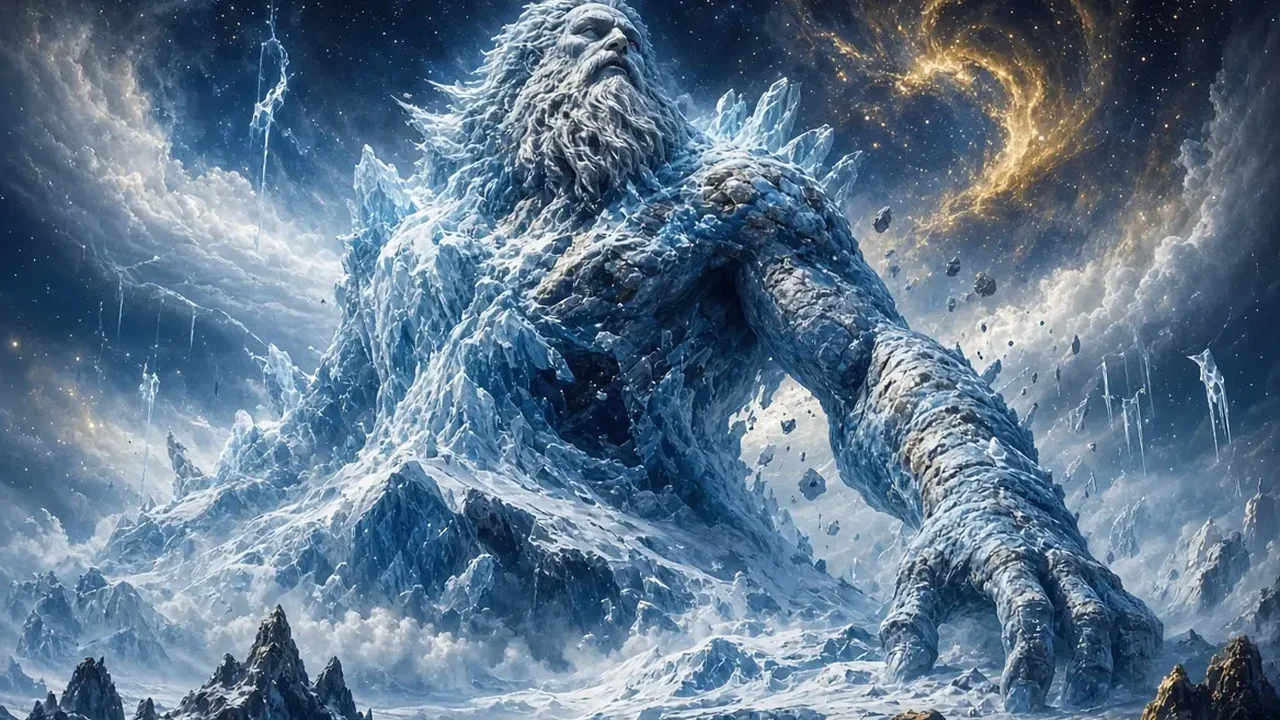
Ymir is the primordial being from whom the world is shaped in the familiar Norse creation story. In Snorri’s Prose Edda, the meeting of frost from Niflheim and warmth from Muspelheim within Ginnungagap gives rise to Ymir, who belongs to the ancient lineage of the jötnar. A primeval cow, Auðhumla (Audhumla), nourishes him with milk and licks a frost-covered salt stone, revealing Búri. Búri’s descendants include Odin, Vili and Vé, who kill Ymir and make the world from his body. This is mythic cosmology, not a scientific account of geology or human evolution.
Searching for Ymir Norse mythology, first giant Ymir, Audhumla cow, how Odin created Midgard, Ginnungagap or Ymir body world map? This guide traces the story in order, separates Ymir from Búri, and explains the roles of the jötnar, gods and first humans.
Who Is Ymir, the First Being in Norse Creation?
Ymir is called the first primordial giant in many English summaries, but the Old Norse figure is better understood as an early ancestor of the jötnar. The name Aurgelmir occurs in related poetic material, while Snorri uses Ymir in the creation account. Calling him a ‘giant’ is convenient, yet not every jötunn in Norse myths is described as physically enormous. What makes Ymir extraordinary is the way his body becomes the material of the world, not a scientifically known height in metres. In the beginning there are no ordinary human settlements, oceans, mountains or settled gods’ kingdoms as later stories imagine them. Instead the narrative creates an archaic state in which life and matter emerge. A painting showing an immense frost-covered figure in a dark void can communicate that beginning, though every exact body shape and color is artistic. It should not be claimed as a preserved Viking-age photograph or literal physical model of the universe.
Ginnungagap, Niflheim and Muspelheim: Where Does Life Begin?
The Prose Edda describes Ginnungagap as the great gap or opening between regions associated with cold and heat. Ice and rime from Niflheim meet warmth and sparks associated with Muspelheim. From the thawing moisture comes the first life, Ymir, and the story introduces a cosmic contrast that later mythology repeatedly explores. Some modern diagrams show two perfectly symmetrical kingdoms with a horizontal laboratory-like line between them. The literature supplies poetic directions and images, not a measured diagram with modern temperatures or a scientifically established creation date. Nor should one call Ginnungagap a black hole or physical space-time tunnel without making clear that such comparisons are modern metaphors. It is a mythic condition of the beginning, in which heat and cold make the emergence of a being imaginable. An educational poster can convey frost, fire and an open gap without inventing numerical forces or claiming that ancient storytellers described the modern Big Bang.
Who Is Auðhumla? The Cow That Fed Ymir
Auðhumla is the extraordinary cow who appears in the creation account and feeds Ymir with four streams of milk. Her own sustenance comes from licking salty, frost-covered stones. Over several days this licking reveals another being within the stones. The image is one of the most memorable and visually surprising details in Norse cosmology, but it is an impossible mythic scene rather than a real animal husbandry method. Online summaries sometimes say Audhumla is Ymir’s biological mother or that she gave birth to Odin directly. Neither statement matches the familiar prose narrative. She nourishes Ymir and reveals Búri, starting the genealogical chain that leads to Odin. A clear illustration might show the cow beside a figure formed from ice, while captions should avoid confusing the cow’s milk with oceans or treating the frost stone as an excavated artifact. The literary picture expresses nourishment and the emergence of new divine ancestry.
Búri, Borr, Bestla and the Birth of Odin’s Family
The being revealed by Auðhumla’s licking is Búri. He has a son named Borr, and Borr marries Bestla, a daughter of the jötunn Bölþorn in Snorri’s account. They become the parents of Odin, Vili and Vé. The genealogy is useful because it shows that divine ancestry and jötunn connections are intertwined from the beginning. Odin is not born directly from the cow, nor is Ymir simply his biological father. Several fantasy family trees collapse the names Búri and Borr because they look similar in translation. In fact, they occupy successive generations. Búri is the early ancestor, Borr is his son, and Odin belongs to the generation after that. A beginner’s infographic should keep those lines separate and label Bestla accurately. That gives readers a clearer relationship between the primordial jötunn tradition and the later divine figures who reshape the cosmos.
How Do Odin, Vili and Vé Kill Ymir?
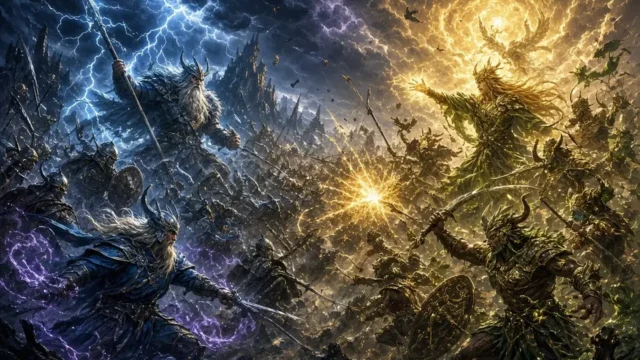
In Gylfaginning, Borr’s three sons kill Ymir, setting off a flood of blood. The violence is a major part of the creation story. Most of the frost-giant line is swept away, while Bergelmir and his family survive in a vessel or trough-like refuge, according to the source tradition. Modern retellings sometimes turn this into an enormous naval battle between organized nations, but the surviving prose does not narrate such a cinematic campaign. Another mistake is to say that Thor kills Ymir or that Odin alone performs the entire act. The account names Odin alongside Vili and Vé. The event is not a historical massacre that archaeologists can date. It belongs to primordial storytelling about the transformation of an earlier being into the world. Because the story involves death and the destruction of life, a responsible children’s version can explain the outline without graphic detail while retaining the role of the three brothers.
The World Made from Ymir’s Body: Earth, Sea, Mountains and Sky
The creation account maps parts of Ymir’s body onto the world. His flesh becomes the earth; his blood becomes the sea and waters; his bones form mountains and rocks; smaller fragments including teeth create stones; his skull becomes the sky, and his brain becomes clouds. These are among the most memorable examples of a mythic body transformed into a cosmos. They also invite exaggerated claims, such as identifying a particular real mountain as Ymir’s right tooth or calculating how many litres of blood could fill the oceans. No such physical measurement is supported by the text. The imaginative picture is more meaningful as a way of connecting the human body with the structure of the world. A visual guide can depict the correspondences with a labelled diagram, provided it says they are elements of Norse mythology and not geological evidence. Readers searching for ‘Ymir body world creation chart’ especially benefit from clear labels rather than unsupported science.
What Are Ymir’s Eyelashes and the Origin of Midgard?
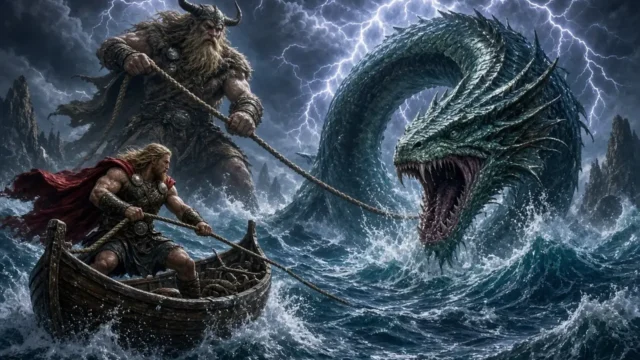
Snorri explains that the gods use Ymir’s eyelashes or brows to form an enclosure against the dangerous outer beings, producing Midgard, the space associated with human life. Different translations may render the body part as eyebrows or eyelashes, so a source-based caption should not pretend there is no variation. The important narrative function is protection and boundary-making. Midgard is not simply an ordinary city beside the palace of Asgard; it represents the human world within mythic cosmology. Later stories include the serpent Jörmungandr around the human sphere, showing how the concept of a defended centre remains important. A drawing may show a circular barrier, but its architecture, exact circumference and placement within a nine-world chart are modern reconstruction. The myth’s emphasis is that the gods shape a habitable place from the earlier giant’s remains and protect it against external threats.
Are Ymir and the First Humans Ask and Embla the Same?
No. Ymir precedes the creation of the world in the familiar story. The first humans, Ask and Embla, appear in a separate episode in which gods encounter wood or tree material and grant life and human capacities. The poetic and prose traditions differ in how they name the divine contributors and describe the gifts. Combining the human creation scene with Ymir’s birth can be a useful infographic sequence, but it should not claim that Ymir himself is the first ordinary man or that Audhumla is the mother of Ask and Embla. The old stories use different narrative stages: primordial matter, the first lineages, the transformation of Ymir and the emergence of humanity. These stages reflect mythic imagination, not the chronology of evolutionary biology. An article aiming at global search visitors should acknowledge that distinction explicitly rather than present the account as a scientific alternative to evidence-based human origins.
Ymir Images, Art and Differences from Modern Games
Searchers often arrive for ‘Ymir frost giant wallpaper’, ‘Norse creation story pictures’, ‘Audhumla cow art’ or ‘Ymir Odin Vili Ve infographic’. A featured image showing ice and an immense primordial figure can immediately establish the atmosphere. An internal poster may depict the gap, cow, family line and major body-to-world correspondences. Yet online games sometimes give Ymir extra elemental powers, battle armor or an exact physical size. Those belong to creative adaptations. The Old Norse texts are more interested in beginnings, ancestors and the making of a habitable world. Good ALT text identifies the actual scene shown—perhaps Ymir in icy Ginnungagap—without listing every keyword or declaring an ‘actual photo of the first giant’. The same applies to comparisons with creation stories from other cultures: parallels can be interesting, but should never be stated as a documented historical meeting of supernatural characters.
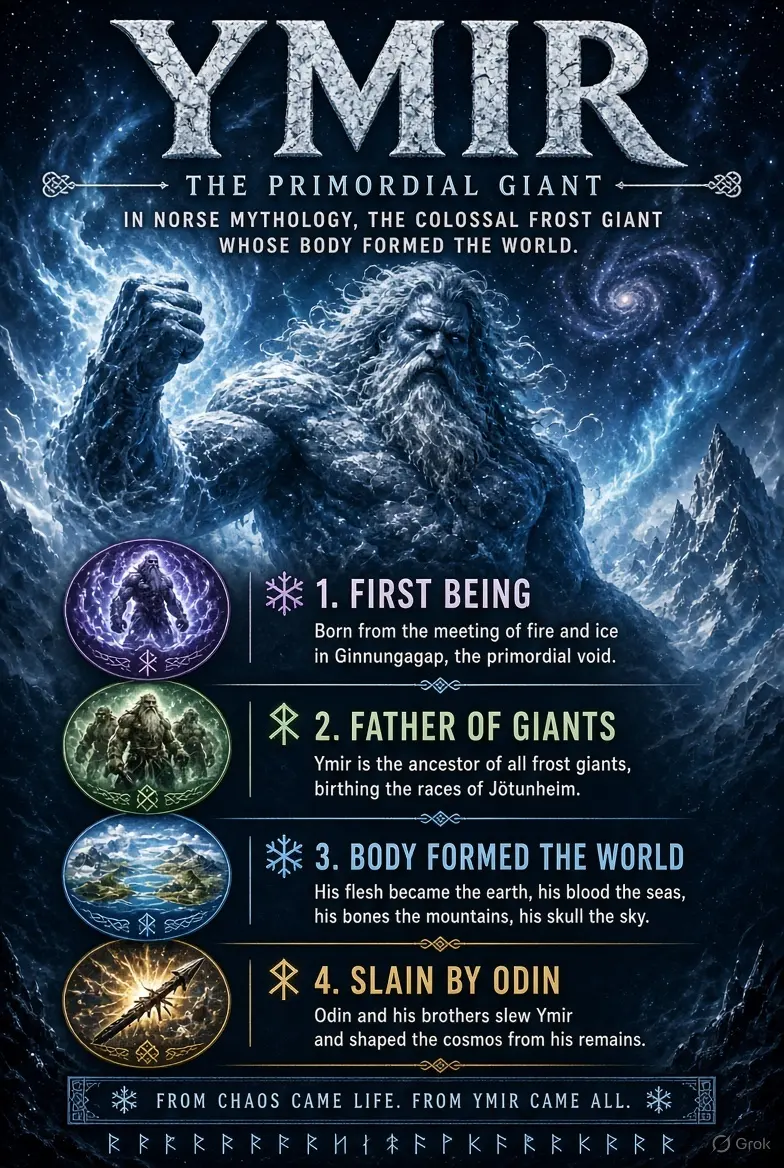
Frequently Asked Questions
Who was Ymir in Norse mythology?
A primordial being associated with the early jötnar, whose body becomes material for the created world.
Who fed Ymir?
The mythic cow Auðhumla nourished him with milk.
Who was Búri?
An early ancestor revealed when Auðhumla licked frost-covered salty stones.
Who killed Ymir?
Odin, Vili and Vé in Snorri’s creation narrative.
How was the world made from Ymir?
His flesh became earth, blood waters, bones mountains, skull sky and brain clouds.
Was Ymir the first human?
No. Ask and Embla belong to a later, separate human creation episode.
Conclusion
Ymir’s story links ice and fire, a nourishing cow, the ancestry of Odin and the transformation of one primordial being into a world. Those images are powerful, but the creation tale should be read as mythology rather than a historical or scientific measurement of the earth.
Sources and artwork notice
Prose Edda: Ymir, Audhumla, Búri and creation; The Elder and Younger Eddas: Creation story; Völuspá and the beginning of the world.
Reviewed 15 November 2026. Visuals are artistic mythology, not scientific diagrams.








Share Your Opinion
Comments are closed on this post.