 Vista

Fact review: 14 November 2026
The Nine Realms of Norse mythology are the worlds commonly associated with gods, humans, giants, elves, dwarfs and the dead. A popular list names Asgard, Midgard, Vanaheim, Alfheim, Jotunheim, Svartalfheim, Niflheim, Muspelheim and Hel. But here is the crucial fact many attractive posters leave out: medieval Norse poems refer to nine worlds without offering one complete official list of their names or a single exact Yggdrasil map.
This image-rich guide explains the frequently used names, what is actually in the older sources, why some reconstructions differ and how to read Nine Realms charts without confusing movie and game designs with the Norse texts.
Why Do We Call Them the Nine Realms?
The phrase ‘nine worlds’ appears in the Eddic tradition, including Völuspá and Vafþrúðnismál. Those texts establish the importance of the number nine within Norse poetic cosmology. What they do not give is a tidy classroom chart naming every realm and locating them as numbered circles. Most diagrams on the web are teaching reconstructions assembled from different places mentioned in different texts. That does not mean the names themselves are fabricated; it means the neat grouping came later.
This distinction matters for someone searching ‘Nine Realms Norse mythology map’. An image can be gorgeous and helpful yet still be speculative. Instead of presenting it as a scan of an ancient Viking manuscript, label it as a modern illustrated reconstruction. That allows artists to make a coherent visual world while keeping the reader aware that the traditions are fragmentary.
Asgard and Midgard: Gods and Human Beings
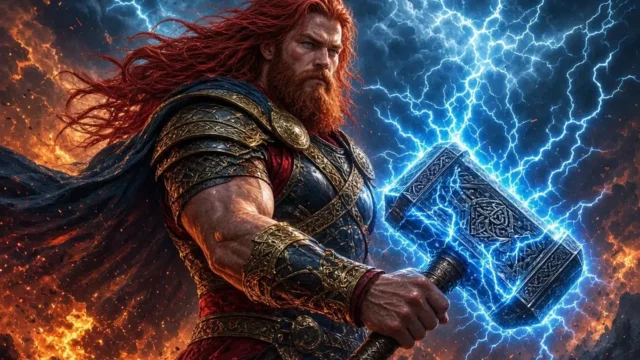
Asgard is most closely associated with the Æsir gods, including Odin and Thor, in familiar prose accounts. Midgard is the human world, bounded in mythic descriptions by protective arrangements and the sea associated with the serpent Jörmungandr. The names are often rendered in English as the enclosure of the Æsir and the middle enclosure, but an exact English translation should not be mistaken for a full architectural blueprint of either place.
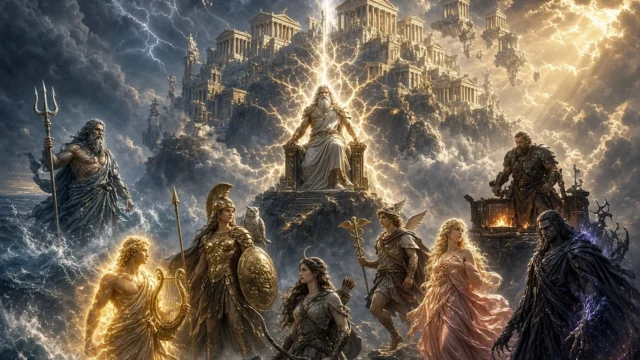
Asgard imagery often focuses on bright golden halls; Midgard artwork uses settlements, forests and coastlines. Those are contemporary illustrations, not archaeological photographs of supernatural cities. The famous rainbow bridge Bifröst connects key locations in later summaries and is a common visual way to suggest communication between divine and human spaces. Some artworks turn it into a fixed railway running vertically between two layers, though no source gives such a modern engineering diagram.
Jotunheim: The Diverse Worlds of the Jotnar
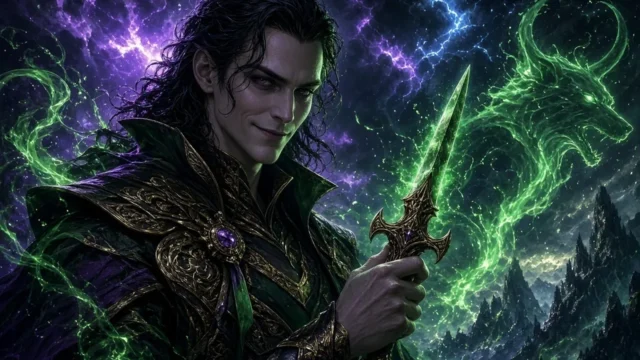
Jötunheimr is strongly associated with jötnar, beings often translated as giants. In the myths, however, they are not all oversized, mindless villains. Some are wise, some marry into divine families, and some become dangerous rivals. Skadi and the ancestry of Loki illustrate why the boundary between gods and jötnar is more socially and narratively complex than a simple good-versus-evil map.
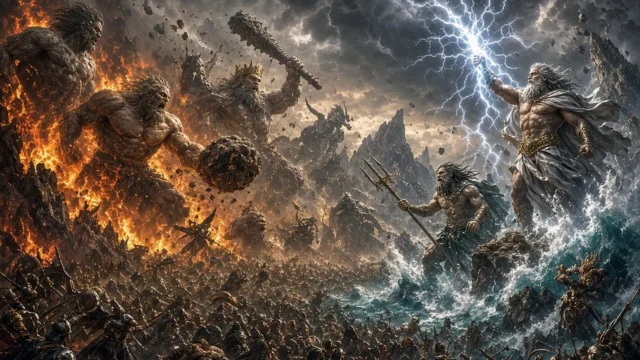
It is also worth distinguishing Jotunheim from Utgard and places named in particular journeys. Modern diagrams sometimes present these names as completely separate numbered realms even when the textual relationship is not that straightforward. If a fantasy poster shows huge mountain fortresses and ice giants under a ‘Jotunheim’ label, the scenic setting is an artistic choice; the reliable core is the association with jötnar and important journeys of the gods.
Vanaheim and the Vanir: Njord, Freyr and Freyja
Vanaheim is associated with the Vanir, a divine group especially represented by Njörðr, Freyr and Freyja. The stories describe conflict and later accommodation between the Æsir and the Vanir. The Vanir are frequently linked in modern summaries with fertility, prosperity and wealth, but that is a broad characterization rather than an exclusive job description stamped on each deity. Their importance emerges through family ties, ritual associations and the outcomes of the Aesir–Vanir conflict.
The surviving descriptions of Vanaheim itself are sparse. Its popular pictures usually show green valleys and glowing gardens because illustrators want visual contrast with Asgard and darker areas. Those colors are not fixed by a medieval map. The responsible caption says ‘Vanaheim, traditionally associated with the Vanir’ rather than claiming a specific palace, mountain shape or exact geographical coordinate.
Alfheim and the Elves: Beauty, Mystery and Uncertainty
Álfheimr is associated with elves. The poem Grímnismál refers to Freyr receiving Alfheim in connection with his first tooth, a striking piece of poetic lore. Later accounts distinguish light and dark elves in ways that scholars continue to interpret. A simple infographic may place beautiful shining light-elves in Alfheim, but it should not assume that every modern fantasy-elf feature appears in a medieval Norse source.
Spiky ears, silvery clothing and an ethereal palace are familiar images from modern fantasy. None is necessary to answer the core question ‘What is Alfheim in Norse mythology?’ The more useful answer is that it is an elf-associated realm mentioned in old poetic material, with details that do not form a modern encyclopedia of elf culture. Readers should be told where creative design starts.
Svartalfheim, Nidavellir and the Dwarfs
One of the most complicated entries in the popular nine-world list is Svartalfheim. Some sources use names associated with ‘black elves,’ while other passages refer to dwarfs and locations such as Niðavellir. Later reconstructions commonly identify Svartalfheim with the world of dwarfs, but that identification and terminology are not perfectly uniform across the literature. This is one reason different Nine Realms charts use slightly different names or positions.
Dwarfs are important craftspeople in Norse myths, making objects such as Mjölnir, Gungnir and other divine treasures. A forge-filled visual is therefore a reasonable thematic illustration, but a precise industrial underground city built to match a video-game level is not documented in an Edda. It is more informative to focus on the role of skilled makers and explain the naming uncertainty in a note than to declare a single map canonical.
Niflheim, Muspelheim and the Beginning of the Cosmos
In Snorri’s creation narrative, Niflheim is associated with mist, cold and early cosmic waters, while Muspelheim is associated with heat and fire. Ginnungagap, the gap between these conditions, forms part of the account of the emergence of primordial life. The contrast of frost and flame makes these areas especially attractive for images. It also invites oversimplification when a poster calls them just the ‘ice kingdom’ and ‘fire kingdom’ with precisely marked royal capitals.
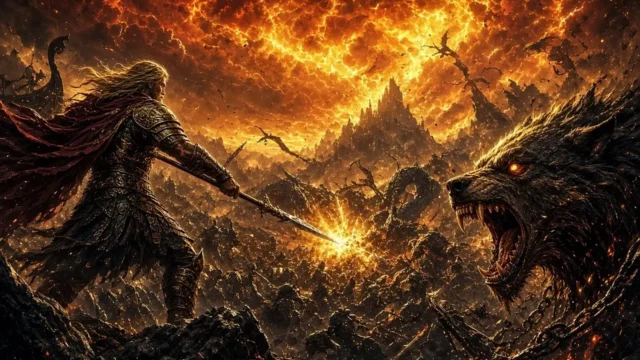
Muspelheim is connected with Surtr and destructive fire, especially in accounts of Ragnarök. Niflheim and the abode of Hel may overlap in some descriptions but should not automatically be treated as completely interchangeable names. The old prose preserves a complex network of places and directions. A helpful reader guide states that these labels carry different narrative functions, even where modern illustrations represent them as neighboring world-circles.
Hel: Realm of the Dead and the Problem of Helheim
Hel is both the name of a female figure, one of Loki’s children with Angrboða, and a name used for an abode of the dead. ‘Helheim’ is a common modern form in popular explanations, though the sources’ terminology deserves care. The realm should not be automatically equated with the Christian concept of eternal fiery punishment. Norse afterlife beliefs were diverse, and Valhalla was not the destination of all deceased people.
Some sources describe a road or journey to the domain of Hel, and stories involving Baldr are particularly relevant. Darkness in a poster can be atmospheric, but it should not be mistaken for evidence that every deceased person suffered in a literal inferno. A sensitive image caption will identify the underworld setting and distinguish the goddess from the place without imposing details from unrelated religions.
Does Yggdrasil Hold All Nine Worlds in Fixed Positions?
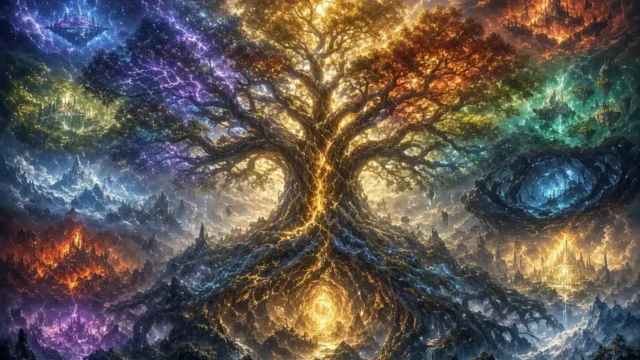
Yggdrasil is the immense ash connecting parts of the mythic cosmos. Illustrations often arrange the Nine Realms in three stacked tiers, with the gods above, people in the center and the dead below. But no surviving medieval text supplies that exact combined diagram. Roots and associated wells are described differently in poetry and prose. The useful visual purpose of the chart is to compare names and relationships, not to claim historically measured distances.
If you are studying the myths, use a modern chart as a memory aid and check each place’s original textual mention. For search visitors, keep ‘Nine Realms map’ as a natural keyword but attach a short explanation that this is a reconstruction. It is not necessary to reject modern art; it is necessary to stop presenting interpretive design choices as unquestioned medieval evidence.
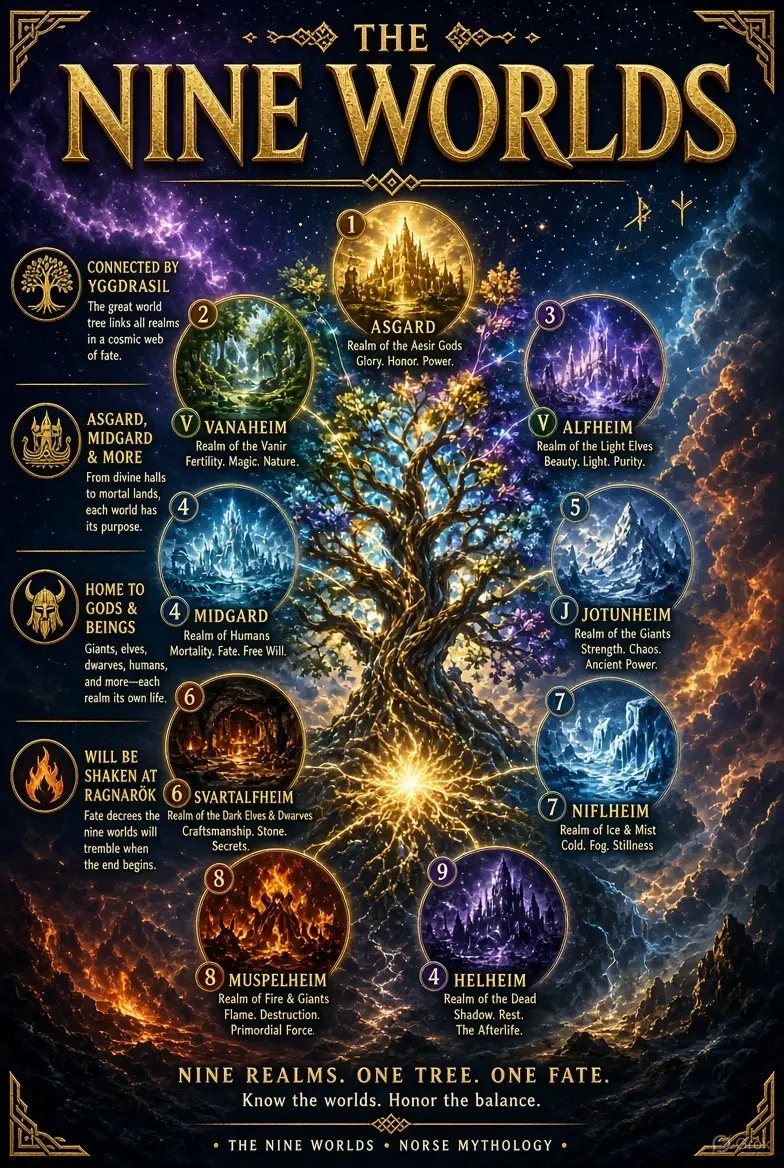
Artwork and source This is a modern reconstruction of the nine realms. No surviving Eddic passage lists all nine together in this arrangement.
Frequently Asked Questions
What are the Nine Realms called?
A common modern list is Asgard, Midgard, Vanaheim, Alfheim, Jotunheim, Svartalfheim, Niflheim, Muspelheim and Hel.
Did Vikings leave an official Nine Realms map?
No complete canonical nine-world map survives in the medieval sources.
Where do humans live?
Midgard is the human world in traditional Norse cosmology.
Is Hel the same as Niflheim?
They are related in some accounts but are not interchangeable labels in every context.
Who lives in Jotunheim?
Jötnar are associated with Jotunheim, though they have varied roles and are not all evil monsters.
Conclusion
In summary: The Nine Realms are best treated as a useful guide to the different mythic locations rather than a fixed map drawn by a single ancient author. Knowing what is certain and what is reconstructed makes the visual guide more valuable and lets readers enjoy the extraordinary worlds without absorbing fabricated facts.
Sources and illustration note
Nine Worlds, sources and uncertainty; Textual nine-world references; Academic and popular reconstruction guide.
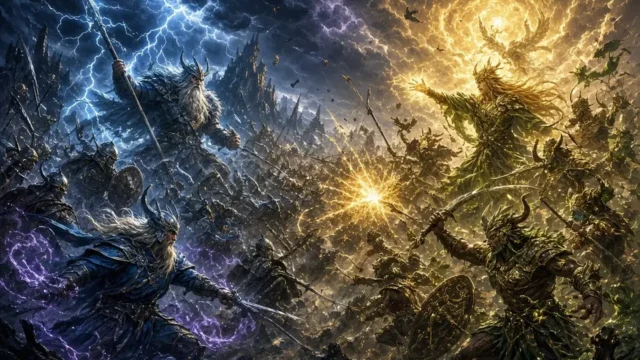
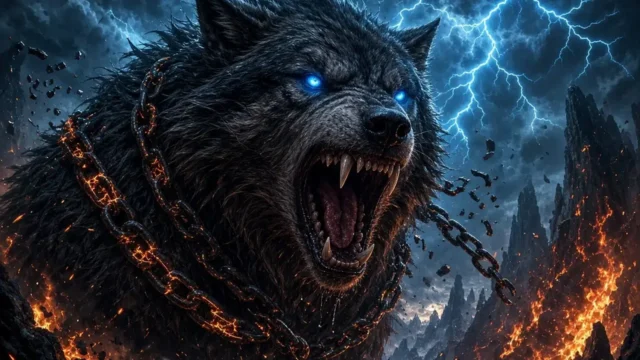
Images are contemporary art and diagrams; no ancient canonical arrangement is implied.



Share Your Opinion
Comments are closed on this post.