 Vista
Reviewed: 14 November 2026
Mjölnir, usually spelled Mjolnir in English search queries, is Thor’s famous hammer in Norse mythology. According to the best-known forging tale, Loki’s actions lead to a competition among dwarf craftsmen and to the creation of the short-handled weapon. The hammer is associated with battle, protection and hallowing. Historical hammer-shaped pendants show that this symbol also mattered to people in the Viking Age, although popular online lists of its exact powers often mix old texts with modern comic fiction.
This guide answers the searches ‘Thor hammer Mjolnir meaning’, ‘Who made Mjolnir?’, ‘What is Mjolnir made of?’, ‘Who can lift Thor’s hammer?’ and ‘Mjolnir Norse mythology images’ without treating a fictional movie rule as an Eddic fact.
What Does Mjolnir Mean in Norse Mythology?
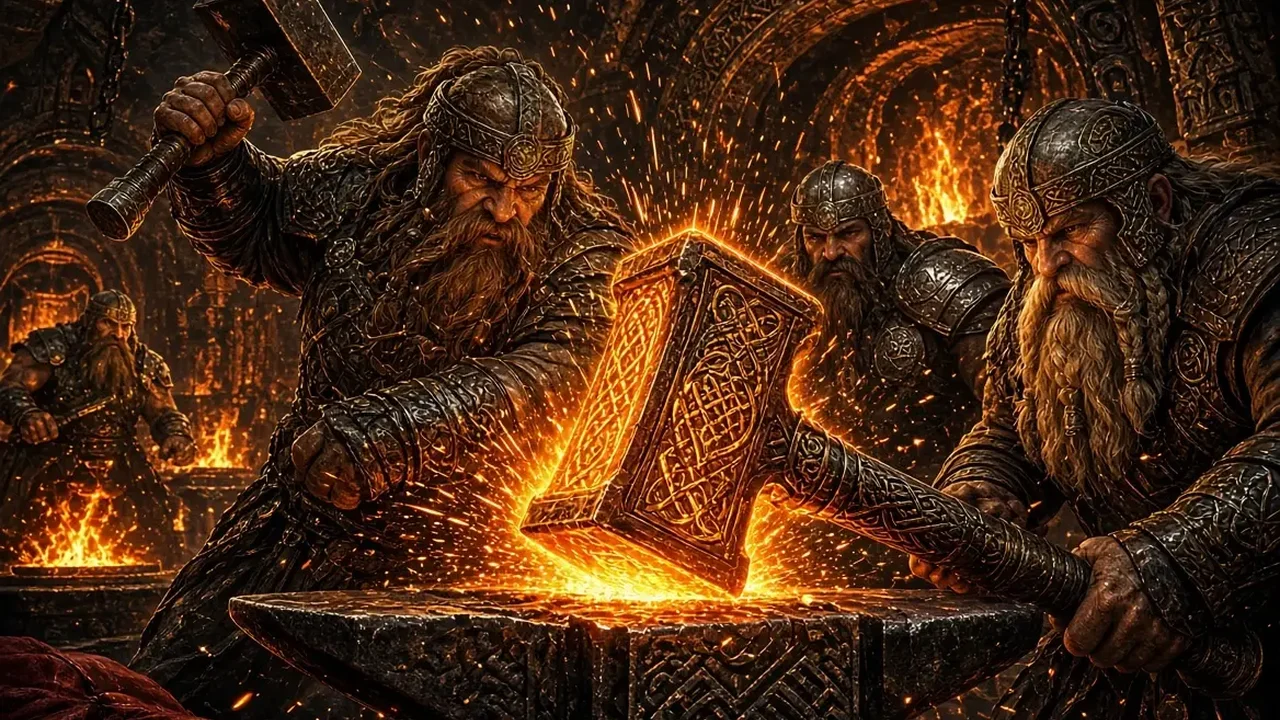
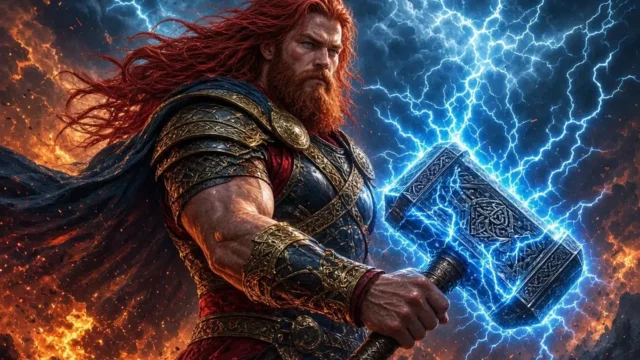
Mjölnir is the celebrated hammer of Thor, the thunder god who repeatedly defends the divine and human worlds from dangerous opponents. The spelling varies in English because the original Old Norse letters are transliterated differently. The name is commonly discussed in connection with crushing, although etymology is more complex than many short internet slogans suggest. The key idea is not a single dictionary gloss but how the object functions in stories: Mjölnir is a weapon, a source of protection and sometimes an instrument of hallowing. Those different roles explain why the hammer became a powerful symbol rather than just a tool used in combat. Readers looking for Thor hammer pictures can identify its short handle and striking form, but modern fantasy illustrations are not a single authoritative portrait of a supernatural artifact. The sources establish the story; artists choose the appearance.
Who Made Thor’s Hammer? The Story of Brokkr and Sindri
The best-known account appears in Snorri Sturluson’s Prose Edda, in the section Skáldskaparmál. Loki has cut off the beautiful hair of Sif, Thor’s wife, creating a crisis he must repair. The sons of Ívaldi craft remarkable gifts, including replacement hair, and Loki then becomes involved in a wager about whether another pair of dwarf craftsmen can produce even better treasures. Brokkr works the bellows while his brother performs the forging. Depending on the manuscript and retelling, the smith is called Eitri or Sindri. That textual variation should not be erased just to keep a poster perfectly simple. The object emerges from a contest shaped by Loki’s interference and the extraordinary abilities attributed to the smiths. This origin is very different from the movie-universe story that uses a specially named fictional metal and different characters.
Why Does Mjolnir Have a Short Handle?
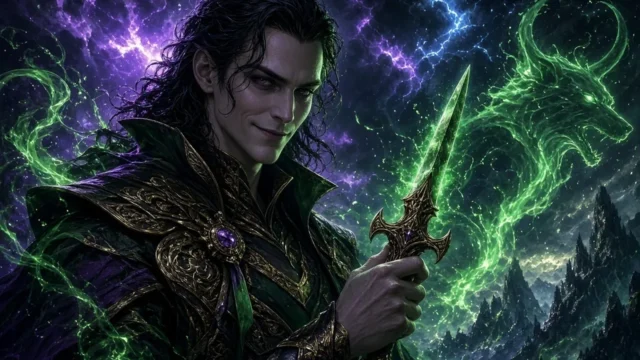
Loki does not merely observe the contest. He turns into a fly and stings Brokkr repeatedly, trying to distract him from the bellows. The final interruption affects the hammer and causes the handle to be shorter than intended. Nevertheless, the judges value it as an exceptionally useful weapon because of the protection it can provide against giants. The detail is part of the story rather than an instruction for real metalworking. Short handles appear in many modern hammer illustrations, but the length, density and exact weight of a divine weapon are not scientifically measurable. Many online infographics supply a precise mass or a pseudo-technical blueprint without naming a text that supports it. Such values belong to fan design and should be labeled accordingly. A strong visual caption can say that the short handle resulted from Loki’s sabotage in the forging tale.
What Powers Does the Mythological Hammer Have?
The Prose Edda presents the hammer as formidable in battle, and later summaries emphasize qualities such as returning after it has been thrown. In individual narratives, Thor raises it against giants and other enemies. It also has a role in ritualized hallowing, including scenes involving a wedding and other events. The literature does not set up a modern superhero rulebook with a universally measured range, electrical output or damage rating. Even the magic associated with an object can be presented differently across texts and later traditions. Thor also has a belt called Megingjörð and iron gloves known as Járngreipr, so it is misleading to treat every piece of his equipment as an integral mechanical part of Mjölnir. A helpful infographic names the items and explains which story uses them. It does not need to claim an invented ‘ultimate power level.’
The Stolen Hammer and Thor’s Unusual Wedding Disguise
In the Eddic poem Þrymskviða, the giant Þrymr steals Mjölnir and demands Freyja as his bride in exchange for returning it. Freyja rejects the demand. The gods then devise a daring solution: Thor is disguised as a bride and Loki accompanies him as an attendant. The giant notices the supposed bride’s extraordinary appetite and intimidating appearance, but Loki keeps offering explanations. Finally the hammer is brought into the ceremony for hallowing. Thor seizes his weapon and defeats the giant. The episode is funny and suspenseful in ways that a thunderbolt-only characterization misses. It is also important evidence that the hammer can have a ceremonial role. If an image depicts Thor in bridal clothing, that scene is not automatically a modern parody; it connects with a recognizable Old Norse poem. The source context makes the unusual visual meaningful.
Is Mjolnir Made of Uru, and Who Can Lift It?
Marvel fiction gives the hammer a different framework, including the fictional material Uru and an enchantment tied to worthiness. Those are valid facts about that entertainment universe, not statements from the medieval Norse poems. The old forging story is about dwarf artisans, a wager and Loki’s sabotage; it does not provide a laboratory description of the metal’s composition. Likewise, a universal rule that only a person judged morally worthy can lift the hammer is a familiar modern fiction rule, not the foundation of every traditional Mjölnir story. This distinction is especially helpful for searchers who arrive after watching a movie. A good guide can answer ‘What is Mjolnir made of?’ by first asking which version is under discussion, then explaining both honestly. Enjoying comics does not require rewriting an ancient poem.
Viking Age Hammer Pendants: Archaeology Versus Fantasy
Hammer-shaped pendants and rings are real archaeological objects. The Swedish History Museum and Denmark’s National Museum describe Viking Age finds connected with Thor’s hammer symbolism. A remarkable tenth-century object found on Lolland bears a short runic inscription interpreted as ‘This is a hammer,’ confirming the interpretation of that particular pendant. These finds show the importance of the shape in historical practice. They do not prove that a supernatural hammer flew through the sky or that every wearer subscribed to exactly the same beliefs. Materials and styles differ, and even the meaning of a specific deposit can be debated. When displaying images, separate museum photographs of known artifacts from CGI fantasy art. Captions should identify which is which. A modern pendant may be a beautiful tribute, but not every rune or invented design on it is a surviving Viking Age symbol.
Mjolnir in Tattoos and Norse Symbol Charts
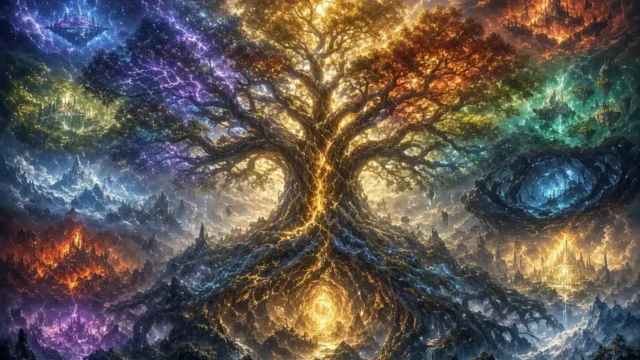
The hammer is widely used today in necklaces, tattoos, phone wallpapers and illustrations. A modern design might surround it with ravens, wolves, runes, Yggdrasil or geometric knotwork. Some combinations are inspired by historical art, while others are personal or contemporary fantasy creations. Neither category has to be rejected, but accurate descriptions should distinguish them. Claims that a particular tattoo guarantees luck, invincibility or protection cannot be treated as verified ancient rules merely because a Pinterest chart says so. A useful design article helps readers understand the source motif, consider placement and choose artwork for its meaning rather than repeat unsupported promises. For SEO, visual descriptions such as ‘Thor hammer pendant’, ‘Mjolnir tattoo idea’ and ‘Mjolnir Norse symbol’ are natural when they correspond to the actual picture. Repeating those phrases everywhere does not improve the facts.
What Happens to Mjolnir After Ragnarok?
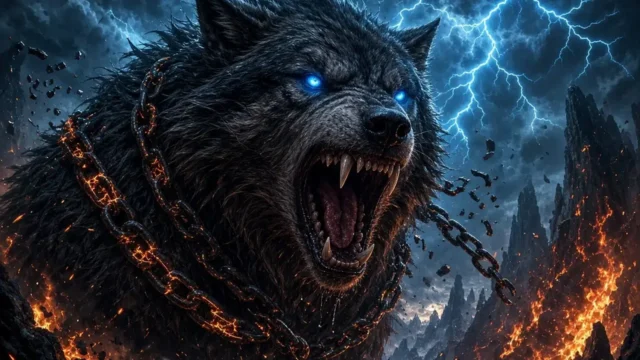
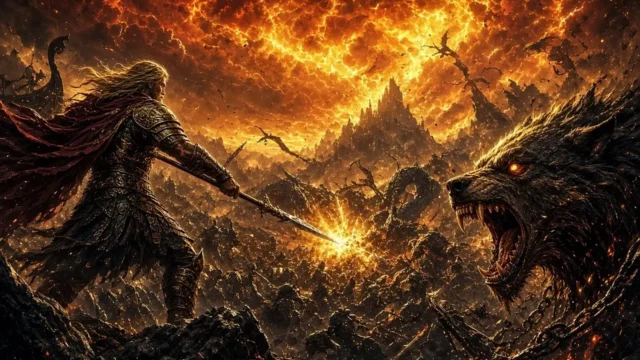
Thor’s final opponent is Jörmungandr, the immense world serpent. During Ragnarök Thor kills the creature but dies from its venom after taking nine steps. The hammer’s story does not simply stop there. In accounts of the renewed world, Thor’s sons Magni and Móði survive and inherit Mjölnir. This makes the weapon a sign of continuity after destruction as well as a symbol of Thor’s personal strength. A striking image might show the hammer under a clearing sky after the battle, but that picture would be an artistic interpretation of the transition, not an ancient photograph. It also helps readers understand why the mythic story is not identical to a film sequel. The medieval tale connects death, inheritance and renewal. That theme is a compelling reason for someone who first searched for a hammer image to keep reading.
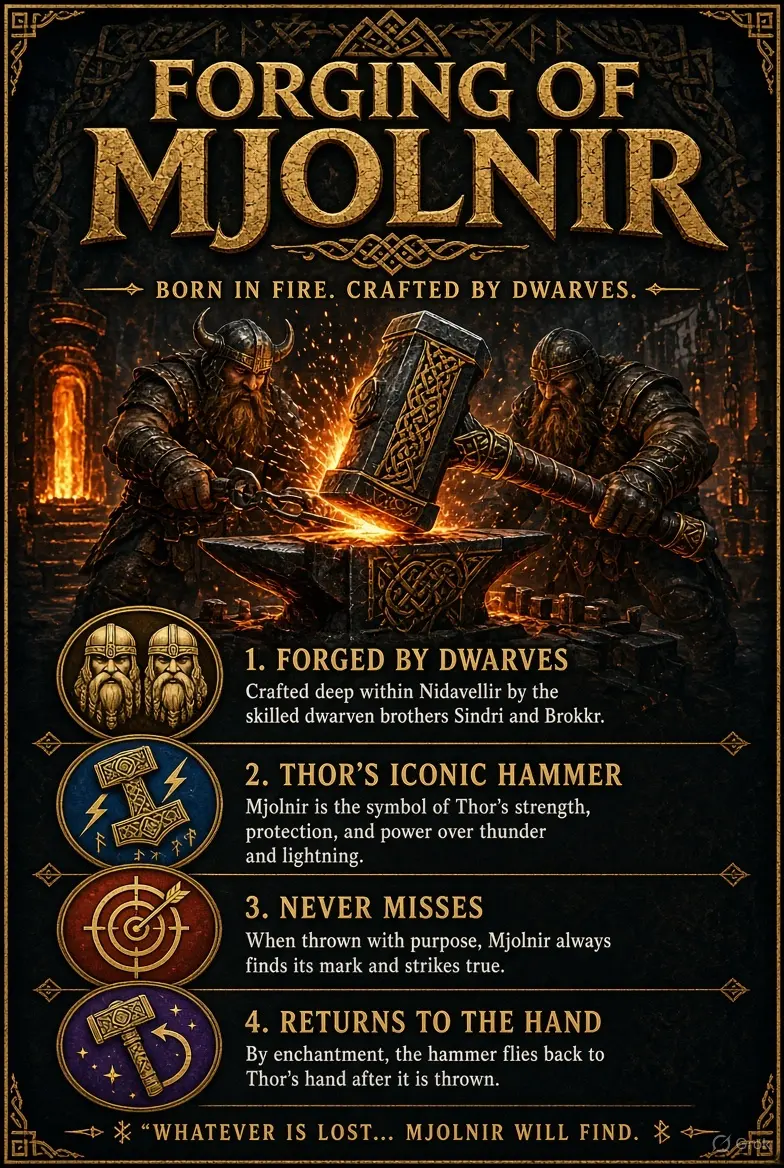
Artwork and source Skáldskaparmál names the smiths and tells how the hammer was made. The forge’s location shown on the poster is a modern reconstruction.
Frequently Asked Questions
What is Mjolnir?
Thor’s legendary hammer, appearing as a weapon and an object used in hallowing scenes in Norse mythology.
Who forged Mjolnir?
A pair of dwarf craftsmen connected with Brokkr and the smith called Eitri or Sindri, depending on the version.
Why is the handle short?
Loki interrupts the blacksmith’s work during the forging contest, causing the shortened handle.
Is Mjolnir made of Uru?
Uru is a fictional material in Marvel’s entertainment universe, not the specified metal of the medieval Edda.
Who receives Mjolnir after Ragnarok?
Thor’s sons Magni and Móði inherit it in accounts of the renewed world.
Conclusion
Mjolnir is not only a fantasy weapon: its forging, hallowing, pendant history and survival after Ragnarok connect it with protection, identity and continuity. The sources are the key to separating the old myth from modern fiction.
Sources and Illustration Note
The Swedish History Museum on Thor’s hammer rings; National Museum of Denmark on the inscribed hammer; Mjolnir and the medieval textual sources.
The artwork is a modern interpretation; it does not depict an excavated supernatural weapon.


Share Your Opinion
Comments are closed on this post.