 Vista
Editorial review: 14 November 2026
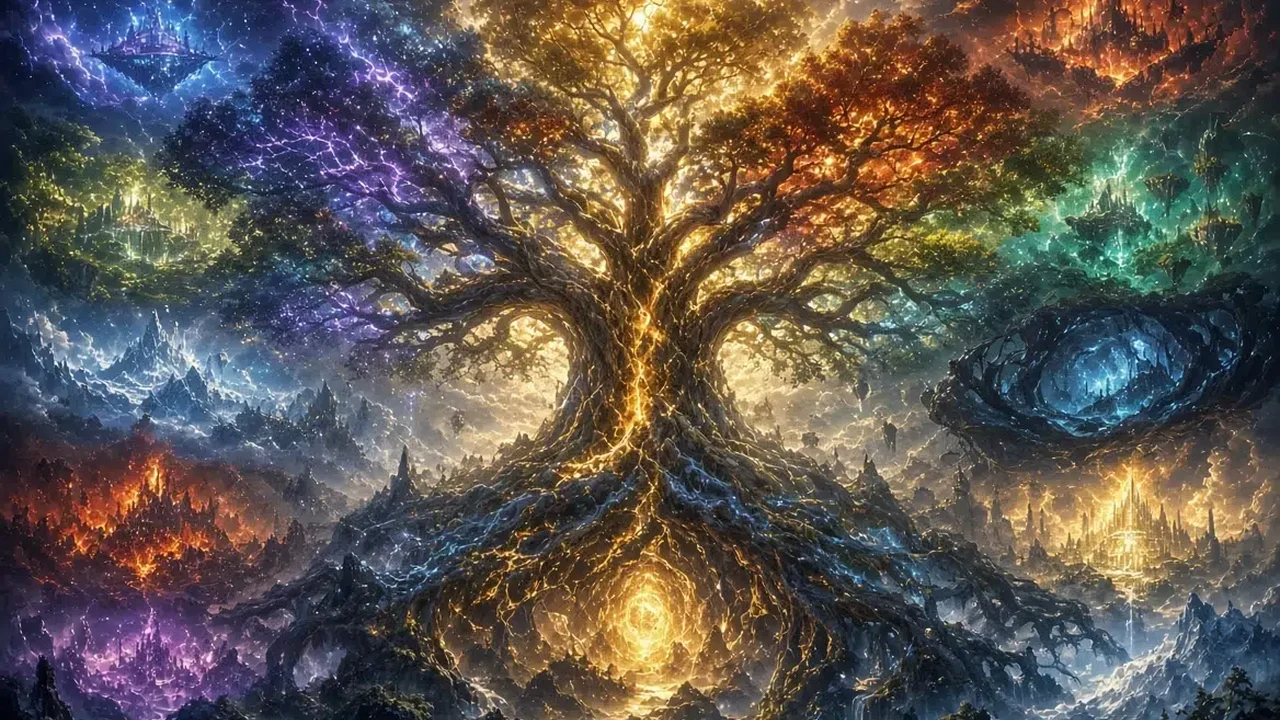
Yggdrasil is the great world tree of Norse mythology, an enormous ash whose branches and roots reach across the mythic cosmos. It is associated with sacred gatherings of the gods, three wells, the Norns who tend it, and animals ranging from an eagle to the squirrel Ratatoskr and the root-gnawing Níðhöggr. The tree is not simply a fantasy map that puts every realm on a numbered branch: medieval texts do not preserve that precise diagram.
This illustrated guide answers what Yggdrasil means, where its roots reach, how it connects to Odin, what happens to it at Ragnarök, and how to read world-tree images or tattoos without mistaking modern art for Viking Age evidence.
What Is Yggdrasil? The World Ash at the Centre of the Stories
In the Prose Edda, Yggdrasil is introduced as the largest and best of trees. Its branches spread over the world, and the gods hold councils at the great ash. It is a cosmological image, not a specimen that archaeologists could locate in a Norwegian forest. The literary tree gives the myths a way to show different beings, sacred places and dangers as parts of a connected world. A portrait of Yggdrasil may show a glowing trunk reaching into space, but that is an illustrator’s method of making the myth visible.
Some readers call it the Norse tree of life. That phrase is useful for discovering art, yet it should not imply that every religious idea about a ‘tree of life’ has exactly the same meaning. Old Norse texts give this ash particular inhabitants, roots and associations. Knowing those specifics produces a more valuable explanation than placing a general inspirational quote beneath an attractive tree wallpaper.
The Three Roots: Why Every Diagram Needs a Source Note
Snorri describes three far-reaching roots. In his account one reaches among the Æsir, another toward the frost giants, and the third extends into Niflheim above Hvergelmir. The root near the giants is associated with Mímir’s well, while the gods’ sacred assembly and Urðr’s well belong to another part of the description. These are not ordinary subterranean roots that could be plotted using geological measurements. They connect spaces that carry narrative meaning, including divine deliberation, wisdom and danger.
An important caution for infographic designers is that Grímnismál and Snorri’s prose locate the roots somewhat differently. Treating one modern arrangement as the only ancient version would hide this variation. If a graphic shows three roots and named wells, the caption should say ‘a reconstruction based largely on Snorri’s Gylfaginning’ rather than claiming to be the sole authentic Viking map.
Urðarbrunnr and the Norns: Fate at the Tree
Near the sacred well Urðarbrunnr, the Norns are associated with destiny and the care of the tree. Urðr, Verðandi and Skuld are the three most familiar names, although the surviving tradition also refers to other norns. In Snorri’s version they take water and mud from the well and spread it on the ash so its branches do not decay. That detail produces a surprising picture: even this vast cosmic tree needs tending. Its significance is not that it is invulnerable, but that it sustains the order of a world under pressure.
Modern posters often translate the three names as a perfectly fixed past-present-future clock. Such symbolism is common, but the linguistic and literary issues are subtler than a rigid timetable. Readers should understand the connection with fate without being told that an exact mechanical interpretation is universally agreed. A thoughtful caption can say that the Norns shape destinies and care for the world tree.
Mímisbrunnr: The Well Where Odin Gives an Eye
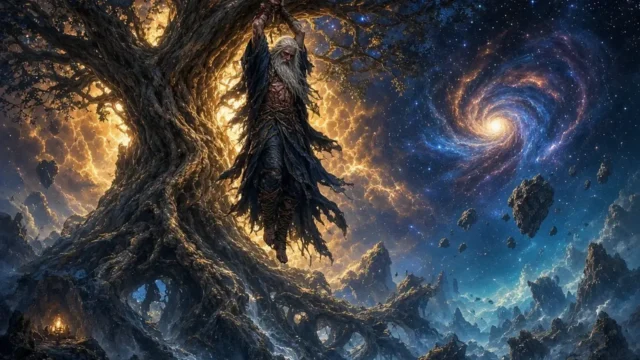
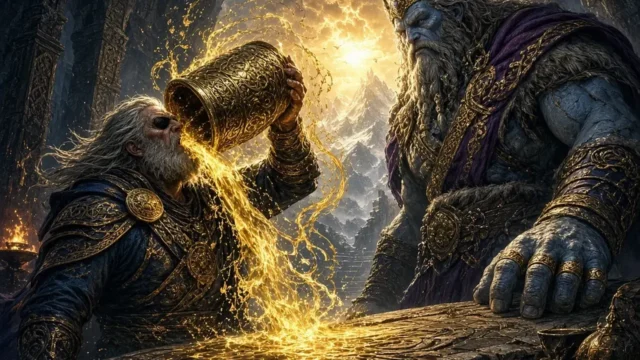
The well linked with Mímir is a place of extraordinary wisdom. Odin asks to drink from it and gives an eye as the price. This is a different episode from Odin’s nine-night sacrifice on a tree for the runes. Because both feature Odin paying for knowledge, social-media illustrations sometimes merge them into a single scene. A useful article separates them. The missing-eye story concerns the well; the hanging and acquisition of runes belongs to the speaker’s account in Hávamál.
The distinction also helps image searchers. An illustration of a one-eyed god leaning over a bright well is an Odin-and-Mímir image. An illustration of the spear-wounded Odin hanging in a tree represents another myth. Both may be associated with Yggdrasil in retellings, but a single caption cannot responsibly substitute one episode for the other.
Hvergelmir and Níðhöggr: The Danger at the Roots
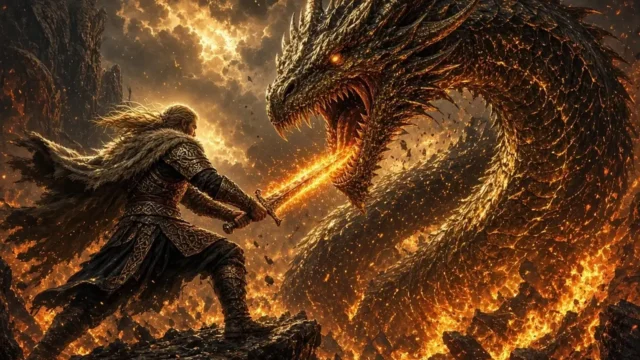
Under the root reaching toward Niflheim, Hvergelmir is associated with waters and serpents. Níðhöggr is the dragon- or serpent-like being that gnaws at the root of the ash. The image is vivid because a destructive creature attacks the foundation of the very world it inhabits. Old Norse sources do not supply a modern biological classification or a fixed cinematic body shape for the creature. The scaly dragon used in much digital artwork is an interpretation.
Other animals contribute to the sense that Yggdrasil is a living environment, not a static symbol. Four stags browse the foliage; their exact narrative role is less extensive than that of the squirrel and the eagle. A poster that explains the tree well should identify these inhabitants and show where the source places them. It need not invent a ‘power level’ for each animal or suggest that the dragon actually destroyed the world tree on a datable historical day.
Ratatoskr, the Eagle and the Hawk Víðópnir?
An eagle sits high in the ash and is associated with knowledge. Between its eyes is a hawk named Veðrfölnir in Snorri’s account. The squirrel Ratatoskr runs up and down the trunk, carrying hostile words between the eagle and Níðhöggr. This is one of the strangest and most memorable elements of Norse cosmology: a tiny messenger helps sustain an argument across the enormous vertical distance of the tree. These details make a picture far more recognizably Norse than generic stars and glowing leaves.
Artwork sometimes adds the named rooster Víðópnir at the very top, mixing traditions or later interpretations. The most reliable way to caption a particular Yggdrasil scene is to name the animals specifically described in the cited passage. A myth infographic should not turn a decorative bird placed on a branch into a verified medieval illustration of an entirely different figure.
Are the Nine Realms Literally Located on Nine Branches?
Modern posters often divide Yggdrasil into three neat levels with nine boxes or circles: Asgard at the top, Midgard in the middle, and Hel below. This diagram is understandable and visually convenient, but it is a modern teaching tool rather than a preserved Old Norse chart. The poems refer to nine worlds without giving one definitive roster or diagram of their locations. Even the arrangement of the tree’s roots differs between texts.
The names commonly used in contemporary guides include Asgard, Vanaheim, Alfheim, Midgard, Jotunheim, Svartalfheim, Niflheim, Muspelheim and Hel. Some reconstructions replace or combine entries. The most accurate accompanying sentence is therefore ‘a popular reconstruction of the nine worlds,’ not ‘the exact nine-layer map drawn by Vikings.’ That small distinction protects a reader from misinformation while leaving room for beautiful original art.
Yggdrasil at Ragnarök, and Its Meaning in Art
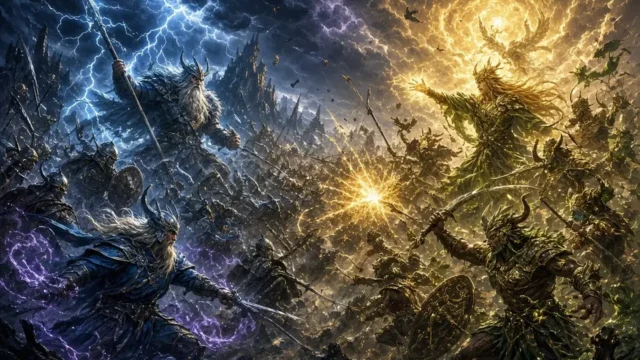
As Ragnarök draws near, the cosmic order shakes and the tree trembles. The poems do not present a simplistic rule that Yggdrasil must burn completely and disappear forever in the exact same manner in every retelling. The story of renewal after catastrophe is an important part of Norse myth. A work of art with roots glowing under a broken sky can communicate that tension, but the caption should distinguish the artist’s scene from an event described word-for-word in a particular poem.
Yggdrasil also appears in tattoo designs, fantasy wallpapers and games. Trees, knots and runic borders may look convincingly ‘Viking’, yet an attractive composition does not automatically make every added symbol historically attested. If you want a meaningful design, choose an element with a known connection to the old sources—the ash, the wells, Ratatoskr or Níðhöggr—and explain the original story alongside any personal modern symbolism.
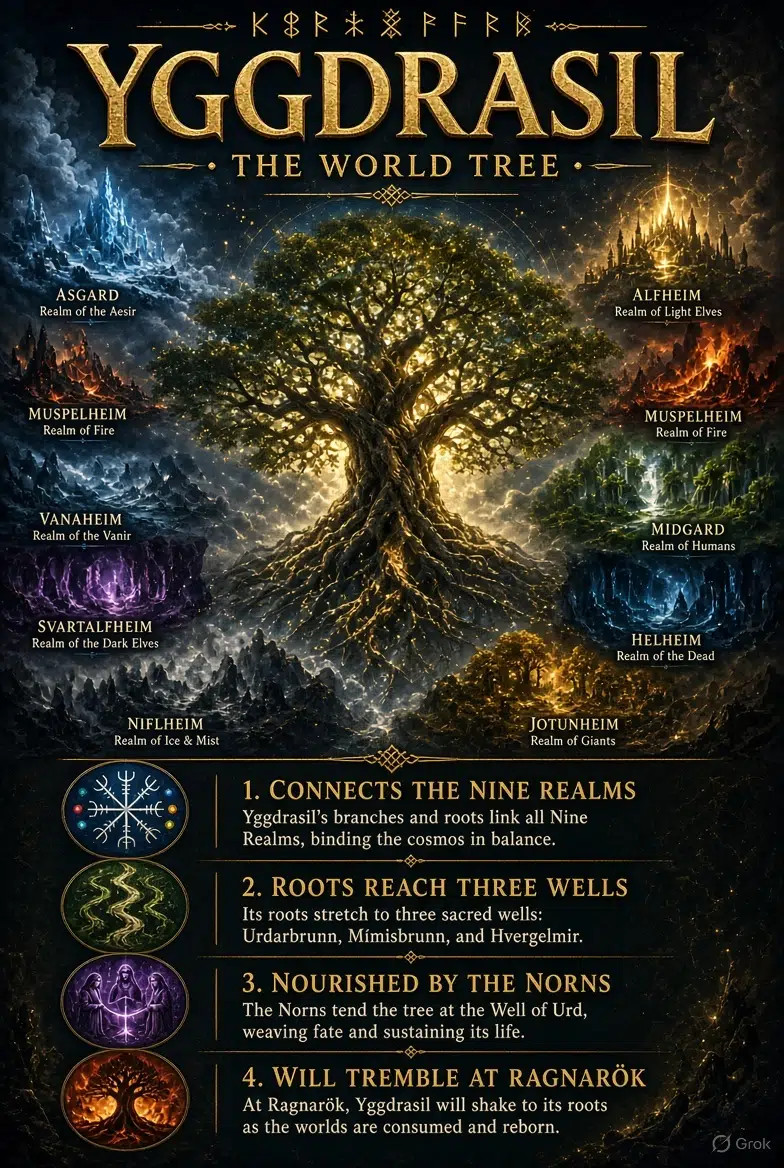
Artwork and source The diagram is a modern reading of Yggdrasil. The Eddas give different accounts of its roots and do not map the nine worlds in fixed positions.
Frequently Asked Questions
What kind of tree is Yggdrasil?
It is described as a mighty ash in the Prose Edda; it is a mythic cosmic tree, not a documented individual tree.
How many roots does Yggdrasil have?
Three far-reaching roots in the familiar prose description, connecting several mythic regions and wells.
Who lives in Yggdrasil?
Among its best-known inhabitants are Ratatoskr, an eagle, the hawk Veðrfölnir, four stags and Níðhöggr near the roots.
Are the Nine Realms map positions historically certain?
No. Medieval sources do not preserve a complete nine-world diagram; modern maps are reconstructions.
What is Odin’s connection to Yggdrasil?
Odin’s search for wisdom links him with the well of Mímir and a separate self-sacrifice on a tree for runic knowledge.
Conclusion
The essential idea: Yggdrasil connects the Norse cosmos, but it also suffers, needs care and holds competing forces. Its roots and inhabitants are more interesting than a generic tree-of-life slogan. Browse the image as an artistic map, then use the texts to discover which details are attested and which are modern design choices.
Sources and artwork note
Gylfaginning 15 (roots and wells); Gylfaginning 16 (animals in Yggdrasil); Academic study of Old Norse mythical space.
All illustrations are modern interpretations of myth, not photographs of supernatural events.










Share Your Opinion
Comments are closed on this post.