 Vista
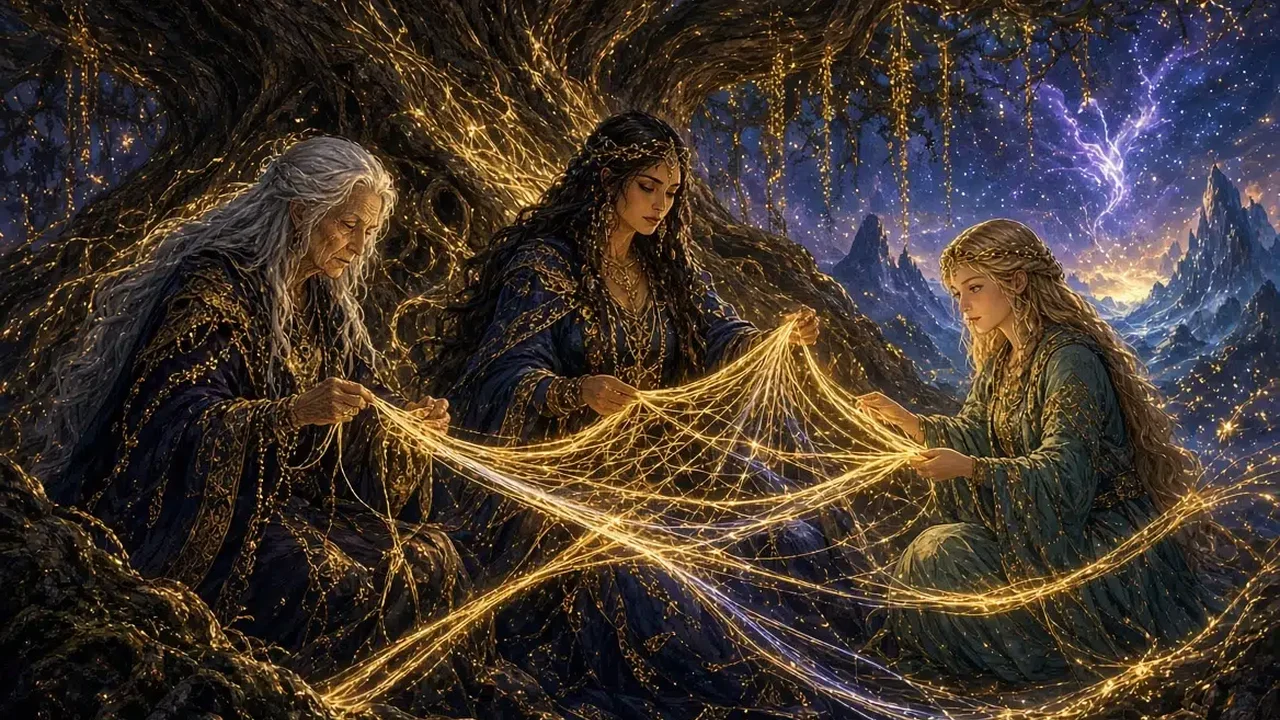
The Norns are figures associated with fate and the shaping of lives in Norse mythology. Three famous names are Urðr (Urd), Verðandi (Verdandi) and Skuld. In Völuspá they appear in a scene near the great world tree, making or establishing laws, deciding lives and shaping destinies. Snorri’s Prose Edda places them by the well Urðarbrunnr beneath a root of Yggdrasil, where they care for the cosmic ash. But the texts also refer to many other norns, so the popular claim that there were exactly three in every Norse tradition is too simple.
This illustrated guide explains Norns Norse mythology, the meaning of the three names, their relationship to Yggdrasil, whether they literally represent past-present-future, how they differ from Valkyries and the Greek Fates, and what their stories imply about Ragnarök. The artwork is a contemporary interpretation, not a record of a real supernatural meeting.
Who Are the Norns? Destiny in the Norse Stories
The norns are among the most intriguing figures in Old Norse literature because they are linked to the course of human life and sometimes to the fate of powerful figures. The famous group is made up of Urðr, Verðandi and Skuld, but Snorri also describes other norns who attend a child’s birth and establish the person’s destiny. Some come from divine families, others are associated with elves or dwarfs. That variety matters. A chart that shows a single official three-member council determining every event in Norse history can be a useful simplified artwork, but it is not a complete summary of the texts. The concept also differs from a modern astrologer’s schedule predicting what will happen on each named day. Old poems use the norns to explore the burden of fate, social conditions, lifespan and the limits of knowledge. Their role provides an emotional backdrop for heroic decisions without supplying an experimentally testable supernatural system.
Urðr, Verðandi and Skuld: What Do the Names Mean?
Urðr is strongly connected with fate or what has happened, and her name is the source of the place-name Urðarbrunnr. Verðandi is related to becoming or happening, while Skuld has associations with obligation or what is due. Popular English charts often assign them a perfectly symmetrical timeline: past, present and future. That can be a helpful mnemonic, but linguistic scholars have pointed out that the precise meanings do not map as cleanly onto three clock compartments as some modern infographics imply. In addition, Skuld can occur as a Valkyrie name in some lists, showing that the literary identities are not simply parts of one rigid department. An informative poster should give the three names and cautious glosses rather than claiming to translate them as an undisputed ancient formula. It is important to let readers see how the symbolism developed while still allowing artists to portray three figures representing the unfolding of time.
The Norns Beside the World Tree Yggdrasil
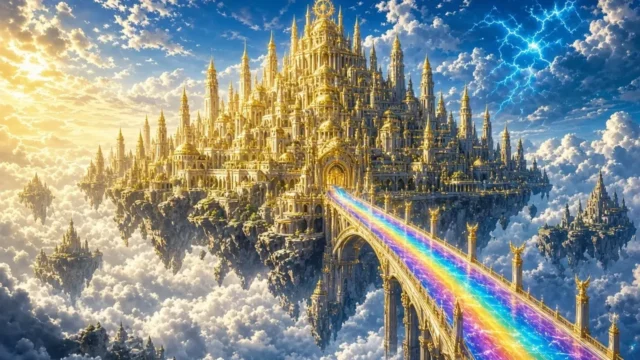
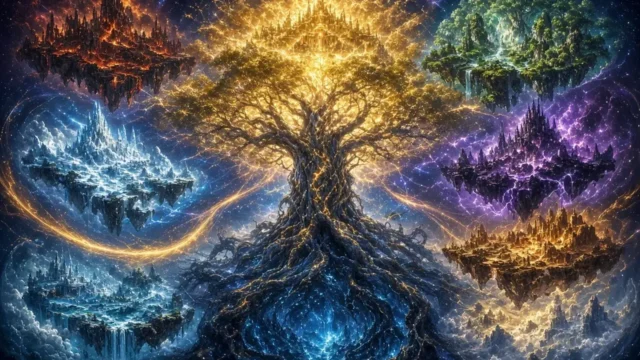
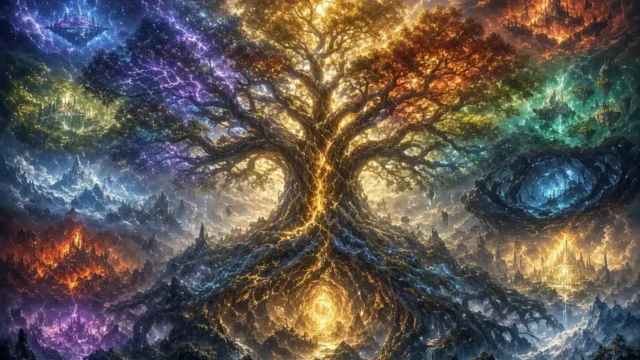
Snorri’s Gylfaginning describes a root of the immense ash Yggdrasil near the sacred well of Urðr. The norns associated with the well tend the tree by taking water and mud from it and applying the mixture to the ash so its branches do not decay. That image is remarkably grounded: even a cosmic tree needs care. It ties the shaping of destiny to the preservation of the world and to the gatherings of gods near the well. The specific geography of the roots can vary between poetry and prose, so an illustration showing the three women sitting on a perfectly measured ‘middle branch’ should be called a reconstruction. A clear composition might include the ash, a well, pale water and three figures, without attempting to place all nine worlds on numbered circles. The literary importance is the relationship between the norns, the sacred location and the fragile continuity of the cosmos.
What Does Urðarbrunnr Mean?
Urðarbrunnr is commonly called the Well of Urðr or Well of Fate. It is associated with a root of Yggdrasil and the gods’ sacred assembly in Snorri’s account. The well supplies the material that helps preserve the tree. This is a different well from Mímisbrunnr, where Odin gives his eye for knowledge, and from Hvergelmir, linked with another part of the cosmic root system and creatures such as Níðhöggr. These distinctions are important for image-search visitors because many modern charts combine all three wells into a single magical pool. A poster showing Odin losing his eye at the Norns’ well may merge separate episodes unless carefully explained. The names can be introduced as a set of related but distinct places in the Norse cosmos. The surviving literature does not provide an exact map with latitude and longitude for any of them.
Do the Norns Weave the Threads of Fate?
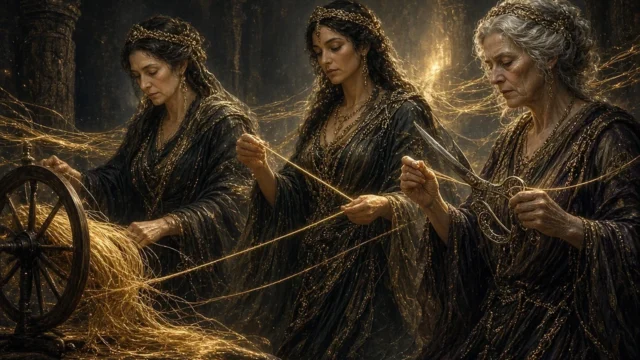
Norns are frequently shown spinning thread, weaving a tapestry or cutting a life cord. Such imagery is understandable in the broad context of fate traditions, and Old Norse poetry uses metaphors of destiny and sometimes textile imagery. However, the best-known Völuspá scene emphasizes setting laws, choosing lives and carving or establishing fate, not a single universally prescribed image of three women with shears standing over an enormous loom. Textiles are therefore a possible artistic motif rather than proof that every norn in every source carries the same object. Some modern descriptions borrow the famous spinning and measuring scheme of the Greek Moirai and quietly transfer it to the Norse norns. That comparison can illuminate common themes but must not erase the different texts. A good caption might say ‘three norns weaving fate — a modern interpretive illustration’ while the article explains what the Eddic passages actually describe.
Good and Bad Norns: Are All Destinies Equal?
Snorri writes that the norns who come to people at birth can differ, and the tradition links favorable destinies with good norns and hardship with others. This raises an important question about the relationship between supernatural fate and the conditions of life. The text does not reduce destiny to an app-style score for luck, nor does it establish that every disappointing event is punishment for a person’s moral failure. A more careful interpretation is that the norns offer a mythic language for explaining why lives unfold differently. Modern spiritual accounts sometimes advertise a specific rune arrangement as a way of forcing the norns to change someone’s future. That promise is not established by the medieval stories. Readers can appreciate the symbolism without treating it as medical, legal or financial advice. The myth explores possibilities and constraints, not a set of predictive calculations that a website could verify.
Norns and Valkyries: Different Roles, Some Overlapping Names
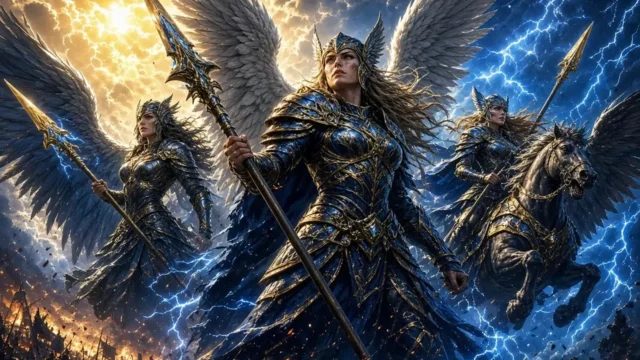
Valkyries are supernatural figures often associated with choosing the slain in battle and with Odin’s warriors. Norns, by contrast, are strongly associated with the establishing or shaping of fate more generally. It would be misleading to use the terms interchangeably simply because both groups are often depicted as women with supernatural authority. Some names, such as Skuld, appear across different poetic lists, which complicates a rigid classification. The best beginner explanation is role-based: Valkyries have a pronounced relationship to battle and death; norns are especially associated with destiny, births and the cosmic tree. Both can appear in the wider literary world of prophecy and mortality. A helpful image hub can therefore feature the two groups in separate galleries with distinct captions and cross-references, rather than label any trio of armoured women ‘the Norns’. Not every Valkyrie carries a loom, and not every norn is a warrior.
Norns Compared with the Greek Fates
Readers of Greek mythology may recognize the Moirai, often represented as Clotho, Lachesis and Atropos. Both the Moirai and the Norse norns are associated with the course of life and the limits placed on it, which makes a comparison attractive. Yet they are not identical figures borrowed from one text or one established family tree. Greek and Norse sources have different names, episodes and historical contexts, while their familiar thread-and-scissors pictures often mix artistic traditions. Comparing the three names is useful when the distinction remains explicit: Urðr, Verðandi and Skuld come from Old Norse literature, whereas the Moirai belong to Greek mythology. A ‘Greek Fates vs Norse Norns’ chart can be educational, but it should not state that one group literally visited the other or that the myths preserve a battle between them. Such imagined encounters belong to modern crossover fiction.
Fate at Ragnarok and Norns Tattoo Symbols
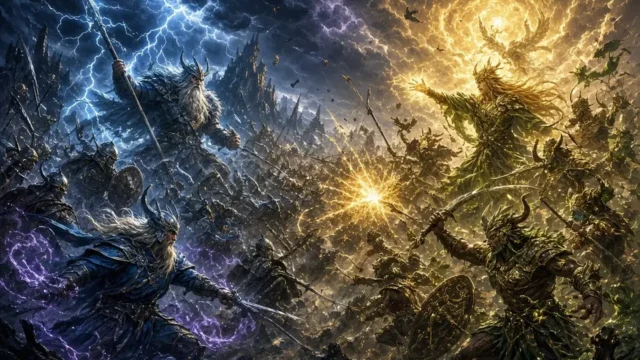
The Norse world contains prophecies of Ragnarök, including the deaths of Odin and Thor and the survival of certain figures in a renewed world. It is tempting to write that the three named norns personally schedule every moment of the final battle. The surviving major sources do not offer a detailed scene in which they draw up a complete battlefield timetable. Their connection to fate gives readers a thematic way to interpret the catastrophe without inventing an unrecorded event. In tattoos and wallpapers, the norns are popular as three women, a well, an ash tree or interwoven threads. Such modern designs can symbolize life, memory and possibility, but a particular bindrune claimed to control destiny is not automatically a historically documented Viking charm. An accurate SEO caption names the visible scene and admits artistic interpretation. The factual poster should focus on three names, the well, Yggdrasil and the role of many norns in the broader tradition.
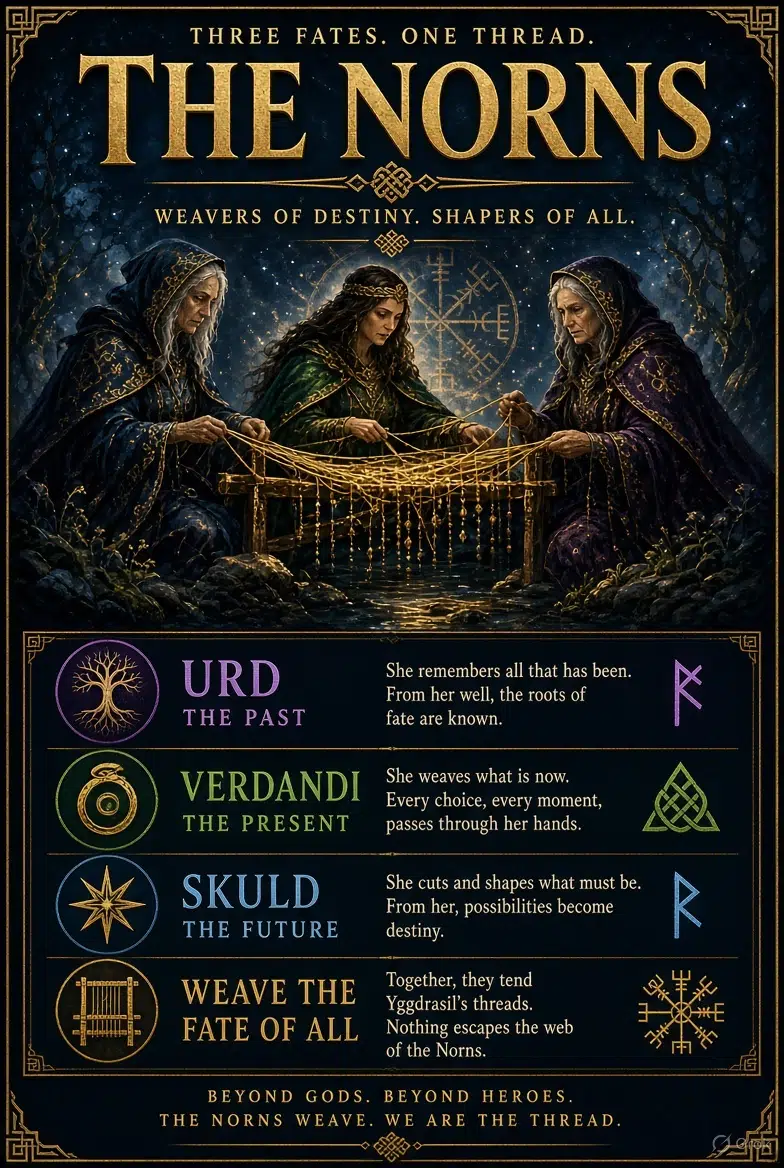
Artwork and source The spinning, weaving and cutting roles in the art are interpretations. Eddic sources describe more Norns than the three named here.
Frequently Asked Questions
Who are the three famous Norns?
Urðr, Verðandi and Skuld are the three well-known names in Völuspá and the Prose Edda.
What is Urðarbrunnr?
The Well of Urðr, associated with Yggdrasil and the norns in Snorri’s account.
Were there exactly three Norns?
No. Snorri also describes other norns associated with births and destinies.
Do the names mean past, present and future?
That is a common simplification; the underlying Old Norse meanings are more nuanced.
Are Norns and Valkyries the same?
No. Norns focus on fate; Valkyries are especially associated with the battle-slain.
Do Norns control Ragnarok?
They are associated with destiny, but the medieval texts do not give a detailed scene showing them scheduling every battle.
Conclusion
The norns connect everyday lives with the vast mythology of Yggdrasil and Ragnarök. Urðr, Verðandi and Skuld are famous, but they are not the only norns in the tradition. Treat modern weaving images as interpretations, and the textual details of fate and the well as the foundation of an accurate visual guide.
Sources and image note
Gylfaginning: Norns, fate and Urðarbrunnr; Poetic Edda: Völuspá and Norn names; Viking Society scholarly Prose Edda edition.
Reviewed 15 November 2026. Visuals are modern illustrations of myth.










Share Your Opinion
Comments are closed on this post.