 Vista
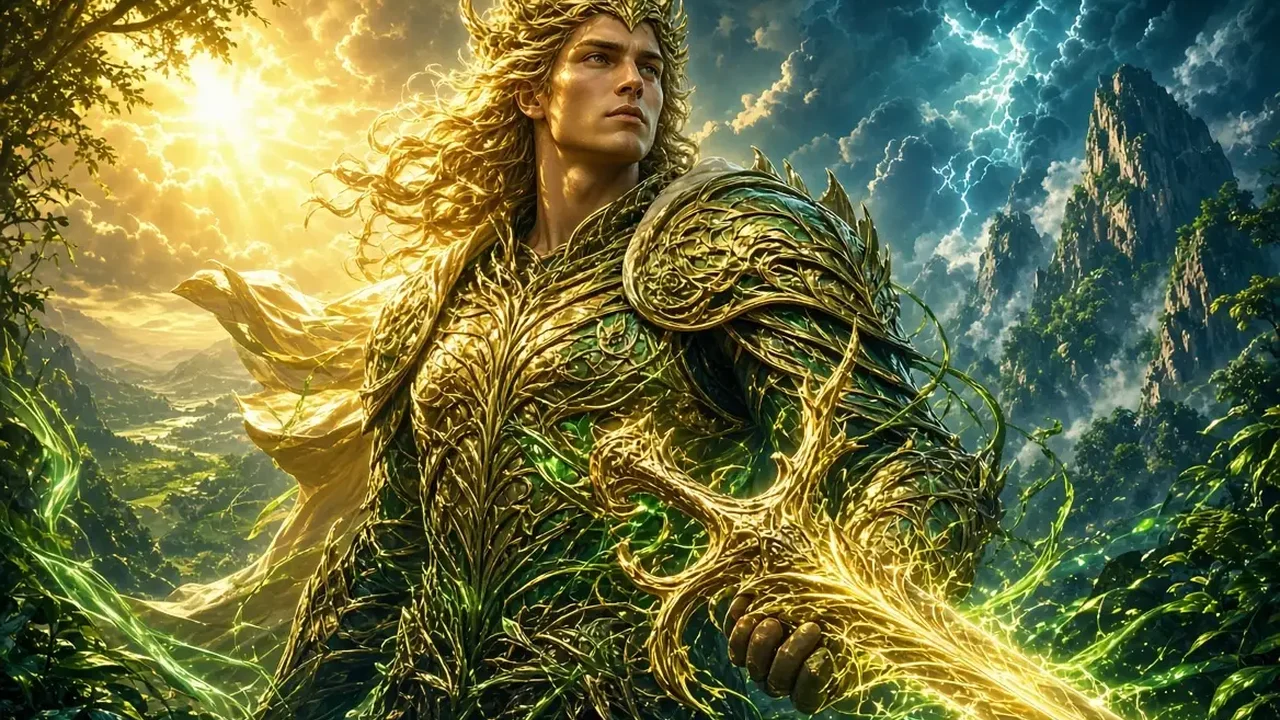
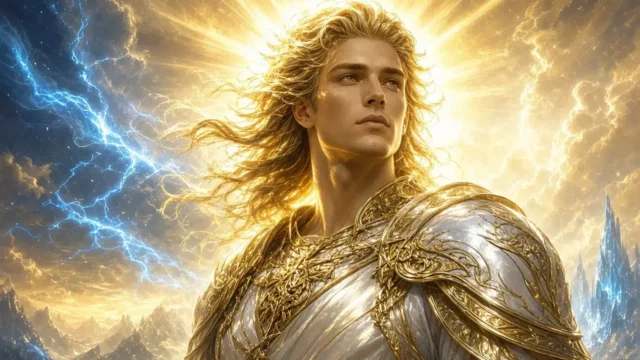
Freyr is a prominent Vanir god in Norse mythology associated with fertile seasons, peace, prosperity, rain and sunshine. His father is Njörðr, and his sister is Freyja. Snorri’s Prose Edda connects him with the growth of the earth and human well-being. Freyr is also central to a memorable love story: he sees the giantess Gerðr from the high seat Hliðskjálf and sends his servant Skírnir to seek her hand. In the process, Freyr gives away an extraordinary sword, a decision with consequences at Ragnarök when he confronts Surtr.
This illustrated guide covers Freyr Norse mythology, the differences between Freyr and Freyja, his boar Gullinbursti, the ship Skíðblaðnir, the story of Gerðr and Skírnir, and the reasons he dies at Ragnarök. It also explains why a ‘fertility god’ title is helpful but incomplete.
Who Is Freyr? A Major God Among the Vanir
Freyr is often introduced as a god of fertility, but the surviving stories give his character a broader role. He is linked with the Vanir, a group of gods whose relationships with the Æsir become part of the larger mythic history. The Prose Edda credits him with governing rain, the sun’s brightness and fruitful growth. He is also associated with human prosperity and peace. These descriptions connect natural abundance and social well-being, but they do not constitute a modern agricultural manual promising a guaranteed harvest from a particular ritual. A modern artist may show Freyr among golden wheat and flowers, which communicates his themes, but it is not an ancient fixed costume. The text does not establish an official icon with precisely twelve stalks of grain or a magical number of seeds. A useful educational guide emphasizes the narrative associations and identifies any modern nature symbolism as artwork rather than verified Viking Age ritual practice.
Freyr’s Family: Njord, Freyja and the Vanir
In Gylfaginning, Njörðr is identified as the father of Freyr and Freyja. They are closely related figures in the Vanir grouping, although their stories and characteristic objects differ. Freyja is associated with Brísingamen, a chariot drawn by cats and Fólkvangr, while Freyr has a legendary ship, a boar and a story about his sword. Modern charts sometimes mistake Freyr and Freyja for a married pair because their names resemble one another; they are siblings in the familiar account. Other images place Freyr in Odin’s immediate biological family, replacing Njörðr as his father. That is not the relationship given in Snorri’s account. Since the gods’ social groups overlap through conflict and reconciliation, it is possible for a Vanir god to appear in stories with Æsir without becoming the son of Odin. Naming the family clearly gives readers a dependable starting point for understanding the wider pantheon.
Freyr’s Connection to Peace, Sunshine and Prosperity
A striking feature of Freyr’s description is the combination of weather and social well-being. Rain and the shining sun support crops, while prosperity and peace allow communities to thrive. This explains why modern summaries often call Freyr a god of fertility and good harvests. The association is grounded in medieval prose, but it would be misleading to promise that a symbol or tattoo physically changes weather. Researchers must also distinguish literary descriptions written down in medieval Iceland from all the varied religious practices of earlier Scandinavia. One text does not preserve a complete record of every regional cult. For a useful SEO article, the practical explanation is that the myths connect Freyr with growth, seasonal abundance and successful life. Such themes can be shown in an image without inventing statistical predictions of harvest yields or a modern ‘powers tier’. A good poster labels peace, fertile seasons, sunlight and rain as associated motifs.
Gerdr and Skirnir: The Love Story in Skírnismál
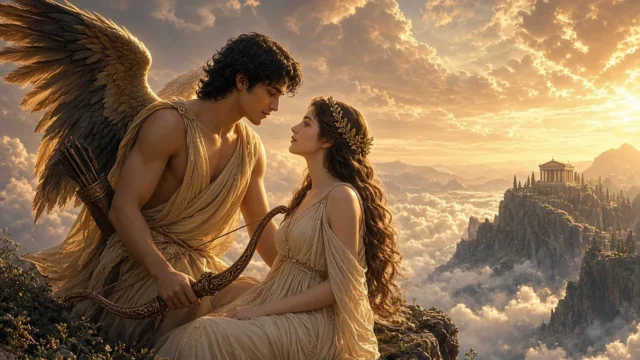
Freyr’s longing for Gerðr begins when he sits in Odin’s high seat Hliðskjálf and looks into distant worlds. He sees the beautiful giantess and becomes so lovesick that he withdraws from ordinary life. His servant Skírnir approaches and is sent on a difficult journey to obtain Gerðr’s agreement to meet Freyr. In the poem Skírnismál, Skírnir first offers gifts, then threatens her with frightening consequences and a curse. That coercive part is important and should not be erased by describing the episode as a perfectly consensual fairy-tale proposal. Gerðr ultimately agrees to meet Freyr in a grove called Barri after nine nights. Different translations can phrase the exchange differently, but the tension remains a key element. Images often show a romantic couple in a bright garden; a truthful article should mention the threats that form part of the surviving poem.
Why Does Freyr Give Up His Magical Sword?
Skírnir asks to take Freyr’s horse and the sword associated with its ability to fight independently. Freyr allows him to carry the weapon on the mission to Gerðr. The choice has later significance, because the mythic accounts connect Freyr’s lack of a sword with his vulnerability at the end of the world. Modern retellings sometimes state that he deliberately destroys the blade forever, or that Gerðr steals it. The source-based version focuses on the transfer to Skírnir and Freyr’s later absence of a weapon when facing danger. This does not mean the Edda provides a detailed custody record of the sword after every stage of the story. The important narrative connection is that personal desire has a costly consequence. A useful image could show Freyr handing a sword to Skírnir, but it should not invent a precise name, weight or rune inscription unsupported by the text.
Gullinbursti: Freyr’s Golden-Bristled Boar
Freyr’s famous boar Gullinbursti is associated with the dwarven smiths Brokkr and Eitri or Sindri in Snorri’s account of a competition to make extraordinary objects. The name can be understood in connection with golden bristles. The boar’s glowing hair and extraordinary movement make it a natural subject for dramatic fantasy art. But a modern portrait of Freyr riding a gold-plated mechanical pig should not be mistaken for a specific historical artifact. The medieval story gives us a supernatural boar, while the artist supplies its armor, exact proportions and surrounding landscape. Some Norse-themed products use a boar symbol for protection or fertility and claim the meaning is guaranteed in every Viking source. That goes beyond the evidence. For an image caption, ‘Gullinbursti, the golden-bristled boar associated with Freyr, in artistic Norse mythology imagery’ is both descriptive and accurate.
Skidbladnir: The Ship That Folds Away
Another extraordinary possession associated with Freyr is Skíðblaðnir, a ship crafted by dwarfs. Snorri describes it as a remarkable vessel able to take many people with equipment and capable of sailing with favorable wind. A distinctive supernatural quality is that it can be folded like cloth and put away when not in use. This imaginative detail has inspired paintings of longships gliding over luminous seas or collapsing into a tiny package. The stories do not provide real dimensions, an archaeological shipyard location or proof that such a folding ship existed. Modern mythological images may show an ornate Viking longship, which is a reasonable visual starting point but still an artistic interpretation. The object also demonstrates Freyr’s connection with skilled craftsmen and extraordinary travel, rather than limiting his role to standing in a field of wheat. A strong poster can give the name and folding property without inventing sailing speed.
Freyr, Beli and the Antler Weapon
In the Prose Edda, Freyr fights the giant Beli without his own sword and kills him using a stag’s antler. This is a distinctive lesser-known story that helps connect the lost sword with his later vulnerability. It also reminds readers that a god’s absence of one legendary weapon does not instantly make him helpless in every encounter. Modern comparisons sometimes give Freyr an enormous spear or magical bow and claim that it appears in every Norse text. The antler episode is much more specific and memorable. For a source-aware illustration, the relevant objects are a stag antler and an opponent called Beli. It should not show the boar Gullinbursti as the animal whose horn is used: boars do not have stag antlers, and the myths describe separate motifs. Keeping these details distinct improves both factual accuracy and visual quality.
How Does Freyr Die at Ragnarok?
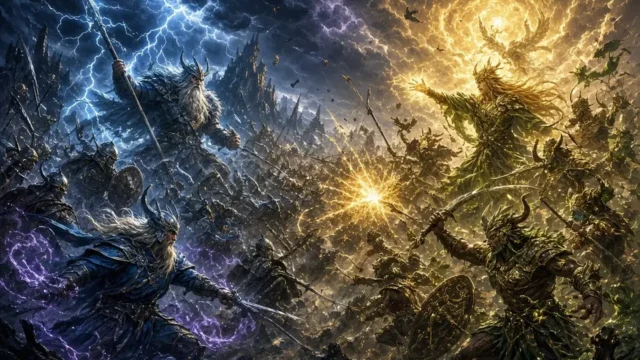
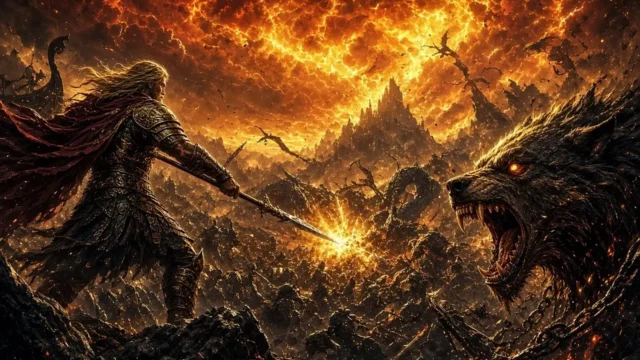
At Ragnarök Freyr faces Surtr, the fiery opponent associated with Múspell, and is killed. Snorri connects his defeat with lacking the remarkable sword he had given to Skírnir. This provides one of the clearest examples in Norse mythology of an earlier personal decision echoing in the world’s final crisis. The cosmic battle also includes Odin against Fenrir and Thor against Jörmungandr, but those are different encounters. Some video games rewrite the sword’s path or give Freyr a different final confrontation. Those adaptations are not direct evidence for the medieval sequence. A good image caption might say ‘Freyr’s final duel with Surtr at Ragnarök, artistic interpretation’. It should not present a made-up fiery weapon as a recovered historical object. The tragic connection between Gerðr, the sword and Surtr is enough to make Freyr’s story both recognizable and emotionally meaningful.
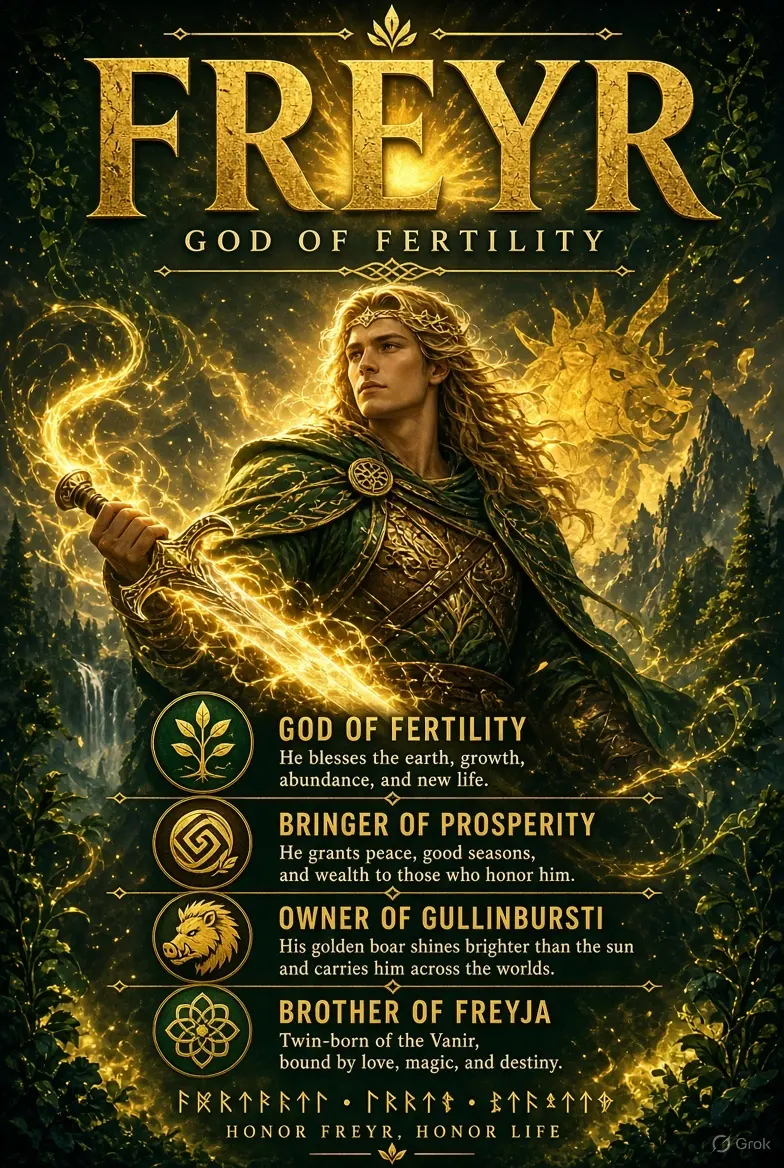
Artwork and source Freyr and Freyja are siblings, the children of Njord. The surviving accounts do not establish that they were twins.
Frequently Asked Questions
Who is Freyr in Norse mythology?
A Vanir deity linked with fertile seasons, rain, sunshine, prosperity and peace.
Who is Freyr’s father?
Njörðr is identified as his father in the familiar prose account.
Is Freyja Freyr’s wife?
No. Freyja is his sister; his major love story concerns Gerðr.
What is Gullinbursti?
The golden-bristled boar associated with Freyr and made by dwarf craftsmen.
Why does Freyr lose his sword?
He gives it to Skírnir for the mission involving Gerðr.
Who kills Freyr at Ragnarök?
Surtr defeats him; Snorri links the outcome with Freyr’s lack of his sword.
Conclusion
Freyr is remembered for abundance, peace and the bright seasons, yet his literature also contains a troubling courtship, exceptional crafted objects and a tragic final duel. Understanding the links between Gerðr, Skírnir, Gullinbursti and Surtr gives readers a fuller picture than a generic harvest-god portrait.
Sources and visual disclaimer
Gylfaginning: Freyr, Gerdr, rain and sun; Skaldskaparmal: Freyr and divine objects; Viking Society edition and mythological source notes.
Reviewed 15 November 2026. Illustrations are modern representations of literary mythology.














Share Your Opinion
Comments are closed on this post.