 Vista
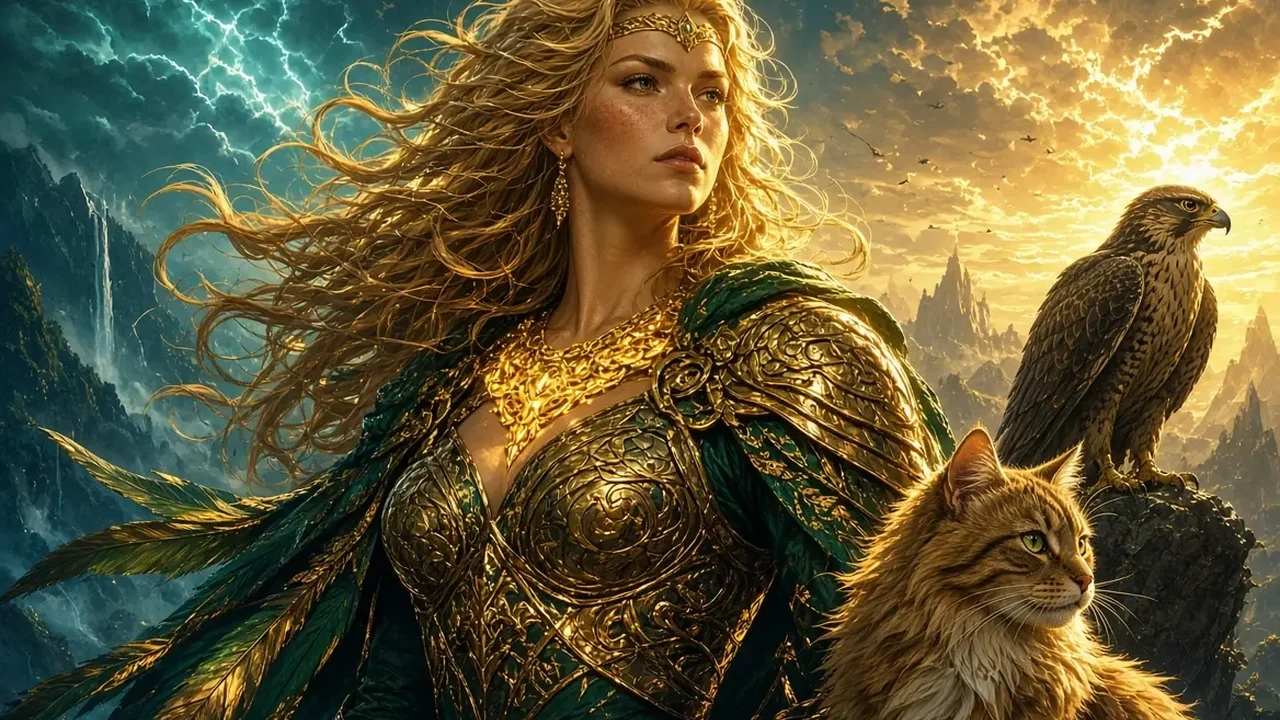
Freyja is one of the best-known goddesses in Norse mythology, associated with love, desire, wealth, magical practices and the fate of some warriors killed in battle. She belongs to the Vanir divine family, is the daughter of Njörðr and the sister of Freyr in the familiar prose account. Freyja’s striking symbols include the necklace Brísingamen, a cat-drawn chariot, a falcon-feather garment and the hall Sessrúmnir in Fólkvangr. But she is not simply the Norse version of a generic ‘love goddess’: the stories give her active roles in negotiations, accusations and the world of the dead.
This illustrated article explains Freyja Norse mythology, Freyja’s powers and family, why she is associated with cats, her famous necklace, what Fólkvangr means, and how to distinguish Freyja from Frigg. It also addresses Freyja pictures, wallpapers, symbols and tattoo searches without treating modern fantasy art as a surviving Viking portrait.
Who Is Freyja? Her Place Among the Vanir
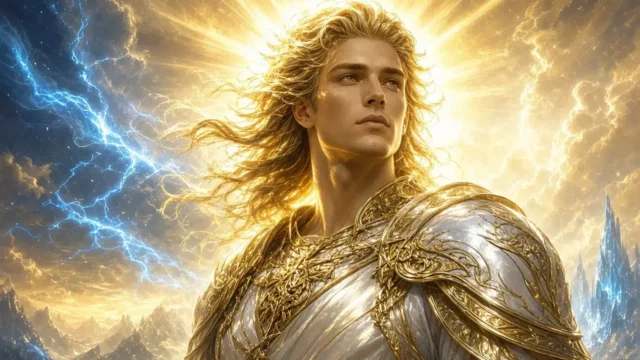
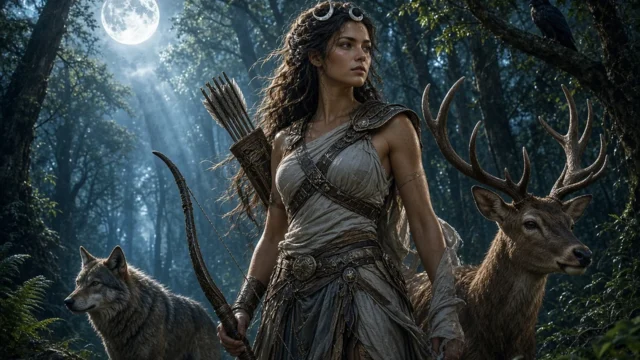
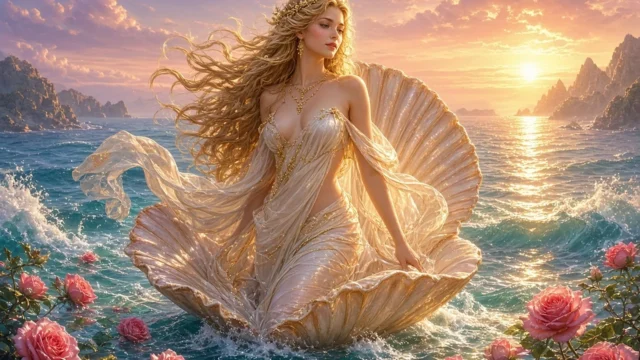
Freyja is described as an important goddess connected with the Vanir, a divine grouping that appears alongside the Æsir. The narratives discuss a conflict and later accommodation between these groups, but they are not two identical teams with perfectly separate powers. Freyja’s father Njörðr and brother Freyr are also associated with the Vanir. This background helps explain why her character appears in the company of Odin, Thor and other Æsir while retaining her own family history. The older spellings Freyja and Freya are commonly used for the same figure; neither spelling identifies a separate goddess. In some popular images she is presented as a warrior queen wearing golden armor, whereas other artists emphasize a necklace or a cat-drawn carriage. Both are interpretations, but the family relationships in the medieval accounts give a more dependable starting point than a modern illustration. A good beginner profile names her family, sphere and the texts that describe her rather than assigning her a made-up official power score.
Freyja’s Love, Desire, Wealth and Magic
The Prose Edda associates Freyja with love and with prayers made by those seeking help in matters of affection. Another well-known association is seiðr, a form of magic discussed in Old Norse literature. In the saga tradition, she is connected with teaching magical practices, though scholars debate how individual narratives reflect pre-Christian religious beliefs. It is therefore reasonable to describe Freyja as having connections to love, desire and magic, but inaccurate to claim that a modern ritual diagram guarantees an ancient result merely by invoking her name. Wealth and precious ornaments are also prominent in her literary image. Not every glittering object in a Pinterest portrait is a historical ‘Freyja talisman,’ however. A reliable image description names the actual visible object and identifies an invented design as modern art. The mythological figure is complex enough without borrowing unsupported promises from contemporary occult marketing.
Brísingamen: What Is Freyja’s Necklace?
Brísingamen is Freyja’s famous necklace, named in multiple Old Norse texts. The object becomes central to episodes involving theft, recovery and disputes among powerful figures. One account associates Loki and Heimdall with a confrontation over a valuable object understood in the tradition as connected with the necklace. The details are not identical in all retellings, and some fuller acquisition stories appear in later sources. A colorful poster showing four dwarfs handing Freyja a necklace may be inspired by a particular later narrative rather than a scene stated identically in every Eddic poem. That is worth labeling. As a symbol, Brísingamen can help viewers recognize Freyja in fantasy artwork, but medieval sources do not establish a universal necklace pattern, jewel count or metal specification. If a shop photo shows an ornate reproduction, call it a modern Norse-inspired necklace rather than the excavated ‘original Brísingamen’.
Why Is Freyja’s Chariot Pulled by Cats?
One memorable detail in the Prose Edda is Freyja travelling in a chariot drawn by two cats. The text does not specify a modern domestic cat breed, exact coat pattern or the names sometimes invented on fan pages. This makes the scene exceptionally attractive for illustrations: a goddess in a gleaming carriage, large cats, a Northern landscape and a sky filled with aurora. The cats give her a visual signature quite different from Thor’s goat-drawn chariot or Odin’s eight-legged horse. Still, it is important not to turn a brief medieval literary detail into a precise veterinary claim about Viking cats. Artists may choose wild-looking animals for dramatic effect. The caption should simply explain that Freyja is associated with a cat-drawn chariot in a medieval account, and that the animals’ appearance is imaginative. This approach serves image-search visitors without offering false historical certainty.
Fólkvangr and Sessrúmnir: Freyja and the Slain
Freyja is also linked with the fate of warriors who die in battle. In Grímnismál and the prose tradition, Fólkvangr is associated with her, and a share of the battle-slain comes under her choosing; Odin receives another share. Her hall is called Sessrúmnir in the Prose Edda. The exact process is not described like a bureaucratic selection system, and the sources do not permit a general rule that all women go to Freyja and all men go to Odin. Those claims are common online but too neat. Nor should Fólkvangr be confused with Valhalla: Valhalla is Odin’s hall, while the poetic passage gives Freyja a distinct role. For a map, one may depict separate halls or fields as a visual aid, but no surviving archaeological plan establishes their precise positions. The important historical distinction is that older Norse afterlife ideas are more varied than a single universal Viking heaven.
Freyja and Frigg: Are They the Same Goddess?
Frigg is Odin’s wife in familiar accounts, whereas Freyja is usually presented as the daughter of Njörðr and sister of Freyr. The names and overlapping themes have led to scholarly discussion of possible connections in religious history, but the surviving narratives also describe them as distinct named figures. A beginner article should not claim confidently that they are identical or that one is simply a disguised version of the other. In a family tree, Frigg belongs beside Odin and is associated with Baldr, while Freyja’s immediate family links to the Vanir. Modern screen adaptations and internet diagrams sometimes rearrange these relationships, making the confusion worse. The most useful comparison focuses on what the stories actually say, where overlap may exist and which parts remain debated. Treating the scholarly issue as an open discussion is more accurate than manufacturing a tidy ‘secret revealed’ headline.
Freyja’s Falcon Cloak, Tears and Her Husband Óðr
Old Norse material also links Freyja with a feather garment that enables bird-like flight and is borrowed by Loki in some adventures. She is described as travelling in search of her absent husband Óðr in Snorri’s account, with her tears associated with gold. Names such as Hnoss and Gersemi appear among the figures connected with her family, though details differ across texts. Each of these motifs offers an image-search angle: Freyja with a falcon-feather cloak, Freyja and golden tears, or Freyja in a northern hall. But because the surviving descriptions are not continuous illustrated biographies, artists have much latitude in assembling a portrait. A costume with an elaborate cape and green lightning does not prove that a Viking artist pictured her that way. Reliable metadata should identify the literary motif while avoiding unsupported claims that one representation is ‘the real face of Freyja’.
Freyja in Tattoos, Wallpapers and Modern Mythology
Searches for ‘Freyja goddess wallpaper’, ‘Freyja symbol tattoo’ and ‘Freyja Norse mythology images’ often blend historical motifs with modern spiritual design. Brísingamen, cats, falcon feathers and her association with Fólkvangr provide source-connected imagery. By contrast, a randomly labelled bindrune ‘Freyja rune’ or a claim that every Viking used a particular tattoo for romantic luck may lack evidence. Some widely circulated Icelandic magical symbols belong to much later traditions and should not be mislabeled as Viking Age emblems. When choosing an illustration for an educational page, use an eye-catching featured image and a simpler factual poster. The featured image can suggest drama and personality; the poster should name only supported relationships and objects. For accessibility, ALT text should describe the actual pictured scene rather than list every imaginable search keyword. Readers gain more from an accurate, memorable explanation than from repetitive keyword stuffing.
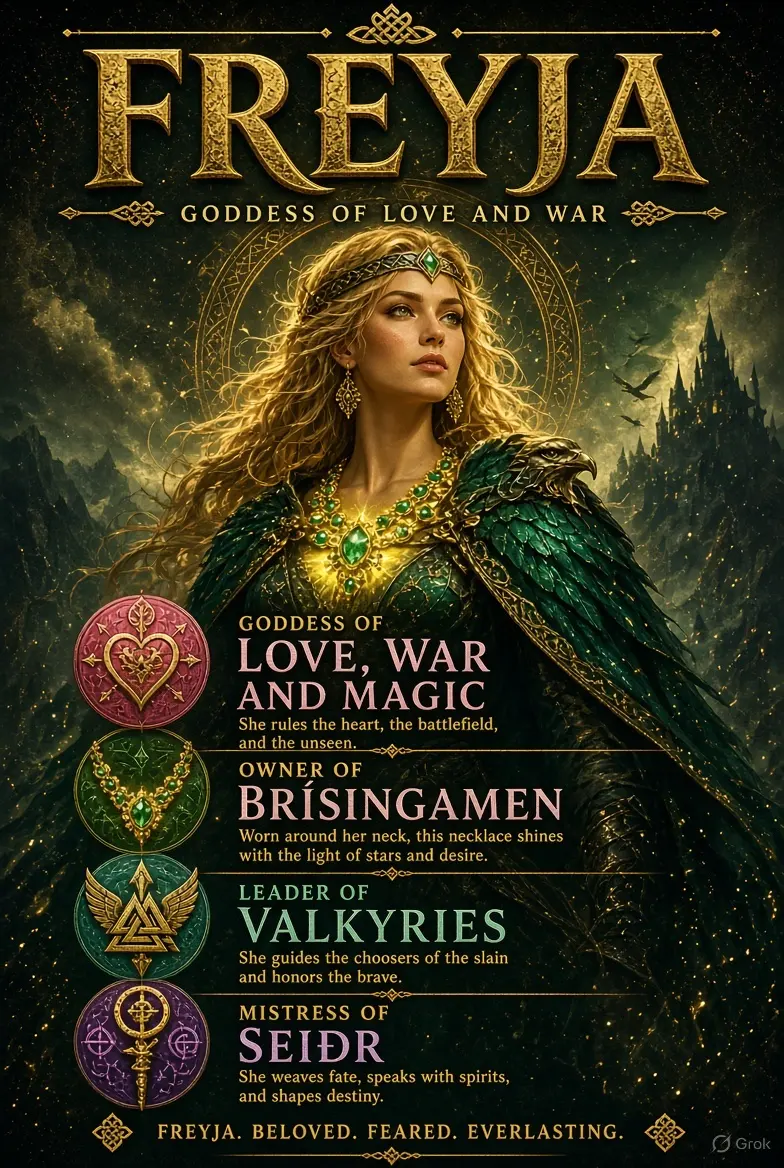
Artwork and source Grímnismál says Freyja chooses half the battle-slain for Fólkvangr. The necklace’s glow and her role guiding Valkyries are artistic interpretations.
Frequently Asked Questions
Is Freyja a goddess of love?
She is strongly associated with love and desire in the Prose Edda, but her stories also involve wealth, magic and the battle-slain.
Who are Freyja’s parents and brother?
Njörðr is her father and Freyr her brother in the familiar accounts.
What is Brísingamen?
The famous necklace associated with Freyja in Old Norse literature.
Why are cats linked to Freyja?
The Prose Edda describes her travelling in a chariot drawn by two cats.
Is Freyja the same as Frigg?
The names are distinct in surviving narratives, although historical connections have been discussed by scholars.
Does Freyja take warriors to Valhalla?
She is associated with Fólkvangr and a share of the slain; Valhalla is associated with Odin.
Conclusion
Freyja matters because she combines affection, precious objects, magic and a role in the fate of warriors. Her necklace and cat-drawn chariot are wonderful artistic subjects, but her stories are richer than a modern fantasy costume. The best approach is to enjoy the illustration and check the name, relationship and episode against its medieval source.
Sources: The Prose Edda, Gylfaginning (primary text); The Younger Edda: Freyr and Freyja; Academic research on Brisingamen.
Images are creative interpretations; textual evidence varies by source. 15 November 2026.




Share Your Opinion
Comments are closed on this post.