 Vista
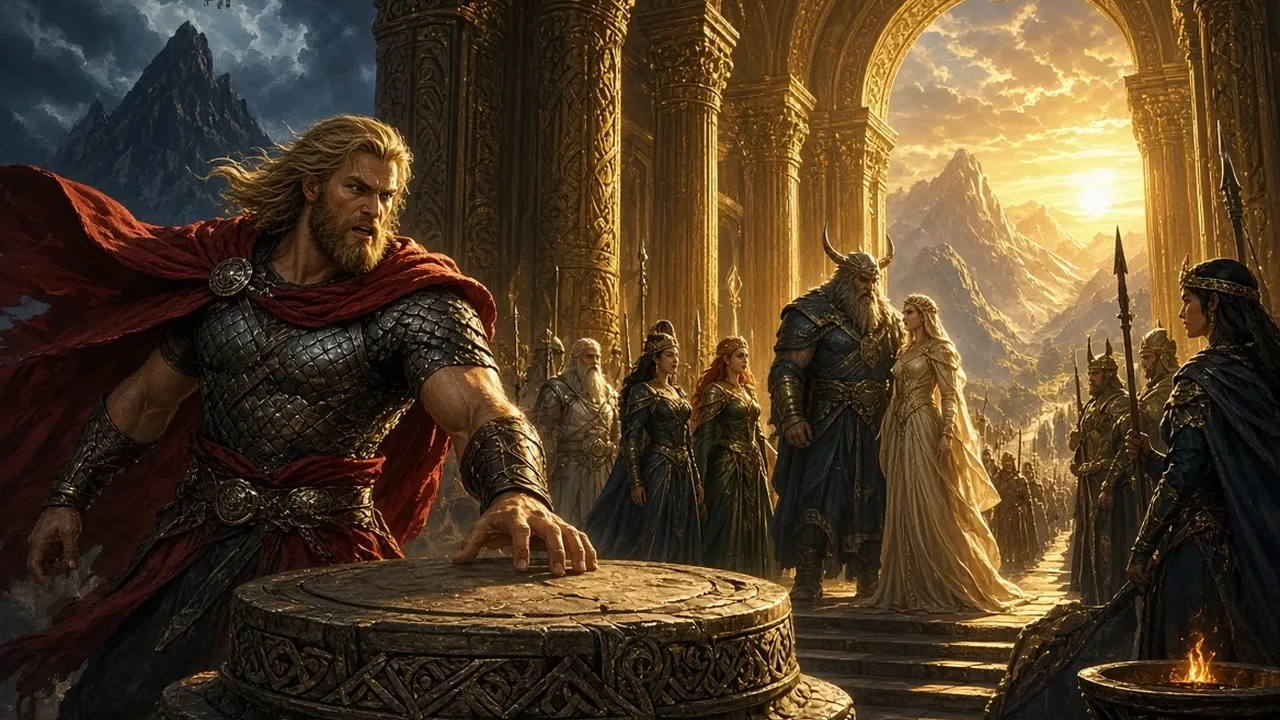
Þrymr (Thrym), a jötunn, steals Thor’s hammer Mjölnir in the Old Norse poem Þrymskviða. He hides it deep underground and demands that the goddess Freyja be brought to him as a bride. Freyja refuses. The gods instead disguise Thor as the bride, with Loki accompanying him as a female attendant. During the supposed wedding, the hammer is brought out to bless the bride. Thor seizes it and defeats Thrym and the assembled jötnar. This witty, often irreverent poem is the source of the well-known search for Thor dressed as a bride to get Mjolnir back.
Below is the full sequence, from the disappearance of the hammer to Loki’s plan, the wedding feast, and the moment Mjölnir returns to Thor. The visuals are fantasy interpretations; the poem does not describe a photographed historical wedding.
Who Is Thrym, and Why Does He Steal Mjölnir?
Þrymr is the jötunn who has taken Thor’s hammer before the poem begins. He is discovered sitting in the world of the jötnar, where Loki questions him about the missing weapon. Þrymr admits he has buried it many leagues beneath the earth and makes a demand: no hammer will be returned until Freyja comes to marry him. The condition is not a polite invitation. The hammer is a powerful possession of the god who repeatedly defends the divine world against enemies, and losing it creates a dangerous imbalance. Yet the poem’s tone is unexpectedly comic rather than solemn throughout. Its speaker describes a powerful god in a helpless situation, then follows an increasingly unlikely disguise. A clear summary should name Þrymr as the thief rather than Loki. Loki performs the investigation and helps arrange the recovery; he is not identified in this poem as the original hammer thief. The precise date of the imaginary theft and exact depth of the burial are not historical measurements.
How Thor Discovers His Hammer Is Missing
At the beginning of Þrymskviða, Thor wakes and realizes that his hammer is gone. He reacts with visible anger and alarms Loki with the news. Their first move is not to launch an army. They visit Freyja to borrow her feather garment so Loki can travel swiftly to the world of the jötnar and investigate. This equipment appears in other Norse stories as well, including the rescue of Iðunn, but the two incidents are separate. In the poem, Loki travels in the borrowed garment and directly questions the suspected giant. Modern pictures sometimes show Thor searching every one of the Nine Realms or Odin conducting a lengthy criminal investigation; those are creative expansions. The source gives a brisk sequence of dialogue and action. The theft itself is not shown as an elaborate burglary scene with guards, magical locks and exact timestamps. Readers asking ‘how did Thrym steal Mjolnir?’ should be told the poem reveals possession of the hammer but does not give a detailed account of the actual stealing technique.
Why Does Thrym Demand Freyja as His Bride?
Þrymr’s requested price is marriage to Freyja. She is a major Vanir-associated goddess, sibling of Freyr, and a figure with stories involving Brísingamen, Fólkvangr and seiðr. In Þrymskviða she reacts angrily to the proposal. Her valuable necklace is mentioned amid the force of her refusal. Some retellings portray Freyja as delighted to marry the jötunn or say Thor accepts her decision to sacrifice herself for Asgard. That is contrary to the poem’s clear resistance. The demand is coercive and the gods must decide how to respond without handing her over. The story has a humorous surface, but the woman’s refusal matters: she is not simply an object transported from one place to another. A responsible image caption should not show an invented romantic wedding between Freyja and Þrymr as if it is the real ending. The entire plot exists because the demand cannot simply be met. The gods eventually resort to deception instead of complying.
Heimdall Proposes the Bridal Disguise
After Freyja refuses, the gods gather to discuss the loss of Mjölnir. Heimdall proposes that Thor dress as the bride, wearing women’s clothing and the bridal adornments required to convince Þrymr. Thor objects because the disguise could damage his reputation for masculine strength. Loki argues that recovering the hammer matters more than maintaining appearances. Their exchange is part of the poem’s joke: an exceptionally strong warrior faces a problem that force alone cannot solve. The solution depends on social performance, clothing and deception. The presence of Heimdall is an important detail that summaries sometimes forget, giving Loki all the credit for inventing the scheme. Loki plays a crucial role, but the council’s proposed disguise is attributed to Heimdall. Artists often turn the garment into a modern white bridal gown, although Old Norse clothing and wedding customs differ from current styles. Such an image can be funny, but it is an imaginative retelling rather than a direct costume record.
Thor as a Bride and Loki as His Attendant
Thor is dressed with bridal clothing, a veil and jewelry. Loki accompanies him in the role of a female attendant and supplies quick explanations when the disguise threatens to fail. They travel to Þrymr, whose household prepares for the wedding. The narrative’s comedy rests on the difference between the bride’s appearance and Thor’s unmistakable appetite and temperament. A film or game can amplify the scene with modern dialogue and exaggerated makeup, but the basic masquerade is from the poem. It is worth distinguishing Loki’s disguise from his ability to change form in other myths. In Þrymskviða he serves as an attendant to the supposed bride and talks his way through awkward questions. Some images portray an entirely different female god accompanying Thor; those can obscure Loki’s part. For an educational poster, label both figures and their roles directly. The story is an example of clever deception, not evidence of a documented Viking historical marriage ceremony.
The Wedding Feast: Why Does the Bride Eat So Much?
At the celebration, the supposed bride consumes an astonishing quantity of food and drink. Þrymr is surprised that his intended wife has such an extraordinary appetite. Loki immediately answers that she has not eaten for days because she was so eager to come to the land of the jötnar. Later Þrymr tries to look closely at her eyes and becomes alarmed by their fiery intensity. Loki again invents an explanation, claiming that she has not slept because of her longing for the wedding. These comic exchanges are memorable because Thor’s physical nature nearly exposes the deception, while Loki’s wit keeps the plan alive. A visual can show a feast with the enormous bride and the worried giant. It should not add invented modern jokes as if they were verbatim translations of the poem. The exact quantities quoted in different editions should be taken from a chosen translation rather than fabricated for extra drama.
How the Wedding Blessing Returns Mjölnir to Thor
Þrymr orders the hammer to be brought in to consecrate the bride and the wedding. It is laid in the lap of the disguised Thor. This is the pivotal moment: the thief has voluntarily placed the stolen weapon back within the reach of its owner. Thor recognizes the opportunity, takes hold of Mjölnir and turns the celebration into a violent reversal. The poem describes him killing Þrymr and other members of the giant household. One should not confuse this use of the hammer to bless a bride with an exact archaeological reconstruction of Viking marriage rituals; the poem is a source for mythic imagery and religious symbolism, but the scene is literary. The popular question ‘how did Thor get his hammer back?’ has a direct answer: through the bridal masquerade and the ritual appearance of the weapon, not through a heroic expedition to dig it out from underground. The wedding setting provides the clever mechanism for its return.
What Does Þrymskviða Tell Us About Thor and Loki?
Thor is immensely strong, yet cannot immediately solve the theft by swinging a weapon he no longer has. Loki, who often causes trouble in other stories, helps him here through reconnaissance and quick improvisation. Heimdall adds strategic advice, and Freyja’s refusal forces the gods to respect a constraint rather than simply choose the easiest person to surrender. The result is a more nuanced set of divine personalities than ‘Thor strong, Loki bad’. The humor also shows that medieval mythological poetry could mock powerful figures affectionately or sharply. It is not necessary to treat every episode as a sacred untouchable battle report. Readers can notice how clothing, gender expectations, appetite, social embarrassment and trickery drive the action. At the same time, the ending is violent, so a children’s version may summarize the defeat of the giant without graphic detail while still being truthful about the outcome.
Thrym vs Marvel, Hammer Theft Images and SEO Context
In Marvel films Mjölnir has adventures and rules about worthiness that differ from older Norse stories. Þrymskviða does not centre on a superhero test determining who deserves to lift the hammer; the dramatic issue is its theft and the deceptive return. Search queries like ‘who stole Thor hammer’, ‘Thor wedding dress mythology’, ‘Thrym Loki Freyja’, ‘Thor bride story’ and ‘Thrymskvida summary’ express different interests in the same episode. A featured image can show a humorous bridal disguise, while the informative poster can explain the sequence from theft to recovery. ALT text should describe the artwork actually visible. An image showing Thor with Mjölnir after the wedding must not be labelled as the theft happening in Asgard. The poem contains no photographs or standardized character faces. Artwork helps tell the story; the names, order of events and source citation provide the factual value.
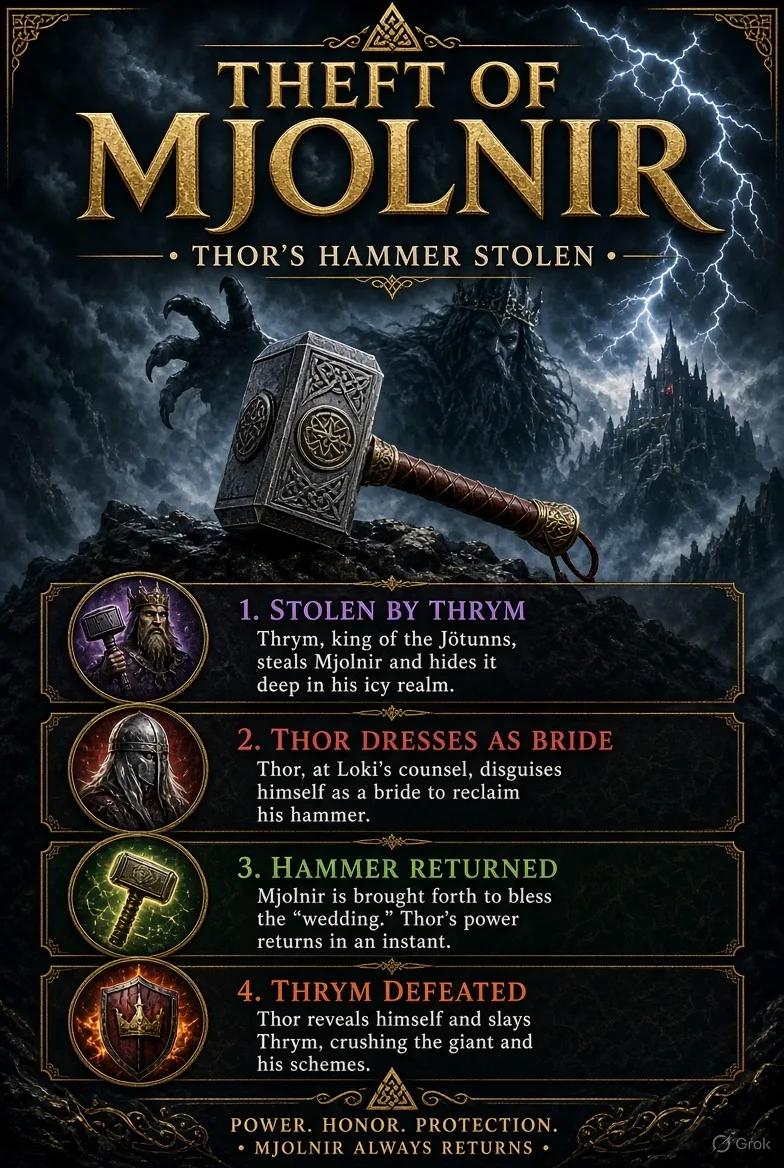
Frequently Asked Questions
Who stole Thor’s hammer?
Þrymr (Thrym), a jötunn, in the poem Þrymskviða.
What did Thrym demand?
He wanted Freyja as his bride in return for Mjölnir.
Did Freyja marry Thrym?
No. She refused, and Thor impersonated her instead.
Who suggested Thor wear a bridal disguise?
Heimdall proposed it; Loki helped carry it out.
How did Thor recover Mjolnir?
It was brought to bless the bride and laid in his lap.
Is this story from Marvel?
No. Its source is the Old Norse poem Þrymskviða.
Conclusion
The theft of Mjölnir is a distinctive combination of danger, comic disguise and clever planning. Þrymr is the thief, Freyja rejects his demand, Heimdall suggests the plan, Loki improvises, and Thor recovers his hammer at the wedding ceremony. Those details make an engaging mythological image gallery without inventing a modern superhero plot.
Sources and illustration note
Þrymskviða — Poetic Edda, text and translation; The Lay of Thrym — Bellows translation; The Prose Edda — Norse myth context.
Reviewed 15 November 2026. Illustration is modern fantasy art, not a historical image.




















Share Your Opinion
Comments are closed on this post.