 Vista

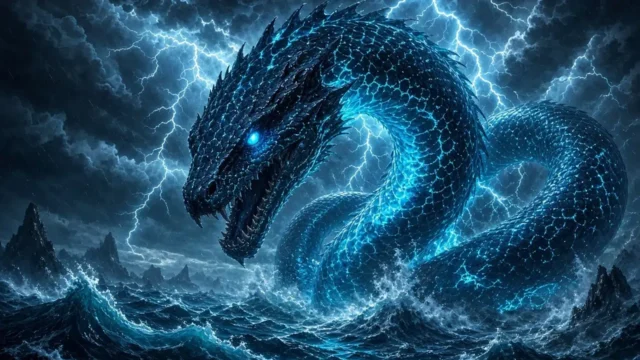
Níðhöggr, commonly spelled Nidhogg, is a dragon-like serpent associated with the roots of Yggdrasil in Norse mythology. The Prose Edda describes it among the creatures harming the cosmic ash and connects it with the squirrel Ratatoskr, who carries hostile messages between Níðhöggr below and an eagle above. The Poetic Edda also associates the creature with dead bodies at Náströnd, and the end of Völuspá contains an enigmatic image of a dark dragon carrying corpses. Exactly how these references fit together is debated.
Readers searching for Nidhogg Norse mythology, Yggdrasil dragon, Nidhogg vs Jormungandr, Nidhogg meaning, Ratatoskr or Ragnarok images will find a source-aware explanation here. The dramatic artwork is a modern interpretation, not a Viking-age photograph of a supernatural monster.
Who Is Níðhöggr? Dragon, Serpent or Something Else?
The name is written Níðhöggr in standardized Old Norse, with English variants such as Nidhogg, Nidhoggr and Nidhögg. Ancient sources use serpent language, and the closing scene of Völuspá evokes a dragon flying through the air. Those are not necessarily contradictory species labels; the imagery of powerful reptiles and dragons in medieval literature is more fluid than the creature classifications of contemporary games. An SEO illustration may show wings, claws and a scaled body, but not every detail is prescribed by a surviving text. The source-grounded identity is a threatening being connected with the great tree, hostile messages, and particular scenes involving the dead. It is also important to resist a common family-tree invention. The Eddas do not identify Níðhöggr as one of Loki and Angrboða’s three famous children. Fenrir, Jörmungandr and Hel belong to that family list. Mixing the world-serpent’s parentage with the root-gnawer produces an attractive but incorrect chart.
Why Does Nidhogg Gnaw the Roots of Yggdrasil?
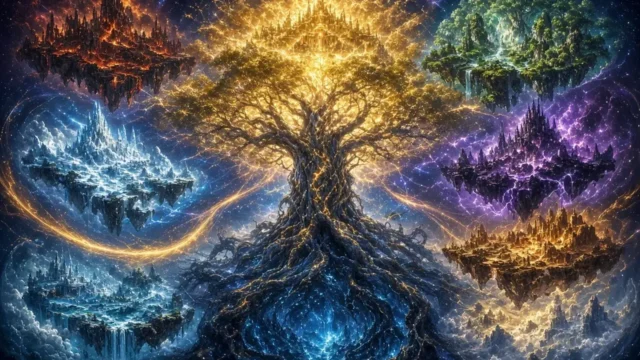
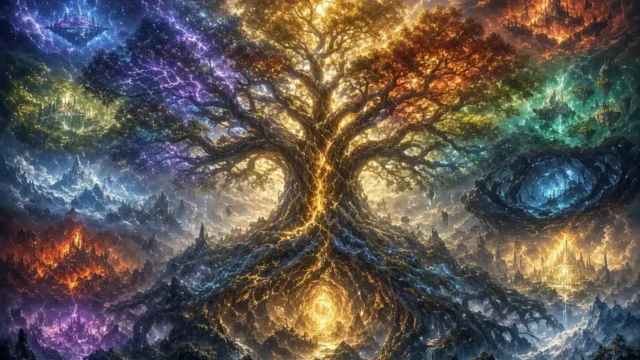
Yggdrasil is the huge ash that structures parts of the Norse mythical cosmos. Different beings inhabit or threaten it: an eagle appears above, deer browse its branches, and the serpent Níðhöggr is associated with damage near the roots. Snorri names Níðhöggr among harmful creatures beneath the tree, and Grímnismál also associates the serpent with the roots. The root-gnawing image expresses how the world remains vulnerable even when represented by an immense and sacred tree. Some online explanations say Nidhogg alone causes Ragnarok by chewing through one branch; the medieval sources do not give such a neat mechanical chain of cause and effect. The tree suffers from several dangers, and the cosmic ending has many interwoven prophecies. For a useful infographic, label the root-associated serpent without inventing a countdown timer, the exact length of a root, or a numerical measure of the monster’s strength. Mythic symbolism is not geological engineering.
Ratatoskr, the Eagle and a Strange Message Network
Ratatoskr is the squirrel connected with messages travelling up and down Yggdrasil. Snorri says it carries words of hostility between the eagle in the tree’s upper reaches and Níðhöggr below. The exchange is often simplified into a cartoon in which the squirrel deliberately lies to start an endless war, but the original prose description should be read carefully before assigning exact motives. The eagle and serpent make natural rivals in the visual composition, and Ratatoskr’s movement shows how the tree is inhabited across different levels. An educational image can place the squirrel along the trunk and the two larger creatures at opposite ends, but its heights and branches are artistic decisions. The presence of hostile messages also adds a less obvious aspect to Níðhöggr: the creature is part of a network of tension, not simply a beast passively eating wood. A reader searching ‘Nidhogg Ratatoskr meaning’ deserves this context rather than a fabricated battle with a named winner.
Where Is Nidhogg? Hvergelmir and the Roots
Níðhöggr is connected in Snorri’s cosmology with Hvergelmir, the spring or well among the roots of Yggdrasil. The broader root geography is complicated. Different poetic and prose accounts associate the tree’s roots with divine spaces, jötnar, the dead and distinct wells. Hvergelmir should not be confused automatically with Urðarbrunnr, which is associated with the norns, or with Mímisbrunnr, connected with Odin’s pursuit of wisdom. Popular Nine Realms posters sometimes draw three matching blue pools and place a serpent in all of them; the source references are not that interchangeable. In a truthful image caption, ‘Níðhöggr near a root of Yggdrasil in a modern artistic interpretation’ is better than a claim that the image reproduces an ancient geographic map. There is no physical cave or Scandinavian tourism site established as this creature’s historical address.
Náströnd: Why Is Nidhogg Connected with the Dead?
The poem Völuspá describes a grim location called Náströnd, often rendered in terms of a corpse-shore, with imagery involving snakes, wrongdoing and the dead. In the surrounding tradition Níðhöggr is associated with gnawing at corpses. The passage has been interpreted in different ways, and its relationship to later Christian moral language has been discussed by scholars. This means that describing Náströnd as a perfectly standardized Viking prison for a fixed list of modern offenses goes too far. The reliable point is that the literature connects the creature with a fearful vision of death and suffering. An image featuring dark waters, bones and serpents can reflect the mood, but it should not be advertised as evidence that Viking archaeologists found the actual underworld. A responsible article explains which passage supports the scene and acknowledges that interpretations of its moral framework remain contested.
What Does the Final Dragon Scene in Völuspá Mean?
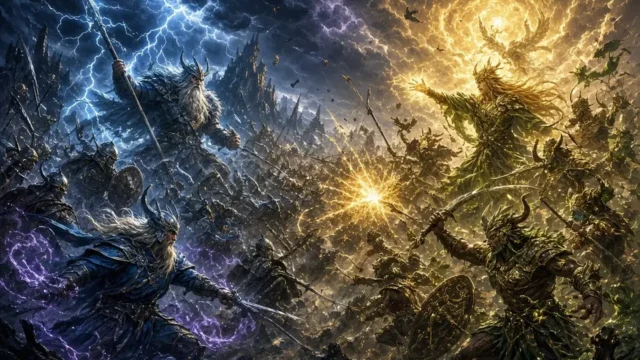
Near the end of Völuspá, after passages involving destruction and renewal, the poet pictures Níðhöggr emerging from below, a dark dragon flying with bodies on its wings. The enigmatic ending has attracted substantial discussion. Does the dragon represent surviving danger after the new world emerges? Is it a final ominous vision, or does the last line mark a departure from the prophetic scene? The poem does not provide a modern explanatory footnote settling every question. That uncertainty should remain visible in an educational article. Many infographics declare with complete confidence that Nidhogg is slain by a particular god at Ragnarok or becomes the new ruler of the cosmos. Such precise events are not established by the famous concluding scene. It is more useful to quote or paraphrase its narrative role cautiously and let readers see that the ending is open to interpretation. A striking dragon-in-flight picture can be labelled as art inspired by Völuspá.
Is Nidhogg the Same as Jörmungandr?
No. Jörmungandr is the Midgard or World Serpent, named among the children of Loki and Angrboða and associated with circling the human world in the ocean. Its best-known opponent is Thor, who kills it at Ragnarök and dies from the venom afterward. Níðhöggr, by contrast, is associated with Yggdrasil’s roots, Ratatoskr and scenes involving corpses. Both are serpent-like and belong to Norse myth, which explains why searches and fantasy artwork may conflate them. But an accurate family tree and gallery must keep the two characters separate. If a large serpent encircles a map of Midgard, that likely evokes Jörmungandr; if it gnaws at a great tree’s roots, that evokes Níðhöggr. An image may combine both motifs for dramatic effect, but the caption should describe the imaginative mash-up rather than teaching a false identity.
Is Nidhogg an Evil God, and What Does the Name Mean?
Níðhöggr is generally treated as a threatening serpent or dragon rather than as a member of the Æsir divine family. Its name has been discussed in relation to elements of hostility, dishonour or striking, but short one-word translations often conceal linguistic uncertainty. Describing the monster as the ruler of all evil or the only force responsible for death in Norse cosmology is not supported by the sources. Norse stories include many dangerous beings whose functions cannot be mapped neatly onto a single good-versus-evil ranking. When describing a tattoo or pendant, it is reasonable for a modern person to see themes of destruction, decay or rebirth in the root-gnawing image. Those are modern interpretations, not guarantees that the same design had one fixed Viking Age magical function. For cultural accuracy, separate the text’s actions from the art’s symbolism.
Nidhogg Wallpapers, Dragon Images and SEO Captions
Searches for ‘Nidhogg dragon wallpaper’, ‘Nidhogg Yggdrasil image’, ‘Ratatoskr squirrel and eagle’, and ‘Nidhogg Ragnarok’ represent related but distinct visual interests. A strong featured image can emphasize dramatic scale and the world tree, while an inside poster can identify roots, the squirrel, the eagle and Náströnd. An ALT description should match the scene actually shown rather than repeat all keywords at once. If the illustration shows only an imposing dragon against a dark forest, it should not claim a precise depiction of the squirrel or the ending of Völuspá. The most valuable part of an image-rich article is that it explains what the creature does in the surviving myths and what the artist imagined. That approach turns fantasy visuals into a useful Norse mythology learning resource without inventing archaeological proof or a fake official dragon portrait.
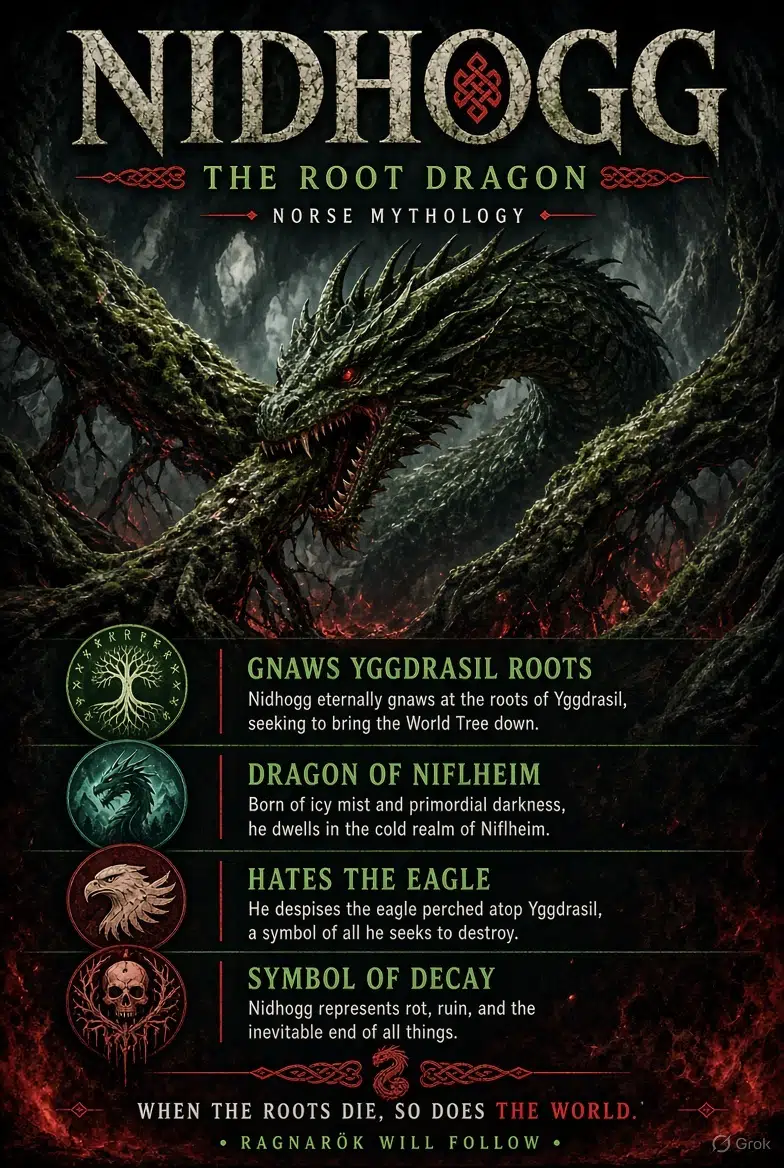
Artwork and source The dragon gnaws at Yggdrasil. The sources do not establish that it was born from icy mist or causes Ragnarök by destroying the tree.
Frequently Asked Questions
What is Nidhogg in Norse mythology?
A serpent or dragon associated with Yggdrasil’s roots and with scenes concerning the dead.
Is Nidhogg Loki’s son?
The familiar Old Norse sources do not list Níðhöggr among Loki and Angrboða’s children.
What is Ratatoskr’s relation to Nidhogg?
Ratatoskr carries hostile messages between the eagle high on Yggdrasil and Níðhöggr below.
Does Nidhogg destroy Yggdrasil at Ragnarok?
The sources do not give a simple, universally established account in which it alone fells the tree.
Are Nidhogg and Jormungandr identical?
No. They are different serpentine beings with different roles and narrative settings.
Does Nidhogg survive Ragnarok?
Völuspá ends with a mysterious dragon scene after renewal imagery; its implications are debated.
Conclusion
Níðhöggr is a vivid part of the Yggdrasil tradition: it threatens the roots, exchanges hostile messages through Ratatoskr and appears in unsettling visions involving the dead. The best dragon artwork captures that mystery without inventing a definite family, battle victory or scientific creature profile.
Sources and art notice
University of Victoria MyNDIR — Níðhöggr; Snorri’s Prose Edda — Yggdrasil and its creatures; Völuspá — dragon and Náströnd passages.
Reviewed 15 November 2026. Images are artistic interpretations of medieval myths.













Share Your Opinion
Comments are closed on this post.