 Vista
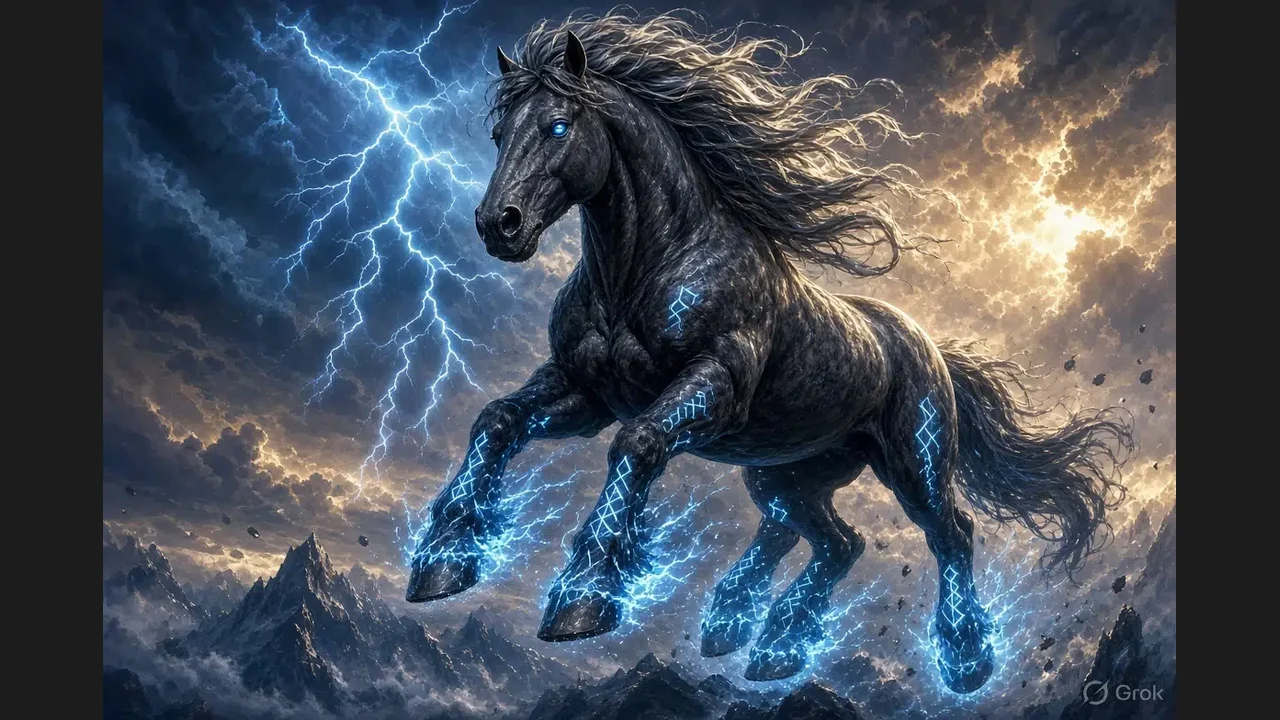
Sleipnir is Odin’s extraordinary eight-legged horse in Norse mythology. The Prose Edda describes him as the finest of horses among gods and people and tells a surprising birth story. A builder promises to strengthen Asgard’s defenses, using the powerful stallion Svaðilfari to haul stones. When the gods realize that the contractor may claim a dangerous reward, Loki changes into a mare to distract the stallion. Loki later gives birth to the gray, eight-legged foal Sleipnir, who becomes Odin’s mount.
If you searched for Sleipnir Norse mythology, Odin eight-legged horse images, Loki Sleipnir mother, Svadilfari, Sleipnir’s powers, or Hermóðr’s journey to Hel, this guide explains the actual episodes and the limits of what we can claim from them. Eight-legged horses in modern art are interpretations of a myth, not evidence of a real eight-legged animal species.
What Is Sleipnir and Why Does He Have Eight Legs?
Sleipnir is identified in Old Norse material as an exceptional horse closely associated with Odin. His defining characteristic is the presence of eight legs, a feature that makes him easy to recognize in a fantasy image even without a human rider. In the Prose Edda, Snorri calls him outstanding among horses and gives him a gray appearance in the birth account. The literary description does not include modern measured running speeds, exact anatomical diagrams or a zoological explanation for eight functioning limbs. Artists sometimes arrange the legs in two extra pairs, blur them to suggest motion or make them appear ghostlike. Those choices can convey supernatural swiftness but are not standardized ancient pictures. A responsible article distinguishes the horse described in medieval literature from the design visible in a particular AI illustration. The real value of Sleipnir’s story is his connection with crossing boundaries and Odin’s access to unusual places, not a fabricated ‘kilometers per hour’ claim.
Who Are Sleipnir’s Parents? Loki and Svaðilfari
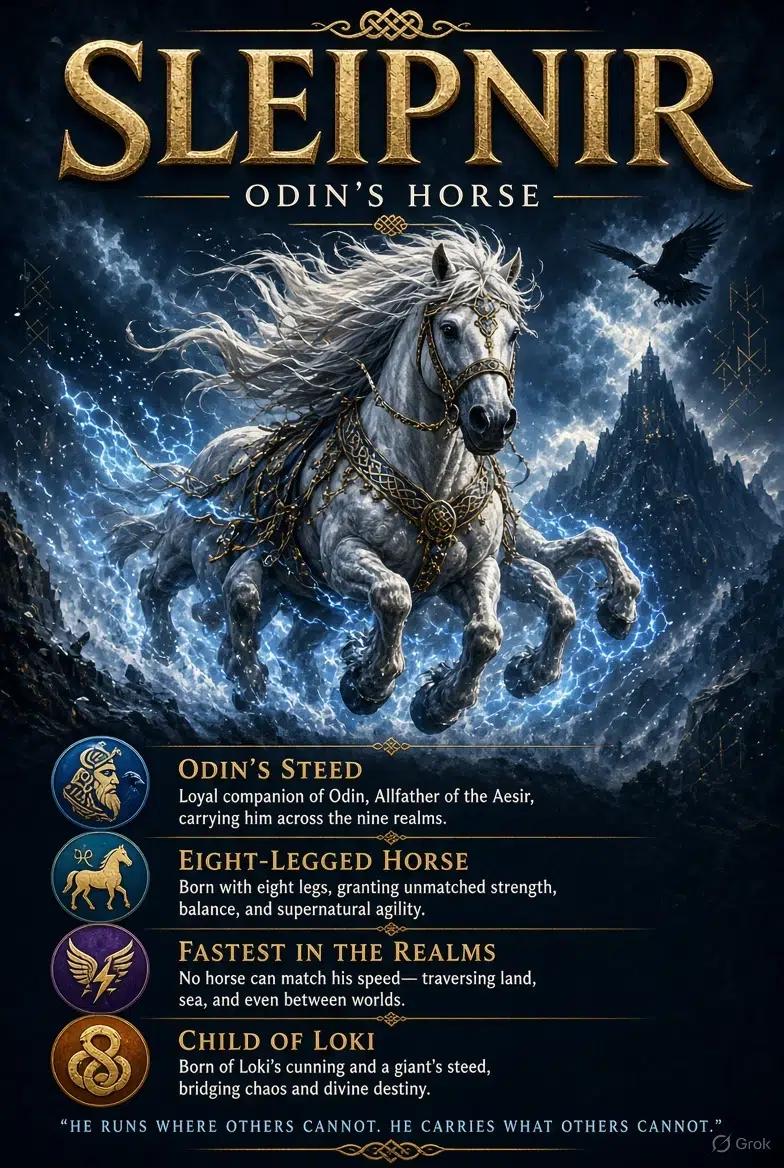
One of the strangest and most famous details in the Prose Edda concerns Sleipnir’s parentage. His father is the powerful stallion Svaðilfari, owned by the builder of Asgard’s defenses. His mother is Loki, who transforms into a mare as part of a scheme to disrupt the builder’s work. Loki subsequently gives birth to the foal. This is not an adoption story, and it is not presented as the ordinary reproduction of a real animal. The medieval narrative explicitly treats Loki’s supernatural change of form as central to the episode. Some modern family diagrams incorrectly write Loki as Sleipnir’s father solely because Loki is usually portrayed as male in other scenes. The source-informed relationship is more unusual: Loki is Sleipnir’s mother in this particular story. A poster can show ‘Mother: Loki (mare form)’ and ‘Father: Svaðilfari’ without inventing extra relatives or implying that the change of form was a human historical event.
The Asgard Wall Builder’s Bargain
The horse’s origin begins with the gods considering a new defensive wall for Asgard. A builder proposes completing extraordinary protection against threatening giants and demands Freyja, the sun and the moon as payment. The gods impose a short deadline, hoping the task cannot be finished in time, and accept the builder’s request to use his stallion. According to Snorri, Loki is influential in allowing this assistance. The stallion proves incredibly strong, hauling stones that let the project advance far more quickly than expected. The gods begin to fear they will have to surrender the promised reward. This is an important part of the narrative because Sleipnir is not born in an isolated stable scene. The horse enters the mythology through a crisis of bargaining, oath-keeping and deception. In an illustration, the nearly completed walls and great stone-hauling stallion give the story its distinctive setting.
How Loki Becomes a Mare and Distracts the Stallion
As the deadline approaches, the gods hold Loki responsible for finding a way out of the bargain. He transforms into a mare and appears near the builder’s stallion during the night. Svaðilfari breaks free from the hauling equipment and pursues the mare into the woods. Without the stallion’s labor the builder cannot finish the walls in time. His anger exposes his giant identity, and Thor intervenes violently in Snorri’s account. The story raises uncomfortable questions about the gods’ promises and their willingness to break them. For Sleipnir, the immediate consequence is more personal: Loki later gives birth to an extraordinary eight-legged foal. Online summaries sometimes replace this with a completely different ‘Loki gifted Odin a horse’ origin. A short caption can accurately say that Sleipnir was born after Loki, in mare form, distracted Svaðilfari to defeat the builder’s deadline. There is no need to sanitize or sensationalize the myth.
Why Does Odin Ride Sleipnir?
Sleipnir belongs to Odin in the familiar stories and makes a powerful visual pairing with the one-eyed Allfather. Odin is a god of journeys in disguise, dangerous knowledge and movement between different parts of the mythic world. A supernatural horse fits that storytelling role. This does not mean the horse has a scientifically verified ability to cross particular dimensions in precisely measured seconds. Nor do all Norse texts explain a fixed set of magical flight rules. What the stories emphasize is that Sleipnir is an exceptional steed able to carry a divine rider on extraordinary journeys. A strong featured illustration can show Odin on a gray eight-legged horse under a stormy sky, but it should not be called an authentic Viking Age photograph. A realistic rider may not be present in every design; in a standalone Sleipnir article, the eight legs themselves are the most important identification feature.
Hermóðr’s Ride to Hel After Baldr’s Death
Sleipnir has a memorable role in the aftermath of Baldr’s death. The gods want Baldr returned from the realm of the dead, and Hermóðr volunteers for the mission. He rides Odin’s horse Sleipnir on a dangerous road toward Hel. In Snorri’s account the journey lasts nine nights, and the horse leaps a great bridge or gate-related obstacle as Hermóðr reaches the destination. At Hel’s hall, the messenger seeks terms for Baldr’s return. The ruler of the dead agrees only if all things weep for him, and the condition ultimately fails because Þökk refuses. This episode gives Sleipnir a real narrative function beyond looking impressive beside Odin. He enables a messenger to attempt an extraordinary rescue. A fantasy poster showing a rider, dark road and eight-legged horse can evoke this story, but the exact atmosphere and costume are modern artistic additions.
Sleipnir in Odin’s Other Journeys and Poetry
Sleipnir also appears in older poetic contexts, including passages involving Odin’s horse and the journeys of heroes. In Baldrs draumar, Odin saddles his horse and travels toward the realm associated with the dead. Not every version of a poem explicitly supplies all details later prose writers add, so it is worth distinguishing a general reference to Odin’s mount from the fully narrated Asgard wall story. Medieval poems use the horse as a recognizable symbol without repeating the complete origin each time. This is an important reading habit for Norse mythology: one text may name a character, another explains the parentage, and a third offers a different episode. A useful article connects those references while noting where the information comes from. It should not imply that every line was originally a single illustrated novel with perfectly synchronized chapters.
What Does the Eight-Legged Horse Symbolize?
Many modern interpreters see Sleipnir as a symbol of exceptional travel, boundary crossing and passage between worlds. The connection with travel to Hel makes such interpretations understandable. Some scholars have also discussed possible ritual or shamanic associations, though these remain scholarly hypotheses and should not be presented as universal statements made by medieval worshippers. The eight legs are a clear source-supported characteristic; the claim that each leg has a specific named element or spiritual power is generally a modern invention unless a precise older source is provided. A tattoo wearer may give the image a personal meaning, and that is valid as modern symbolism. But calling every eight-legged horse tattoo a documented Viking protection charm overstates the evidence. Good image content describes the creature accurately and offers interpretations in a separate paragraph rather than blending them into fact.
Sleipnir Images, Wallpaper and Differences from Marvel
Sleipnir’s eight-legged design lends itself to striking wallpapers and illustrated charts. Useful image-search phrases include ‘Odin eight-legged horse’, ‘Sleipnir Norse mythology art’, ‘Loki Sleipnir mother’ and ‘Svadilfari horse mythology’. Some modern entertainment adaptations change the horse’s appearance, origin or powers, while other works omit the character altogether. The older accounts preserve the origin through the Asgard builder’s bargain and the link with Odin. Since fantasy pictures often include extra legs that overlap visually, ALT text should identify the creature only when the artwork clearly shows the intended eight-legged mount. The info poster should focus on the names, parentage and key episodes, not imagined height, weight or speed statistics. With those basic facts in place, visitors who first came to see a dramatic horse image can understand why the myth has remained so memorable.
Frequently Asked Questions
Whose horse is Sleipnir?
Sleipnir belongs to Odin in the familiar Norse stories.
How many legs does Sleipnir have?
Eight, a defining supernatural characteristic.
Who gave birth to Sleipnir?
Loki, transformed into a mare, gives birth to Sleipnir in Snorri’s account.
Who is Sleipnir’s father?
The stallion Svaðilfari, which helps the builder of Asgard’s wall.
Does Sleipnir take Hermóðr to Hel?
Yes. Hermóðr borrows Odin’s horse for the journey to seek Baldr’s return.
Is Sleipnir a real horse species?
No. The eight-legged horse belongs to mythology, not verified zoology.
Conclusion
Sleipnir is remembered for eight legs, but his full story also involves Loki’s transformation, a dangerous contract, Odin’s travels and Hermóðr’s desperate mission to Hel. Those episodes make an illustrated guide valuable beyond a spectacular fantasy wallpaper.
Sources and visual disclosure
Prose Edda — The wall builder and Sleipnir; Gylfaginning chapter 42: Birth of Sleipnir; The Edda, Norse textual source edition.
Reviewed 15 November 2026. Illustrations are creative depictions of literary mythology.










Share Your Opinion
Comments are closed on this post.