 Vista
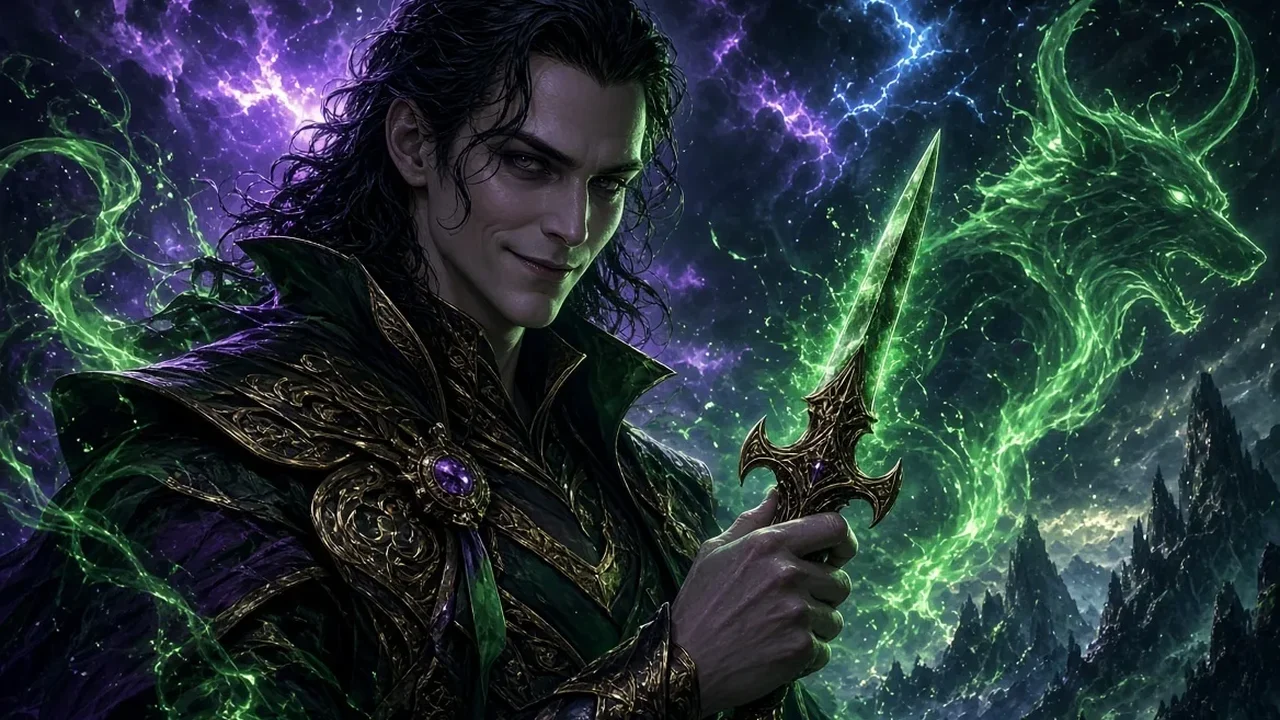
Loki in Norse mythology is a cunning, shape-changing figure who moves among the gods, causes extraordinary trouble and sometimes solves the same crises he creates. His parentage connects him to giants, while stories place him alongside Odin and Thor. With Angrboða, Loki is the father of Fenrir, the world serpent Jörmungandr and Hel. He is also associated with the eight-legged horse Sleipnir in a very different maternal role. These family details are not the same as Marvel’s version of Loki.
Readers looking for Loki Norse mythology explained, Loki’s children, ‘Is Loki a god or giant?’, the truth about his punishment or Loki fantasy images can find all those answers here. The emphasis is on older narrative sources, notably Eddic poetry and Snorri’s prose, rather than treating a movie plot as a record of pre-Christian Scandinavian belief.
Is Loki a God, a Giant or a Trickster?
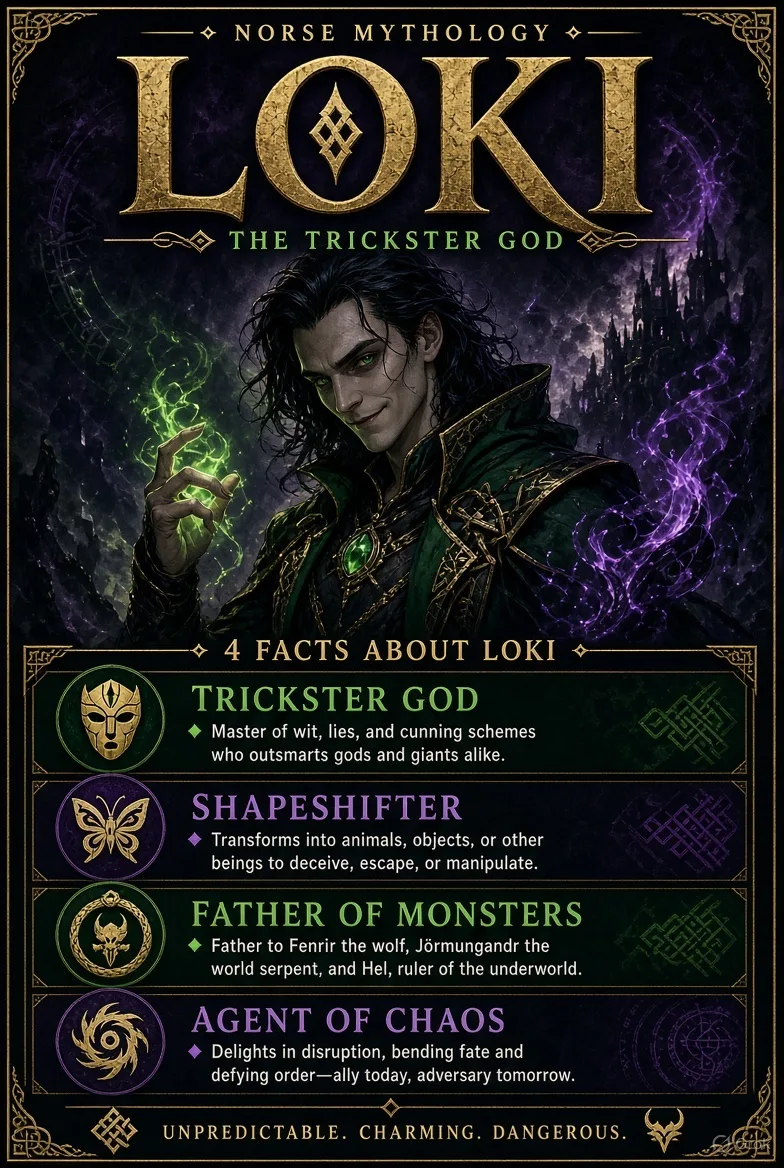
Loki is difficult to classify using tidy modern labels. His father is named Fárbauti and his mother Laufey, and he is often described in relation to the jötnar, a group commonly translated as giants. Yet the narrative places him in intimate company with the Æsir. He attends their gatherings, travels with Thor and can rescue them from threats. The word ‘trickster’ captures his inventiveness, shifting loyalties and habit of exposing other characters’ vulnerabilities, but it does not erase his distinct mythological role.
A common question is whether Loki has a fixed official title such as ‘the god of mischief.’ That phrase makes a convenient introduction, especially for comic fans, but it can be more modern shorthand than a complete source-based description. Loki’s behavior ranges from useful cleverness to cruelty and catastrophic deception. He does not always work for the same side, and the stories are more complex than a permanent villain-versus-hero arrangement.
Loki’s Parents, Odin and the Truth About Thor
Loki’s parentage in the surviving tradition is usually given as Fárbauti and Laufey. A famous passage in Lokasenna refers to an old shared bond between Loki and Odin, often understood as blood-brotherhood. This is not the same as an adoption in which Odin raises Loki as Thor’s younger brother. That arrangement belongs to the film and comic narrative and is a powerful source of confusion when fans search for ‘Loki real Norse mythology family tree.’
Thor and Loki certainly share adventures. Thor relies on Loki’s quick thinking at times, but Loki also puts him in awkward or dangerous situations. In the episode involving Sif’s hair, Loki causes the initial offense and must arrange a remedy that ultimately leads to the production of valuable objects. Their relationship is one of difficult companionship within a changing network of gods, not a straightforward story of two boys raised in one royal household.
Who Are Loki’s Children? Fenrir, Jormungandr and Hel
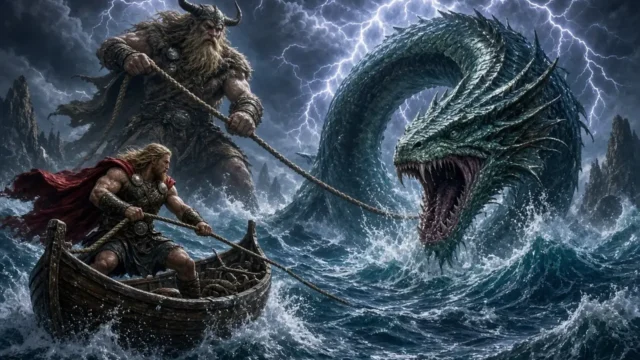
With the giantess Angrboða, Loki fathers three especially important beings. Fenrir is the monstrous wolf whose growth terrifies the gods. Jörmungandr is the great serpent placed in the sea around Midgard, where it becomes Thor’s fated enemy. Hel is a figure associated with the realm of the dead. Each child has a different role in the mythology; placing all three in one generic category of ‘evil demons’ loses the meanings that make their stories distinct.
Some family trees also show Narfi or Nari and Váli in relation to Loki, but accounts of his offspring, their names and the events of his binding need source-aware treatment. Not every chart online agrees. For an accurate Loki children picture, draw Angrboða and Loki as parents of the three famous beings and keep uncertain branches appropriately labeled. Do not confuse Hel the character with Hel as a location or with popular images that invent a standard half-skull costume.
Sleipnir: Why Is Loki Called a Mother?
A stranger episode concerns the building of Asgard’s protective wall. Loki assumes the form of a mare and distracts the stallion helping the builder. In the resulting tradition Loki gives birth to Sleipnir, the extraordinary eight-legged horse later ridden by Odin. This makes Loki’s ability to alter form more than a simple disguise: the myth allows a transformation with consequences for the divine family.
This episode is frequently reduced to a viral question designed to shock readers. The better explanation places the event in the builder’s bargain and its consequences. The gods make a dangerous agreement about the walls of Asgard, Loki’s intervention helps them escape its terms and an unusual animal joins the mythology. The narrative should not be twisted into modern claims about biology or history; it is supernatural storytelling from an older cultural world.
Loki, Sif’s Hair and the Treasures of the Gods
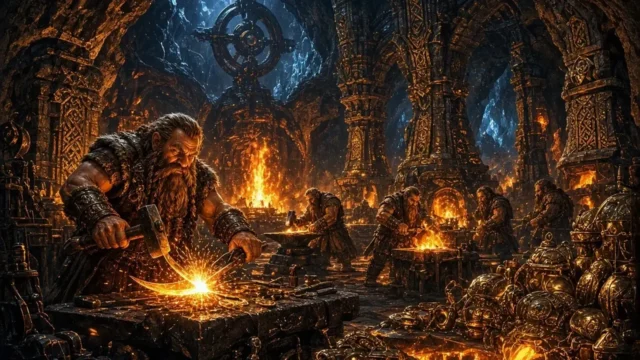
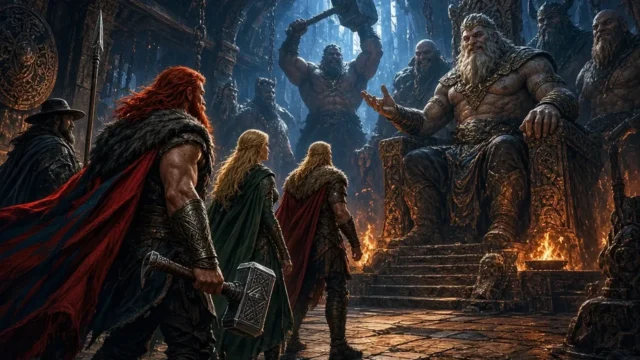
In one widely repeated myth Loki cuts Sif’s beautiful hair. Thor, Sif’s husband, is furious and forces Loki to repair the harm. Loki approaches skilled dwarven makers, and a competition among craftsmen produces several extraordinary treasures. The hammer Mjölnir, Odin’s spear Gungnir and other objects belong to this wider network of stories. The incident neatly demonstrates Loki’s double role as the cause of chaos and the person clever enough to produce a solution.
Modern Norse art often gives Loki green magic, a horned helmet or an elaborate costume. None of those features should automatically be read as a historical requirement. For SEO image captions, it is more helpful to name the actual story: ‘Loki and the forging of Mjolnir’ or ‘Loki’s trick involving Sif’s hair.’ The source-informed label can attract readers who came from a dramatic image and want to know what truly happens in the myth.
Baldr’s Death: When Loki Becomes Dangerous
The death of Baldr marks a darker turn. In the familiar narrative Loki exploits a weakness involving mistletoe and guides the blind Höðr into the fatal action. The death throws the gods into mourning and a journey to the world of the dead follows. Accounts vary in how much responsibility they explicitly assign to Loki, so a detailed comparison should name the text being discussed rather than pretend there is one unchanged screenplay.
Other episodes, including Lokasenna, portray Loki openly challenging or insulting the gods. The cumulative effect is a figure who cannot simply be called the lovable comic relief of a divine family. The plot also raises serious questions about loyalty and punishment in mythic storytelling. Readers asking ‘Why was Loki punished?’ should know that his binding is connected with this turbulent relationship and the traditions surrounding Baldr.
Loki’s Punishment: Binding, Serpent Venom and Sigyn
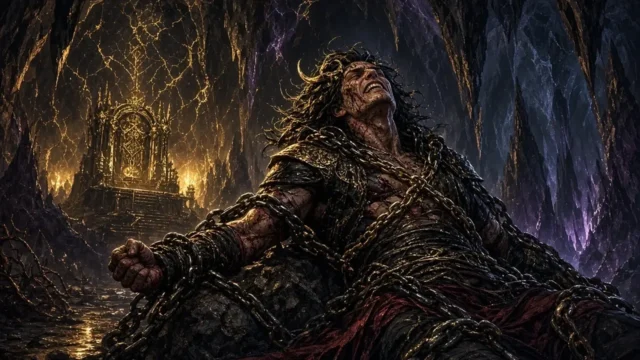
In Snorri’s account Loki is captured and bound, and a serpent is positioned to drip venom onto him. His wife Sigyn holds a bowl to catch the poison. When she moves to empty it, drops fall on Loki and his convulsions are connected in the narrative to earthquakes. Versions differ in some horrific details, and the events should be presented as myth, not as an actual scientific explanation for tectonic movement.
Art of Loki bound in a cave can be powerful, yet informational images sometimes invent a particular chain, weapon or calendar date with no textual basis. The core points are his confinement, Sigyn’s loyal intervention, the venom and the connection to the events leading toward Ragnarök. These are enough to make a meaningful visual guide. A poster should help identify the characters and distinguish this punishment from earlier scenes of Loki merely being questioned by the gods.
What Happens to Loki at Ragnarok and in Marvel?
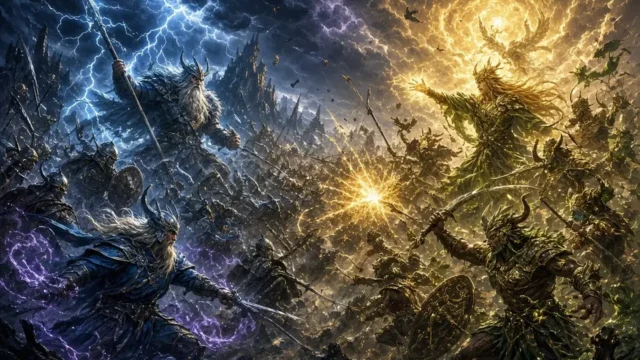
In the Ragnarök tradition Loki escapes confinement when the cosmic bonds break and participates in the final struggle. In Snorri’s telling Loki and Heimdall kill each other. As with other end-time scenes, different poetic and prose accounts offer distinct levels of detail. Loki’s role shows how someone who lived among the gods can also contribute to their destruction. He is entangled with the very threats represented by his children.
Marvel’s Loki is a separate fictional adaptation with an adopted-brother story, a recognizable actor and a modern storyline about redemption, timelines and magic. It is fine to compare these versions, but inaccurate to claim that the medieval texts feature the modern plot points. Search engines may send readers to this page for both types of Loki, so clear labels—’traditional Norse account’ and ‘modern adaptation’—are part of good reader service, not an obstacle to entertainment.
Frequently Asked Questions
Is Loki Thor’s brother in the original myths?
No. That relationship comes from modern adaptations; the Eddic and prose material do not use that genealogy.
Is Loki a god or a giant?
He has jötunn ancestry and is closely involved with the Æsir; a single modern label hides important nuance.
Who are Loki’s three famous children?
Fenrir the wolf, Jörmungandr the world serpent and Hel, with Angrboða as their mother.
Why was Loki tied up?
He is bound after events surrounding Baldr and his conflict with the gods; Sigyn tries to protect him from serpent venom.
Who kills Loki at Ragnarok?
In Snorri’s account Loki and Heimdall kill each other in the final battle.
Conclusion
Conclusion: Loki’s significance lies in the mixture of help, betrayal, transformation and devastating consequences. The real pleasure of his mythology is tracing those episodes and relationships rather than reducing him to a mischievous superhero sidekick. Use a family tree or original Loki art to recognize the characters, then compare each claim with its underlying source.
Sources: World History Encyclopedia; Oxford — Prose Edda; Loki text guide. Reviewed 14 November 2026. Illustrations are artistic representations.







Share Your Opinion
Comments are closed on this post.