 Vista

Iðunn (Idunn or Idun) is the goddess who keeps the apples that preserve the youth of the gods in Norse mythology. In Snorri’s Skáldskaparmál, the giant Þjazi forces Loki into helping him abduct Iðunn. Without her, the Æsir quickly age. Loki is sent to bring her back and escapes in a borrowed hawk disguise while Þjazi pursues him as an eagle. The gods defeat the pursuing giant at Asgard. That is the central story behind the popular search for Idunn golden apples.
Here we explain who Iðunn is, whether she is immortal, her connection with Bragi, the exact role of Loki, how her abduction leads to Skaði’s appearance, and why the apples should not be confused with the Golden Apples of Greek mythology. The illustrations are contemporary fantasy art, not archaeological portraits of a deity.
Who Is Iðunn, and What Is Her Role Among the Æsir?
Iðunn is an important mythological figure despite appearing in relatively few long surviving episodes. The Prose Edda identifies her as the wife of Bragi, a god associated with poetry, and as the keeper of extraordinary apples. The apples are described as a remedy against the aging of the gods: when they grow old, they eat them and become youthful again. It is common to call Iðunn a goddess of youth or renewal, but the central textual fact is her stewardship of the apples rather than an unlimited set of healing powers. Modern artworks sometimes place her in a sunlit orchard, with shining fruit and a golden crown. That can evoke the story without proving that the Eddas prescribe one hairstyle, dress or orchard location. The important reader takeaway is that a seemingly quiet keeper of fruit becomes essential to the continued vitality of the whole divine community. Her value to the gods is revealed most clearly when she disappears.
Are Iðunn’s Apples the Secret of Immortality?
The apples prevent or reverse aging in the familiar prose account, but it is imprecise to conclude that the gods cannot die under any circumstances. The very same mythological world contains Ragnarök, where Odin, Thor and other divine figures are killed. Therefore Iðunn’s apples are associated with youthfulness and continued renewal, not a scientifically defined medicine guaranteeing invulnerability. Ancient sources do not provide a dosage, growing season, mineral content or real botanical species for these supernatural fruits. Calling them ordinary orchard apples with an experimentally measurable anti-aging substance is misleading. Their literary function is to make the gods dependent on Iðunn and thus vulnerable when she is taken away. A useful illustrated poster should say ‘apples of youth’ rather than promise a guaranteed cure for biological aging. Readers can enjoy the symbolism of renewal without mistaking a myth for modern medical advice.
How Does Þjazi Force Loki Into the Plot?
The story begins when Odin, Hœnir and Loki travel together and try to cook an ox. An eagle sitting above interferes with the meal; when Loki attacks it, his staff sticks to the bird and he is dragged along. The eagle is actually the jötunn Þjazi, and Loki must make a dangerous promise to secure his release. He agrees to lure Iðunn and her apples out of Asgard. This sequence matters because Loki is not casually handing the goddess over as a friendly gift: he is trapped in a bargain after behaving recklessly. At the same time, the story does not remove his responsibility for deceiving her. An original image might show an eagle over the travellers or Loki hanging from a staff, but its exact composition is an artist’s decision. In a well-sourced explanation, the eagle’s true identity and the coercive bargain provide the link between Loki’s trouble and the threat facing all the gods.
Loki Lures Iðunn Out of Asgard
Loki tells Iðunn that he has found apples of extraordinary quality in a wood beyond Asgard and asks her to bring her own apples so they can compare them. When she leaves the protected space, Þjazi descends in the form of an eagle and carries her to his home in Þrymheimr. The precise dialogue differs in translation, but the trick depends on curiosity and an apparently harmless comparison of fruit. Modern retellings sometimes replace this with a magical portal or claim that Iðunn willingly chooses to marry Þjazi. Those are not details of the familiar Prose Edda episode. A caption can simply describe ‘Loki deceiving Iðunn before Þjazi abducts her as an eagle’. This avoids portraying the event as a documented historical kidnapping or inventing emotions that the text never describes. The story’s tension comes from how easy it is for a crucial guardian of the gods’ well-being to be removed from safety.
Why Do the Gods Grow Old Without Iðunn?
The disappearance of Iðunn is discovered when the gods begin to become gray-haired and aged. Their sudden decline exposes how closely their continued youth depends on access to the apples. The gods investigate who last saw her, and Loki becomes the focus of their anger because he led her out of Asgard. They threaten him with severe consequences unless he brings her back. The episode illustrates divine fallibility: even powerful beings can be careless, can lose something they depend on, and must cooperate to recover it. It is not evidence that an actual historical population of people stopped aging after eating a rare type of apple. For a fantasy illustration, aged gods gathered in a worried hall make an effective contrast with a bright basket of fruit. The accurate explanation is narrative, however, and should not become a false contemporary health recommendation about an anti-aging diet.
How Loki Rescues Iðunn Using Freyja’s Falcon Disguise
Loki borrows Freyja’s feather or hawk disguise, travels to Þrymheimr, and finds Iðunn while Þjazi is away. He changes her into a nut and carries her away in his claws. Þjazi returns, notices the absence and follows as an eagle. The extraordinary pursuit moves rapidly toward Asgard. Seeing the approaching hawk and eagle, the gods prepare shavings near their walls and set them alight after Loki passes safely inside. Þjazi’s wings are caught by the flames; he falls and is killed by the gods. This is the outcome in the familiar version of the myth. Some images depict a dramatic dogfight between two human warriors in the sky, but that changes the unusual feature of the narrative: Loki and Þjazi are both flying in bird forms. The details also explain why Freyja’s feather garment appears in discussions of Loki’s transformations.
Why Does Skaði Demand Compensation After Þjazi’s Death?
Þjazi has a daughter, Skaði, whose subsequent story begins with her father’s death. She arrives among the gods in war equipment and demands compensation. Rather than depicting her as an unrelated villain, it is important to connect her grievance with the events surrounding Iðunn. In Snorri’s version the compensation includes a chance to choose a husband while seeing only the gods’ feet; hoping to select Baldr, she instead chooses Njörðr. The gods also have to make her laugh, leading to Loki’s strange comic performance. This series of episodes links the apples of youth with mountains, marriage, grief and uneasy settlements. A related article about Skaði can be a natural internal link once it is publicly available. For now, a draft should not insert a fake public URL. The broader lesson is that one mythic conflict changes relationships throughout the pantheon, not merely the situation of the abducted goddess.
Is Iðunn the Same as the Greek Hesperides or Persephone?
Greek stories also feature extraordinary fruit: the Hesperides are linked with golden apples, while Persephone’s pomegranate belongs to a different underworld narrative. Similar fruits can make engaging comparisons, but they are not proof that Iðunn, Persephone and the Hesperides are one character with multiple spellings. The cultures, texts, and roles differ. Iðunn’s story especially concerns the gods’ aging, Loki’s bargain and Þjazi’s abduction. Modern crossovers and fantasy games may change the fruit, add healing spells or combine multiple myths. They can be enjoyable fiction but should not silently replace the Old Norse account. A comparative chart can use three columns for the story’s source, the fruit and its narrative role, with explicit caveats about modern art. This is more valuable than claiming that every golden apple in world mythology comes from the same ancient tree.
Idunn Images, Golden Apples Wallpaper and Safe SEO Captions
The strongest visual subjects include Iðunn holding a basket of glowing apples, the eagle Þjazi approaching, Loki in hawk form, and the worried gods beginning to age. Search phrases include ‘Idunn Norse goddess images’, ‘Idunn golden apples mythology’, ‘Loki rescues Idunn’, ‘Thjazi eagle story’ and ‘Idunn Bragi wife’. Captions should describe what actually appears: a portrait with fruit is not automatically the rescue scene. The alt text for a poster may identify the apple keeper and her abduction, while the featured image should be described as a creative illustration if it shows no source-identifiable location. Do not claim a particular fantasy figure is a preserved Viking portrait. Nor should an anti-aging health claim be placed inside the image. The attraction of Iðunn’s story is the high stakes created by a humble-looking object, and an accurate article can communicate them without making up powers or scientific statistics.
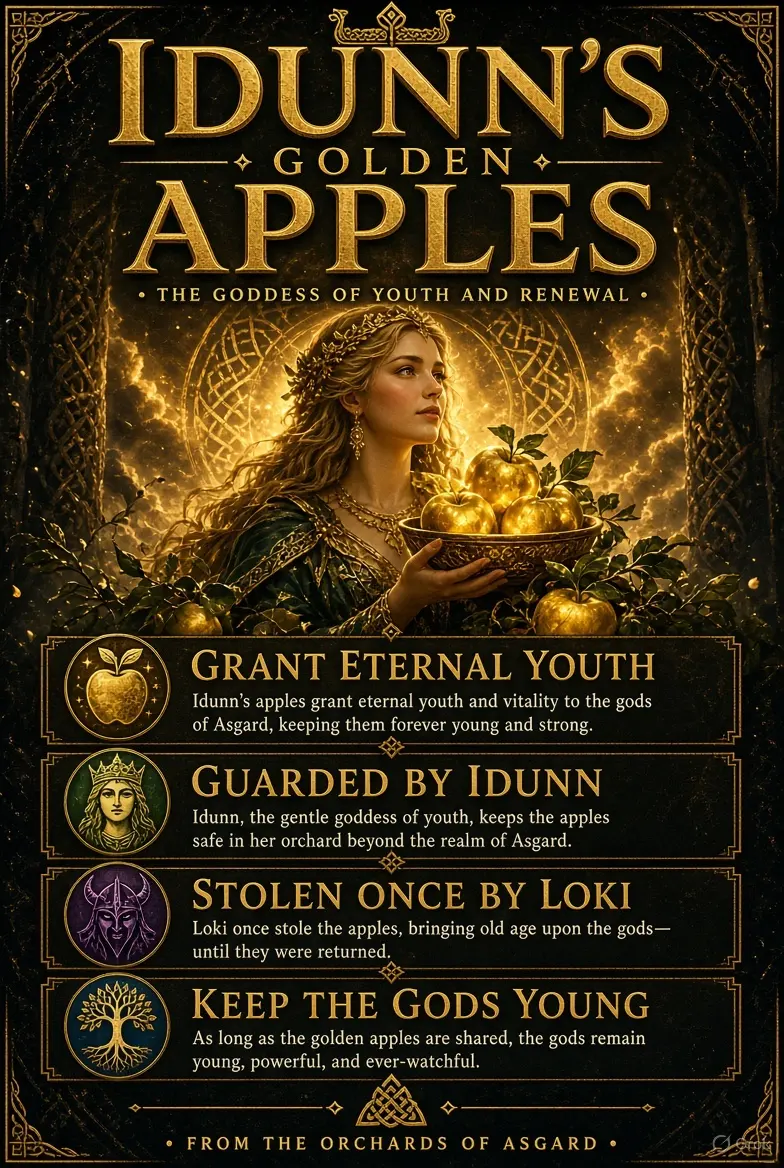
Artwork and source In Skáldskaparmál, Loki lures Iðunn out with her apples and Þjazi abducts her. The story describes renewed youth and gives no fixed location for an orchard.
Frequently Asked Questions
Who is Idunn in Norse mythology?
Iðunn is a goddess associated with the apples that maintain the youth of the Æsir.
Who is Idunn’s husband?
Bragi, associated with poetry, is named as her husband in the Prose Edda.
Who kidnaps Idunn?
The jötunn Þjazi, appearing as an eagle, after Loki lures her away.
How does Loki rescue Idunn?
He borrows Freyja’s feather disguise, changes Iðunn into a nut and flies home while Þjazi pursues him.
Do her apples make every god immortal?
They maintain youth in the story; they do not prevent the deaths described at Ragnarök.
What connects Idunn to Skadi?
Skaði is Þjazi’s daughter and seeks compensation after he dies during the rescue.
Conclusion
Iðunn’s myth shows how the gods’ youth depends on a keeper they can lose. Loki’s reckless bargain, Þjazi’s abduction and the dramatic bird pursuit make the apples of youth far more than decorative fruit. An informative gallery should preserve those details and distinguish artistic glow from the medieval source.
Primary sources and image disclosure
Snorri Sturluson: Skáldskaparmál, Iðunn and Þjazi; The Prose Edda, Gylfaginning; Viking Society for Northern Research: Skáldskaparmál edition.
Reviewed 15 November 2026. Artwork illustrates mythology, not historical events.


















Share Your Opinion
Comments are closed on this post.