 Vista
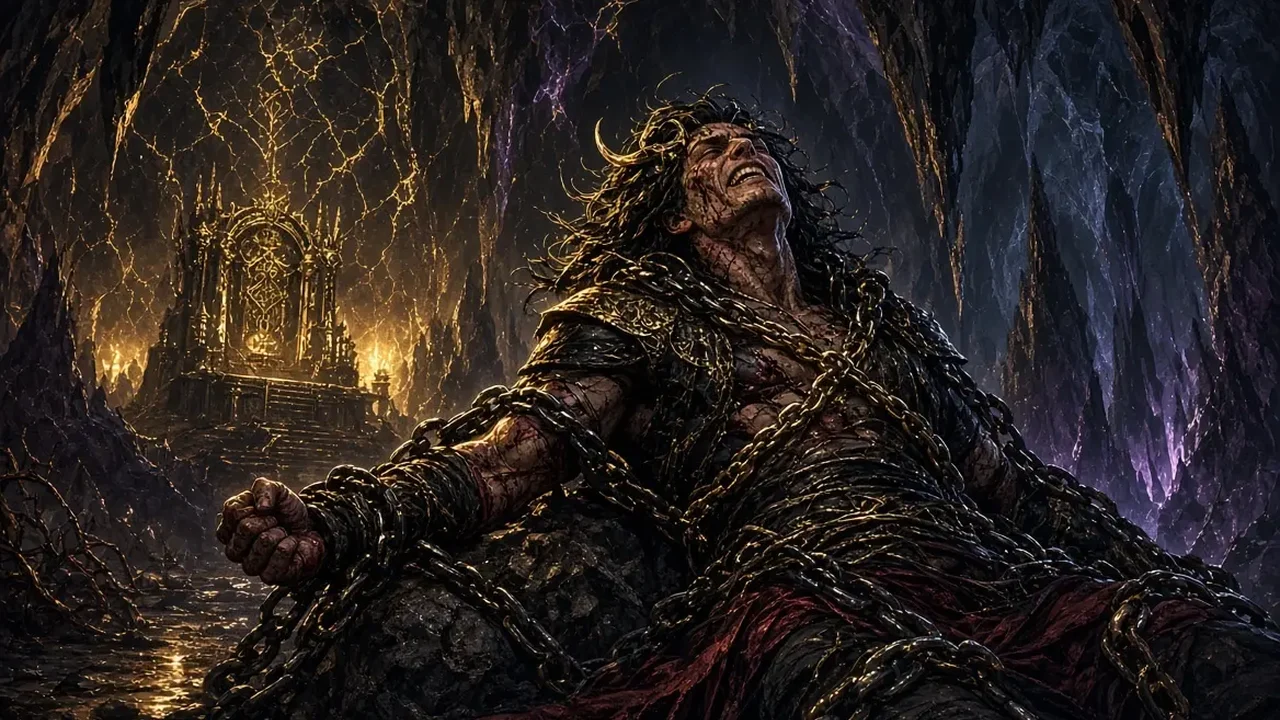
Loki is bound and tortured by the gods after events surrounding Baldr’s death and the failure to bring him back from Hel in Snorri’s Gylfaginning. After hiding as a salmon, he is captured with a net and brought to a cave. The gods bind him with material taken from his son, Skaði places a venomous serpent above his face, and his wife Sigyn holds a bowl to catch the falling poison. When she must empty the bowl, the venom strikes Loki; the tale uses his convulsions to explain earthquakes. He remains bound until Ragnarök.
This article explains why Loki was bound, what happened to his children, who is Sigyn, why Skaði helps punish him, how he tries to escape as a salmon and how this episode differs from modern Marvel stories. Its illustrations are dark fantasy art, not historical records.
What Did Loki Do That Led to His Punishment?
Loki is involved in the death of Baldr in Snorri’s narrative. Frigg has obtained promises from almost everything not to harm her beloved son, but mistletoe has been overlooked. Loki discovers this weakness and helps the blind Höðr aim a mistletoe weapon at Baldr. The resulting death devastates the divine community. Frigg then sends Hermóðr to try to recover Baldr from Hel, which offers to release him only if all things weep for him. A being called Þökk refuses, and Snorri says she is thought to be Loki in disguise. That refusal makes the attempted rescue fail. The story of Loki’s binding follows these events. Yet the surviving Old Norse texts preserve differing emphases about Baldr and Loki, so it is important to say that this exact chain comes from Snorri’s prose rather than every poetic version. Loki’s punishment is not described as a sentence imposed for stealing Thor’s hammer; Þrymr is the thief in the separate comic poem Þrymskviða.
How Does Loki Hide in a Four-Doored House?
Knowing the gods seek to capture him, Loki withdraws to a mountain and builds a house with doors looking in four directions. This unusual design allows him to watch for approaching enemies. He spends time near the waterfall called Fránangr, where he can change into a salmon and hide in the water. The scene adds a different side to Loki’s cunning: he is not simply an invincible shape-shifter but a fearful fugitive forced to anticipate the gods’ movements. In his house he experiments with a fishing net to understand how someone might catch a swimming creature. When he notices danger approaching, he throws the net into his fire and flees. A modern illustration may show runes carved all over the doors or a precise location on a tourist map. The old prose does not establish such details. The four doors, salmon form, waterfall and half-burned net are the recognizable elements of this part of the story.
How Does Kvasir Help the Gods Catch Loki?
Kvasir, a figure famous elsewhere for exceptional wisdom, enters Loki’s abandoned dwelling and sees the remains of the burned net in the fire. From its pattern he understands a device for capturing fish and tells the others. The Æsir make a new net and take it to the waterfall. Loki tries to hide beneath stones, swim ahead of the advancing mesh and finally jump over it. Thor plays an important role when the gods draw the net through the river. In the end Loki leaps and Thor catches him, holding on toward the tail as the salmon slips. Snorri even uses this to explain the tapering shape of a salmon’s body. That is an etiological myth, not a biological theory of fish evolution. It would be misleading to say Loki willingly surrenders or that Odin immediately freezes the waterfall with a magic spell. The capture depends on the net, Kvasir’s insight and the combined efforts of the gods.
What Happens to Loki’s Sons, Váli and Narfi?
The punishment of Loki is unusually grim because it involves his family. In Snorri’s telling the gods take two sons associated with Loki; one is transformed into a wolf, which tears apart his brother, often named Narfi or Nari. The sources and manuscript details involving Váli, Nari and Narfi are not perfectly simple, and other passages have different family lists. The gods then use the dead son’s entrails to bind Loki to stones, and the bindings become hard as iron. This is violent mythological material, not an event to imitate or portray graphically in a school poster. A careful article can state the basic sequence without dwelling on gruesome imagery. It is also important not to confuse these sons with Fenrir, Jörmungandr and Hel, who belong to Loki’s relationship with Angrboða in the familiar account. Marvel adaptations offer very different relationships and should not be taken as evidence for medieval names. The punishment episode shows the horrifying cost of conflict among the gods.
Who Is Sigyn, and Why Does She Hold a Bowl?
Sigyn is Loki’s wife in the familiar Prose Edda story. She stands near him during his captivity and holds a bowl beneath the serpent, catching venom so it does not fall onto his face. This makes her a significant figure of loyalty and suffering in later interpretations. The source says she leaves periodically to empty the bowl, not that she is the one pouring poison on him. Some social-media infographics incorrectly identify the woman holding the basin as Skaði, but the two have different roles. Sigyn catches the poison; Skaði places the serpent. The text does not provide a complete portrait of Sigyn’s feelings or a guarantee that she succeeds forever. Her action is repeated yet necessarily interrupted. A source-aware image can show her standing with the basin and Loki bound nearby, but her exact dress and face are artistic choices. Calling her Loki’s rescuer who instantly frees him would contradict the central image of his continuing punishment.
Why Does Skaði Place a Snake Above Loki?
Skaði is the jötunn daughter of Þjazi, who earlier comes before the gods seeking compensation after her father is killed. She marries Njörðr in the complicated settlement described by Snorri. In the binding episode, the same figure takes a venomous serpent and fastens it above Loki so its poison drips down. That detail is significant because it connects stories which are often taught separately. Loki had participated in the chain of events leading to Þjazi’s death, and Skaði’s involvement in his punishment reflects a longstanding troubled relationship. Yet the text does not provide a neat courtroom speech explaining her precise personal motivation during the binding. A careful article should describe what she does and the earlier context rather than invent a revenge oath word for word. A poster may label the woman with the snake ‘Skaði’, while the woman catching venom must be labelled ‘Sigyn’. Clear labels avoid one of the most common confusions in visual retellings.
Why Does Loki’s Pain Cause Earthquakes in the Story?
When Sigyn’s bowl becomes full, she has to turn aside to empty it. During that gap the serpent’s venom falls onto Loki, causing painful convulsions. Snorri explains the shaking of the earth as the result of this movement. The myth uses a supernatural narrative to account for a frightening natural phenomenon. Actual earthquakes, however, are caused primarily by movements and stresses in the Earth’s crust, not by a captive deity. It is therefore wrong to claim that seismic measurements prove Loki is suffering in a real underground cave. An educational article can respectfully distinguish the ancient mythic explanation from modern geology. The repeated sequence of bowl filling, venom falling and trembling land also gives the tale its narrative rhythm. Loki’s release is not achieved when Sigyn catches a certain number of drops, nor is an exact calendar date offered for his escape. His bonds remain in place until the foretold cosmic crisis.
How Does Loki Escape at Ragnarök?
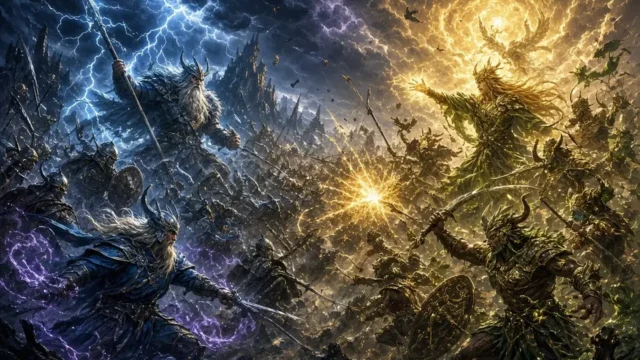
The Gylfaginning account places Loki in confinement until the fate of the gods. At Ragnarök the bonds of many dangerous beings break, the Midgard Serpent rises, Fenrir escapes and the forces opposing the gods gather. Loki appears among those who come against the Æsir. In Snorri’s final-battle description he fights Heimdallr, and the two kill one another. Some modern films instead make Loki the secret king of the newly created world or have Thor personally execute him before Ragnarök. Those are adaptations, not the familiar Edda ending. The sequence matters because the captivity is a long anticipation of the catastrophic battle, not a short prison sentence. His punishment follows Baldr’s death, then he remains bound during the intervening period. An informative poster can mark the stages as crime, escape attempt, capture, venom and Ragnarök. It should not invent an exact number of years of imprisonment or a modern map of his cave.
Loki Bound Tattoo, Sigyn Art and Mythology Image Keywords
Related visual searches include ‘Loki bound by gods’, ‘Sigyn holding bowl’, ‘Skadi venomous serpent’, ‘Loki salmon net’, ‘Loki Norse punishment’ and ‘Loki Ragnarok’. Some visitors want the frightening cave tableau, while others specifically need the family relationships and the difference between Sigyn and Skaði. A featured image can focus on Loki chained to stones with a serpent overhead. The inside information poster should list the principal characters and clarify that Sigyn protects him temporarily while Skaði sets the snake. ALT text should describe what is visible rather than pretend a mysterious woman has a verified name if the artwork lacks identifying features. Distinguish modern cosplay, comic-book Loki and Old Norse literary Loki. A tattoo artist can use the symbolism of suffering or loyalty without advertising a magical ancient charm that guarantees protection. Reliable keywords grow from precise identification and readable storytelling, not invented historical statistics.
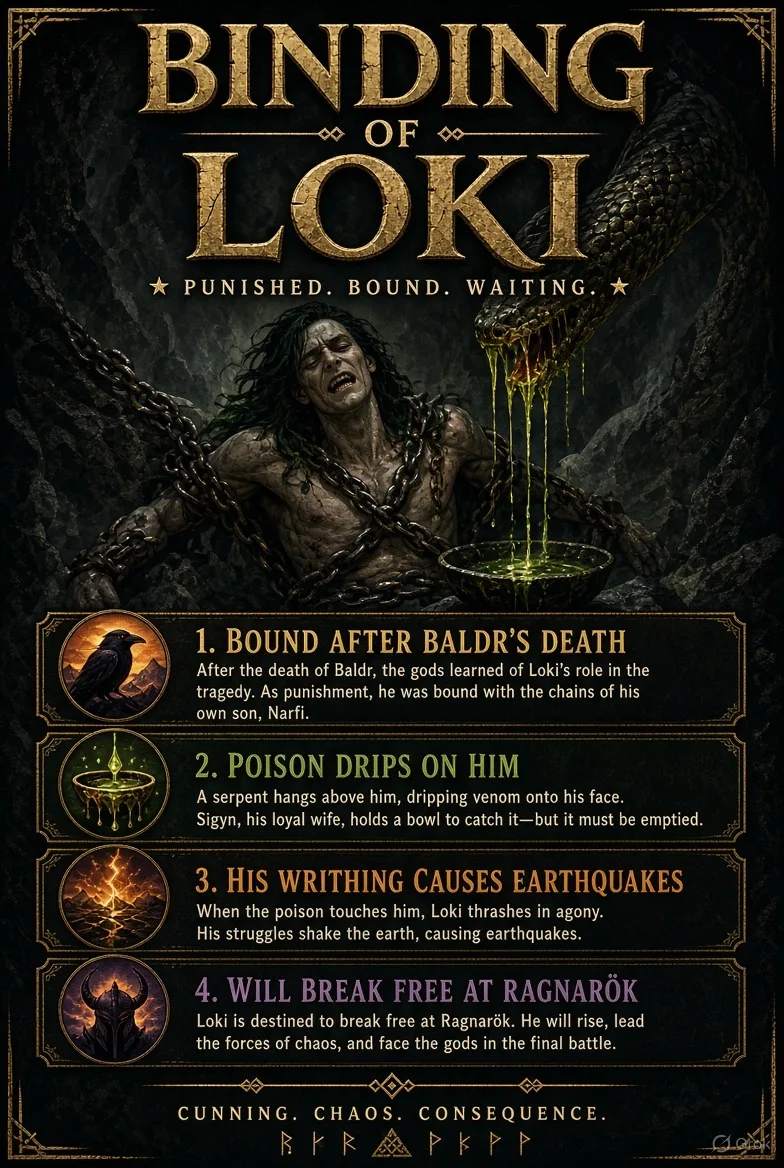
Artwork and source The bonds are made from the entrails of one of Loki’s sons in the sources. The names and details vary between the Lokasenna prose ending and Gylfaginning.
Frequently Asked Questions
Why was Loki bound?
Snorri links it to his role in Baldr’s death and the failed attempt to release Baldr from Hel.
Who caught Loki in salmon form?
The gods used a net, and Thor seized him as he jumped.
Who is Sigyn?
Loki’s wife, who catches the serpent’s venom in a bowl.
Who placed the snake over Loki?
Skaði in Snorri’s Gylfaginning.
Why does the earth shake in the myth?
Loki’s painful convulsions when venom reaches him are used to explain earthquakes.
What happens to Loki at Ragnarök?
He breaks free and, in Snorri’s account, dies fighting Heimdallr.
Conclusion
Loki’s binding is more complex than a simple punishment picture. His capture involves a salmon disguise and Kvasir’s discovery of a net; his confinement involves family tragedy, Skaði’s serpent and Sigyn’s recurring act of care. The eventual release at Ragnarök makes the myth an ominous bridge to the final battle.
Sources and art disclaimer
Gylfaginning: Loki captured, bound and punished; Lokasenna: Loki’s quarrel with the gods; Völuspá: Loki, Sigyn and Ragnarök.
Reviewed 15 November 2026. Artwork depicts mythic events, not history.












Share Your Opinion
Comments are closed on this post.