 Vista

Odin hangs for nine nights on a windswept tree, wounded by a spear and offered to himself, in the Old Norse poem Hávamál. He receives neither bread nor drink, looks down into the depths and takes up the runes before falling from the tree. The episode, commonly called the Rúnatal, is one of Norse mythology’s most memorable accounts of knowledge gained at immense personal cost. The poem does not explicitly identify the tree by name in these particular lines, although it is widely associated with Yggdrasil, the world tree.
This source-based guide explains why Odin makes the sacrifice, what the famous nine nights signify, whether he actually dies, how the runes relate to Old Norse writing and magic, and why a modern rune tattoo should not be marketed as an authenticated ancient formula. It also distinguishes this episode from Odin giving up an eye at Mímir’s well and from the separate Mead of Poetry story.
What Does Hávamál Actually Say About Odin’s Sacrifice?
Hávamál is a collection of Old Norse poetic material preserved in a medieval manuscript, not a modern biography of Odin. Its section commonly called Rúnatal includes a striking first-person account: the speaker hangs from a windy tree for nine nights, wounded by a spear and dedicated to Odin, himself to himself. There is no food or drink during the ordeal. In the following lines the speaker peers downward, takes up runes and falls back from the tree. These details are the secure basis for the famous imagery. Some English editions label the key verses 138 and 139; Henry Adams Bellows uses 139 and 140 because editorial numbering differs. A careful SEO article should mention that instead of accusing one translation of being fabricated simply because the number changes. The text does not provide a day-by-day diary naming a different magical lesson for each of the nine nights, a specific mountain on which the tree grows, or a list of nine wounds. Such claims belong to later interpretation.
Was the Tree Yggdrasil or an Unnamed Tree?
Modern summaries almost always say Odin sacrificed himself on Yggdrasil, and the association fits the greater mythology of the immense world tree. Yet the key Hávamál verse calls it a windy tree whose root is unknown to people; it does not name Yggdrasil in the same line. Yggdrasil is described elsewhere as a cosmic ash, with roots connected to different mythical regions and wells. That combination makes the interpretation widely accepted, but scholarly precision distinguishes an association from an explicit statement in every individual verse. An illustration can show an enormous ash with Odin suspended among the branches and roots disappearing into mist. The image should not be presented as a Viking photograph or a scientifically accurate reconstruction of the world tree. Nor does the poem give an exact branch number or GPS location. The literary emphasis is exposure, uncertainty and the extraordinary setting of a solitary ordeal, not cartography. For image captions, ‘Odin’s nine-night sacrifice on a tree traditionally identified with Yggdrasil’ is accurate and clear.
Why Does Odin Sacrifice Himself to Himself?
The poem’s wording identifies Odin as both the one who is offered and the deity to whom the offering is made. That paradox makes the episode unusual. Readers have compared it with an initiation into hidden knowledge, a symbolic death and rebirth, and broader Northern European ritual traditions. Scholars also debate the extent to which medieval Christian imagery may have influenced the preserved wording. The poem itself does not supply a definitive doctrinal explanation, so a responsible guide describes these as interpretations rather than settled historical facts. Odin is connected throughout Norse literature with the pursuit of wisdom, including uncomfortable or dangerous bargains. The nine-night ordeal fits that characterization by showing that knowledge has a cost. But it should not be turned into advice to imitate the act physically: hanging or injuring oneself is dangerous and is not required to study runes. One can understand the story through reading, language, literature and art without treating its supernatural actions as a real-world experiment.
The Spear, the Nine Nights and the Absence of Food
Three details recur in nearly every faithful picture of this episode: a spear wound, nine nights and the refusal or absence of food and drink. The spear recalls Odin’s wider association with weapons such as Gungnir, but the poem does not explicitly label the particular spear Gungnir in its key line. The number nine appears in several Norse mythic contexts, including groups of worlds and mothers, but a chart claiming that each night precisely opens one named chakra is a modern invention, not a translation of Hávamál. Similarly, the literary expression of deprivation should not be read as a verified medical report about safe fasting durations. Nine nights without nourishment or water, alongside serious injury, would be life-threatening for a person. The story makes sense in its supernatural mythic setting. Visual art can communicate discomfort and endurance without turning it into a contemporary challenge. Accuracy means naming the poetic motifs while resisting invented details such as the tree’s temperature or the spear’s measured depth.
What Are the Runes Odin Takes Up?
Runes are characters used in historical Germanic writing traditions, with different alphabets and periods. Elder Futhark has twenty-four traditional characters, while the Younger Futhark used in much of Viking Age Scandinavia has sixteen. Old Norse poems also give runes symbolic and magical associations. In Hávamál the word rúnar can mean runes and may invite deeper associations with secrets, depending on context and translation. Odin’s finding or taking up the runes is a mythic account of access to powerful knowledge; it is not archaeological evidence that a single historical person created the entire writing system overnight. Many modern images present a convenient A-to-Z substitution chart as the original Viking alphabet. That is inaccurate: rune signs were not standardized one-to-one replacements for all modern English letters. A useful poster can refer to ‘runes and secret knowledge’ without claiming to display every ancient rune correctly, especially when the illustration contains invented bindrunes or symbols from much later Icelandic traditions.
Does Hávamál Say Odin Invented the Entire Runic Alphabet?
A distinction between discovering, receiving and inventing matters. The poem describes Odin looking down and taking up the runes. Other verses reflect on their carving, interpretation and powers, involving several mythological figures. They do not function as a modern inventor’s patent for the complete Elder Futhark. Historical evidence places rune writing among Germanic-speaking peoples centuries before the medieval manuscripts were written down, and its development is investigated through inscriptions and linguistic scholarship. Thus the literary origin story belongs to belief and myth, while dates and distributions of real inscriptions belong to archaeology. A responsible article should not claim that the famous nine-night scene proves the existence of a worldwide secret alphabet or that modern English letters can be converted mechanically into rune charms with guaranteed effects. For SEO, the useful answer to ‘Did Odin invent runes?’ is that he gains rune knowledge in myth, not that we have a historical inventor’s identity.
How Is the Sacrifice Different from Odin’s Missing Eye?
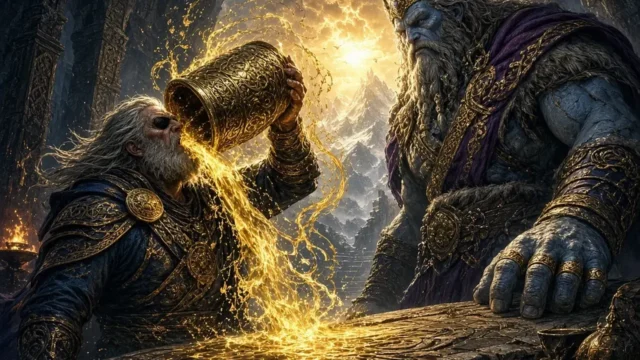
Odin also gives up an eye in a story concerning Mímir’s well, seeking wisdom from a special source of knowledge. That is not the same event as the nine-night ordeal. The eye story is associated with Mímisbrunnr and its guardian, while Hávamál’s tree scene involves a spear wound, hanging, deprivation and runes. Some dramatic wallpapers combine Odin’s missing eye, ravens, spear and glowing tree, which makes a recognizable god portrait. The collage is legitimate artistic shorthand, but the article should identify which elements come from which episode. Likewise, the Mead of Poetry involves Kvasir, dwarfs, Gunnlöð and Odin’s pursuit of poetic inspiration, not the exact mechanics of the tree ordeal. These separate narratives make Odin a complex figure whose wisdom arises through multiple risky quests. A searcher who asks ‘Why did Odin lose his eye and hang on a tree?’ needs both stories clearly distinguished, without an invented sequence saying the eye falls out during the nine-night sacrifice.
What Happens After Odin Finds the Runes?
Following the key ordeal verses, Hávamál continues with material about powerful songs, a drink of extraordinary mead and the development of knowledge and ability. The sequence is poetically dense and not every scholar interprets its relationship to the rest of the poem identically. Nonetheless the overall impression is transformation: after suffering, the speaker acquires new understanding and becomes more powerful in words and deeds. The story does not say Odin becomes an ordinary mortal human who then starts a writing school, nor does it provide a chronological calendar linking every stanza to a particular Viking settlement. Nor is it certain that every rune-related passage in the poem was composed at precisely the same historical moment. The surviving document reflects literary transmission and editorial decisions. An effective educational poster can present three steps—ordeal, acquisition of runes, and wisdom—without inventing an elaborate magical training syllabus. The reader should leave understanding the poem’s narrative, not a list of pseudo-historical techniques.
Odin’s Nine Nights Tattoo, Wallpaper and Rune Symbols
Common searches include ‘Odin hanging Yggdrasil nine nights’, ‘Odin rune sacrifice meaning’, ‘Havamal runes’, ‘Odin spear sacrifice tattoo’ and ‘Yggdrasil Odin wallpaper’. A strong featured image can show a lonely figure suspended in a windswept cosmic tree. An inside poster can explain the nine nights, spear, lack of food and runes using clear type. Tattoos may symbolize sacrifice, learning, persistence or the pursuit of wisdom, but these are personal modern meanings. Popular Icelandic magical staves such as Vegvísir should not automatically be described as rune signs from Odin’s original Viking Age ordeal; their documented history is much later and different. A clear ALT description should identify the figure and tree actually pictured. If the art shows a rune circle, its precise letters need visual verification before a caption claims they form an authentic Elder Futhark inscription. Attractive imagery should invite reading, not substitute invented archaeology for actual Eddic literature.
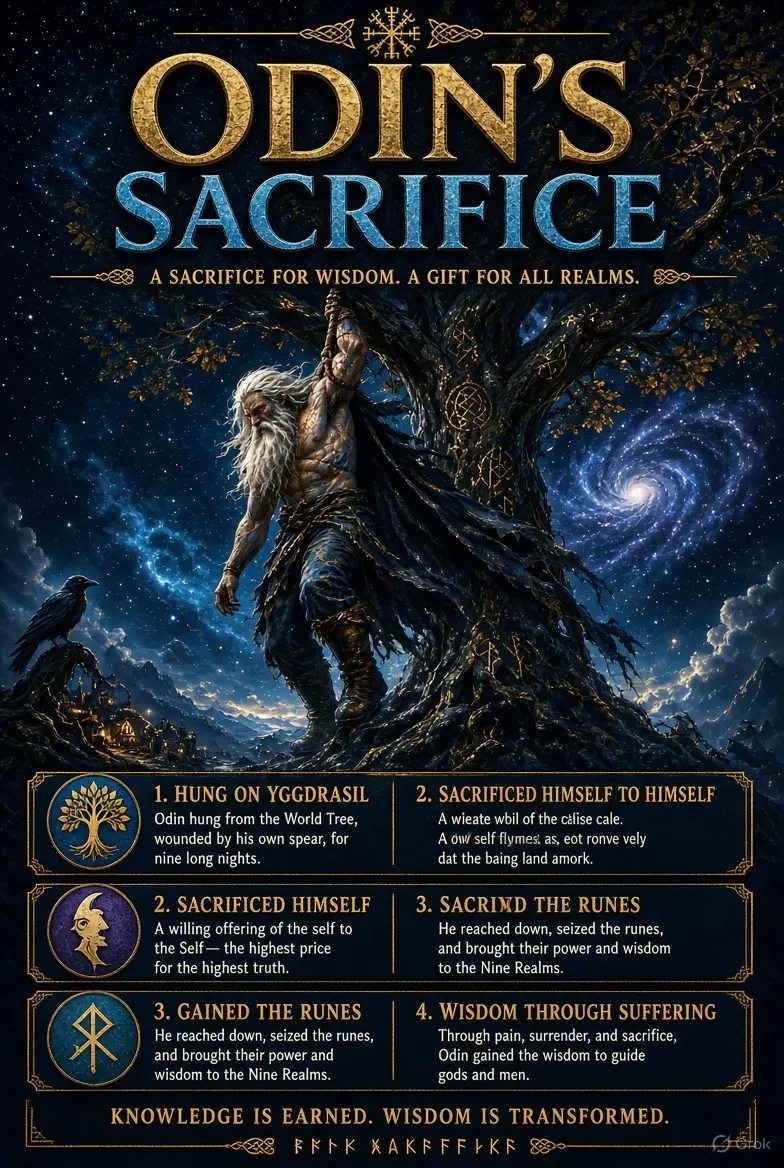
Artwork and source Hávamál leaves the tree unnamed. Its identification as Yggdrasil is a common reading, and Odin is wounded with a spear in the poem.
Frequently Asked Questions
Why did Odin hang on the tree for nine nights?
In Hávamál he endures a self-offering connected with the acquisition of runic knowledge.
Is the tree named Yggdrasil in the verse?
The key lines describe an unnamed windy tree; scholars widely connect it with Yggdrasil.
Was Odin wounded by Gungnir?
A spear wound is explicit; the particular spear is not named in that line.
How many nights does Odin hang?
Nine nights, according to the poem.
Did Odin create the runes historically?
No historical evidence identifies Odin as a real inventor; the story is mythical and rune history is studied through inscriptions.
Is this the same story as Odin losing his eye?
No. The eye sacrifice at Mímir’s well is a distinct wisdom quest.
Conclusion
The nine-night ordeal in Hávamál explains Odin’s pursuit of runes through a mysterious self-offering, spear wound and deprivation. The myth is powerful without invented day-by-day rituals, unsafe imitation or claims that all modern rune diagrams are authentic ancient spells. Distinguishing poem, interpretation and inscription history gives readers the most useful explanation.
Primary sources and visual disclaimer
Hávamál — Rúnatal and the nine nights (critical edition); Hávamál: 138–143, Odin’s experience with runes; Hávamál text and variant stanza numbering.
Checked 15 November 2026. Mythological illustrations are not historical photographs, and the dangerous ordeal is not a practice to imitate.










Share Your Opinion
Comments are closed on this post.