 Vista
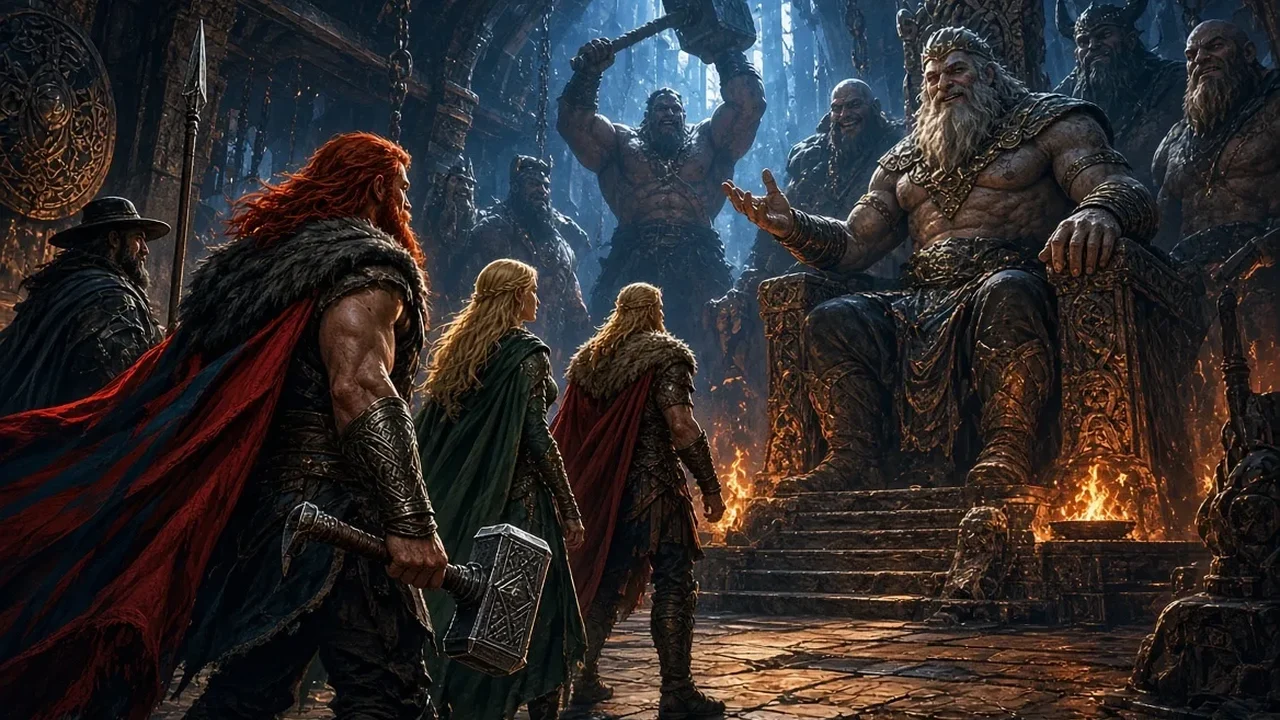
Thor’s journey to Útgarða-Loki in Norse mythology is a story in which seemingly simple contests reveal the limits of even divine strength. In Snorri’s Gylfaginning, Thor travels with Loki and the young servant Þjálfi to a giant’s hall. Loki loses an eating contest, Þjálfi loses a footrace, and Thor appears to fail at drinking from a horn, lifting a cat and wrestling an old woman. The next day their host reveals the trick: Loki raced against wildfire, Þjálfi against Thought, the horn reached the sea, the cat was Jörmungandr and the old woman Elli was Old Age.
This guide covers Thor Utgard-Loki challenges, who Skrýmir really was, how the illusions worked, why Thor’s apparent failures were extraordinary, and how the experience connects to his later fishing encounter with the Midgard Serpent. This is an old literary myth, not evidence of actual supernatural athletic competitions.
What Is Utgard, and Who Is Útgarða-Loki?
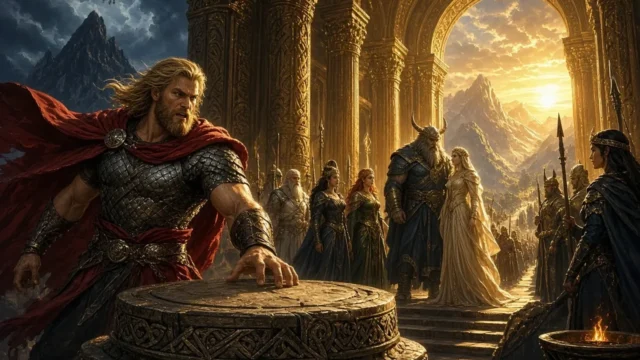
Útgarðr is a mythic destination in the world of jötnar, and Útgarða-Loki is the powerful host who orchestrates Thor’s contests. The name resembles Loki’s, but the giant host is not simply the same character as Odin’s cunning companion Loki. Keeping the two names separate is essential for an accurate story. In Snorri’s Gylfaginning, the travelling party meets Útgarða-Loki after a strange encounter with Skrýmir, a seemingly enormous giant. Modern mythology charts sometimes put the location on a precisely measured branch of Yggdrasil or identify its hall with a contemporary Nordic ruin. Neither claim is established by this narrative. The place functions as an arena of deception in which appearances cannot be trusted. Its apparent size, towering inhabitants and confident host make Thor look weak before the contests begin. In visual art, a vast hall and tiny visitors are useful for communicating the imbalance, but the architecture is an artist’s reconstruction, not an archaeological site.
How Does Thor Meet Skrýmir Before Reaching the Castle?
On the journey Thor and his companions spend the night in what seems to be a large shelter. They discover that the space is part of a gigantic glove belonging to Skrýmir. The next day Skrýmir joins them, carrying the provisions in a bag that Thor cannot open. At night Thor attacks the sleeping giant with Mjölnir several times, but Skrýmir barely reacts and mistakes the blows for harmless things landing on him. Thor becomes frustrated because his famous hammer seems powerless. The later revelation makes sense of the scene: Útgarða-Loki had disguised himself as Skrýmir and used deception to keep the blows away. They struck a mountain instead, leaving deep valleys. This is not a fair physical duel between ordinary characters. The host shapes Thor’s perceptions so that the god misunderstands what he is hitting. A striking illustration can show the enormous glove and tiny travellers, but captions should identify the glove scene as the prelude to the castle challenges.
Challenge One: Loki Versus Logi in an Eating Contest
Inside the giant hall, the travelling Loki claims that no one can eat as quickly as he does. Útgarða-Loki produces an opponent called Logi. The two eat from opposite ends of a trough. Loki consumes his portion of meat, while Logi consumes not only the meat but the bones and the trough itself. On the visible scoreboard, Loki loses. The next day the host explains that Logi was wildfire, which devours everything it reaches. This is an essential distinction: Logi, the eating contestant, is not simply another spelling of Loki, the travelling god. Their similar names make confusion especially common in video captions. The contest illustrates the difficulty of competing with a force of nature disguised as a person. A useful poster can show the two names and a small fire symbol, making clear that the test was impossible by ordinary standards. The myth does not teach a real competitive-eating technique or recommend attempting such a challenge.
Challenge Two: Þjálfi Races Against Hugi
Þjálfi is a young human servant of Thor, associated with remarkable running speed. When he offers to race, Útgarða-Loki produces a youth called Hugi. Þjálfi loses the first race and does not catch up in the next attempts either. The name Hugi is connected with thought, and the host later reveals that the opponent was the speed of his own thought. Physical legs cannot reasonably outpace that abstract principle in a contest designed by a magician. This is why the story is not simply evidence that Þjálfi is a slow runner. The narrative contrasts a genuine human ability with an impossible standard disguised as a fair rival. Some modern images show Hugi with mechanical wings or as a lightning spirit; such appearances are artistic decisions. A source-aware caption might say ‘Þjálfi racing against Hugi, who represents Thought’. It should also identify Þjálfi correctly rather than call him a son of Odin or a different giant.
Challenge Three: Why Can’t Thor Empty the Drinking Horn?
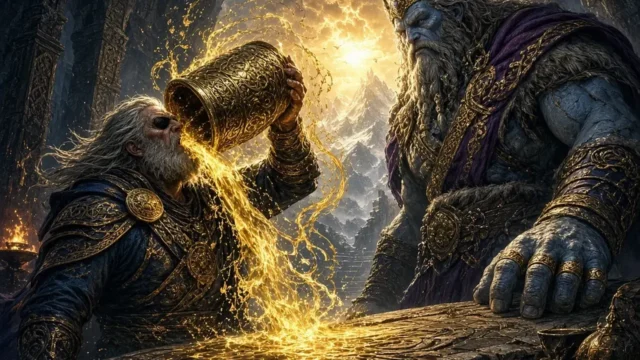
Thor chooses a drinking challenge. Útgarða-Loki brings him a horn that appears possible to drain in a small number of swallows. Thor drinks with enormous effort three times, yet the level barely lowers. His host mocks the result. The next day the explanation is that the far end of the horn was connected to the sea. Thor had actually been drinking enough to lower the water level of the ocean, producing a mythic explanation for ebb tides. This is among the most impressive illusions because the measurement was never fair. Thor was not failing to consume an ordinary vessel of liquid; he was confronting an entire sea without knowing it. As mythology, the story can inspire a striking image of a horn blending into ocean waves. Scientifically, tides are caused by gravitational effects, especially the Moon and Sun, not by a giant drinking horn. A responsible educational article should keep that distinction clear rather than present the legend as coastal physics.
Challenge Four: The Cat That Was Jörmungandr
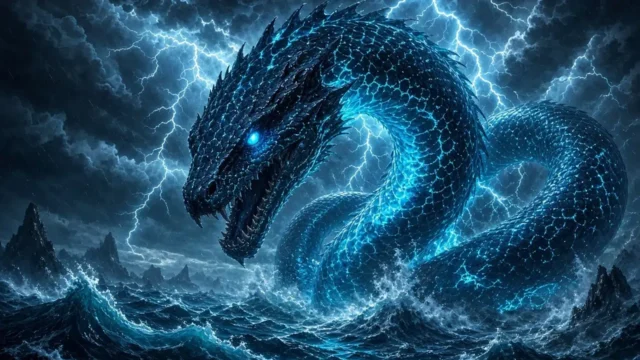
The host next asks Thor to lift a gray cat. Thor finds the task astonishingly difficult. He grips the creature and stretches with all his power, but he manages to raise only one of its paws from the floor. This appears humiliating in the hall. However, the cat was actually the Midgard Serpent Jörmungandr disguised by the host’s magic. The creature lies around the human world and is so enormous that lifting even part of it amazes Útgarða-Loki. The host later admits that everyone was afraid when Thor achieved this much. This episode connects the seemingly playful cat to the dangerous World Serpent. A modern picture could show a cat’s shadow transforming into a giant sea snake; that is a visual interpretation of the deception. It should not teach that Jörmungandr is ordinarily a domestic cat or has the permanent ability to turn into one in every source. The episode belongs specifically to a magical contest engineered by Útgarða-Loki.
Challenge Five: Elli, the Old Woman Thor Cannot Defeat
Finally Thor asks for a wrestling opponent. Útgarða-Loki calls an elderly woman named Elli. Thor expects an easy victory, but the more he struggles, the firmer she stands. Eventually she forces him down onto one knee. The host later reveals that Elli represents Old Age, which no person, however strong, can defeat forever. This is the story’s sharpest reflection on the limits of physical strength. Thor’s partial resistance is presented as amazing, because he withstands the force of aging for longer than expected. Some modern retellings turn Elli into a weak grandmother whom Thor refuses to hurt out of kindness. Snorri’s account is different: he genuinely wrestles and loses against a personified force. The point is not a joke about actual older people lacking strength. The contest makes aging an undefeated opponent that even the divine warrior cannot simply overpower. An educational poster can label Elli as Old Age without presenting the trial as medical advice.
The Final Reveal: Why Was Thor Actually Stronger Than He Thought?
The following morning Útgarða-Loki tells Thor how the contests were manipulated. Skrýmir was his disguise, and Thor’s hammer strikes had left valleys in a mountain. Logi was wildfire, Hugi was Thought, the drinking horn reached the sea, the cat concealed the World Serpent and Elli was Old Age. The host admits that Thor frightened the inhabitants with the scale of his achievements. Thor’s seeming losses therefore reveal extraordinary power when the hidden standards are understood. Furious at the deception, Thor raises his hammer, but Útgarða-Loki and his castle vanish from sight. He cannot take revenge on the host at that moment. This ending is important: the god learns the truth but cannot recover a normal victory because the arena itself was an illusion. The story does not describe a public tournament in which Thor later wins a rematch and receives a golden trophy. Its philosophical value is the gap between appearances and the reality of an unfair test.
How Does This Story Connect to Thor Fishing for Jörmungandr?
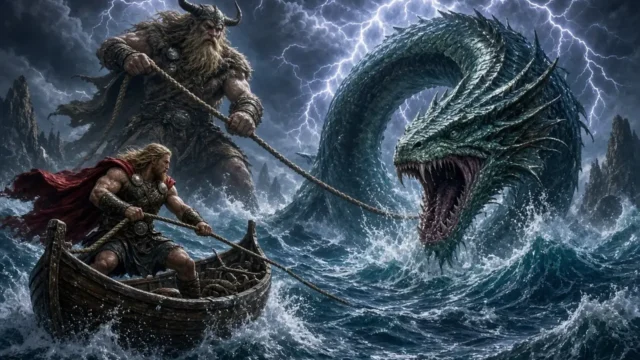
Snorri’s narrative makes a clear transition from the Útgarða-Loki journey to Thor’s next adventure. After realizing that the gray cat represented Jörmungandr, Thor becomes intent on finding the serpent itself. He later travels to the jötunn Hymir and goes fishing using an ox head as bait. When the enormous serpent rises near the boat, Hymir is terrified and cuts the line in the familiar prose version. That story occurs separately from the illusion-based contests, although both involve the Midgard Serpent. The sequence makes Thor’s character more understandable: his pride is wounded by deception, but he also discovers that his strength can challenge cosmic forces. Readers who search for ‘Thor lifted Jormungandr cat’ should not confuse the cat contest with the ocean fishing incident or the final Ragnarök battle. Three distinct episodes reuse the same serpent, each with a different narrative function.
Thor Utgard-Loki Five Challenges Images and Search Keywords
Searches like ‘Thor lifting cat Norse mythology’, ‘Thor drinking horn sea’, ‘Elli old age goddess’, ‘Loki Logi eating contest’, ‘Thjalfi Hugi race’ and ‘Utgard Loki five challenges’ all lead to this distinctive story. The best featured image could show Thor with the gray cat or confronting an enormous hall; the poster can organize five tests and five hidden identities in readable pairs. ALT text should describe the visible challenge accurately. If only the drinking horn appears in a picture, do not claim it simultaneously depicts the running race and the old woman. Images can visualize abstract forces such as Thought, Fire and Old Age, but they are not historical photos of actual creatures. A good long-form visual guide explains the trick behind each trial rather than giving unsupported numerical strength ratings or claiming that the game adaptation is the definitive medieval account.
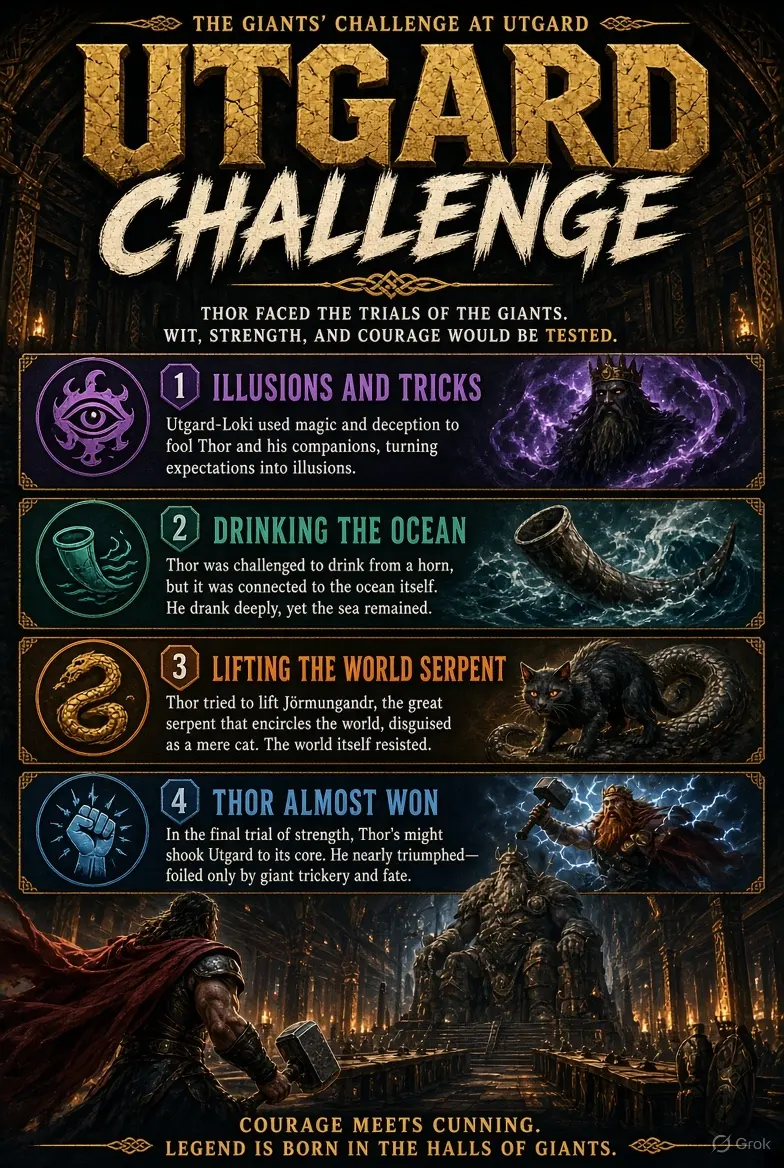
Artwork and source Thor lowered the sea, lifted one paw of the cat and went down on one knee wrestling Elli, old age personified. Loki and Þjálfi face the other two trials.
Frequently Asked Questions
Who is Útgarða-Loki?
The jötunn host who uses illusions to test Thor and his companions.
Is Útgarða-Loki the same as Loki?
No. Their names resemble each other, but they are distinct figures in Snorri’s story.
Who won the eating contest?
Logi, who is revealed to be wildfire, defeated the travelling Loki.
Why could Thor not empty the horn?
Its other end reached the sea, so the task was impossible as an ordinary drinking contest.
What was the gray cat really?
Jörmungandr, the enormous Midgard Serpent.
Who was Elli?
The personification of Old Age, whom Thor could not defeat in wrestling.
Conclusion
Thor’s visit to Útgarða-Loki shows that apparent defeat can hide extraordinary achievement. Loki, Þjálfi and Thor face wildfire, Thought, the sea, Jörmungandr and Old Age without knowing the true nature of their opponents. Clear source-based captions make the five impossible challenges one of the most rewarding Norse mythology visual stories.
Sources and illustration note
Gylfaginning: Thor’s visit to Útgarða-Loki; Útgarða-Loki — source and story overview; Norse mythology of the contests and illusions.
Reviewed 15 November 2026. Artwork is a creative Norse myth interpretation.










Share Your Opinion
Comments are closed on this post.