 Vista

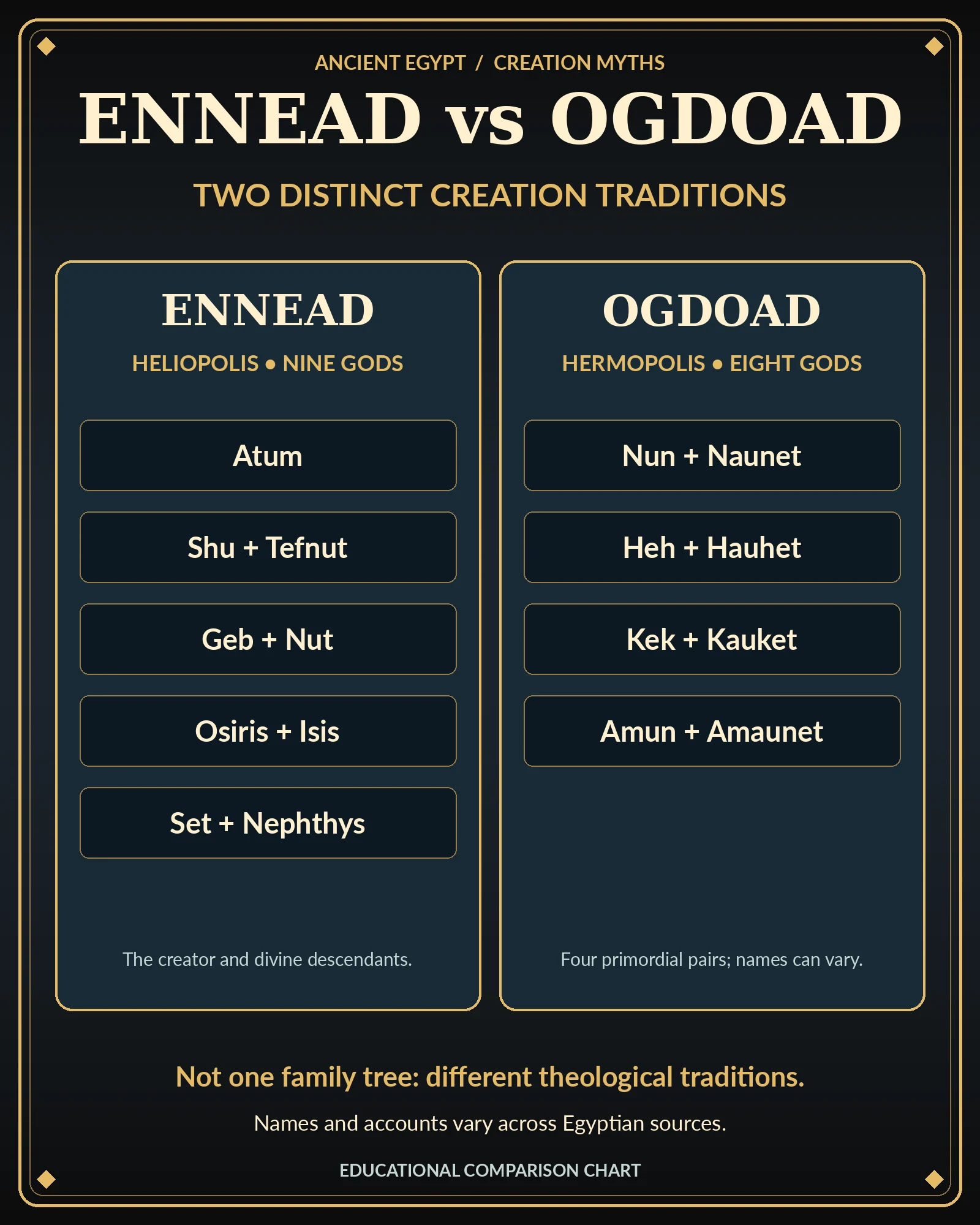
The Egyptian primordial gods are the beings who existed at the very beginning, before the sky, earth and people. The most important are Nun, the dark waters of chaos, and the group of eight called the Ogdoad worshipped at Hermopolis: Nun and Naunet (water), Heh and Hauhet (endlessness), Kek and Kauket (darkness) and Amun and Amaunet (hiddenness). Egypt did not have one single creation story. Different cities told different versions, with Atum at Heliopolis, Ptah at Memphis, Amun at Thebes, the Ogdoad at Hermopolis and Neith at Esna. What they share is the idea of an ordered world rising out of dark, watery chaos on a first mound of land.
This guide sets out the main creation traditions side by side, explains the primordial gods and their symbols, and separates what the texts say from what modern writers have added.
Primordial Gods Quick Facts
| Item | Detail |
|---|---|
| Starting point | Nun, the endless dark water of chaos |
| First land | The primeval mound, linked with the benben |
| Hermopolis group | The Ogdoad: four male-female pairs of primeval forces |
| Heliopolis tradition | Atum creates Shu and Tefnut; the Ennead follows |
| Memphis tradition | Ptah creates by thought and speech |
| Theban tradition | Amun as hidden creator, later Amun-Ra |
| Esna tradition | Neith as a creator goddess |
What Does “Primordial” Mean Here?
“Primordial” means existing at the very beginning. In Egyptian thought, creation was not “something from nothing” but order from disorder. Before creation there was not an empty void but a limitless, dark, watery state that contained all possibilities. Egyptians called it Nun, and it never completely disappeared. They believed it still surrounded the ordered world and lay beneath the earth, a reminder that order (ma’at) must be maintained against the threat of chaos.
The primordial gods are therefore not “first rulers” like the Greek Titans. They are the qualities of the pre-creation world personified: water, darkness, endlessness and hiddenness. They are present in the background of creation stories more than they act as characters in adventures.
Nun: The Primeval Waters
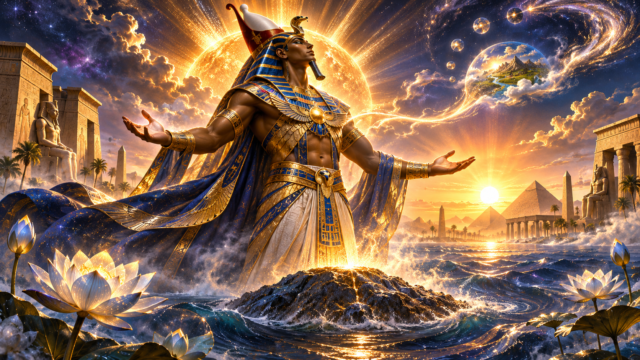
Nun is the god of the primeval ocean. He is usually shown as a bearded man, often with arms raised to hold up the sun boat of Ra, rising from the water at dawn. His female counterpart is Naunet. Nun is not worshipped in the usual way and has few temples of his own; he is a cosmic idea and a source from which others arise. Many Egyptian texts call Nun “the father of the gods”, and the Nile’s yearly flood was sometimes seen as an echo of the primeval waters.
The Ogdoad of Hermopolis
The city of Hermopolis Magna, called Khemenu in Egyptian, meaning “eight-town”, was the centre of a tradition about eight primeval deities. They are grouped in four pairs, each with a male and a female form. The males are usually shown with frog heads and the females with snake heads, which is a link with amphibious life in the marshes.
| Male | Female | Quality |
|---|---|---|
| Nun | Naunet | Primeval water |
| Heh | Hauhet | Endlessness, infinity |
| Kek | Kauket | Darkness |
| Amun | Amaunet | Hiddenness, air or the unseen |
In the Hermopolitan story, the eight gods act together to bring forth the sun, in the form of a lotus flower, a cosmic egg or a bird on the first mound, depending on the version. The Ogdoad is not a single fixed text but a pattern that appears in several sources over time, which is why details differ.
Story box (retold from Hermopolitan tradition): In the dark, the eight primeval gods move on the face of the water. They have no light, no land and no time. Their combined movement gives rise to a mound, and from the mound a lotus opens. In the heart of the lotus, a child, the young sun, appears, and the world is lit for the first time. The frog and snake heads are signs of life stirring in mud and water. This is a religious story and varies between sources.
The Primeval Mound and the Benben
Almost every Egyptian creation story includes a first mound of land rising from the water. It was probably inspired by the sight of mud banks emerging as the Nile flood receded each year. The mound is the place where the creator stands and where life begins. At Heliopolis the mound was linked with the benben, a sacred stone or pyramid-shaped object, and this idea probably influenced the shape of pyramids and the tips of obelisks. Temples were often seen as symbolic copies of the first mound, so a temple’s sanctuary was the most sacred place because it recalled the first land.
Four Cities, Four Creation Stories
| City | Creator | How creation happens |
|---|---|---|
| Heliopolis | Atum | Self-created on the mound; produces Shu and Tefnut; the Ennead follows |
| Hermopolis | The Ogdoad | Eight primeval deities bring forth the sun from the mound |
| Memphis | Ptah | Creation through thought in the heart and speech of the tongue (Shabaka Stone) |
| Thebes | Amun | Hidden creator whose breath or presence is in all things; merged with Ra |
| Esna | Neith (and Khnum) | Creator goddess who forms the world through her word and acts, in later temple texts |
These stories were not seen as rivals in the way modern debates are. Egyptian thinkers were comfortable with several explanations that look at the same event from different angles. Each city naturally placed its own god at the centre, and priests blended ideas to connect their local god with national religion. For deeper detail, see our guides to Atum, Ptah, Amun-Ra and Khnum.
Why Did Egyptians Imagine Creation This Way?
The creation stories mirror the landscape. Each year the Nile flooded, covered the land with water and then fell, leaving islands of fresh earth where plants and animals returned. The daily sunrise also seemed to bring light out of darkness. To an Egyptian, these repeated events were small versions of the first creation. This is why creation was not only a story about the past but also a pattern that kept going. Rituals, festivals and kingship were meant to help maintain order in the present.
History, Mythology and Speculation
| Category | What belongs here |
|---|---|
| History | Texts and temples connected to Hermopolis, Heliopolis, Memphis, Thebes and Esna; the Pyramid Texts and later sources |
| Mythology | Nun, the Ogdoad, the mound, the lotus and egg images, divine creators |
| Speculation | Claims that the Ogdoad encodes lost science; modern attempts to link Egyptian creation with other world religions; exact dates for each tradition |
Myth vs Fact
| Popular claim | Reality |
|---|---|
| Egyptians had one official creation story. | They had several, linked to different cities and priesthoods. |
| The Ogdoad were evil chaos gods. | They were forces of the pre-creation state, not evil beings. Their role in creation was positive. |
| Egyptians believed the universe came from nothing. | Their stories begin with chaos waters, not absolute nothing. |
| The Ogdoad were all frogs and snakes. | Frog and snake heads are common in images, but Egyptian art varies. |
| Egyptian creation stories prove ancient knowledge of modern cosmology. | There is no evidence for that. They are religious and poetic accounts. |
Frequently Asked Questions About Egyptian Primordial Gods
Who was the first Egyptian god?
It depends on the city. At Heliopolis it was Atum, at Hermopolis the Ogdoad, at Memphis Ptah, and at Thebes Amun. Nun is the primeval water from which many traditions begin.
What is Nun in Egyptian mythology?
Nun is the god of the primeval waters, the dark chaotic ocean that existed before creation.
What is the Ogdoad?
It is a group of eight primeval deities worshipped at Hermopolis, made of four male-female pairs representing water, endlessness, darkness and hiddenness.
Why are the Ogdoad shown with frog and snake heads?
Frogs and snakes live in water and mud, which fit the pre-creation world. The male gods are usually shown as frogs and the female gods as snakes.
What is the primeval mound?
It is the first piece of land that rose from the waters, where the creator stood. Temples were symbolic copies of it.
Is Amun one of the primordial gods?
Yes, in the Hermopolitan Ogdoad Amun and Amaunet stand for hiddenness. Later, Amun became a major creator god in Thebes.
Did Egyptians believe Nun still existed?
Yes. They believed Nun surrounded the ordered world and lay in the underworld, which is why the night journey of the sun passes through water.
How do Egyptian creation myths compare with other cultures?
Many cultures describe a watery beginning and a first land. Similarities can be interesting, but they do not prove direct links, and each culture’s story should be read in its own context.
Reliable Sources
- World History Encyclopedia: Egyptian Mythology
- Egypt Exploration Society: Gods of Egypt
- The Metropolitan Museum of Art: Divine Egypt
Last updated: 25 November 2026. Related reading on Vista Hub: our guides to Atum, Ptah, Amun-Ra, Khnum and Egyptian mythology.
Related guides: Egyptian Mythology: Ancient Gods, Creation Stories, Symbols and the Afterlife · Egyptian Gods Family Tree: Relationships, Parents, Children and Divine Families Explained











Share Your Opinion
Comments are closed on this post.