 Vista

Hathor (Egyptian: Hwt-Hor, “House of Horus”) was the ancient Egyptian goddess of love, beauty, music, dance, joy and motherhood. She is shown as a cow, as a woman with cow ears, or as a woman wearing a sun disc between cow horns. She was also a sky goddess, a protector of the dead in the western cliffs of Thebes, and one of the faces of the Eye of Ra.
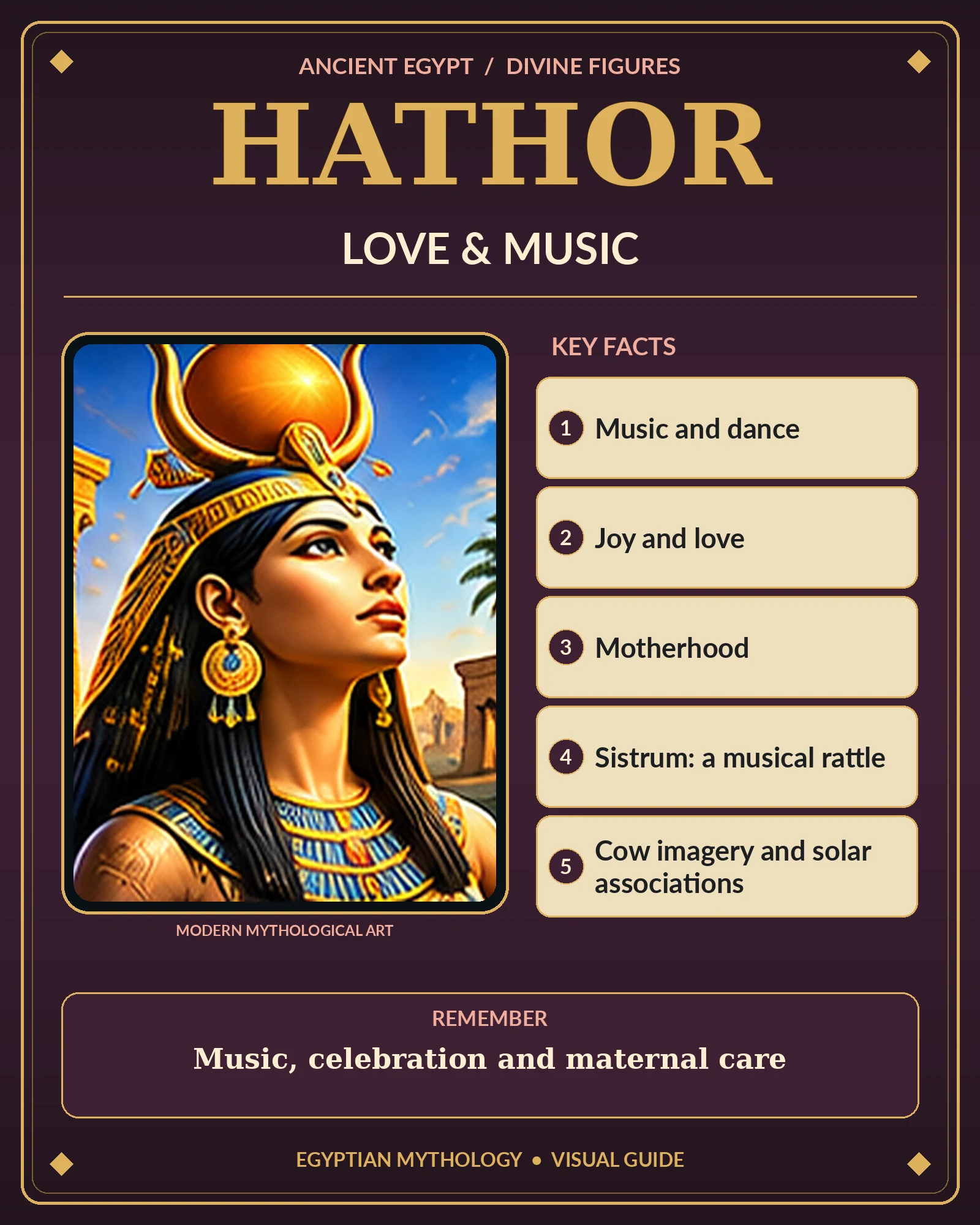
This guide separates Egyptian evidence from the Greek label “Aphrodite” and from modern claims. You will find a fact box, her many roles, her symbols, the temple at Dendera, the festival of the Beautiful Meeting, a comparison with Isis and Sekhmet, a myth vs fact table, ten FAQs and sources.
Hathor Quick Fact Box
| Item | Answer |
|---|---|
| Egyptian name | Hwt-Hor, “house (or mansion) of Horus” |
| Domain | Love, beauty, music, dance, joy, motherhood, the sky, foreign lands and the dead |
| Appearance | Cow, woman with cow ears, or woman with sun disc and cow horns |
| Parents | Ra (as his Eye); some texts name other parents |
| Consort and child | Often Horus (the Elder) in older tradition; Ihy, god of music, as child |
| Symbols | Cow horns, sistrum, menat necklace, mirror, sycamore tree |
| Main temple | Dendera, in Upper Egypt |
| Other sacred places | Deir el-Bahari (Thebes), Serabit el-Khadim (Sinai) |
| Titles | “Mistress of Turquoise”, “Lady of the Sycamore”, “Golden One” |
| Greek equivalent | Aphrodite |
Who Is Hathor in Egyptian Mythology?
Hathor is one of Egypt’s oldest and most beloved goddesses. A cow-like goddess appears on the Narmer Palette, an early royal monument from around 3100 BCE, though scholars debate whether that figure is Hathor or the related goddess Bat. Over time Hathor absorbed many roles, and Egyptians prayed to her for fertility, safe childbirth, joy and a good life, and for protection in the afterlife.
Her name, “House of Horus”, can be read in two ways: the sky as the house in which the falcon Horus lives, or the mother as the house of the king, who is Horus. Both readings fit her dual role as sky goddess and royal mother. In older myth, she is the divine mother or wife of Horus, a role later taken by Isis. Read our Horus guide and Isis guide for the two goddesses’ relationship to him.
Hathor’s Symbols and How to Recognise Her
| Symbol | Meaning |
|---|---|
| Cow horns and sun disc | Her sky and solar link; the disc is the sun held between the horns |
| Cow | Nourishment, motherhood and the sky |
| Sistrum | A ritual rattle that stands for music, joy and calming the goddess |
| Menat | A heavy beaded necklace used in rites and music |
| Mirror | Beauty, love and the sun’s reflection |
| Sycamore | The tree of life, giving food and water to the dead |
Hathor and Isis can look alike, since Isis adopted the cow horns and sun disc in later periods. The throne headdress identifies Isis, while an inscription or a pure cow-horn-and-disc crown with a sistrum usually marks Hathor. A face shown from the front, with cow ears, appears on columns called Hathor capitals in temples such as Dendera.
Hathor and the Eye of Ra: From Rage to Joy
In the story of the Destruction of Mankind, the fierce form of the Eye of Ra is Sekhmet, but in many tellings the raging goddess is Hathor, who is calmed by beer and becomes gentle again. This link explains why Hathor’s festivals involved music, dancing and drinking: the revelry was an offering to soothe the dangerous side of the goddess. Compare the story in our Sekhmet guide.
Story box: the goddess who left Egypt. Another tradition, the Myth of the Sun’s Eye, tells of the Eye of Ra leaving Egypt in anger and living in Nubia as a lioness. Egypt suffers without her, and Thoth is sent to coax her back with stories and promises. When she returns, she is calmed and becomes the gentle Hathor, bringing joy and abundance. The story is known from a late text, so it reflects Greco-Roman period priestly tradition.
Dendera: The Temple of Hathor
The temple at Dendera, in Upper Egypt near Qena, is one of the best-preserved Egyptian temples. The present building dates mostly to the Ptolemaic and early Roman periods, and its walls and ceilings are covered with reliefs, including astronomical scenes. Its roof chapels were used for rites connected to the new year and the rebirth of the sun. One of its famous carvings, a circular zodiac, was removed in the 19th century and is now in the Louvre, a reminder of the history of the removal of antiquities.
The Beautiful Meeting: Hathor and Horus
Every year, a festival called the Beautiful Meeting saw Hathor’s statue travel by boat from Dendera to Edfu to be reunited with Horus. Texts at Edfu describe the procession, music and offerings, and pilgrims joined the celebration. It was a ritual marriage of the two deities, celebrating renewal and fertility. See our Horus guide for the Edfu temple.
Hathor in the Afterlife and in Foreign Lands
- Western Thebes. Hathor appeared as a cow emerging from the cliffs to welcome the dead; Hatshepsut’s temple at Deir el-Bahari has a shrine to her.
- Sinai turquoise. At Serabit el-Khadim, miners honoured her as “Mistress of Turquoise”, linking her to precious stones and foreign expeditions.
- The Seven Hathors. A group of fate-goddesses who attended births and foretold a child’s destiny.
Hathor, Isis and Sekhmet Compared
| Goddess | Main identity | Easy visual clue |
|---|---|---|
| Hathor | Love, music, joy, motherhood | Cow horns with sun disc, sistrum |
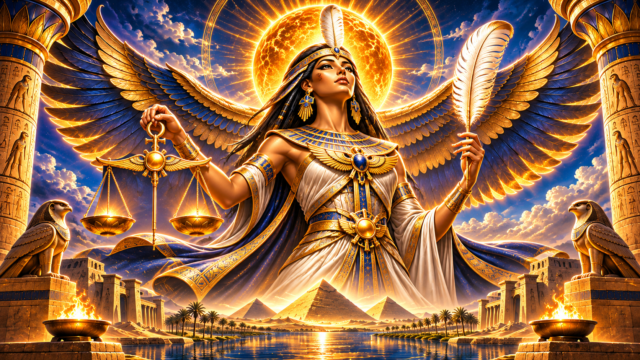
| Isis | Magic, motherhood, kingship | Throne headdress, winged arms |
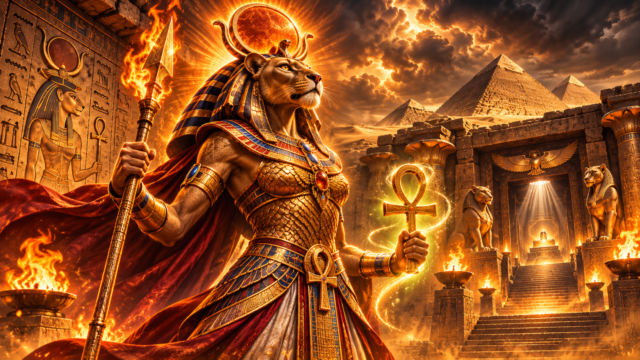
| Sekhmet | War, plague, healing | Lioness head |
Myth vs Fact: Common Claims About Hathor
| Claim | What the evidence shows |
|---|---|
| “Hathor is only a love goddess.” | She was also a sky goddess, a protector of the dead and a mistress of foreign lands. |
| “Hathor is the same as Isis.” | They merged in some periods but are distinct goddesses. |
| “Hathor is the same as Aphrodite.” | Greeks linked them, but Hathor’s roles are broader. |
| “The Narmer Palette shows Hathor for sure.” | Scholars debate whether the cow figure is Hathor or Bat. |
| “Hathor’s festivals were only parties.” | The revelry was part of ritual to calm the goddess and celebrate renewal. |
| “The Dendera zodiac is still at Dendera.” | The original is in the Louvre; a copy is on the temple roof. |
Frequently Asked Questions About Hathor
What is Hathor the goddess of?
Love, beauty, music, dance, joy and motherhood, as well as the sky and protection of the dead.
Why does Hathor have cow horns?
The cow stood for nourishment and motherhood, and the horns hold the sun disc, showing her link to the sky and sun.
Who is Hathor’s husband?
In older tradition, Horus the Elder; their yearly meeting is the Beautiful Meeting.
What is a sistrum?
A rattle used in rituals, linked to Hathor and Isis, meant to please and calm the goddess.
Where is the temple of Hathor?
Dendera in Upper Egypt, one of the best-preserved temples in the country.
What is the difference between Hathor and Sekhmet?
Hathor is the gentle goddess of love and music; Sekhmet is the fierce lioness, though both can be the Eye of Ra.
Who are the Seven Hathors?
Fate-goddesses who appeared at a child’s birth to announce its destiny.
What does “Mistress of Turquoise” mean?
A title from Sinai, where miners honoured her as patron of turquoise expeditions.
Is Hathor similar to Lakshmi or Parvati?
Readers compare goddesses of beauty, fertility and abundance, but the traditions are separate, and any similarity is thematic, not historical.
Is Hathor worshipped today?
The ancient cult ended; some modern groups honour her, which is a modern reconstruction.
Sources and Further Reading
Last updated: 25 November 2026.
- World History Encyclopedia, “Egyptian Mythology”: worldhistory.org
- Egypt Exploration Society, “Gods of Egypt”: ees.ac.uk
- The Metropolitan Museum of Art, “Divine Egypt”: metmuseum.org
















Share Your Opinion
Comments are closed on this post.