 Vista
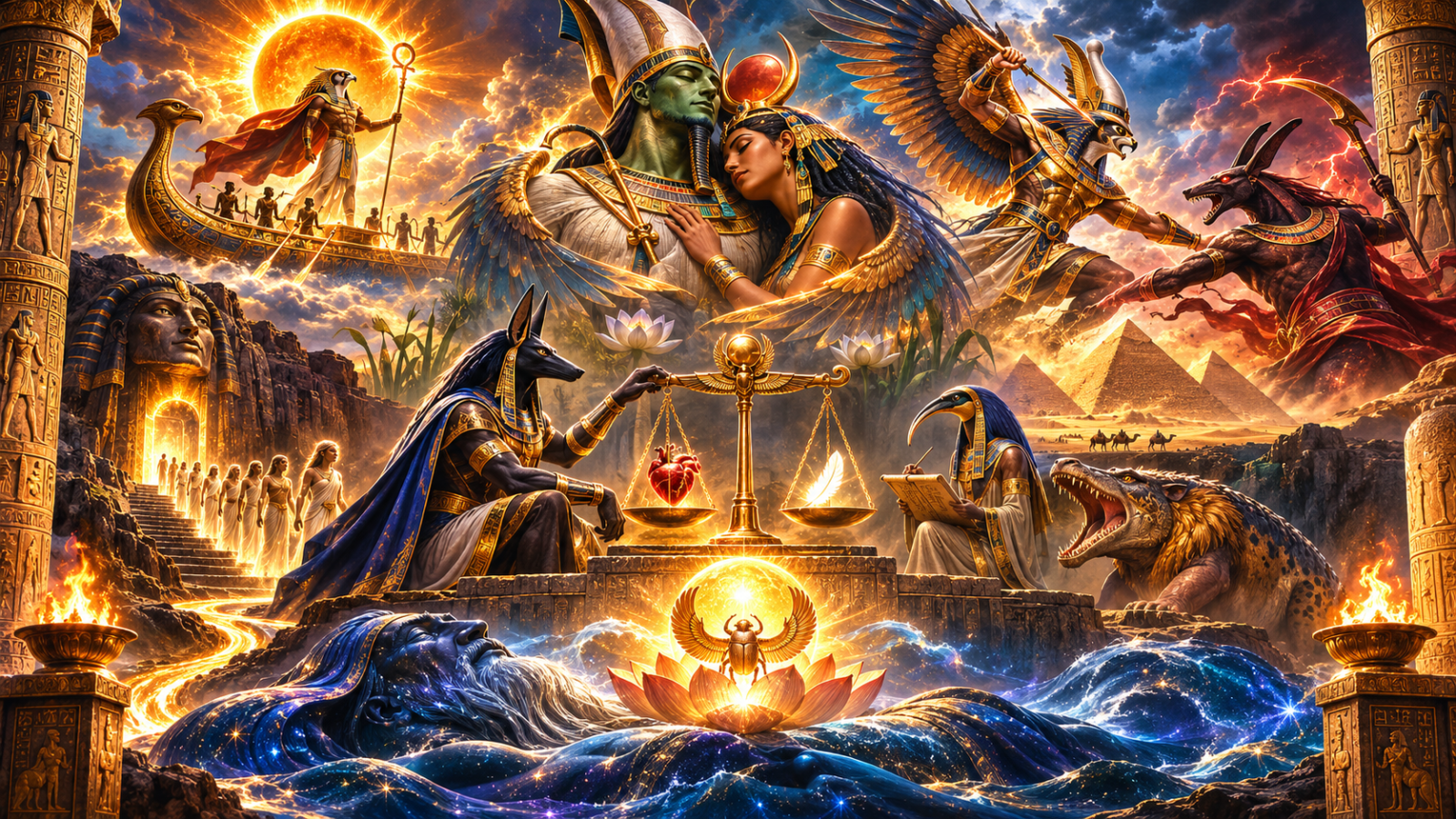
Egyptian mythology stories explore creation, the return of the sun, the rivalry of divine relatives, the protection of children and the hope of life after death. This collection of 15 famous Egyptian myths and legends includes major sacred narratives, individual mythological episodes and two remarkable ancient literary tales. Each retelling explains the meaning and identifies the kind of tradition it belongs to.
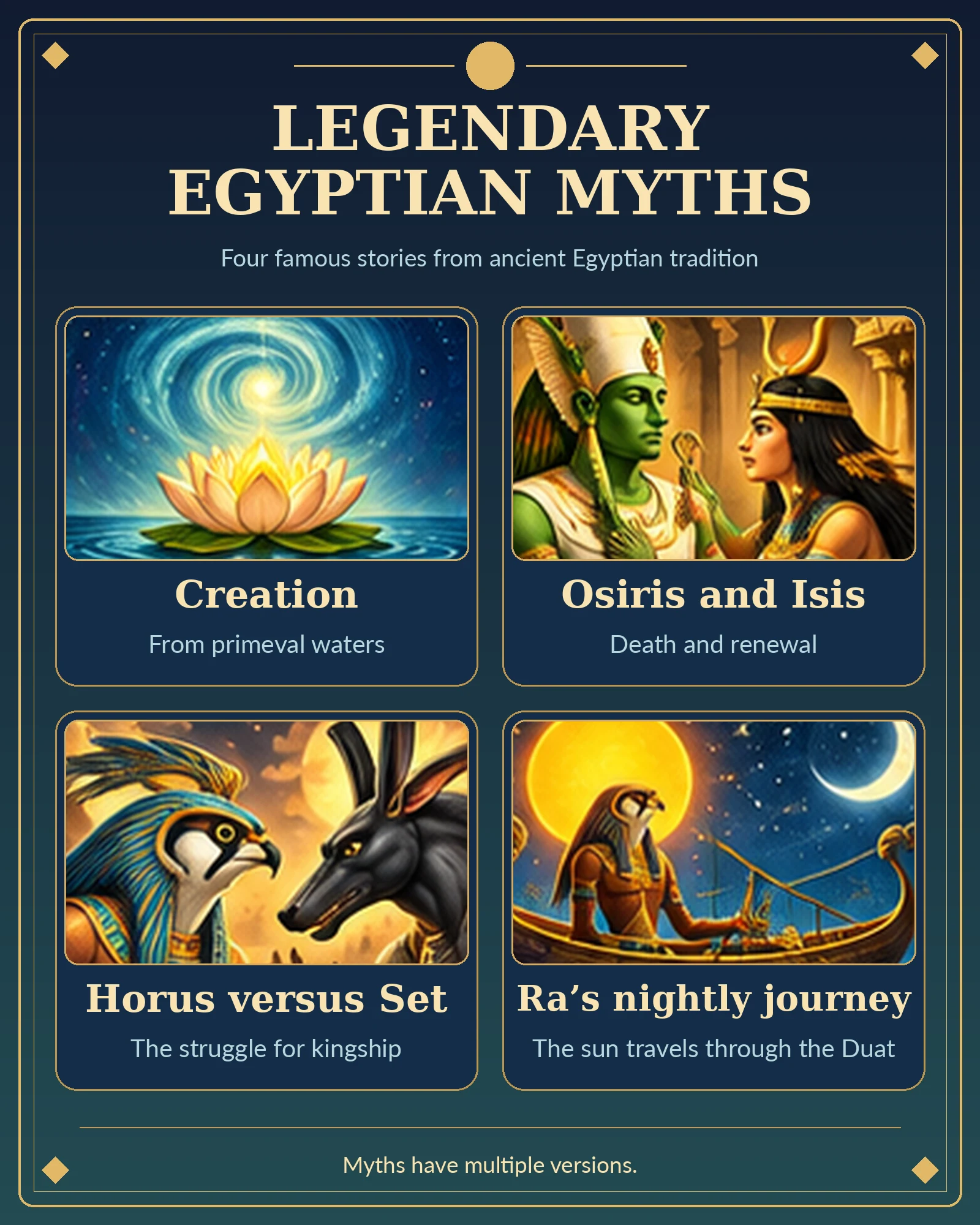
Ancient Egypt did not have one canonical mythology book. Many of its stories survive in separate religious compositions, temple and funerary imagery, and literary manuscripts. A later Greek-language retelling can contain details absent from older Egyptian sources. The following stories are therefore organized for learning, not presented as one exact chronological sequence. Some sections summarize creation or funerary motifs rather than complete narrative texts.
| Story | Theme |
|---|---|
| 1. Atum and the beginning of creation | Creation and order |
| 2. Shu separates the sky from the earth | Cosmic space |
| 3. Ptah creates through thought and speech | Creative intelligence |
| 4. Ra’s nightly voyage and the serpent Apep | Renewal and cooperation |
| 5. Osiris, Isis and the loss of a king | Loss and regeneration |
| 6. Horus and Set dispute the throne | Legitimate succession |
| 7. The restored Eye of Horus | Restoration and protection |
| 8. Isis learns the secret name of Ra | Knowledge and speech |
| 9. Isis and the healing of the child Horus | Childhood and protection |
| 10. The Heavenly Cow and the dangerous Eye of Ra | Force and restraint |
| 11. Khnum shapes life like a potter | Craftsmanship and creation |
| 12. The weighing of the heart and Ammit | Justice and the afterlife |
| 13. Khonsu and the princess of Bakhtan | Healing legend and devotion |
| 14. The Shipwrecked Sailor and the talking serpent | Survival and fortune |
| 15. The Tale of Two Brothers: Anubis and Bata | Trust and transformation |
Creation myths of ancient Egypt
1. Atum and the beginning of creation
In the Heliopolitan tradition, the world begins with the primordial waters of Nun. The creator Atum emerges and brings forth Shu and Tefnut, beginning the genealogy that leads to the earth, the sky and the divine family. Creation here is a movement from an undifferentiated condition toward a world of recognizable relationships.
The image of land emerging from water is especially meaningful in an agricultural society shaped by the Nile. It does not describe a laboratory experiment or a modern theory of the origin of matter. Instead, it provides a religious explanation of the arrival of order. Other Egyptian cities preserved other creation accounts, so this opening should be understood as a particular tradition rather than the first chapter of one universal Egyptian scripture.
Story theme: Creation and order.
2. Shu separates the sky from the earth
Geb and Nut represent the earth and sky in the familiar divine family. Ancient images can show Nut arching above the reclining earth god while Shu occupies the space between them. The image makes the inhabited world a consequence of a divine arrangement: there is room between the earth below and the heavens above.
Nut also has important associations with the movement of celestial bodies. Some representations describe the daily solar cycle through her body. Rather than treating these images as literal maps of the atmosphere, readers can think of them as different symbolic accounts of a cosmos whose parts are connected. A useful illustration would show the three figures and identify their roles without inventing scientific dimensions or planetary positions that the ancient scene never claims to measure.
Story theme: Cosmic space.
3. Ptah creates through thought and speech
The Memphite tradition associated with Ptah offers another way of imagining creation. Here the creative process can be understood through the heart and tongue: thought and its expression give form to the world. For a culture in which skilled artisans made sacred objects and scribes recorded meaningful words, this image provides an especially rich model of creativity.
Ptah’s story need not be inserted after Atum as though one creator had to finish the other’s work. It reflects a distinct religious framework. Modern readers can compare it with the Heliopolitan genealogy and notice the different emphasis: one account highlights the generations of a divine family, while the other highlights creative intelligence and articulation. Neither account establishes that spoken words alone can produce physical objects in the modern scientific sense.
Story theme: Creative intelligence.
Famous stories of Egyptian gods
4. Ra’s nightly voyage and the serpent Apep
At sunset, the sun disappears from the visible sky. In Egyptian solar religion, this familiar event becomes the beginning of a hazardous voyage. Ra travels through the hidden realm, encountering forces that could obstruct the world’s renewal. Apep, the great serpent, represents a recurring threat to the solar cycle.
Other gods may contribute to the defense of the solar vessel. Set’s participation in some protective scenes is especially striking because he is also an opponent in the Osiris cycle. The struggle is renewed rather than permanently ended by a single victory. Each dawn therefore marks the successful continuation of a cosmic process.
The Amduat and related funerary compositions supply important historical context for solar night journeys. Their images are not eyewitness reports of a boat under the earth. They express a sacred understanding of time, danger and renewal.
Story theme: Renewal and cooperation.
5. Osiris, Isis and the loss of a king
The Osiris cycle begins with a devastating rupture in the divine family. Set causes the death of Osiris, and Isis undertakes the work of seeking, protecting and restoring him. Nephthys is associated with mourning and funerary protection. The story leads toward Osiris’s authority in the realm of the dead and the continuation of his line through the child Horus.
It is important to recognize the nature of the evidence. Earlier Egyptian sources preserve episodes, allusions and ritual representations. Plutarch’s later account supplies many details familiar to modern readers, but its narrative should not be mistaken for a verbatim Old Kingdom text. The number of scattered body parts and the exact arrangement of events can differ.
The lasting significance of the story lies in the relationship between loss, protection, succession and renewed existence. Osiris does not simply return to an ordinary human life.
Story theme: Loss and regeneration.
6. Horus and Set dispute the throne
With Osiris gone from earthly kingship, Horus the child and Set become rival claimants to royal authority. The literary composition known as the Contendings of Horus and Seth presents the dispute through divine judgments, challenges and reversals. It is not merely a straightforward duel decided by who possesses the biggest weapon.
The narrative’s stakes are the succession of kingship and the restoration of a meaningful order. Modern readers may notice its unexpected humor, trickery and episodes that do not resemble a conventional heroic epic. Such features make it particularly valuable as ancient literature.
A short retelling should avoid combining every account of Horus and Set into one seamless sequence. There are several forms of Horus and many related mythological episodes. For a beginner, the central relationship is the claim of Osiris’s son to the kingship contested by Set.
Story theme: Legitimate succession.
7. The restored Eye of Horus
The injury and restoration of Horus’s eye form an important episode in the wider conflict traditions. The restored eye, often called the wedjat, becomes a visual expression of soundness and renewal. Thoth is associated with restoration in important accounts, although the particulars vary.
The image found on many amulets is not simply a record of a wound. Its religious usefulness comes from the idea that what has been damaged can be made whole again. This is why an object representing an eye can have funerary and protective significance.
The Eye of Ra should not automatically be treated as the same symbol with the same story. Solar Eye traditions involve other divine powers and narratives. When interpreting an ancient artifact, a museum’s documentation is more reliable than a universal rule based only on whether the eye faces left or right.
Story theme: Restoration and protection.
8. Isis learns the secret name of Ra
A magical narrative about Isis and Ra presents a striking contest between knowledge and divine authority. Isis arranges a crisis in which Ra needs relief, then seeks the hidden name that he has not willingly disclosed. The god’s ordinary public names are not enough for the purpose of the narrative; the concealed identity is what matters.
The story belongs to a tradition in which names and effective speech were religiously significant. Its point is not that Isis defeats Ra in a permanent war for the Egyptian throne. Rather, the story illustrates how specialized knowledge can become a form of power.
This narrative also circulated in a healing context. It should be approached as historical evidence of Egyptian ritual beliefs, not as a modern cure for snakebite or poisoning. Real bites require prompt medical assessment. The ancient story’s cultural significance remains valuable without treating a supernatural remedy as medical fact.
Story theme: Knowledge and speech.
9. Isis and the healing of the child Horus
A protective tradition centers on Horus as a vulnerable child. In a narrative associated with magical stelae, the young god suffers from a poisonous bite or sting, and divine intervention involving Isis and Thoth brings healing. This is quite different from Horus as the powerful royal falcon: the same broad divine identity can appear as a child requiring protection.
The Metropolitan Museum of Art preserves stelae showing Horus controlling dangerous animals. Their inscriptions and images document ancient concerns about snakes, scorpions and other threats. For households in the Nile valley, illness and injury were immediate concerns rather than distant mythological abstractions.
The story is a useful introduction to the relationship between religion, family life and ancient approaches to illness. It should never be interpreted as proof that modern poisoning can be treated by a ritual object. Its historical value is in what it reveals about ancient beliefs and protective practices.
Story theme: Childhood and protection.
10. The Heavenly Cow and the dangerous Eye of Ra
In the myth commonly known as the Heavenly Cow, humanity’s rebellion against the aging solar god leads to a dangerous divine response. The solar Eye is sent against human beings. The force becomes so destructive that its continuation would threaten the survival of humanity itself. The familiar story of the red-colored drink explains how the dangerous goddess is pacified.
The narrative does not end simply with a defeated enemy. It also concerns the reorganization of the cosmos and the changed relationship between gods and human beings. The Heavenly Cow appears in the myth’s wider explanation of cosmic arrangements.
Hathor and Sekhmet are associated with the solar Eye in related traditions, and the terminology of a specific translation should be respected. A reading focused on the limits of destructive power offers more insight than turning the goddess into a one-dimensional monster.
Story theme: Force and restraint.
11. Khnum shapes life like a potter
The ram-headed creator Khnum is associated with fashioning life through the familiar image of a potter shaping material on a wheel. This is a creation motif rather than a single universally fixed adventure story. It translates the mystery of human existence into the language of skilled craftsmanship.
Consider why the image is meaningful. A potter gives a recognizable form to material through purposeful action. The image of a creator working in this way helps convey the religious idea that life has an origin and an intentional form. Royal birth imagery can also use creation and craftsmanship to express the significance of the king.
Khnum’s cult was important in particular areas, including Elephantine. His presence beside other creator gods illustrates the diversity of Egyptian religious ideas. A story collection should identify this as a creative image and avoid inventing dialogue or a dramatic plot that is not preserved in its sources.
Story theme: Craftsmanship and creation.
Afterlife and healing legends
12. The weighing of the heart and Ammit
The judgment scene found in Egyptian funerary manuscripts presents an unforgettable image of moral accountability. The deceased appears before a balance, the heart is considered in relation to the feather of Ma’at, and divine figures attend the proceedings. Anubis may supervise the scales and Thoth may record the result. Ammit represents the terrifying possibility of failure.
This is better described as a funerary scene or ritual narrative than as a conventional short story with one named human hero. Its meaning extends beyond the fear of a monster. It expresses the importance of proper order, justification and hope for continued existence.
The Book of the Dead was a collection of funerary compositions rather than one fixed book identical in every copy. Museum papyri offer historical examples of the imagery. The physical balance in a modern illustration should not be presented as an instrument capable of measuring moral goodness in real life.
Story theme: Justice and the afterlife.
13. Khonsu and the princess of Bakhtan
The Bentresh Stela preserves a religious legend set in the reign of Ramesses II. A foreign princess suffers an affliction, and a divine image associated with Khonsu travels from Egypt to address the crisis. The story celebrates the reputation and effectiveness of the god beyond the immediate setting of his temple.
The artifact itself and the events it describes must be distinguished. The surviving monument is a later work using an earlier royal setting, not an independently confirmed medical report from the reign it portrays. Its value lies in the religious and political meaning of the legend.
A reader familiar with the fictional Khonshu in Moon Knight may find the historical tradition interesting because the ancient deity’s lunar and healing associations differ from modern superhero storytelling. The Bentresh legend is a reminder that modern entertainment is only one possible reinterpretation of an old divine name.
Story theme: Healing legend and devotion.
Ancient Egyptian folktales and literature
14. The Shipwrecked Sailor and the talking serpent
This Middle Kingdom literary tale follows a sailor who survives a disaster at sea and reaches an extraordinary island. There he meets a great speaking serpent. Rather than serving only as a frightening monster, the creature tells a story of its own losses and offers reassurance about the sailor’s future return.
The encounter changes the meaning of the island from a place of danger into a setting for reflection on fortune, loss and survival. The sailor eventually returns to the human world. The tale is a story within a story, making it an appealing introduction to the narrative techniques of ancient Egyptian literature.
Unlike the religious creation accounts, this is a literary tale containing marvelous events. It is not a report that a giant talking snake was discovered. The distinction lets readers enjoy the imaginative adventure while appreciating the extraordinary age and craft of the surviving Egyptian writing.
Story theme: Survival and fortune.
15. The Tale of Two Brothers: Anubis and Bata
The Tale of Two Brothers survives as an ancient Egyptian literary composition featuring brothers named Anubis and Bata. A false accusation breaks their relationship, setting Bata on a path of escape and remarkable transformations. Animals and divine intervention play roles in the unfolding story, and changes of bodily form become central to the narrative’s later developments.
The story is a useful example of the overlap between mythological names, folktale motifs and literary entertainment. It should not be confused with a universal account of the funerary god Anubis’s genealogy. The narrative uses recognizable religious and marvelous elements for its own purposes.
For readers looking for a moral story, themes of trust, accusation and consequences offer a starting point for discussion. Such a modern reading is an interpretation, not proof that all ancient audiences understood the story in exactly the same way.
Story theme: Trust and transformation.
How to read Egyptian mythology stories for beginners
Read the creation traditions first, then the solar journey and the Osiris cycle. The royal conflict makes more sense once the relationship between Osiris, Isis, Horus and Set is understood. The funerary narratives can then be read as a distinct group, rather than as events that necessarily happen after the royal conflict.
For a school project, select a short myth and make three notes: the characters, the main idea and the historical type of evidence. A chart of the family, the sun’s journey or the heart judgment can help explain complex relationships, but label it as an educational diagram. A modern illustration should never be mistaken for a photograph of an ancient event.
Readers looking for moral stories can discuss trust, knowledge, protection and restraint. These are modern interpretive themes, not a claim that every ancient text was composed as a children’s lesson. Some of the longer literary narratives contain mature themes, so age-appropriate versions should be selected for younger readers.
Frequently asked questions
What is the most famous Egyptian mythology story?
The story of Osiris, Isis, Horus and Set is among the best-known mythic cycles.
Who created the world in Egyptian mythology?
Atum and Ptah are central to different creation traditions; no single universal account applies to all Egypt.
Why does Ra fight Apep?
Apep represents a threat to the continuation of the solar journey.
What is the story behind the Eye of Horus?
It is associated with the injury and restoration of Horus’s eye and symbolizes wholeness.
Did ancient Egyptians have moral stories?
Yes, their literary traditions include teachings and stories that invite reflection on actions and consequences.
Is the Tale of Two Brothers a religious myth?
It is a literary tale with mythological and marvelous elements, rather than a universal religious genealogy.
Are Egyptian mythology stories real?
The sources and religious traditions are historically documented; supernatural events are matters of belief or literary narrative.
Which Egyptian myths are suitable for beginners?
Begin with creation, the solar voyage, the Osiris family and the judgment scene.
Is there one original Egyptian mythology book?
No. Religious and literary materials survive in many different sources.
Conclusion and sources
These fifteen stories show the diversity of Egyptian religious imagination and ancient literature. Their common themes are not proof of a single unified canon. Read each in its own historical and religious setting.
- UCL Digital Egypt — Creation
- UCL Digital Egypt — New Kingdom literature
- UCL Digital Egypt — Middle Egyptian literary summaries
- UCLA Encyclopedia of Egyptology — Myth of the Heavenly Cow
- Metropolitan Museum — Amduat papyrus of Henettawy
- Metropolitan Museum — Magical Stela
- Louvre — Stèle de Bakhtan
- Smarthistory — Egyptian deities
- Bentresh Stela — translation
- Metropolitan Museum — Khnum and sacred rams
- University of Michigan — Kelsey Museum, Death Dogs
Related guides: Egyptian Mythology: Ancient Gods, Creation Stories, Symbols and the Afterlife · Egyptian Mythology for Kids: Gods, Stories, Symbols and Fun Facts (Illustrated Learning Guide)



















Share Your Opinion
Comments are closed on this post.