 Vista

Egyptian mythology tells the sacred stories of ancient Egypt: the creation of the world, the powers of gods and goddesses, the nightly battle of the sun, the death and renewal of Osiris, and the journey of the deceased into the afterlife. This illustrated-encyclopedia guide introduces the major figures, their symbols and relationships, with historical context and clear distinctions between ancient beliefs and modern speculation.

What is Egyptian mythology?
Egyptian mythology is the collection of sacred stories, images and ideas through which the people of ancient Egypt understood the universe. It explains why the sun rises, how order emerges from chaos, what gives a king authority, why the Nile matters and how the dead might enter another form of existence. Its famous characters include the sun god Ra, the jackal-headed Anubis, the resurrected Osiris, the magical goddess Isis and the falcon-headed Horus. Yet the tradition is much broader than a list of powerful gods. It connects agriculture, astronomy, kingship, medicine, art, family life and funerary customs into an unusually rich religious worldview.
For a beginner, the most important principle is that Egyptian myths were not assembled into one authorized book with a single uninterrupted plot. A temple might celebrate the creator Atum, another the craftsman god Ptah and another the hidden god Amun. These traditions could coexist. Gods acquired new names, combined with one another and developed additional responsibilities over centuries. The contradictions that sometimes surprise modern readers are therefore part of the evidence rather than errors that need to be removed. This guide explains the major traditions, distinguishes their historical settings and gives readers a route through the stories without pretending that every ancient Egyptian agreed on every detail.
In modern English, mythology can sound like a synonym for fiction. In the historical study of religion it has a more specific purpose: it describes inherited narratives that organize a community’s understanding of sacred events and meaningful relationships. A historian need not decide whether a deity exists to study the documented worship of that deity. Similarly, an attractive illustration may help readers remember a story, but its visual beauty does not make it an archaeological artifact.
Ancient Egyptian mythology at a glance
The Nile valley supplied the setting for a religious tradition that lasted through many political changes. A simple timeline is useful because the objects surviving from different periods do not necessarily express the same emphasis. The Old Kingdom is particularly associated with the great pyramid complexes and royal Pyramid Texts. Middle Kingdom funerary literature includes the Coffin Texts. New Kingdom sources include illustrated funerary manuscripts and accounts of the solar journey through the night. Later temples and manuscripts continued to develop earlier ideas, including during the Ptolemaic and Roman periods.
A religious object could be simultaneously practical and symbolic. A protective amulet might be worn on the body, placed among mummy wrappings or dedicated in a sanctuary. A royal image could communicate political authority while presenting the king as an actor in cosmic order. A funerary scene might portray an ideal harvest, not necessarily an eyewitness account of ordinary farming. Understanding the intended audience and location of an object is often more informative than simply identifying a recognizable symbol on it.
The table below is a beginner’s orientation, not a universal hierarchy of ancient gods.
| Subject | Quick answer |
|---|---|
| Civilization | Ancient Egypt and its changing religious traditions |
| Major gods | Ra, Osiris, Isis, Horus, Anubis, Set and many others |
| Creation | Multiple traditions including Atum, Ptah and Amun |
| Afterlife | Preservation, judgment and renewed existence |
| Primary evidence | Inscriptions, ritual texts, artifacts and archaeological contexts |
| Key concept | Ma’at: proper order, truth and justice |
How did the Egyptian gods create the universe?
In a familiar Heliopolitan account, creation begins with Nun, the undifferentiated primordial waters. Atum emerges as a creator associated with the first land and produces Shu and Tefnut. Shu is linked to air and separation, while Tefnut is commonly linked to moisture. Their descendants Geb and Nut represent earth and sky. The next generation includes Osiris, Isis, Set and Nephthys. The nine divine figures are conventionally called the Ennead.
One striking image associated with this family presents Nut arching above Geb while Shu holds the sky apart from the earth. The relationship turns the visible landscape into a meaningful divine arrangement. The sky is not merely a background for a story; it is an active part of the living cosmos. The daily movement of the sun can likewise be imagined through Nut’s body. There are different ways of presenting the same cycle, depending on the surviving source.
The first mound is another useful image. In a landscape shaped by seasonal water, land appearing above water supplies a powerful analogy for the beginning of an organized world. The sacred mound should not be mistaken for a scientifically described geological event. It expresses the relationship between creation and the renewal that made human life possible.
Other Egyptian traditions emphasize different beginnings. In the Memphite tradition, Ptah creates through thought and utterance, giving creative intention a physical result. Hermopolitan traditions focus on eight primordial deities, the Ogdoad, associated with conditions preceding the organized world. Theban theology emphasizes Amun, whose hidden character could coexist with his solar association as Amun-Ra. These accounts are not stages of one universal story; they are alternative and sometimes overlapping frameworks. Reading them together reveals the creative richness of Egyptian religion.
Egyptian gods family tree: how the major deities are related
A family tree is one of the easiest ways to begin learning Egyptian mythology, provided that its limits are understood. In the Heliopolitan scheme, Atum stands at the beginning, followed by Shu and Tefnut, then Geb and Nut. Osiris and Isis form a couple, as do Set and Nephthys in many accounts. Horus the child is the son of Osiris and Isis. This scheme helps explain why the struggle over Osiris’s kingship becomes a dispute within a divine family rather than a battle between unrelated strangers.
Do not assume that every deity can be inserted into this particular chart. Anubis has different parentage traditions, including a later account connecting him to Osiris and Nephthys. Horus is also a name associated with several forms and traditions; Horus the Elder and Horus the child should not automatically be treated as one character with a single genealogy. Ra, Amun and Ptah can be described as creators without becoming a single person in every religious context.
Some local groups were organized differently. Amun, Mut and Khonsu form a famous Theban triad; Ptah, Sekhmet and Nefertum are associated in Memphis. The importance of these groups shows how local temples and worship helped shape relationships between divine figures. The safest approach is to ask which family or theological tradition a chart is showing before treating its connecting lines as definitive. A chart built for readers can acknowledge such differences instead of inventing missing relationships.
Atum → Shu and Tefnut → Geb and Nut → Osiris, Isis, Set and Nephthys. Osiris + Isis → Horus the child. Other traditions differ.
Ra: the sun god and the cycle of renewal
Ra, also written Re, is one of the most recognizable deities in ancient Egypt. His solar associations made him important to ideas of creation, kingship and continued existence. Artistic representations may show a human body with a falcon head and a solar disk, but Egyptian artists also represented solar divinities through other forms. The disk is particularly useful as a visual clue, though it is not sufficient on its own to identify every figure.
The daily solar cycle supplied a grand mythic pattern. In the morning the sun appears renewed; during the day it crosses the sky; at night it moves through a hidden realm. The nightly journey is dangerous because forces threatening the continuation of cosmic order must be overcome. Its successful completion makes sunrise a recurring victory rather than an event that can be taken entirely for granted within the religious imagination.
Apep, or Apophis, is the great serpent opponent in this cycle. Ra is not always pictured as fighting alone. Other protective figures may participate, and Set can appear defending the solar barque despite his antagonistic role in the Osiris story. This surprising relationship is a useful warning against sorting the Egyptian gods into fixed modern teams of heroes and villains.
Ra’s importance also did not prevent the worship of other creator figures. The combined name Amun-Ra illustrates a religious language in which powers and identities could be related without necessarily eliminating the individual traditions behind them.
Osiris, Isis and Set: the story of a lost king
The story of Osiris and Isis is central to Egyptian ideas of death, renewal and legitimate succession. Osiris is a divine ruler whose brother Set brings about his death. Isis mourns him and undertakes a search and restoration that allow the line of succession to continue. Nephthys is commonly associated with the mourning and protection surrounding the deceased god. In Egyptian funerary art, the two goddesses may appear in positions that express their protective roles.
The story is not preserved in one complete, universally authoritative Egyptian narrative. Its episodes appear in ritual texts, images and references from different periods. A later extended account by the Greek author Plutarch contains familiar dramatic details, but should not be casually projected onto every earlier Egyptian source. An account of the myth can therefore explain its essential relationships without claiming that a particular number of scattered body parts or a particular sequence of episodes is true of every telling.
Osiris does not simply resume the life of an ordinary king. He comes to represent the domain of the dead and the hope of renewed existence. His mummy-like form and royal attributes make death and kingship visible together. His association with fertility and vegetation also makes renewal meaningful in the world of the living.
Isis is much more than the grieving wife in this narrative. Her persistence, protection and magical capacity make her important to motherhood and healing as well as funerary religion. Her cult spread far beyond Egypt in later antiquity, acquiring new audiences and forms. That historical development is distinct from the ancient story itself, even though the two help explain why Isis became such an enduring figure.
Story box: The king is lost; Isis seeks and protects him; Osiris becomes associated with the realm of the dead; Horus continues the claim to kingship. Individual episodes vary among ancient sources.
Horus vs Set: a battle over kingship
After Osiris’s death, Horus becomes a central figure in the contest for legitimate rule. His conflict with Set brings questions of succession, family obligation and political order into the divine world. In the New Kingdom literary account commonly called the Contendings of Horus and Seth, the dispute includes judgments, contests and reversals, not merely a single fight.
The injury and restoration of Horus’s eye became especially meaningful. The restored eye can symbolize wholeness and recovery, which helps explain its appearance on protective amulets and funerary objects. It does not follow that wearing a modern eye pendant guarantees physical healing or protection; the evidence concerns the object’s ancient symbolic and ritual significance.
Horus also represents the living king in important royal traditions, while Osiris provides a model of deceased kingship. These relationships connect mythical succession with political continuity. Egyptian rulers could claim divine associations through their titles and ceremonial roles without every depiction amounting to the assertion that the ruler had the same nature as every deity.
Set’s role is deliberately more complicated than the label evil god suggests. His association with storms, deserts, disruptive force and the Osiris conflict does not exhaust his significance. The contrast with his protective role in solar religion makes him an especially interesting figure for readers interested in moral ambiguity within myth.
Anubis and the protection of the dead
Anubis is closely associated with funerary rites, embalming and the protection of the deceased. His canine form makes him immediately recognizable to many modern readers. Jackals and related canids belong to the natural environment of Egypt, but an image with a canine head is not simply a zoological portrait. The animal features communicate the identity and religious character of the god.
Anubis is frequently presented with dark or black coloring. The symbolism is commonly connected to burial, fertile earth and regeneration rather than an implication that the deity is morally evil. Readers should avoid transferring modern fantasy conventions about black clothing or sinister monsters onto Egyptian funerary art.
In scenes of judgment, Anubis may attend or supervise the balance. Osiris presides over the realm of the dead, while Thoth can record the result. Their responsibilities overlap within a ritual system but are not identical. Thus the popular search question about whether Anubis or Osiris is the Egyptian god of death has a more useful answer than simply picking one: both are associated with death, in different ways.
In stories of the treatment of Osiris’s body, Anubis’s role supplies a divine model for practices associated with embalming. Such narratives help explain why the procedures mattered to ancient Egyptians. They are not medical records documenting the historical invention of preservation techniques by an actual individual.
Bastet, Sekhmet, Hathor and other powerful Egyptian goddesses
Bastet and Sekhmet demonstrate how a shared animal association does not require identical divine roles. Bastet is often represented in feline form and associated with protection. Sekhmet’s lioness features communicate dangerous power, destruction and protection, with healing also belonging to her complex religious identity. In stories of the solar Eye’s destructive force, the danger it poses to humanity can be a major theme.
Hathor is associated with music, joy, motherhood, love and the sky, among other aspects. Her cow horns and solar disk are familiar visual attributes. Isis likewise appears with many roles and can share visual conventions with other goddesses. Consequently, an Egyptian goddess wearing a horned crown should not be automatically labeled Isis or Hathor without examining the inscription, setting and other attributes.
Ma’at represents truth, justice and proper order. Her feather appears in funerary scenes where the deceased faces judgment. Nut embodies the sky in important creation and solar traditions. Taweret’s distinctive composite form is associated with protection, particularly around childbirth. Together these figures demonstrate that Egyptian goddesses were not limited to marriage or domestic life. Their activities encompass the universe, political order, dangerous force and the protection of vulnerable people.
When a reader asks which goddess was the strongest, a historically useful comparison is to identify the domains in which each was especially significant rather than assigning fictional combat scores. The importance of divine power depended on the religious context.
Egyptian gods, powers and identifying symbols
The following reference groups major deities by common associations and visual clues. These are learning aids, not exclusive definitions. A god can be depicted in several forms, and the same symbol may appear on different figures. A museum label or inscription is more reliable than a guess based on costume alone. The names use familiar English spellings; alternative forms such as Re, Seth, Djehuty and Ausar may appear in different publications.
To make a comparison useful, distinguish a deity’s role from an attribute. A solar disk is an attribute, while renewing cosmic life is a role. A jackal head is an attribute, while overseeing funerary protection is a role. Confusing these categories makes it difficult to understand why different gods may share symbols. The table is designed as a starting point for deeper individual studies.
| Deity | Major association | Common visual clue |
|---|---|---|
| Ra | Sun, creation, renewal | Solar disk and falcon |
| Anubis | Embalming and funerary protection | Dark canine head |
| Osiris | Afterlife, renewal, deceased kingship | Mummy form, royal crown |
| Isis | Magic, healing, motherhood | Throne sign or horned crown |
| Horus | Sky and kingship | Falcon |
| Set | Storms, desert, disruptive power | Distinctive Set animal |
| Thoth | Writing, knowledge, measurement | Ibis or baboon |
| Bastet | Protection and feline associations | Cat or feline head |
| Sekhmet | War, danger and healing | Lioness head |
| Hathor | Joy, music and motherhood | Cow horns and sun disk |
| Ma’at | Truth and order | Feather |
| Khonsu | Moon | Lunar disk |
| Sobek | Crocodile and water | Crocodile head |
| Ptah | Creation and craftsmanship | Close-fitting cap |
| Nut | Sky | Star-covered body |
What happens after death in Egyptian mythology?
Ancient Egyptian funerary belief contains a powerful hope that death is not the final destruction of the individual. Continued existence involves preservation, protection, ritual assistance and moral accountability. Funerary goods often reflect the wish that meaningful elements of earthly life might continue. The emphasis is therefore not simply a fascination with death, but also a desire to maintain life, identity and relationships.
The Duat is an otherworldly realm described in varied traditions, particularly through the imagery of the solar night journey and the passage of the dead. Illustrated funerary texts can present gates, divine figures, dangerous beings and changing regions. There is no single modern geographical map that can reproduce every description. A responsible educational diagram should identify the tradition or text it illustrates.
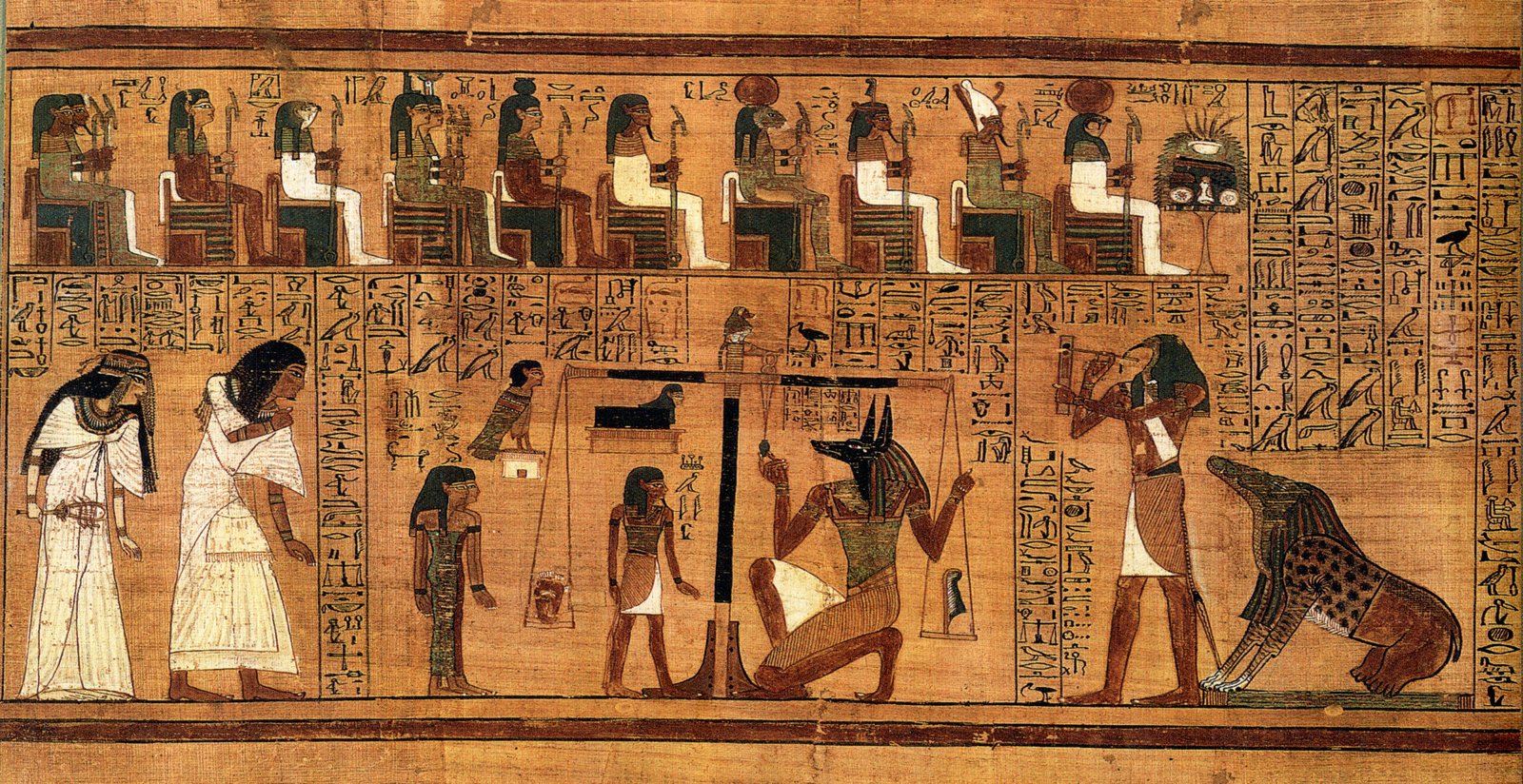
The weighing of the heart is one of the most familiar scenes of Egyptian funerary religion. The heart is assessed in relation to the feather associated with Ma’at. Anubis is often shown attending the balance, Thoth recording the outcome and the composite being Ammit waiting nearby. A successful judgment is associated with justified existence. Failure threatens the deceased’s hoped-for continuation.
Aaru, or the Field of Reeds, represents an idealized continuation of a familiar landscape in important funerary traditions. Its fields, water and agricultural activities reflect the value of an ordered, fertile world. It is better understood within Egyptian religious ideas than treated as a simple equivalent of every other culture’s heaven. Similar hopes for life beyond death do not erase the distinctive beliefs of the traditions being compared.
The ancient Egyptian understanding of the person also involves aspects commonly called ka, ba and akh. These terms resist exact one-word English equivalents. The ka is often associated with sustaining life and offerings, the ba with an aspect capable of mobility, and the akh with a transformed or effective existence. Different contexts complicate those summaries. Presenting the three as interchangeable words for soul hides important differences.
Why did ancient Egyptians make mummies?
The preservation of bodies is strongly connected with Egyptian ideas about the continued existence of the deceased. Embalming methods developed over time, varied with resources and changed according to period and burial practice. The bodies seen in museums do not all represent the same procedure. Some were naturally preserved by dry conditions, while others underwent elaborate treatment.
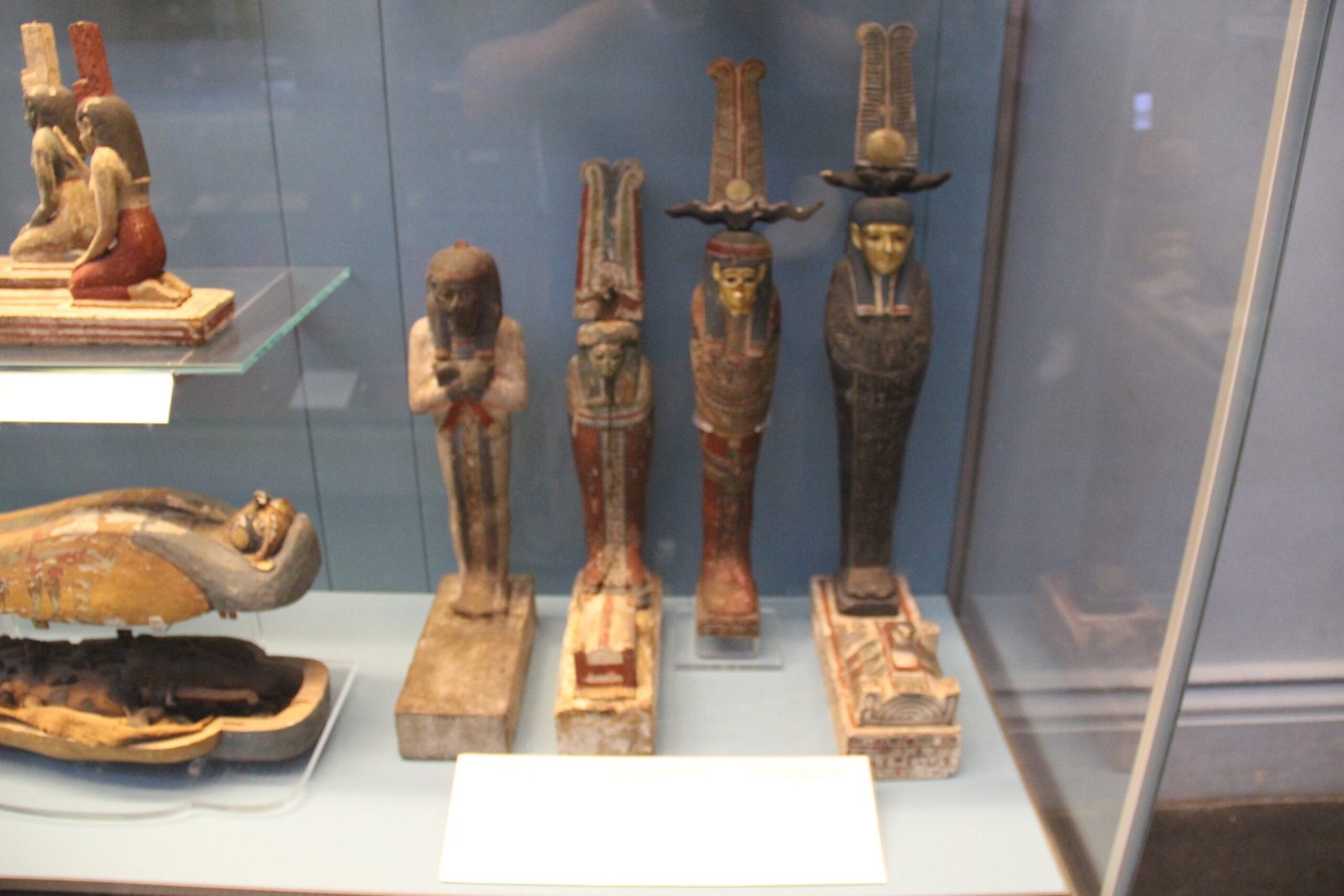
Natron, a naturally occurring mixture of salts, helped remove moisture in many embalming traditions. Treatment of the internal organs, the use of linen and the provision of protective materials varied. Canopic jars and the four sons of Horus are famous components of funerary protection, but their physical use and form changed through Egyptian history. The religious goal was distinct from the objectives of modern medical preservation.
A mummy is a preserved body, not a sleeping supernatural creature waiting to awaken. Modern research can reveal information about diet, disease, age, preservation materials and sometimes biological relationships. It does not establish that ancient magical words can reverse death. Likewise, a museum display of human remains raises ethical questions about consent, dignity and the appropriate treatment of the deceased.
When examining a photograph, an image of a person wrapped in linen may be modern artwork, a film prop or a genuine archaeological object. Provenance and collection information matter. Unverified online photographs are not reliable evidence for a specific pharaoh’s identity.
The Book of the Dead and the ancient funerary texts
The Egyptian Book of the Dead is not a single ancient book with the same contents in every copy. It is a modern name for a collection of funerary compositions that could be selected and arranged for individual owners. It is also known through the idea of going forth by day, a title that better communicates the hope of continued freedom and existence.
The earlier Pyramid Texts and Coffin Texts belong to related but distinct bodies of funerary literature. The Pyramid Texts are known especially from inscriptions in royal pyramids, while the Coffin Texts are associated with a wider range of funerary settings. Later illustrated manuscripts make some religious scenes particularly accessible to modern museum visitors.
The Papyrus of Ani and the Papyrus of Hunefer are familiar examples in the study of the Book of the Dead. Their illustrations help readers understand how writing and image worked together. A figure accompanied by a label, a ritual formula and a sequence of divine characters is not merely a decorative picture.
Modern readers sometimes ask whether the book is dangerous to read. Studying translations and museum images is an ordinary educational activity. There is no scientific basis for the claim that reading a funerary manuscript releases a supernatural curse. Its words should nonetheless be treated respectfully as evidence of a historical religious tradition rather than repackaged as an authentic modern guarantee of magical power.
Ancient Egyptian symbols and their meanings
The ankh, the restored eye of Horus, the scarab and the djed pillar are among the most familiar Egyptian symbols. The ankh commonly expresses life and can be seen in scenes of deities offering life to the king. The eye of Horus is linked to restoration and protection. The scarab evokes renewal and solar associations, while the djed pillar is associated with stability and Osiris. The was scepter communicates authority in many divine and royal representations.
The Eye of Ra is not simply another name for every Eye of Horus amulet. Solar Eye traditions can express active and potentially destructive divine power, whereas the restored eye of Horus is especially associated with healing and wholeness. Their iconography and associations can overlap, so a rule about right versus left eyes is not adequate for interpreting every surviving object.
Other symbols need equal care. The cobra on royal headdresses is connected to protection and royal power. The tyet or Isis knot has protective funerary associations. Lotus or water-lily imagery can communicate creation and renewal. Egyptian signs can also function as writing, where an attractive form may have a sound value or a grammatical function rather than representing a mysterious hidden message.
Today these motifs appear in jewelry, tattoos, wallpapers and spiritual art. Modern meanings can be personally important without being identical to ancient meanings. A clear article or gallery should distinguish historical interpretation, documented use and contemporary design.
Why do Egyptian gods have animal heads?
Animal-headed figures are often the first images people recognize as Egyptian. Anubis’s canine head, Horus’s falcon head, Thoth’s ibis associations and Sobek’s crocodile form make divine identities memorable. Yet Egyptian deities were also represented as entirely human, entirely animal and in other combined shapes. The variety of representations is evidence of an adaptable religious and artistic system.
A falcon soaring above the landscape can suggest the sky and watchfulness; a lioness can express dangerous strength. Such associations provide useful starting points, but each god’s complete history involves more than the natural behavior of the animal. The representation of a deity does not prove that ancient people encountered a biological human-animal hybrid.
This distinction also matters when comparing Egyptian and Hindu religious images. Ganesha’s elephant head and Anubis’s canine form demonstrate that several religious traditions use composite visual language, but the two figures belong to different histories and narratives. Visual resemblance alone is not evidence of shared origin.
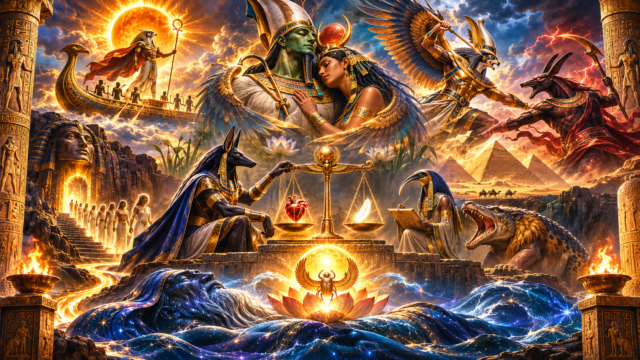
An artwork created today can help illustrate a deity’s appearance, but a costume or fantasy weapon invented by the artist should not be presented as authentic ancient evidence. Whenever possible, compare modern art with dated ancient objects and their catalog descriptions.
Pyramids, temples and the power of myth
Egyptian monuments provide material context for these ideas. Pyramids formed part of larger royal funerary complexes. Their arrangement, inscriptions and surrounding buildings can reflect the relationship between kingship, burial and cosmic order. Temples served as sacred spaces where ritual attention could sustain relationships between the gods, the king and the wider community.
Not every Egyptian structure is a pyramid, not every pyramid contains the same layout, and not every chamber has a known ritual purpose. A useful reading of architecture begins by distinguishing observable features from their interpretation. Archaeologists study stonework, quarrying, tools, inscriptions, surrounding settlements and other material evidence. The existence of unanswered engineering questions does not by itself support an extraterrestrial explanation.
The Great Sphinx at Giza likewise belongs to a particular historical and architectural setting. Claims about an entire hidden civilization or a portal beneath it require evidence beyond speculative digital pictures. Legends surrounding the monument can be interesting subjects of cultural history without being accepted as established discoveries.
For more context on construction, the Giza plateau and common misconceptions, see Vista Hub’s existing Egyptian pyramid mysteries guide. A focused pyramid article and a mythology overview serve related but different purposes.
Egyptian mythology vs Hindu, Greek and Norse mythology
Comparisons can make unfamiliar stories easier to approach. Ancient Egyptian and Hindu traditions both include solar deities, divine animal imagery, ideas about cosmic order and important river landscapes. Egyptian and Greek traditions contain sacred stories about the dead, divine families and competing claims to authority. Norse myths also explore threats to the continuity of the cosmos, divine knowledge and conflict.
The value of comparison lies in identifying both similarities and differences. Ra and Surya are associated with the sun, but their narratives and ritual histories are not interchangeable. Anubis and Yama are both relevant to discussions of death, yet Anubis’s funerary role differs from Yama’s place in Hindu and related traditions. Ma’at and dharma can be discussed as meaningful concepts of order without declaring that they are the same concept.
There is also a difference between a thematic parallel and a documented historical connection. Similar-looking names or objects are insufficient to prove that two deities originated from one another. Historical contact requires material, textual and chronological evidence. The existence of later trade between India and Egypt does not establish that all earlier religious systems shared a single origin.
Readers familiar with the stories of Zeus, Odin or Vishnu may use those traditions as a learning bridge. The goal is not to stage a fictional power contest between cultures, but to understand why each tradition develops its own accounts of life, authority, nature and death.
Is Egyptian mythology real? Ancient evidence versus modern theories
This question has several meanings. The civilization, temples, inscriptions, artifacts and historical religious practices are real subjects of archaeological investigation. The existence of a particular temple dedicated to a deity can be established through evidence. Whether a supernatural event narrated in a sacred story occurred is a different question, not something an artistic scene alone can settle.
Modern conspiracy claims about ancient aliens, mysterious electrical devices or buried technological civilizations often move from an unusual image to an extraordinary conclusion without establishing the intervening steps. Reliable interpretation considers the original inscription, archaeological context, physical materials and relevant comparisons. An edited photograph or an unsupported caption is not equivalent to a documented discovery.
The same method applies to alleged curses. An unexplained death in a retelling is not proof that a burial ritual caused it. To establish causation, evidence would need to connect the proposed cause and outcome while accounting for ordinary explanations. A compelling story and a defensible conclusion are not the same thing.
Modern fantasy films, games and comics create their own versions of Egyptian gods. They are entertainment works, not translations of ancient temple texts. A reader can enjoy a dramatic Anubis or Khonshu design while recognizing the difference between a fictional universe and historical religious evidence.
How to read Egyptian mythology as a beginner
Start with a small group of familiar figures rather than memorizing hundreds of names. Learn the basic solar journey of Ra and the family conflict of Osiris, Isis, Horus and Set. Next examine how funerary belief connects Anubis, Thoth, Ma’at and Ammit. Then learn the major creation traditions and compare them without forcing them into a single chronological narrative.
A useful second step is to examine one ancient object at a time. Look at its date, material, findspot, inscription and catalog description. Ask whether the figure is part of a temple scene, an amulet, a coffin or a funerary manuscript. The purpose of the object can explain why a deity is depicted in a particular way.
Keep an informal glossary of variant spellings. Ra and Re, Set and Seth, Apep and Apophis, Khonsu and Khons, and Ma’at and Maat may appear in different books. A search engine may return results for several spellings, but the reader should still check whether the names refer to the same figure or to distinct forms.
Finally, remember that every simplified family tree, map and chart is a teaching device. It should state what evidence it summarizes. Where the ancient sources differ, an honest note about uncertainty adds value rather than weakening the story.
Egyptian mythology FAQs
Who is the most powerful Egyptian god?
There is no universal power ranking. Ra and Amun-Ra were especially prominent in different contexts; Ptah and other deities could have central creative roles in local traditions.
Who is the Egyptian god of death?
Osiris rules the dead and represents renewed existence, while Anubis is associated especially with embalming and funerary protection.
Who was the first Egyptian god?
Atum is the originating deity in one important creation account. Other traditions center Ptah, Amun or primordial divine groups.
Are Ra and Horus the same god?
They are distinct but sometimes connected in solar and royal traditions, including combined forms such as Ra-Horakhty.
Why was Set sometimes a protector?
Set could defend the solar barque against Apep even though other stories portray him as the opponent of Osiris and Horus.
What does an ankh mean?
It is an ancient sign commonly associated with life. Modern jewelry meanings should be distinguished from historical usage.
Is the Egyptian Book of the Dead a magic book?
It contains historical funerary compositions and ritual expressions. It is not a modern instruction manual that guarantees supernatural results.
Do Egyptian gods still have worshippers?
Modern Kemetic religious communities draw on ancient Egyptian religion. Their practices should not be assumed to reproduce every ancient ritual exactly.
Did aliens build the pyramids?
The archaeological record supports construction by ancient humans. Questions about particular techniques are not evidence of alien builders.
Can a mummy return to life?
No scientific evidence supports reviving a long-dead mummified person through a spell or ritual.
Is Egyptian mythology the same as Hindu mythology?
No. There are meaningful parallels in imagery and themes, but these traditions have their own histories, concepts and narratives.
What should I read first?
Start with the solar cycle, the Osiris and Horus stories and the afterlife traditions, then explore creation myths and individual deities.
Sources and further reading
- Australian Museum — Religion and gods in ancient Egypt
- Australian Museum — The underworld and afterlife
- Smarthistory — Egyptian deities
- Smarthistory — Religious life and afterlife
- Harvard Digital Giza — Frequently asked questions
- Auckland Museum — Chaos and Order
Conclusion
Egyptian mythology offers a window into a civilization that explored cosmic order, nature, family relationships and mortality through sacred narratives and objects. Its gods are best understood through their particular traditions, rather than a universal ranking or a modern fantasy storyline. The most rewarding way to explore the subject is to read the stories alongside the archaeological objects that preserve them and to distinguish mythic meaning from documented history. Continue with our forthcoming guides to individual Egyptian gods, their family relationships, symbols and funerary traditions.
Updated 25 November 2026. Historical and religious education; descriptions of supernatural events refer to ancient beliefs.

















Share Your Opinion
Comments are closed on this post.