 Vista
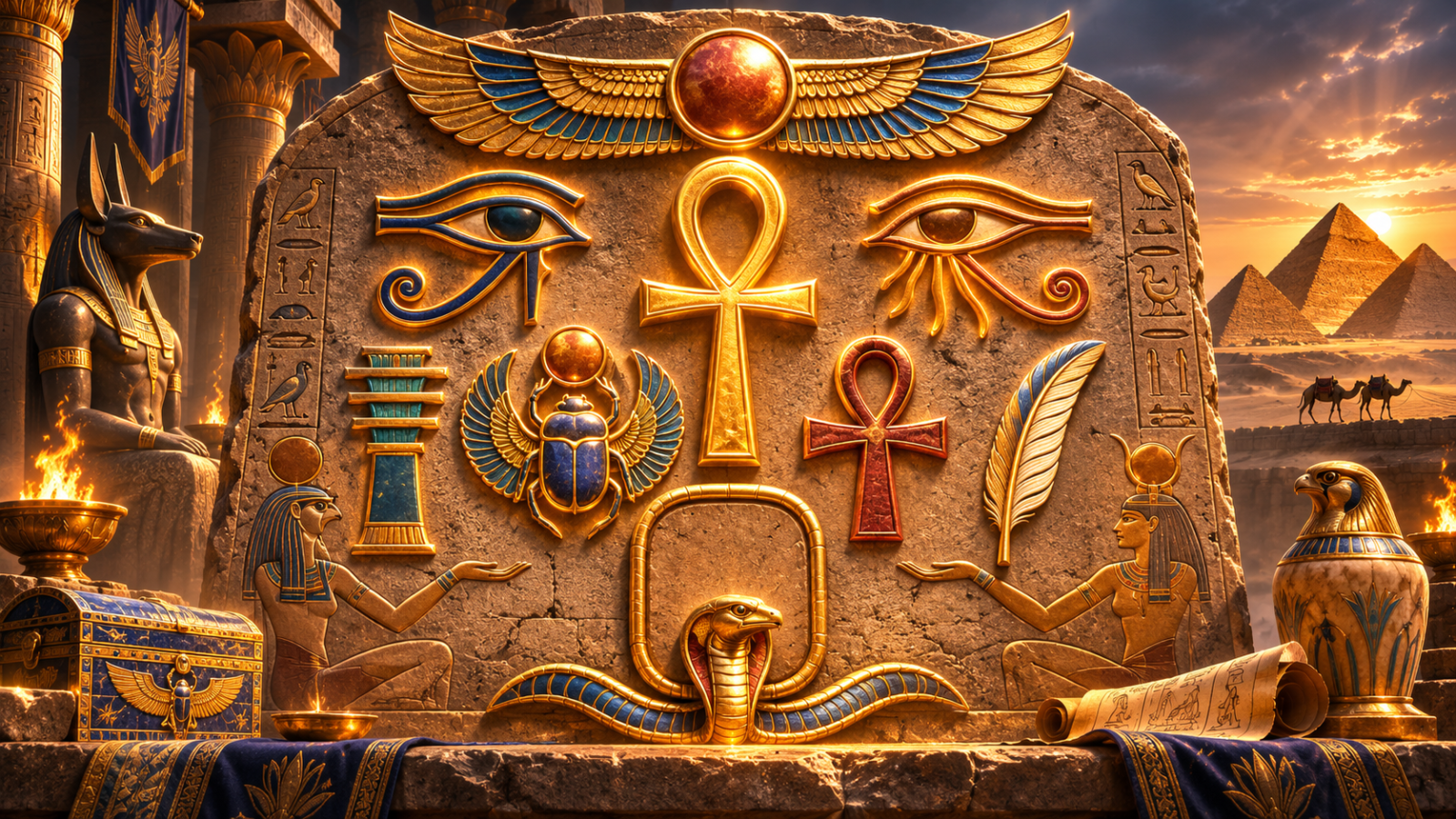
Ancient Egyptian symbols communicate ideas about life, renewal, divine protection, royal authority and the afterlife. The ankh signifies life; the restored Eye of Horus is associated with wholeness; the scarab evokes renewal; and the djed represents stability. These familiar signs form part of a rich visual and religious language rather than a universal collection of supernatural powers.

This reference covers fifteen symbols or closely related groups. It explains how to recognize them, what their historical meanings were and which interpretations require caution. The visual gallery will accompany the text after historical images and educational illustrations are selected. A museum artifact, an artistic reconstruction and a modern tattoo design should be identified separately.
Egyptian civilization developed across thousands of years. Symbols could acquire different associations, appear together and function as writing as well as imagery. The table offers a quick orientation, not a dictionary that can decode every ancient scene without context.
Ancient Egyptian symbols chart: names, shapes and meanings
| Symbol | Identification and historical association |
|---|---|
| 1. Ankh | Looped cross; life |
| 2. Eye of Horus (Wedjat) | Stylized eye with markings; restoration |
| 3. Eye of Ra | Solar agency; protective and dangerous force |
| 4. Scarab and Khepri | Beetle; becoming, solar renewal |
| 5. Heart scarab | Funerary beetle amulet; judgment |
| 6. Djed pillar | Pillar with horizontal bars; stability |
| 7. Was scepter | Long staff with animal-like top and forked base; authority |
| 8. Tyet (Knot of Isis) | Looped knot with hanging arms; protection |
| 9. Shen ring | Closed rope loop; encircling protection |
| 10. Cartouche | Elongated name enclosure |
| 11. Uraeus and royal cobra | Rearing cobra; royal protection |
| 12. Feather of Ma’at | Ostrich feather; truth and order |
| 13. Lotus and papyrus | Water plants; renewal and the two lands |
| 14. Winged sun disk | Solar disk between wings; divine and royal protection |
| 15. Ouroboros | Serpent with tail in mouth; enclosing imagery |
Egyptian symbols of life, healing and rebirth
1. Ankh
Identification and meaning: Looped cross; life.
The ankh is among the most recognizable ancient Egyptian signs. It has a loop above a crossbar and a descending stem. As a hieroglyph it expresses life or living, and its use in religious art connects that idea to the continuing well-being of the king or deceased. In temple scenes a deity may extend an ankh toward a ruler. The gesture expresses a religious relationship rather than a mechanical transfer of energy.
The original physical object that inspired the shape is debated. A sandal strap is one proposed explanation, but the interpretation of its shape should not be confused with its well-established linguistic meaning. Modern pendants often use the ankh as a personal emblem of life or African heritage. Those meanings can be valuable without being identical to every historical use. The Met’s combined ankh, djed and was object provides a particularly helpful example of how several signs could express complementary wishes.
2. Eye of Horus (Wedjat)
Identification and meaning: Stylized eye with markings; restoration.
The wedjat represents the restored eye of Horus. The broader mythic tradition includes the injury suffered during the conflict with Set and the recovery of the eye. Its image translates an episode of damage and recovery into a compact expression of restored well-being. The Metropolitan Museum documents numerous examples of eye amulets from different periods.
The sign usually includes an eyebrow, an eye outline and characteristic markings beneath it. It can be depicted in different orientations and materials. Some amulets carry additional signs on their reverse, making the meaning of the entire object richer than the eye considered alone. A documented archaeological find can also show where an amulet was placed on the deceased.
People often search for the Eye of Horus as a protection symbol. That is a useful description of its ancient intended role, provided it is not treated as a guarantee that wearing jewelry prevents illness or accidents. A separate detailed comparison with the Eye of Ra is useful because the two concepts are related but not identical.
3. Eye of Ra
Identification and meaning: Solar agency; protective and dangerous force.
The Eye of Ra is closely related to the active power of the solar god. In Egyptian mythological traditions this power may be personified by goddesses, including Hathor and Sekhmet in relevant accounts. The dangerous solar Eye can threaten humanity, while its protective aspect can also safeguard divine order. The story commonly associated with the Heavenly Cow provides a memorable example of how solar force and its restraint become religious themes.
Modern diagrams often identify every right-facing eye as the Eye of Ra and every left-facing eye as the Eye of Horus. Such a simplified rule may help a designer distinguish two modern icons, but it is not sufficient to identify every archaeological object. The names, inscriptions and surrounding figures provide stronger evidence. Solar and restored-eye traditions could intersect.
Readers should also avoid equating the Egyptian Eye with every modern all-seeing-eye image. A visual resemblance does not automatically establish a historical link to a secret society or contemporary political organization.
4. Scarab and Khepri
Identification and meaning: Beetle; becoming, solar renewal.
The scarab draws upon the recognizable form of a beetle. The deity Khepri is associated with the emerging sun and the religious idea of becoming. A small beetle-shaped artifact can therefore communicate renewal rather than serving merely as an animal ornament. Egyptian scarabs were made in diverse sizes and materials and could have several functions.
Some examples carry names or signs on their flat undersides and were used as seal-amulets. The Met has a Middle Kingdom scarab combining the eye, ankh and djed signs. Such combinations show why it is useful to examine an object’s base as well as its carved back. A photograph showing only the beetle may conceal the inscription that makes the object historically informative.
The heart scarab belongs to a more specific funerary practice. It should not be confused with every small decorative scarab sold today. The beetle’s biological habits can help explain the ancient analogy, but the religious connection is not a modern scientific claim about human resurrection.
5. Heart scarab
Identification and meaning: Funerary beetle amulet; judgment.
A heart scarab is an excellent example of how shape, inscription and placement can work together. In the funerary tradition, the heart was central to the deceased’s assessment before Osiris. Some heart scarabs carry a version of a composition known as Spell 30 or 30B of the Book of the Dead. Its purpose was to appeal to the heart not to act as an adverse witness in judgment.
The Met’s scarab for Gautsoshen was discovered within the chest area of her mummy wrappings. This archaeological context is especially valuable because it connects the text with the physical use of the object. Other examples are uninscribed or have different appearances, so no single museum specimen establishes the form of every heart scarab.
Modern displays sometimes put every scarab under a general label of good luck. Although renewal and protection are useful broad themes, they do not capture this specific funerary function. Understanding the judgment scene gives the amulet a more precise meaning.
Egyptian protection symbols, power and sacred names
6. Djed pillar
Identification and meaning: Pillar with horizontal bars; stability.
The djed is a vertical sign with a series of horizontal elements near its upper part. Its established meaning is stability or endurance, and it has important connections with Osiris. The symbol appears in funerary amulets and combinations with other signs of well-being. Its religious association with the backbone of Osiris is one important way to explain its form and significance.
There have been different interpretations of the original object represented by the sign. A study guide should distinguish this question from its recognized ancient meaning. The djed is sometimes advertised online as a picture of a modern electrical insulator or technological apparatus. A resemblance between shapes does not establish what the object was designed to do.
An actual djed amulet is better understood through archaeological context and associated texts. A small example found among mummy wrappings tells us about a funerary practice, whereas a modern diagram imagining wires and circuitry adds information not supplied by the ancient object.
7. Was scepter
Identification and meaning: Long staff with animal-like top and forked base; authority.
The was scepter is a staff with a distinctive upper end and a divided lower end. In religious imagery it communicates dominion or authority. Gods and royal figures may hold it alongside other attributes. Its long shape makes it relatively easy to distinguish from the compact ankh and djed in a labeled chart.
The three symbols can be assembled into one composition. The Met’s surviving example illustrates the combination of life, stability and dominion. This is a useful reminder that hieroglyphic signs can form meaningful expressions rather than existing as unrelated emblems.
For a student or tattoo designer, the important distinction is between the was scepter and other ceremonial staffs, particularly the royal crook and flail. A long object in the hand of an ancient figure cannot always be identified by length alone. Examine the shape of its ends and the surrounding scene before assigning a name.
8. Tyet (Knot of Isis)
Identification and meaning: Looped knot with hanging arms; protection.
The tyet is often called the Knot of Isis. Its outline resembles an ankh at first glance, but the side elements bend downward. Surviving amulets connect the sign with the goddess and funerary protection. The Emory University and Penn Museum collections offer documented examples.
Red materials occur in important examples, although the sign should not be described as necessarily red in every period or object. The Global Egyptian Museum records a blue-glass example. This is a good reminder that color can be relevant to interpretation without being an absolute rule of identification.
A practical identification guide should show the ankh and tyet side by side. The ankh’s side arms extend horizontally, while the characteristic tyet shape includes descending elements. A modern pendant combining both symbols can be aesthetically meaningful, but it should not be labeled an exact replica of a specific ancient artifact unless that artifact is documented.
9. Shen ring
Identification and meaning: Closed rope loop; encircling protection.
The shen ring looks like a closed loop of rope with a short element where the ends meet. Its significance includes enclosure and protection. It appears as a hieroglyph, an amuletic form and an element in larger compositions. A bird or deity may carry the sign as part of a religious or royal scene.
The idea of encircling makes it useful for understanding the related cartouche. But the short, round shen sign and the elongated name enclosure should be identified separately. Their relationship does not mean that every circular piece of Egyptian jewelry was a shen amulet.
Modern sources sometimes translate the ring simply as infinity. That may convey a broad idea associated with some interpretations, but it is more helpful to begin with the documented protective context. The surrounding scene determines whether royal authority, divine protection or another aspect of enclosure is particularly relevant.
10. Cartouche
Identification and meaning: Elongated name enclosure.
A cartouche is an elongated form of the shen sign that surrounds a royal name, or in certain contexts a divine name. Egyptologists use its distinctive outline to identify names in inscriptions. The enclosed hieroglyphs, not the outline alone, establish which name has been written. A blank cartouche cannot automatically be identified with Tutankhamun or any other king.
This sign gives a useful example of the relationship between imagery and language. Its enclosing shape has symbolic significance, while the signs inside may represent sounds and words. A modern cartouche generator can approximate a person’s name using selected phonetic signs. It does not automatically produce an authentic ancient Egyptian personal name with historically correct grammar.
A souvenir necklace with your name can be a creative adaptation. When shopping or designing, distinguish a modern name transliteration from the documented birth or throne name of a pharaoh. For a school chart, label the outer enclosure separately from the written name.
Royal, cosmic and natural symbols
11. Uraeus and royal cobra
Identification and meaning: Rearing cobra; royal protection.
The uraeus is the raised cobra associated with the Egyptian royal brow and with divine protection. It is often connected with Wadjet, a goddess closely associated with Lower Egypt. The cobra and the vulture of Nekhbet can appear together in expressions of royal authority and the relationship between the two lands.
A serpent is not inherently a symbol of evil in Egyptian religion. The uraeus demonstrates this clearly. Its dangerous natural qualities can express the ability to protect a sacred or royal person. Compare this context with Apep, the serpent that opposes the solar journey. The forms may share a general animal association while communicating opposite religious roles.
The royal cobra also differs from a snake drawn purely as decoration. Identification depends on position, context and other attributes. A contemporary cobra tattoo does not automatically carry the same precise religious meaning as a cobra on a documented pharaoh’s crown.
12. Feather of Ma’at
Identification and meaning: Ostrich feather; truth and order.
The feather of Ma’at expresses one of the most important ideas in Egyptian religion: proper order, truth and justice. Ma’at can be represented as a goddess with a feather on her head. In the well-known funerary scene, the deceased’s heart is weighed in relation to the feather.
This is not a modern instrument for measuring goodness. The balance illustrates a religious judgment involving several figures, including Anubis, Thoth and Osiris. Ammit is associated with the feared outcome of failure. The feather is therefore best understood in the context of the whole scene, rather than as a standalone magical device.
Royal representations of offering Ma’at also point toward the relationship between legitimate rule and the maintenance of order. The concept is broader than the particular funeral illustration. If comparing it with justice or dharma in another tradition, describe similarities and differences without assuming a single historical origin.
13. Lotus and papyrus
Identification and meaning: Water plants; renewal and the two lands.
The Egyptian blue lotus is botanically a water lily. Its opening in association with daylight supplied an analogy for the sun’s return and new life. Flower-shaped vessels and plant motifs show how this religious imagery could enter the design of objects as well as monumental decoration.
The water lily also has associations with Upper Egypt, while papyrus represents Lower Egypt in familiar heraldic imagery. When the two plants appear joined, the composition can express the unity of the land. The Metropolitan Museum’s chalice fragments provide concrete historical examples of plant-based designs.
Indian readers may recognize lotus imagery from Hindu and Buddhist traditions. That comparison is interesting because water flowers can communicate beauty and renewal in more than one culture. However, the specific plant species, religious stories and historical uses are not automatically identical. A shared floral image is not sufficient proof that two religious traditions originated from one another.
14. Winged sun disk
Identification and meaning: Solar disk between wings; divine and royal protection.
A winged sun disk combines the circular solar image with outspread wings. In important Egyptian temple settings it is associated with Horus, particularly the form connected with Edfu. It can occupy a prominent position above entrances and other scenes, where its placement is part of the meaning of the image.
The Met and Penn Museum preserve architectural examples. They show how the sign is integrated with inscriptions and surrounding religious figures. A disk, wings and accompanying cobras can all contribute to a larger statement. The motif should not be interpreted by extracting one component and ignoring the rest.
The shape may remind modern viewers of a flying craft or mechanical wings. That impression is not evidence of ancient aviation. Temple iconography supplies a more direct explanation of the documented image. For modern artwork, use a caption identifying solar and protective imagery, and distinguish a creative reconstruction from the original architectural relief.
15. Ouroboros
Identification and meaning: Serpent with tail in mouth; enclosing imagery.
Ouroboros is a later Greek-derived name widely applied to a serpent arranged in a circle with its tail in its mouth. Egyptian sources contain related enclosing serpent imagery. Modern interpretations frequently describe it as eternity, cyclical time or renewal, but the precise meaning of an Egyptian example requires particular attention to its context.
A specialist iconological study hosted by the University of California’s eScholarship service questions treating the Egyptian tail-in-mouth serpent as one isolated sign with an invariant meaning. Related forms of enclosing serpents can communicate similar ideas. This makes the motif a good case study in how an attractive modern symbol can oversimplify an ancient visual tradition.
If you want an ouroboros tattoo, a continuous circle can express personal renewal or continuity. That is a modern interpretation, not a proof that every Egyptian image of a circular serpent had exactly the same meaning. A separate discussion of the motif can explore its development across later cultural traditions.
How Egyptian symbols worked as hieroglyphs and amulets
A hieroglyph belongs to a writing system. Depending on its usage, it may represent a sound, a word or help clarify a word’s meaning. An amulet is an object that may take the shape of such a sign, a deity, an animal or another meaningful form. These categories overlap, but they are not identical. A sign carved into a sentence may have a linguistic function that a pendant shaped like the same sign does not have.
Materials, inscriptions and archaeological context provide important clues. Some amulets were worn by living people and others were placed with the deceased. Color and position could matter, while combinations of signs could express multiple wishes. To study an object, record its collection name, period, material and findspot if known. Then compare the visible sign with the museum’s interpretation. This method is especially useful for beginners who encounter contradictory symbol charts online.
Egyptian symbols for protection, love, strength and good luck
Protection is a reasonable umbrella term for several historical amulets, but it should not erase their specific functions. The wedjat relates to restoration, the tyet to Isis and funerary protection, and the uraeus to divine and royal defense. The djed expresses stability rather than a measurable increase in physical strength.
Modern queries about love symbols, attracting money and removing negative energy often reflect contemporary spirituality rather than ancient Egyptian usage. A person may choose a symbol for its aesthetic or personal meaning. The evidence does not establish that it can guarantee wealth, cure disease or keep a home safe from physical harm. An honest educational chart separates ancient associations from present-day interpretations.
Tattoo meanings and how to identify authentic ancient Egyptian signs
Before choosing a tattoo, look up the individual sign in a museum catalog. Decide whether you want a faithful reference to an ancient object or a creative contemporary design. Both are legitimate aesthetic choices, but they should be described differently. For names in hieroglyphs, remember that Egyptian writing does not match the modern English alphabet letter for letter.
Avoid combining random signs into a supposed authentic ancient spell. A readable inscription requires linguistic knowledge. If a design includes several signs, label their meanings separately and check how they are arranged. A modern illustration can be attractive without claiming to reproduce an ancient religious object exactly.
When sharing a diagram, provide a caption explaining whether it is original artwork, a documented facsimile or a historical photograph. The source and licensing status should be checked before reuse. A picture found online without attribution should not be treated as evidence of either its authenticity or permission to publish it.
FAQs about ancient Egyptian symbols
What is the most famous ancient Egyptian symbol?
The ankh and Eye of Horus are among the most recognizable signs.
What Egyptian symbol means life?
The ankh is the established hieroglyph and emblem associated with life.
What symbol means protection?
Several symbols had protective associations, including the wedjat, tyet and shen. Their specific functions differ.
What is the difference between the Eye of Horus and Eye of Ra?
Horus’s restored eye is linked to wholeness; the Eye of Ra relates to active solar power. Their imagery can overlap.
What is the Egyptian symbol for strength?
The was scepter expresses authority or dominion. The djed represents stability, not a physical strength measurement.
Does the scarab mean good luck?
Scarabs have several ancient uses, including renewal, seals and funerary protection.
What is the difference between ankh and tyet?
The ankh has horizontal arms, while the tyet has hanging side elements.
Can ancient Egyptian symbols be translated directly into English?
Not always. Signs can function as sounds, words or contextual indicators in inscriptions.
Is the Eye of Horus an Illuminati symbol?
Its documented ancient religious meaning is distinct from modern secret-society claims.
Can wearing an Egyptian symbol protect me from illness?
There is no scientific guarantee of physical protection or medical benefit from wearing a symbol.
Conclusion and historical sources
Ancient Egyptian signs become more meaningful when studied alongside their religious stories and actual objects. Use the chart as a starting point and examine the context of each image before assigning an exact interpretation.
- Met — Wedjat Eye Amulet
- Met — Ankh, djed and was
- UCL — Amulets and symbols of power
- Met — Scarab with hieroglyphs
- Met — Gautsoshen heart scarab
- Emory — Isis knot amulet
- Global Egyptian Museum — Shen ring
- UCLA Encyclopedia of Egyptology — Cartouche
- Smarthistory — Egyptian deities
- Met — Water lily and papyrus
- Penn Museum — Winged sun disk
- University of California — The Egyptian Ouroboros
- UCL — Amulets


















Share Your Opinion
Comments are closed on this post.