 Vista
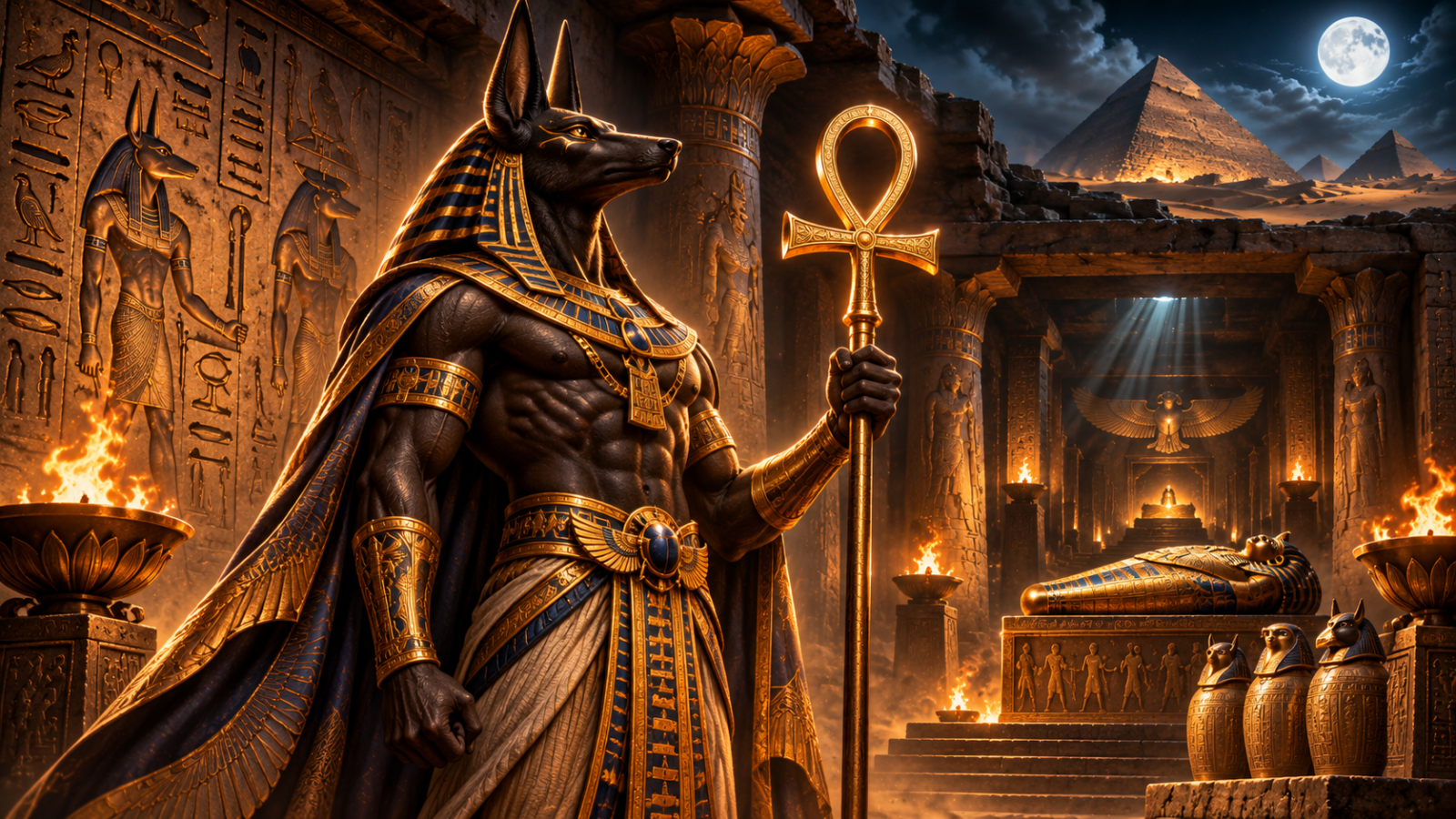
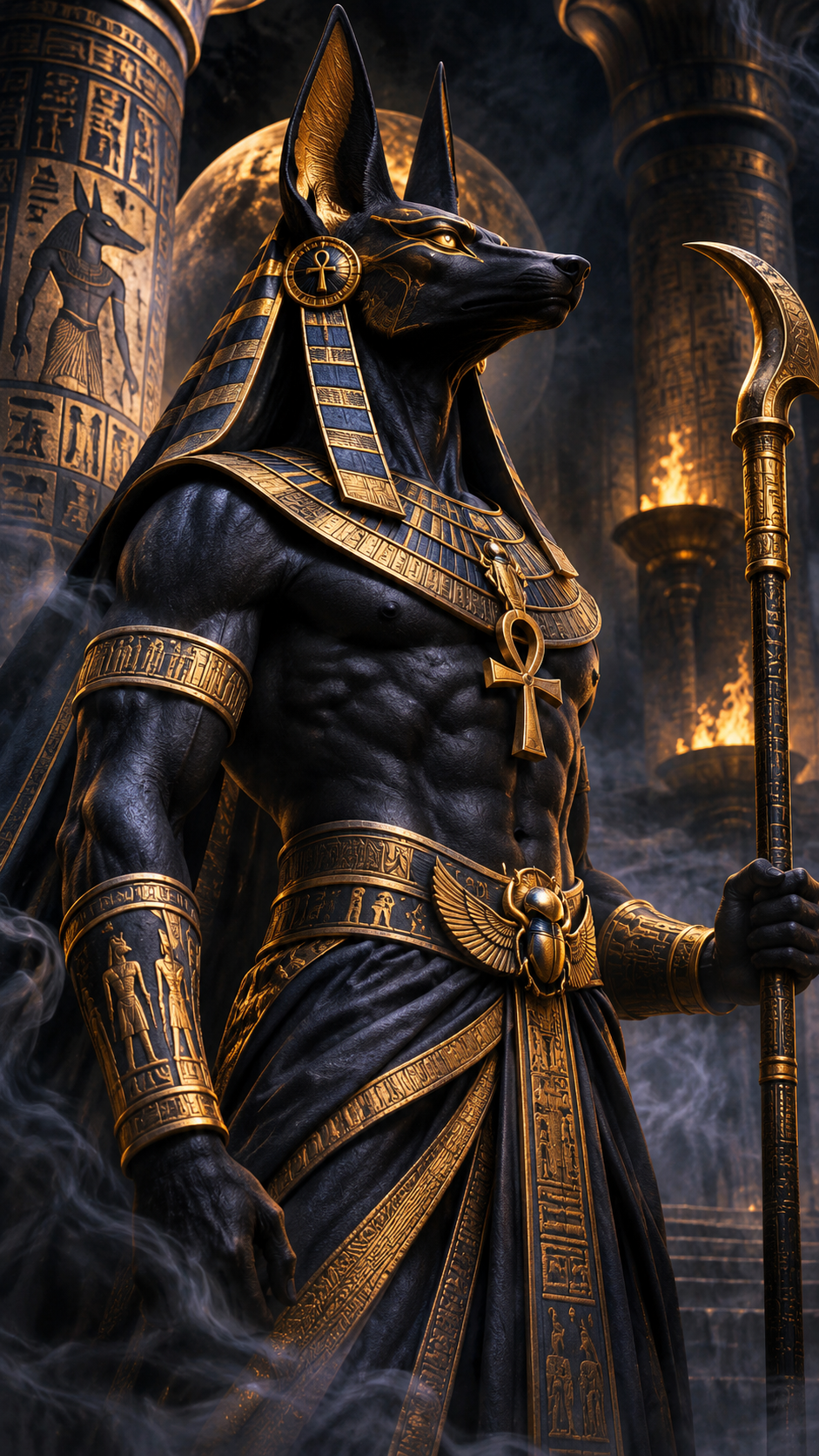
Anubis was the ancient Egyptian god of embalming, cemeteries and the safe passage of the dead. He is shown as a black jackal, or as a man with a jackal’s head, and his Egyptian name was Inpu. In the funerary texts he guards the tomb, oversees mummification, leads the deceased into the hall of judgment and tends the scales in the weighing of the heart. He was not a god of evil or a “god of death” who kills; he was the protector of the dead.

This guide keeps three things apart: what Egyptian texts and objects actually say about Anubis, what later Greek and Roman writers added, and what modern pop culture invents. You will find a fact box, the main myths, symbols, cult centres, the surprising “jackal or wolf” science, a myth vs fact table, and ten FAQs with sources.
Anubis Quick Fact Box
| Item | Answer |
|---|---|
| Egyptian name | Inpu (also written Anpu); “Anubis” is the later Greek form |
| Appearance | Black canine or a man with a canine head, often with a collar and a flail |
| Main roles | Embalming, cemeteries, guide of the dead, keeper of the scales |
| Colour | Black, linked to the fertile Nile soil and to rebirth, not to evil |
| Parents | Varies by period: Ra and a cow goddess, Ra and Bastet, or, in later tradition, Osiris and Nephthys |
| Famous epithets | “Foremost of the Westerners” (the dead), “He who is upon his mountain”, “He of the embalming place” |
| Cult centre | Cynopolis (Hardai) in Upper Egypt, and the Anubieion at Saqqara |
| Animal | Probably the Egyptian wolf (African golden wolf), long called the “Egyptian jackal” |
| Greek form | Anoubis; blended with Hermes as “Hermanubis” in the Roman period |
| Danger level | None; he protects the dead and the tomb |
Who Is Anubis in Egyptian Mythology?
Anubis is one of the oldest funerary gods of Egypt. Images and names of a canine funerary god appear very early, in the age of the first kings, and he is prominent in the Pyramid Texts, the oldest religious spells, where he looks after the dead king. Egyptologists link this to a practical fact: wild canids prowled the desert edges where early burials lay, and digging at graves was a real danger. A canine god may have turned that threat into protection.
His epithet “Foremost of the Westerners” refers to the dead, who were thought to dwell in the west where the sun sets. Over time, this title passed to Osiris as the Osiris cult grew, and Anubis took a supporting but still essential role: the god who prepares and guides the dead rather than the king who rules them.
Story box: why a canine? The sources do not give one official reason. Common scholarly explanations are the practical one above, and a symbolic one: a canine that haunts cemeteries becomes the cemetery’s guard. The black colour matters more than the animal. Black was the colour of Kemet, the “black land” of fertile Nile silt, and of the darkened skin of embalmed bodies, so it signalled renewal rather than death alone.
Anubis’s Family: Who Were His Parents?
There is no single Egyptian family tree for Anubis, because Egyptian religion tolerated several traditions at once. The main versions are below.
| Tradition | Parents | Where it appears |
|---|---|---|
| Early funerary texts | Ra and a cow goddess (often named Hesat) | Pyramid and Coffin Text period |
| Another early version | Ra and Bastet | Coffin Text period |
| Osirian tradition | Osiris and Nephthys; raised by Isis | Later periods, and the Greek writer Plutarch |
The Osiris-and-Nephthys version is the one most readers meet today. In it, Nephthys, sister and rival of Isis, conceives Anubis with Osiris, and Isis raises the child and later makes him her guard. It fits the Osiris story neatly, which is why it spread, but it is a later arrangement, not the oldest one. For the wider divine family, see our Egyptian gods family tree guide.
Anubis and Embalming: The God Behind the Mummy
Mummification was thought to be taught and supervised by Anubis. Embalming workshops were called by names linked to him, and the chief embalmer ritually represented him. A clay jackal mask found from the Ptolemaic period has often been cited as evidence that a priest could wear a mask during rites, though scholars are careful about how widely that practice was followed.
In the Osiris myth, Anubis is the first embalmer. After Set killed Osiris and scattered his body, Isis and Nephthys gathered the pieces, and Anubis wrapped and preserved them, making Osiris the model for every mummy. This is why embalming spells say the dead person becomes “an Osiris” and why Anubis stands at the head of the bier in tomb paintings.
- Protector of the body. He guards the mummy against decay and robbers.
- Overseer of the workshop. Embalmers worked under his patronage.
- Opener of the way. The Opening of the Mouth ritual and funerary procession invoke him as guide.
The Weighing of the Heart: What Anubis Does
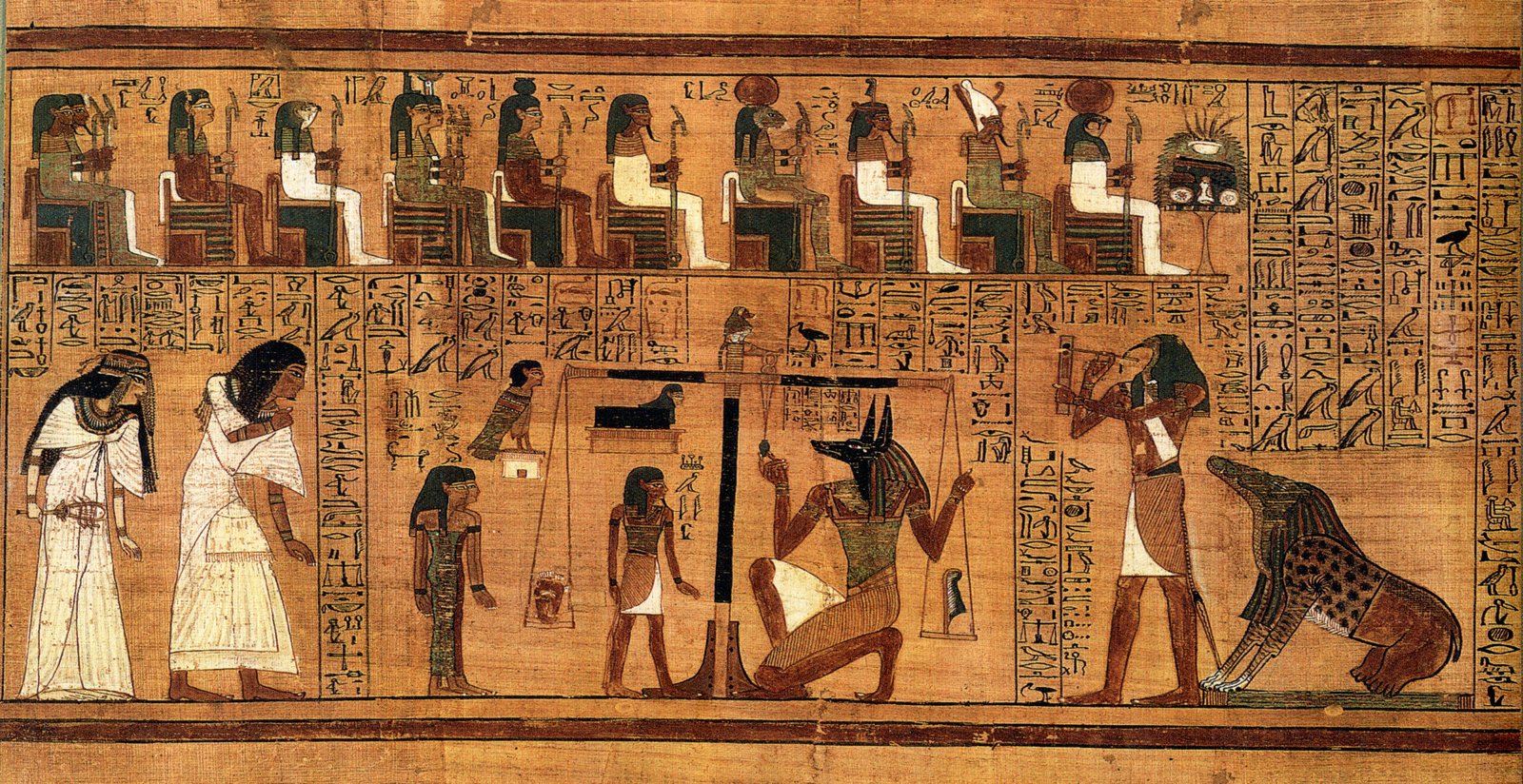
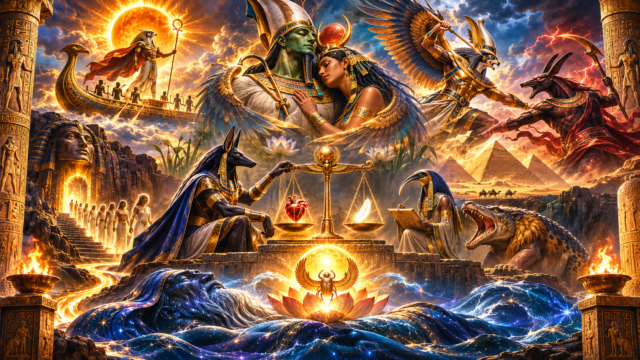
The most famous scene in Egyptian funerary art is the weighing of the heart, best known from Spell 125 of the Book of the Dead and its illustrated papyri. The dead person is led into the hall of judgment, usually by Anubis. The heart is placed on one pan of a balance and the feather of Maat, goddess of truth and order, on the other. Anubis checks the scales, Thoth records the verdict, and the monster Ammit waits to devour a heart found heavy with wrongdoing.
Two points are often misunderstood. First, Anubis is not the judge: the verdict belongs to the divine tribunal presided over by Osiris, and Anubis acts as guide and technician. Second, the scene was a ritual safeguard, not a threat that only the wicked feared. The spells were written so the deceased could answer correctly, and the scene mostly shows a successful outcome, with the justified dead presented to Osiris.
Story box: a heart that stays quiet. The Egyptians also placed a heart scarab over the mummy’s chest, inscribed with a spell asking the heart not to testify against its owner. The heart, not the brain, was treated as the seat of thought and memory, and it was left in the body during mummification for exactly this reason.
Symbols and How to Recognise Anubis
| Symbol or clue | Meaning |
|---|---|
| Black canine head | Cemetery guardian; renewal; the Nile’s black soil |
| Reclining canine on a chest | The “Anubis shrine” form, guarding a sacred treasury; a famous example was found in Tutankhamun’s tomb |
| Flail | Divine authority, shared with other gods and kings |
| Scales | The weighing of the heart |
| Embalming table or bier | His role as first embalmer |
| Imiut fetish | A skinned-animal emblem on a pole, associated with Anubis and embalming rites |
A simple identification rule: if the figure has long, upright ears and a narrow snout, is black, and stands near a mummy or scales, it is Anubis. If the head looks like a sleek canine with a longer, thinner snout and a different context, it may be another canine deity such as Wepwawet, “opener of the ways”, who is usually grey or white and associated with military processions.
Cult Centres and Temples
Anubis’s main cult centre was Hardai in Upper Egypt, which the Greeks called Cynopolis, “city of dogs”. He was worshipped at cemeteries across the country, but the site that shows the scale of his cult best is the Anubieion at Saqqara. Excavations of the canine catacombs there found enormous numbers of mummified dogs and related canids, offered by pilgrims in the Late and Ptolemaic periods. Published estimates run to several million, though the exact figure is uncertain and should be treated as an approximation.
These animal mummies were votive offerings. Visitors paid for a mummified dog to carry their prayer to the god, much as people leave candles or offerings today. They do not mean that every dog was sacred or that Egyptians worshipped animals as animals; the animal was a vessel for the deity’s power.
Is Anubis a Jackal or a Wolf? What Genetics Found
For a century, Anubis was described as a jackal-headed god. A 2011 genetic study in PLoS ONE by Eli Rueness and colleagues showed that the animal long called the Egyptian jackal is genetically part of the grey wolf complex, not the golden jackal group. Later work on golden jackal lineages, including a 2015 analysis, separated African and Eurasian forms and supported treating the African animal as a distinct wolf-like species, now often called the African golden wolf (Canis lupaster).
This does not change the Egyptian god, but it may change the label. Anubis may have been modelled on the Egyptian wolf rather than a true jackal, though the ancient artists drew a stylised divine canine, not a zoological portrait, so no one can say which species they had in mind. Both “jackal-headed” and “wolf-headed” appear in modern writing; the safest wording is “canine-headed” or “jackal-headed, often thought to depict the Egyptian wolf”.
Anubis, Osiris and Isis: How the Story Changed
As the cult of Osiris became dominant, many of Anubis’s old titles moved to Osiris, and Anubis became his helper. This is a pattern in Egyptian religion: gods merged, borrowed and reassigned roles rather than replacing each other. By the Late Period Anubis is firmly part of the Osirian circle, as guardian of the body and escort of souls.
In the Hellenistic and Roman periods, Greek visitors identified Anubis with Hermes, who also guided souls, and the combined figure Hermanubis appears in statues and cult. Anubis even spread through the Roman world with the cult of Isis. See our guides to Egyptian gods and goddesses and famous Egyptian myths for the wider stories.
Anubis in Modern Culture
Anubis is one of the most recognised Egyptian gods in films, games and fantasy novels, where he is often cast as a villain or a stern judge. That image is modern. In Egyptian belief he is a protector, closer to a guardian and guide than a punisher. If you want accurate depictions, look to tomb paintings, papyri and museum collections, not to adaptations.
Myth vs Fact: Common Claims About Anubis
| Claim | What the evidence shows |
|---|---|
| “Anubis is the god of evil or death itself.” | He is the protector of the dead and embalming, not a killer or villain. |
| “Anubis judges every soul.” | The verdict belongs to Osiris and the tribunal; Anubis guides and checks the scales. |
| “Anubis is definitely a jackal.” | Genetics suggests the Egyptian “jackal” is a wolf-like animal; the god is a stylised canine. |
| “Anubis was Osiris’s father.” | Later tradition makes him Osiris’s son; earlier ones name Ra as father. |
| “Black means evil in Egypt.” | Black symbolised fertile soil, rebirth and the preserved body. |
| “Anubis curses tomb robbers.” | He guards tombs in spells, but the famous “mummy’s curse” is a modern legend, not an Egyptian doctrine. |
Frequently Asked Questions About Anubis
What is Anubis the god of?
Embalming, cemeteries and the guidance of the dead, including a key role in the weighing of the heart.
Is Anubis good or evil?
Neither in a modern sense. He is a protective funerary god, and the Egyptians prayed to him for a safe passage to the afterlife.
Who are Anubis’s parents?
It depends on the period. Early texts name Ra with a cow goddess or Bastet; later tradition names Osiris and Nephthys, with Isis as foster mother.
Why does Anubis have a dog or jackal head?
Canids roamed cemetery edges, so a canine became the symbolic guardian of graves. The animal is probably modelled on the Egyptian wolf.
Why is Anubis black?
Black stood for the fertile Nile soil and for the preserved, darkened body, so it meant renewal and protection.
What does Anubis do in the weighing of the heart?
He leads the deceased into the hall and tends the scales; Thoth records the result and Osiris presides.
Is Anubis the same as Wepwawet?
No, though they are related canine gods. Wepwawet, “opener of the ways”, is linked to war and processions and is usually shown grey or white.
Was Anubis worshipped by ordinary people?
Yes. Pilgrims left offerings, including mummified dogs at Saqqara, and families invoked him in funerary prayers.
Is Anubis worshipped today?
The ancient state cult ended long ago. Today he appears in museums, scholarship, and some modern neo-pagan practice, which is a modern reconstruction.
Is there a real Hindi or Indian god like Anubis?
Cultures differ, so there is no exact match. Yama, in Indian tradition, is also associated with the dead and with judgment, but his myths, role and iconography are different. Comparison is useful for understanding, not for equating the two.
Sources and Further Reading
Last updated: 25 November 2026.
- Rueness et al., “The Cryptic African Wolf: Canis aureus lupaster Is Not a Golden Jackal and Is Not Endemic to Egypt”, PLoS ONE (2011): doi.org/10.1371/journal.pone.0016385
- World History Encyclopedia, “Egyptian Mythology”: worldhistory.org
- World History Encyclopedia, “Osiris”: worldhistory.org
- Egypt Exploration Society, “Gods of Egypt”: ees.ac.uk
- The Metropolitan Museum of Art, “Divine Egypt”: metmuseum.org




















Share Your Opinion
Comments are closed on this post.