 Vista
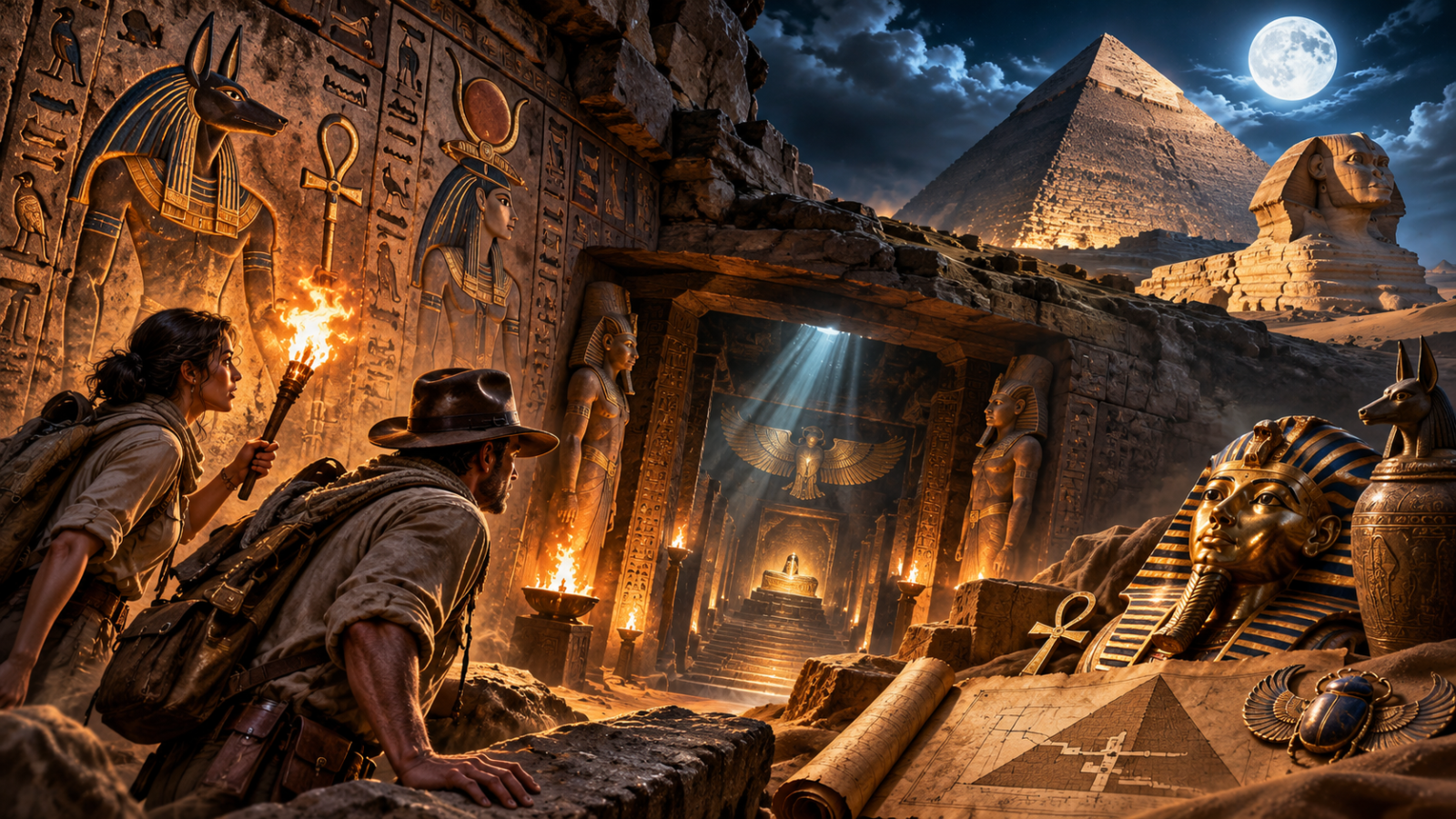
The biggest ancient Egypt mysteries are not about aliens or curses. They are real research questions that scientists are still working on: how exactly the pyramids were built, what lies inside hidden voids of the Great Pyramid, how Tutankhamun died, where Nefertiti and Cleopatra were buried, and why some of Egypt’s most powerful periods collapsed. Some of these puzzles have been partly solved in recent years, and some remain open.

This guide separates three things clearly: what is well established, what is a leading theory, and what is still unknown. For each mystery you will see the evidence, the main explanations, and the latest verified research. We do not treat internet rumours as evidence, and where a claim has been tested and failed, we say so.
Quick Guide: Which Egyptian Mysteries Are Solved?
| Mystery | Status | Short answer |
|---|---|---|
| Who built the Giza pyramids? | Largely solved | Egyptian workers, housed in a planned town beside the plateau |
| How were the pyramids built? | Partly solved | Ramps, levers, sleds and river transport; exact ramp layout still debated |
| Is there a hidden void in the Great Pyramid? | Confirmed, purpose unknown | A void of at least 30 metres sits above the Grand Gallery |
| How did Tutankhamun die? | Debated | A 2010 genetic and CT study pointed to malaria and bone disease, but other explanations exist |
| Where is Nefertiti’s tomb? | Unsolved | Radar scans found no hidden chamber behind Tutankhamun’s tomb |
| Where is Cleopatra’s tomb? | Unsolved | Never found; searches continue near Alexandria |
| Who made the Great Sphinx? | Mostly accepted | Most Egyptologists link it to King Khafre, around 2500 BCE |
| Where is Imhotep’s tomb? | Unsolved | Probably at Saqqara, but never identified |
| What happened to Cambyses’ lost army? | Unsolved | Only a story from Herodotus; no confirmed remains |
| Why did the Old Kingdom collapse? | Debated | Probably a mix of weak central rule and environmental stress |
Mystery 1: Who Built the Pyramids?
This is the most misunderstood question, and the evidence is strong. In December 1988 the archaeologist Mark Lehner and his team began excavating a previously unknown settlement about 400 metres south of the Sphinx near an old stone wall known in Arabic as Heit el-Ghurab, the “Wall of the Crow”. The project, run by Ancient Egypt Research Associates (AERA), found bakeries, storage areas, houses and animal bones in a town that was in use for a fairly short time during the Fourth Dynasty.
Cemeteries beside the plateau hold the burials of workers, and some skeletons show healed injuries, which suggests medical care. The picture that emerges is of a state-organised workforce of Egyptians, fed with bread, beer and meat, rather than an army of whipped slaves. Estimates of the workforce vary. One widely repeated figure is around 10,000 workers at a time, but scholars disagree and the number depends on assumptions about the building schedule. The rest of the workforce, including support staff, may have been larger.
Fact box: The Heit el-Ghurab town was later reinterpreted by Lehner as also a Nile port and trade centre, because wood and pottery from the Levant were found there. So the builders’ settlement was probably part of a larger logistics network, not just a camp.
Mystery 2: How Were the Pyramids Built?
The Great Pyramid has roughly 2.3 million blocks, and its construction took only a couple of decades in the 26th century BCE. Egyptologists agree on the basic tools: copper chisels, wooden sleds, ropes, levers, and ramps. They disagree on the shape of the ramps. Proposals include a long straight ramp, ramps that zigzag up the faces, ramps that wrap around the structure, and a mix of an outer ramp and an internal one.
Three discoveries help narrow the question:
- The Merer papyri. In 2013 a French-Egyptian team led by Pierre Tallet found papyrus rolls at Wadi al-Jarf, an ancient harbour on the Red Sea. They include the logbook of an official named Merer, who led a boat crew transporting limestone from the Tura quarries to Giza for Khufu’s pyramid. This is first-hand administrative evidence from the age of the builders.
- The Hatnub quarry ramp. Archaeologists working at the Hatnub alabaster quarry reported in 2018 a steep ramp flanked by staircases and rows of postholes, which suggests the Egyptians used timber-supported ramps to haul heavy stone on steep slopes.
- The lost Nile branch. A 2024 study in Communications Earth & Environment, led by Eman Ghoneim, used satellite radar, geophysical surveys and soil cores to propose a now-vanished Nile branch, named the Ahramat Branch, running about 64 kilometres beside 31 pyramids. Many pyramids have causeways that end at its suggested banks, which supports the idea that boats carried materials close to the building sites.
The Ahramat study is a strong hypothesis supported by several kinds of data, but it does not by itself reveal how stones were lifted at the pyramid. The exact construction method of every course remains an open research area.
Mystery 3: The Hidden Voids Inside the Great Pyramid
In 2017 the ScanPyramids team, working under Egypt’s Ministry of Antiquities, announced in the journal Nature the discovery of a large void above the Grand Gallery of the Great Pyramid. It has a cross-section similar to the Grand Gallery and a minimum length of 30 metres. It was detected with cosmic-ray muons, which behave like X-rays for massive structures, by three independent detector technologies. The paper called it the first major internal structure found in the pyramid since the nineteenth century.
Earlier, in 2016, the same project reported smaller anomalies, including a cavity near the north-east edge and a space behind the north face. In 2023 the team announced a corridor roughly nine metres long behind the chevron blocks above the north entrance, investigated with endoscopic and ultrasonic tools.
What nobody can say yet is the purpose of the voids. They could be construction features, such as relieving spaces that spread weight, or they could be something else. Nature’s authors stated that there is no information yet about the role of the Big Void, and drilling or opening the structure is controlled by strict conservation rules. This is a true unsolved mystery, and it is exciting because it comes from careful physics, not rumour.
Mystery 4: How Did Tutankhamun Die?
Tutankhamun became king as a child and died around 1324 BCE at about 19 years old. Popular stories suggested murder, but CT scans and genetic work have changed the debate. In 2010 a team led by Zahi Hawass, published in the Journal of the American Medical Association, analysed DNA and CT data from royal mummies. They concluded that his parents were a brother and sister and that he had a bone disorder in the foot, Köhler disease II, along with signs of malaria tropica, which together could have contributed to his death.
This does not make the case closed. Ancient DNA from mummies is hard to analyse, and other researchers have proposed different explanations, such as a leg fracture or embalming-related changes that are difficult to interpret. A fair summary is that illness is the best-supported explanation so far, but the exact cause of death is still debated. The “murder” claims have not been demonstrated by the evidence.
Mystery 5: Nefertiti’s Missing Mummy and Tomb
Queen Nefertiti, wife of Akhenaten, is one of the most famous women of the ancient world, yet her burial place is unknown. In 2015 the Egyptologist Nicholas Reeves argued that Tutankhamun’s tomb might be a small outer part of a larger tomb that held Nefertiti. Radar scans in late 2015 first seemed to suggest hidden spaces behind the walls. A second scan in 2016 produced contradictory results.
In May 2018 a three-year investigation, with a tie-breaker survey by the Polytechnic University of Turin, concluded with very high confidence that no hidden chambers lie adjacent to Tutankhamun’s tomb. The hypothesis was therefore not supported. Some researchers have also proposed that an unnamed mummy known as the Younger Lady (KV35YL) could be Nefertiti, but no ancient text calls Nefertiti the sister of Akhenaten, so the identification is unproven. Nefertiti’s final resting place remains unknown.
Mystery 6: Where Is Cleopatra’s Tomb?
Ancient writers say Cleopatra VII died in 30 BCE and that Octavian allowed her burial beside Mark Antony in a mausoleum she had built in Alexandria. The ancient city has been damaged by earthquakes, tsunamis and sea-level rise, and parts of the royal quarter are now under water, so nobody has found the grave.
Since 2005 the Dominican archaeologist Kathleen Martínez has been searching at Taposiris Magna, a temple about 45 kilometres west of Alexandria, on the idea that the queen was buried in a temple linked with Isis. Her team has found tombs, coins and, reported in 2025 with Robert Ballard’s team, a sunken ancient port nearby. These are important archaeological finds, but no tomb of Cleopatra has been identified, and many Egyptologists remain doubtful about the theory. Treat any headline that says her tomb has been found as a claim that needs peer-reviewed confirmation.
Mystery 7: The Great Sphinx
The Sphinx is carved from the natural limestone of the Giza plateau. Most Egyptologists attribute it to King Khafre, builder of the second pyramid, in the 26th century BCE, based on its position within his pyramid complex and the construction methods. A few non-specialist authors have claimed it is thousands of years older, but those arguments have not been accepted by Egyptologists.
The missing nose is a separate puzzle. It was not shot off by Napoleon’s army. Drawings made before 1798 already show it missing, and a medieval Egyptian historian, al-Maqrizi, blamed a Sufi zealot in the 14th century for damaging the face. The Sphinx’s original purpose, perhaps as a guardian of the royal necropolis connected to the sun god, is inferred rather than recorded in a surviving text.
Mystery 8: The Tombs of Imhotep and Alexander
Imhotep, the official credited with designing Djoser’s Step Pyramid, was later worshipped as a god of healing, so his tomb must once have been important. It has never been identified, though Saqqara is the likely area. Alexander the Great’s body was brought to Egypt after his death in 323 BCE and displayed in Alexandria for centuries, but the tomb’s location is lost. Both cases show how much of ancient Egypt lies under modern cities and sand.
Mystery 9: The Lost Army of Cambyses
The Greek historian Herodotus wrote that the Persian king Cambyses sent an army of 50,000 men toward the oasis of Amun, and that they vanished in a sandstorm around 524 BCE. Treasure hunters have announced discoveries from time to time, but no claim has been confirmed by a peer-reviewed excavation. Herodotus was writing about a century later and the numbers may be exaggerated, so this is best seen as an unproven story.
Mystery 10: Why Did the Old Kingdom Collapse?
Around 2200 BCE the strong central government of the pyramid age broke up, and the First Intermediate Period began. Scholars have pointed to long reigns that weakened royal authority, power shifting to provincial governors, and a series of low Nile floods linked with regional climate change. Not all researchers agree on how severe the drought was, and the collapse was probably caused by several factors working together rather than a single event.
Where Did Egyptian Writing Begin?
Excavations at Abydos found tomb U-j with small labels carrying early signs, dated to around 3200 BCE. They show that writing in Egypt was being used for administration very early, close to the time of the first kings. Whether Egyptian writing developed independently or was influenced by Mesopotamian writing is a matter of scholarly discussion, and it remains an open question.
Myth vs Fact: Popular Claims Tested
| Popular claim | What the evidence shows |
|---|---|
| “Aliens built the pyramids.” | Excavated workers’ towns, tools, quarries and the Merer papyri document human builders. |
| “A mummy’s curse killed Tutankhamun’s discoverers.” | The deaths cited were from ordinary causes, and most of the expedition lived long lives. |
| “Secret rooms were found behind Tutankhamun’s walls.” | The 2018 radar survey found no hidden chambers. |
| “Cleopatra’s tomb has been discovered.” | No confirmed tomb has been found; the Taposiris Magna work is ongoing. |
| “The pyramids contain no hidden voids.” | At least one large void has been confirmed by muon imaging. |
| “Egyptians had no scientific knowledge.” | Medical papyri and surveying records show systematic practical science. |
How to Judge a Mystery Claim Yourself
- Check the publication. Findings in peer-reviewed journals or announced by official antiquities authorities carry more weight than a viral video.
- Look for independent confirmation. The Big Void was seen by three separate detector teams; a single unverified image is not enough.
- Separate discovery from interpretation. A void is a measurement; calling it a secret chamber of treasure is a guess.
- Watch for words like “proof” and “they don’t want you to know”. Serious researchers describe limits and uncertainty.
- Check dates. Egyptian archaeology changes fast, so look for the newest source.
Frequently Asked Questions About Ancient Egypt Mysteries
What is the biggest unsolved mystery of ancient Egypt?
There is no single answer, but the purpose of the voids inside the Great Pyramid and the location of tombs such as Cleopatra’s and Nefertiti’s are among the most discussed open questions.
Who really built the Egyptian pyramids?
Egyptian workers did, in a state-organised effort. Their town, bakeries and cemeteries have been excavated near Giza.
How did Egyptians move the huge stones?
Evidence points to sleds, ramps and levers on land and boats on the Nile. The Merer papyri and the proposed Ahramat Branch support river transport, while the exact ramp design is still debated.
What was found inside the Great Pyramid in 2017?
A void at least 30 metres long above the Grand Gallery was detected by cosmic-ray muon imaging. Its purpose is unknown.
How did King Tutankhamun die?
A 2010 study suggested malaria and bone disease, but scholars still debate the exact cause. There is no firm evidence for murder.
Has Nefertiti’s tomb been found?
No. Radar surveys finished in 2018 found no hidden chambers behind Tutankhamun’s tomb, and her burial place is still unknown.
Has Cleopatra’s tomb been discovered?
No confirmed tomb exists. Searches at Taposiris Magna have produced important finds, but not an identified burial.
How old is the Great Sphinx?
Most Egyptologists date it to the reign of Khafre, roughly 4,500 years ago.
Why are there still so many mysteries in Egypt?
Much of ancient Egypt is buried under sand, farmland and modern cities, and ancient records are incomplete. New technology such as radar, muon imaging and satellite mapping keeps adding data.
Where can I follow reliable news about Egyptian discoveries?
Check announcements from Egypt’s Ministry of Tourism and Antiquities, peer-reviewed journals, and major museum or university projects such as ScanPyramids and AERA.
Sources and Further Reading
Last updated: 25 November 2026. Research on Egypt changes quickly, so recheck recent discoveries before citing them.
- Morishima et al., “Discovery of a big void in Khufu’s Pyramid by observation of cosmic-ray muons”, Nature (2017): doi.org/10.1038/nature24647
- National Geographic, “Mysterious Void Discovered in Egypt’s Great Pyramid”: nationalgeographic.com
- Ghoneim et al., “The Egyptian pyramid chain was built along the now abandoned Ahramat Nile Branch”, Communications Earth & Environment (2024): nature.com
- Ancient Egypt Research Associates, “The Lost City of the Pyramids”: aeraweb.org
- Archaeology Magazine, “Port of the Pyramids” (2014): archaeology.org
- Hawass et al., “Ancestry and Pathology in King Tutankhamun’s Family”, JAMA (2010): jamanetwork.com
- National Geographic, “It’s Official: Tut’s Tomb Has No Hidden Chambers After All” (2018): nationalgeographic.com
- National Geographic, on the search for Cleopatra’s tomb at Taposiris Magna: nationalgeographic.com
Related guides: Heka: Ancient Egyptian God of Magic, Spells and Medicine — What Egyptian Magic Really Meant · Apis Bull and Sacred Animals of Ancient Egypt — Memphis, the Serapeum and Animal Mummies














Share Your Opinion
Comments are closed on this post.