 Vista
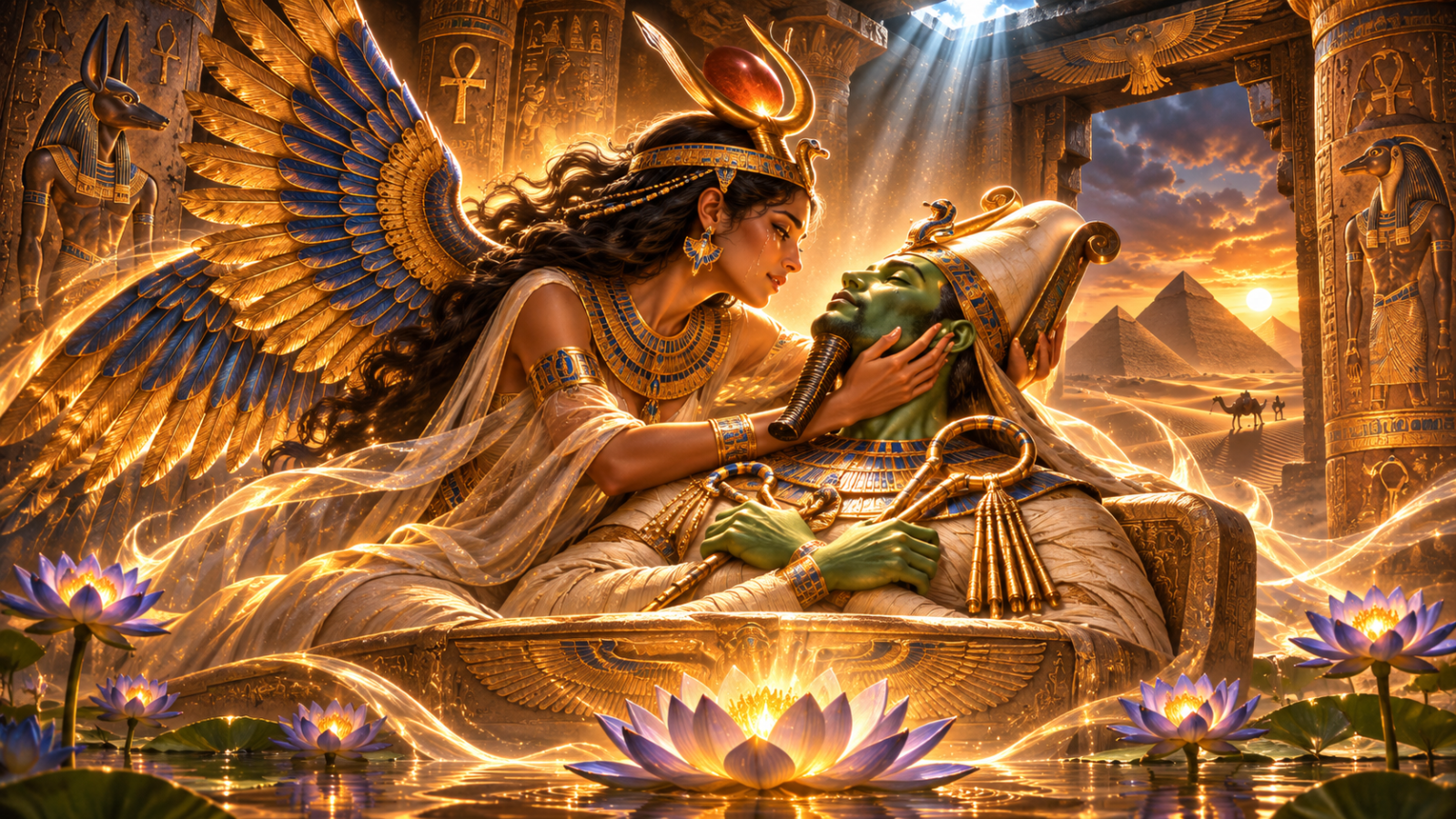
Osiris was the ancient Egyptian god of the afterlife, resurrection and the fertile Nile flood. He is shown as a mummiform king with green or black skin, a white crown and the crook and flail. In the central myth, his brother Set kills him, his wife Isis restores him, and his son Horus avenges him. Osiris then rules the dead as judge of the underworld, and every Egyptian hoped to become “an Osiris” after death.

This guide separates what Egyptian texts say about Osiris from the Greek retelling by Plutarch and from modern pop culture. You will find a fact box, the full myth in clear stages, the meaning of his symbols, his cult at Abydos, the judgment scene, a myth vs fact table, ten FAQs and sources.
Osiris Quick Fact Box
| Item | Answer |
|---|---|
| Domain | Afterlife, resurrection, kingship of the dead, vegetation and the Nile flood |
| Appearance | Mummiform king, green or black skin, atef crown with feathers, crook and flail |
| Parents | Geb (earth) and Nut (sky) |
| Siblings | Isis, Set and Nephthys |
| Wife and son | Isis; Horus |
| Enemy | Set, his brother |
| Cult centres | Abydos (main), Busiris (Djedu) in the Delta |
| Symbols | Djed pillar, crook and flail, atef crown, sprouting grain, mummy wrappings |
| Main festival | The Osiris mysteries at Abydos, around the Khoiak month |
| Greek version | Plutarch’s “On Isis and Osiris” (around 100 CE) |
Who Is Osiris in Egyptian Mythology?
Osiris appears in royal religious texts from the Fifth Dynasty, and by the Middle Kingdom ordinary people could hope to join him after death. In the earliest texts he is a dead king who rules the underworld; later he is also the green god of grain. His green or black skin signals rebirth and the dark, fertile Nile soil, not sickness or evil.
His position as ruler of the dead made him the model for every burial. A dead Egyptian was called “Osiris So-and-so”, expecting to be justified, like him, against enemies and to rise again. That is the heart of Egyptian funerary religion: the deceased shares Osiris’s fate.
The Myth of Osiris: Step by Step
No ancient Egyptian text gives the whole story in one place. The fullest connected version is by the Greek writer Plutarch, around 100 CE, based on earlier Egyptian sources found in pieces across the Pyramid Texts, hymns and temple inscriptions. The stages below follow that combined tradition.
- A good king. Osiris rules Egypt, teaches agriculture and law, and is loved by his people.
- Set’s plot. His jealous brother Set builds a chest to fit Osiris exactly, tricks him into lying in it, seals it and throws it into the Nile.
- Isis searches. Isis finds the chest in Byblos, where a tree had grown around it, and brings it home.
- Dismemberment. Set finds the body and cuts it into pieces scattered across Egypt.
- Restoration. Isis and Nephthys gather the pieces, and Anubis helps embalm the body. Isis revives Osiris long enough to conceive Horus.
- Horus avenges. Horus grows up and contends with Set for the throne; the gods eventually judge in Horus’s favour.
- King of the dead. Osiris cannot return to the living world, so he becomes ruler of the underworld and judge of the dead.
Story box: the missing piece. In many versions the phallus of Osiris is eaten by a Nile fish and never found, so Isis makes a replacement. Not every text includes this detail, and the number of body pieces varies by city, because different temples claimed to hold relics of Osiris. Plutarch says fourteen pieces, while Egyptian temple lists give other counts.
Why Is Osiris Green? Colour and Symbols Explained
| Symbol | Meaning |
|---|---|
| Green or black skin | Vegetation, rebirth, the Nile’s fertile black soil |
| Mummy wrappings | His death and his status as model of every mummy |
| Atef crown | The white crown of Upper Egypt flanked by feathers, kingship |
| Crook and flail | Royal authority and care for the people |
| Djed pillar | Stability and Osiris’s backbone; raised in festivals |
| Sprouting grain | Rebirth; “Osiris beds” were mud and seed forms that sprouted in tombs |
Osiris’s link to grain was acted out in rituals. During the festival month of Khoiak, priests made figures of Osiris from soil and grain, watered them until they sprouted, and buried them. The sprouting made the idea visible: death leads to new growth. For other signs and how to tell them apart, see our guide to Egyptian symbols.
Osiris as Judge: The Hall of Two Truths
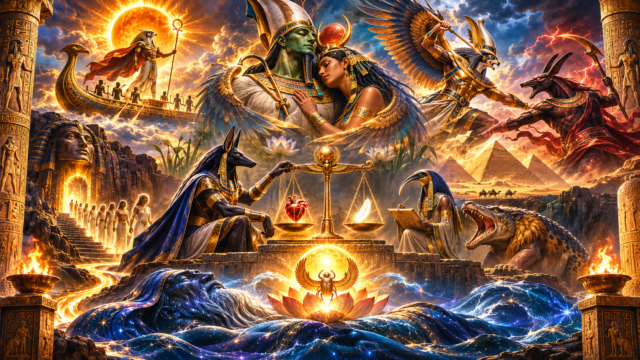
In the judgment scenes of the Book of the Dead, Osiris sits enthroned at the end of the hall, with Isis and Nephthys behind him. The deceased is brought in by Anubis, the heart is weighed against the feather of Maat, and Thoth records the result. If the heart balances, the dead person is declared “true of voice” and presented to Osiris; if not, Ammit waits. The scene is described in more detail in our Anubis guide.
The judgment includes the “Negative Confession” in Spell 125, where the dead person lists wrongs they have not done, such as stealing, lying or causing pain. This reflects Egyptian ethical ideals and the importance of Maat in daily life, though it should not be read as a complete legal code.
Abydos: The Holy City of Osiris
Abydos in Upper Egypt, an old royal burial site of the earliest kings, became the main centre of Osiris. A tomb at Umm el-Qa’ab, associated with an early king, was identified in the Middle Kingdom as the tomb of Osiris, and pilgrims left offerings there. People who could not be buried at Abydos built memorial chapels or stelae, to share in the god’s blessings.
The Temple of Seti I at Abydos, built in the 13th century BCE, has a famous chamber called the Osireion, a deep, water-fed structure linked to the Osiris cult. Annual mystery plays re-enacted the myth, with processions of the god’s image from the temple to his tomb. Our knowledge of these rites comes from inscriptions, stelae and the later descriptions, and the details are only partly known.
Osiris, Isis and Horus: The Divine Family
Osiris is part of the Ennead of Heliopolis: the children of Geb and Nut are Osiris, Isis, Set and Nephthys. His kingship passes to his son Horus, which explains why every living pharaoh was identified with Horus and every dead one with Osiris. For the wider relationships, read our Egyptian gods family tree.
Is Osiris a “Resurrection” God Like Jesus? Comparing Carefully
Popular websites often claim that Osiris’s story is the “original” of later religious stories. Scholars reject strong versions of this claim. Osiris does not return to ordinary life; he rules the underworld, and his “rebirth” is restoration and a new kind of existence, not a return to earth. Comparisons across religions can be interesting, but equating stories without evidence of direct borrowing is poor method, and many such claims are modern inventions.
Osiris in the Greek and Roman World
In the Ptolemaic period, Greeks blended Osiris with Apis to make Serapis (Sarapis), a god worshipped across the Mediterranean. Roman authors wrote about Osiris and Isis, and the Isis cult, in which Osiris was prominent, spread widely. Plutarch’s version is a Greek interpretation and should be marked as such, since it adds philosophical meanings not present in Egyptian sources.
Myth vs Fact: Common Claims About Osiris
| Claim | What the evidence shows |
|---|---|
| “Osiris is the god of death who kills people.” | He is the ruler and judge of the dead, not a killer; he himself was killed in the myth. |
| “Osiris came back to life on earth.” | He is restored enough to father Horus, then rules the underworld. |
| “Osiris is green because he is poisonous or evil.” | Green means growth and rebirth. |
| “Plutarch’s story is the Egyptian original.” | It is a Greek retelling based on earlier Egyptian sources, with additions. |
| “The Osiris myth copied other religions.” | Claims of direct copying lack evidence; Osiris belongs to Egypt’s own funerary tradition. |
| “Only kings could become Osiris.” | Early on it was royal, but by the Middle Kingdom ordinary people hoped for the same fate. |
Frequently Asked Questions About Osiris
What is Osiris the god of?
The afterlife, resurrection, kingship of the dead and the fertility of the Nile and grain.
How did Osiris die?
In the myth, his brother Set tricked him into a chest, sealed it and threw it into the Nile, and later dismembered the body.
Why is Osiris green?
Green stood for plants, growth and rebirth; his skin can also be black for the fertile Nile soil.
Who are Osiris’s parents and siblings?
Geb and Nut are his parents; Isis, Set and Nephthys are his siblings.
Who is Osiris’s wife and son?
Isis is his wife and Horus his son. In some traditions Anubis is also his son, as covered in our Anubis guide.
What does Osiris do in the afterlife?
He presides over the judgment of the dead and rules the realm where the justified live on.
Where was Osiris worshipped?
Across Egypt, but especially at Abydos and in Busiris in the Delta.
What is the Djed pillar?
A symbol of stability often linked to Osiris’s backbone, raised in festivals to represent his renewal.
Is Osiris the same as Serapis?
Not exactly. Serapis was a Ptolemaic-era god combining aspects of Osiris and Apis with Greek features.
Is Osiris similar to Yama in Indian tradition?
Both rule or judge the dead, so readers often compare them, but their myths, origins and roles differ, and comparison should not be treated as identity.
Sources and Further Reading
Last updated: 25 November 2026.
- World History Encyclopedia, “Osiris”: worldhistory.org
- World History Encyclopedia, “Egyptian Mythology”: worldhistory.org
- Egypt Exploration Society, “Gods of Egypt”: ees.ac.uk
- The Metropolitan Museum of Art, “Divine Egypt”: metmuseum.org





















Share Your Opinion
Comments are closed on this post.