 Vista
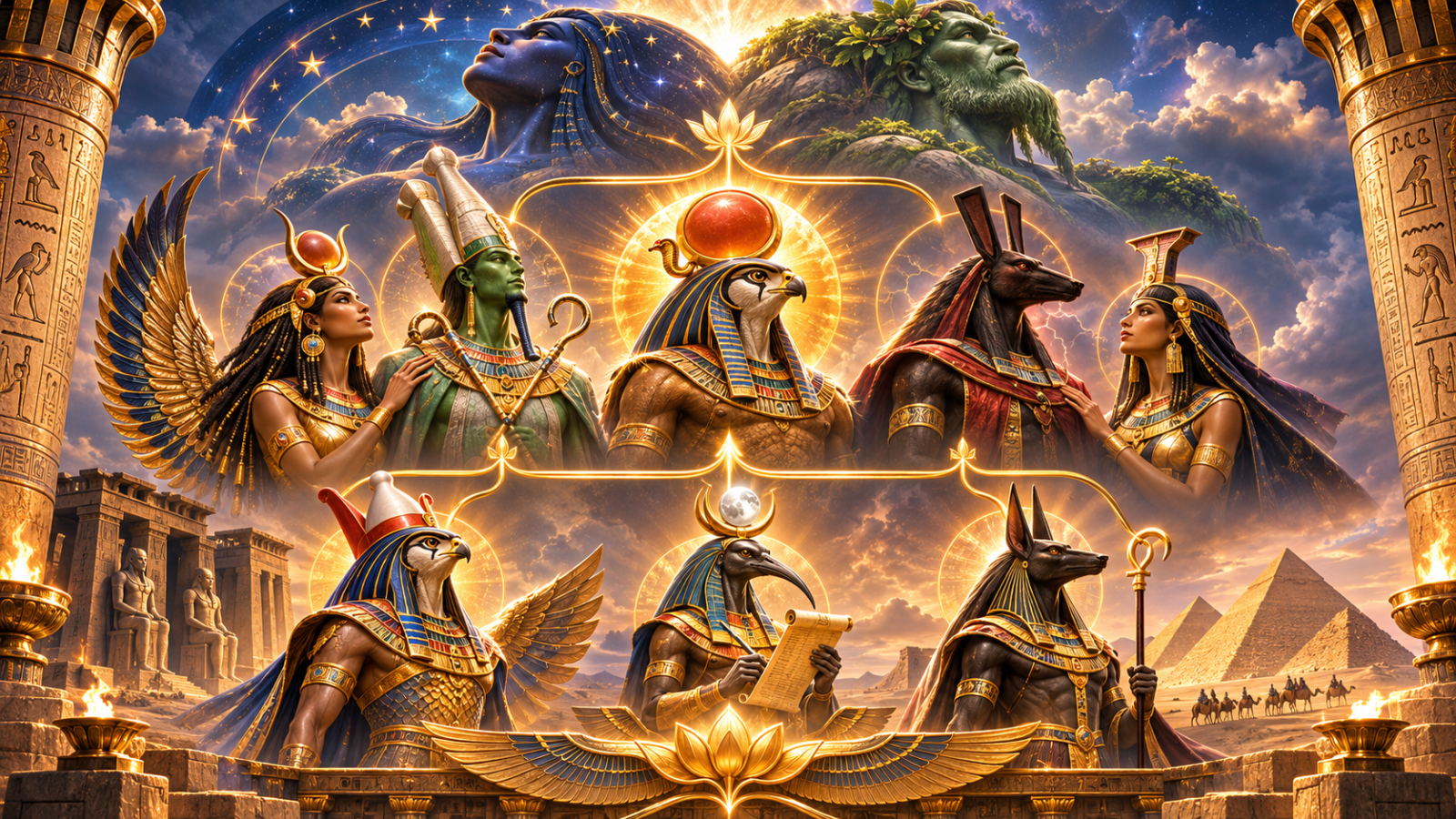
The Egyptian gods family tree begins with Atum in the Heliopolitan tradition, followed by Shu and Tefnut, Geb and Nut, and the four siblings Osiris, Isis, Set and Nephthys. Horus the child follows in the next generation. Other traditions offer different families and creation accounts.

What does the Egyptian gods family tree show?
An Egyptian gods family tree explains how deities are related in particular creation and religious traditions. The most familiar version begins with Atum, continues through Shu and Tefnut, then Geb and Nut, and reaches the siblings Osiris, Isis, Set and Nephthys. Horus the child belongs to the next generation as the son of Osiris and Isis. This structure is commonly used to introduce the Great Ennead of Heliopolis. It explains several famous myths, particularly the struggle over Osiris’s throne, through relationships that are easy to visualize.
However, no single family tree includes every Egyptian deity with universally agreed parents and children. The ancient Egyptian religion developed across different places and millennia. Atum could be regarded as a creator, while Ptah or Amun could occupy a central creative position in another tradition. A solar god might appear in a combined form with a different deity. Horus could be represented in distinct forms, and Anubis’s parentage was not identical in all sources.
The central purpose of this article is to give readers a usable chart while showing where the chart must stop. A family tree is an explanation of relationships in a specified myth, not a biological record or a complete map of an ancient religion. The key is to distinguish documented relations, local divine groupings, combined divine identities and later interpretations.
The nine gods of the Great Ennead of Heliopolis
The word Ennead comes from a Greek term for a group of nine. The Great Ennead commonly associated with Heliopolis comprises Atum, Shu, Tefnut, Geb, Nut, Osiris, Isis, Set and Nephthys. A count matters here because modern posters sometimes add Horus or Anubis to the group without distinguishing the next generation from its nine core members.
Atum is the origin of the divine genealogy in this particular scheme. Shu and Tefnut form the next generation. Shu is associated with air and the separation of earth and sky, and Tefnut is often described in connection with moisture. Geb represents earth and Nut the sky. Their relationship makes the physical universe part of the divine family rather than a passive setting for it.
Osiris, Isis, Set and Nephthys form the next generation in the familiar arrangement. Their stories concern kingship, death, the renewal of life, the disruption of order and protection of the deceased. Osiris and Isis are a couple in the central narrative. Set and Nephthys are commonly associated as a couple, although their relationship must not be reduced to one modern fictional character profile.
The chart shows the major relationships in a simplified form. In a visual version, the first nine figures should be marked as the Great Ennead. Horus the child should appear below the Osiris–Isis pair. Other figures can be included in an adjacent panel when their relationships are clearly labeled as variant or local traditions.
| Generation | Gods | Relationship |
|---|---|---|
| 1 | Atum | Originating creator |
| 2 | Shu, Tefnut | Descendants of Atum |
| 3 | Geb, Nut | Descendants of Shu and Tefnut |
| 4 | Osiris, Isis, Set, Nephthys | Children of Geb and Nut |
| 5 | Horus the child | Son of Osiris and Isis; outside the nine |
Atum → Shu and Tefnut → Geb and Nut → Osiris, Isis, Set and Nephthys. Osiris + Isis → Horus the child.
Atum and the primordial waters: where does creation begin?
The Heliopolitan creation tradition presents the beginning of the organized world through Atum and the primordial waters known as Nun. Nun is not best understood as an ordinary parent standing at the top of a modern family tree. It represents an underlying primordial condition from which the created world emerges. The distinction between emergence from a cosmic condition and descent from two parents is important for diagram design.
The first land rising from water provides a powerful image in the religious environment of the Nile valley. Creation can be expressed through landscape and the arrival of differentiation rather than through a literal domestic family scene. Atum produces the next generation in ways described through religious imagery that vary across texts.
Other creation traditions do not necessarily begin at the same point. A family tree that puts Atum above every single Egyptian deity therefore makes a claim that is too strong. It can accurately illustrate a Heliopolitan lineage, but not prove that every local Egyptian temple used the same genealogy. In Memphis, the creative function of Ptah was central. Hermopolitan theology emphasized primordial deities, while Amun acquired major creative importance in Theban traditions.
Readers can recognize a parallel between the idea of a first cosmic principle and creation stories from other cultures. The comparison is useful only if the distinct Egyptian evidence remains visible. It is not proof of a shared historical origin.
Who are Shu, Tefnut, Geb and Nut?
Shu and Tefnut introduce conditions of the ordered cosmos in the Heliopolitan lineage. Their descendants Geb and Nut are particularly memorable because ancient art presents their relationship in the shape of the visible world. In a well-known kind of scene, Nut arches over the earth, Shu supports the sky and Geb lies below.
This image answers a different question from a modern diagram of the atmosphere. It shows a divine relationship through which the space inhabited by humans becomes possible. The importance of Shu is expressed through separation and support. Nut’s position connects the sky with the passage of celestial bodies, including the sun.
Geb is unusual to some modern readers because they expect the earth to be portrayed as a goddess and the sky as a male deity. The Egyptian example is a useful reminder that such associations are not universal. The gender of a natural element in one religious tradition should not automatically be transferred to another.
Nut’s relationship to the daily solar journey also illustrates why genealogies and symbolic roles do not perfectly overlap. The sky goddess may appear in accounts of the sun’s nightly passage without those accounts needing to supply an ordinary human-style parentage. A chart can represent cosmic relationships using a different line or symbol from a parent-child link.
Osiris and Isis: the royal family at the center of the story
Osiris and Isis are central to the family narrative that links kingship, death and continuity. In the famous story, Osiris loses his life through the actions of his brother Set. Isis searches for and protects Osiris, and the possibility of a new generation allows the issue of kingship to continue. The child Horus becomes a claimant to the royal position.
The myth should not be presented as a single complete text known to every ancient Egyptian. Different episodes occur in sources from different periods. Plutarch’s later account is influential in modern retellings, but its details should be distinguished from earlier Egyptian religious texts. This is especially relevant when a graphic gives a precise number of body fragments or a dramatic timeline of events.
Isis’s religious identity extends beyond being the wife of Osiris and mother of Horus. She has independent associations with healing, protection, magic and royal legitimacy. Osiris likewise represents far more than the victim of a family feud. His identification with the realm of the dead and the renewal of existence made him significant in funerary religion.
A family chart is a useful introduction to these roles, but a reader should not confuse a relational label such as mother or brother with the full religious importance of a deity. The chart and the stories work best when used together.
Who are the real parents of Horus?
For Horus the child in the Osiris story, the familiar answer is Osiris and Isis. The family connection explains why Horus’s challenge to Set is framed as the restoration of rightful kingship. It is one of the most important relationships to include in a beginner’s Egyptian mythology chart.
There is a complication: Horus is not the name of one exclusively defined character across every period and temple. The deity can appear in multiple forms with different theological associations. Horus the Elder and Horus the child are among the forms that readers encounter in historical literature. Their identities should not be collapsed merely because the English name Horus is shared.
The falcon is a useful visual clue, but it cannot identify the precise form without context. A royal falcon image, a child deity and a solar form related to Ra may each communicate distinct religious themes. Labels, inscriptions and surrounding images can help determine which form is represented.
For a family tree intended for students, the safest wording is Horus the child, son of Osiris and Isis. A footnote should explain that other forms of Horus have different relationships. This small qualification avoids the need to invent a contradiction where the ancient evidence describes several forms.
Anubis parents: Osiris, Nephthys or another tradition?
Anubis is one of the gods most frequently added to popular family tree posters. His association with embalming and funerary protection makes him an important participant in the Osiris cycle. A later account, notably associated with Plutarch, connects Anubis’s parentage with Osiris and Nephthys. Other traditions connect him with different divine parents.
This is why a confident chart showing one set of parents with no qualification can mislead readers. A relationship supported in a later source may be a genuine part of the surviving mythological tradition without being the only ancient answer. The appropriate approach is to label this relationship as a variant and avoid presenting it as a settled universal genealogy.
Another common question is whether Anubis is the brother of Horus. In the particular version that makes Osiris the father of both, they could be described as half-brothers. But that conclusion depends on the chosen genealogy. It should not be turned into an unconditional fact about every Egyptian depiction of the two deities.
The two gods can also be distinguished by function. Anubis’s funerary associations contrast with Horus’s strong connections to sky and kingship. They may appear in the same broader religious context without having to share the same role. The useful visual representation is a dashed connection labeled with its source tradition, not a solid line that conceals uncertainty.
Ra, Amun-Ra and the difference between combined gods and family members
Ra is a solar deity, while Amun was an important deity associated especially with Thebes. The combined name Amun-Ra expresses a religious identification that draws these divine identities together. Amun-Ra should not be placed on a chart as the child of Amun and Ra. Combining names and giving birth are distinct ideas.
Egyptian religion often allowed divine identities to be associated while their other forms and cults remained meaningful. Atum could have solar associations, and Horus could be related to Ra in particular combined forms. These relationships make a single rigid diagram inadequate.
A good family tree can include a second legend for combined or associated forms. Instead of a vertical line that suggests descent, use a horizontal connection marked combined divine identity. This allows Ra, Amun and Amun-Ra to be explained without making the chart inconsistent.
This distinction is also relevant to modern claims connecting Amun-Ra with the name Rama. Similar sounds do not establish a historical genealogical relationship between the Egyptian god and the Indian religious figure. Such a conclusion would require independent linguistic, historical and archaeological evidence.
The Theban triad and the Memphite triad
At Thebes, Amun, Mut and Khonsu formed a well-known divine group. Amun’s importance grew as Thebes gained political and religious prominence, while Mut and Khonsu had their own religious identities. Khonsu is especially associated with the moon. A family diagram can show this grouping separately from the Heliopolitan Ennead.
Memphis provides another familiar example through Ptah, Sekhmet and Nefertum. Ptah’s creative and craft associations, Sekhmet’s formidable protective and dangerous power, and Nefertum’s links to fragrant flowers and renewal express a particular local religious framework. The existence of such groups explains why a deity can be important in one family without being part of the original nine of Heliopolis.
These triads are not simply missing branches that have to be forced into the first family tree. They are evidence of the regional organization of religious life. Understanding the temple and city associated with the group can be as informative as learning the names of its members.
A student can use three separate boxes on the same page: Heliopolitan Ennead, Theban triad and Memphite triad. This is clearer than a diagram with dozens of lines that silently assumes a universal genealogy.
| Religious center | Group | Members |
|---|---|---|
| Heliopolis | Ennead | Atum and eight other gods |
| Thebes | Triad | Amun, Mut, Khonsu |
| Memphis | Triad | Ptah, Sekhmet, Nefertum |
| Hermopolis | Ogdoad | Eight primordial deities |
The Hermopolitan Ogdoad: eight primordial gods
The Ogdoad associated with Hermopolis comprises eight primordial deities, commonly organized in four male-female pairs. The pairs express aspects of the world before its ordered creation. Their names and exact presentation can vary in surviving traditions.
They should not be inserted below Geb and Nut simply because they form another well-known numerical group. The Ogdoad represents a different creative framework. The Great Ennead and the Ogdoad are therefore useful comparative panels, rather than consecutive generations of one family.
This distinction gives students a more accurate understanding of the plural nature of Egyptian religion. A chart can show which group belongs to which place and what religious question it addresses. The number nine does not automatically imply a contest with the number eight, nor did all communities have to select one and reject the other.
How to identify gods on a family tree with pictures
Visual clues are useful when reading a chart, but a single attribute rarely proves a deity’s identity in isolation. Ra can appear with a solar disk; Horus often takes falcon form; Anubis is associated with a canine head; Isis may carry a throne sign; Osiris often appears in a mummy-like form with royal attributes. Set has a distinctive animal form whose zoological identification is debated.
Nut may be represented as a sky figure, Geb as the earth and Shu as the one separating them. These images can make the chart easier to memorize, provided that the artwork follows the intended tradition. Modern fantasy weapons, costume colors and invented features should not be used as evidence for an ancient genealogy.
A family tree with pictures should contain readable names and a legend. Use a solid line for the relationships presented as part of the selected traditional account, a dashed line for variants and a separate symbol for combined identities. If the chart is offered as a printable study aid, include the explanatory legend directly in the PDF, so its meaning survives when the image is shared separately from the article.
The biggest error to avoid is treating an attractive modern poster as more authoritative than the archaeological sources behind it. Check an ancient object’s date, location and catalog description when identifying its figures.
What Egyptian family trees can and cannot prove
The comparison of Egyptian gods to Hindu, Greek or Norse divine families can illuminate themes such as generational succession and cosmic order. It is not sufficient evidence that the gods of different cultures were related to one another or came from a single ancient family. Anubis and Yama both appear in discussions of death, but their roles and historical settings are different.
A family chart cannot prove the reality of supernatural events or biological relationships among gods. It is a model of ancient religious narratives. Nor does it prove that every worshipper in ancient Egypt knew or accepted the exact version selected for an educational chart.
The useful conclusion is more modest and more interesting: the surviving myths reveal that Egyptians imagined the creation and maintenance of the world through a range of relationships. Some were familial, others were cosmic or local, and others involved combining the identities of divine figures. Respecting those distinctions is the foundation of a good visual encyclopedia.
Egyptian gods family tree FAQs
How many gods are in the Egyptian family tree?
There is no single total. The Heliopolitan Great Ennead consists of nine figures; numerous other gods belong to other traditions.
Who is the father of the Egyptian gods?
Atum is the originating creator in the Heliopolitan lineage, while other traditions emphasize other creators.
Who are Horus’s parents?
Osiris and Isis are the parents of Horus the child in the famous Osiris narrative.
Who is Anubis’s mother?
Nephthys is named in one important later tradition, but the parentage varies.
Are Horus and Anubis brothers?
Only in some genealogical interpretations. They have distinct religious roles.
Is Ra the father of all Egyptian gods?
No universal genealogy establishes that. Ra’s creative and solar significance varies by tradition.
Is Amun-Ra the child of Amun and Ra?
No. The name expresses a combined divine identity, not a parent-child relation.
Who are the four children of Geb and Nut?
The familiar Ennead chart shows Osiris, Isis, Set and Nephthys.
What is the difference between Ennead and Ogdoad?
The Ennead is a group of nine, while the Ogdoad is a group of eight primordial deities associated with Hermopolis.
Can I use the family tree for school?
Yes, if the tradition and variant relationships are labeled clearly.
Sources and further reading
- Australian Museum: Religion and gods in ancient Egypt
- Metropolitan Museum of Art: Divine Egypt
- Smarthistory: Religious life and afterlife
- Plutarch, On Isis and Osiris — a later Greek-language account; compare with earlier Egyptian sources.
Conclusion
Use the Great Ennead as a starting point, not a universal divine family. Add the local triads and alternative relationships as separate panels. A carefully labeled family tree makes Egyptian mythology easier to learn without erasing its rich diversity.
Updated 25 November 2026. Educational explanation of historical religious traditions.
Related guides: Interactive Egyptian Gods Family Tree · Egyptian Gods and Goddesses: Names, Pictures, Powers and Symbols Explained






















Share Your Opinion
Comments are closed on this post.