 Vista
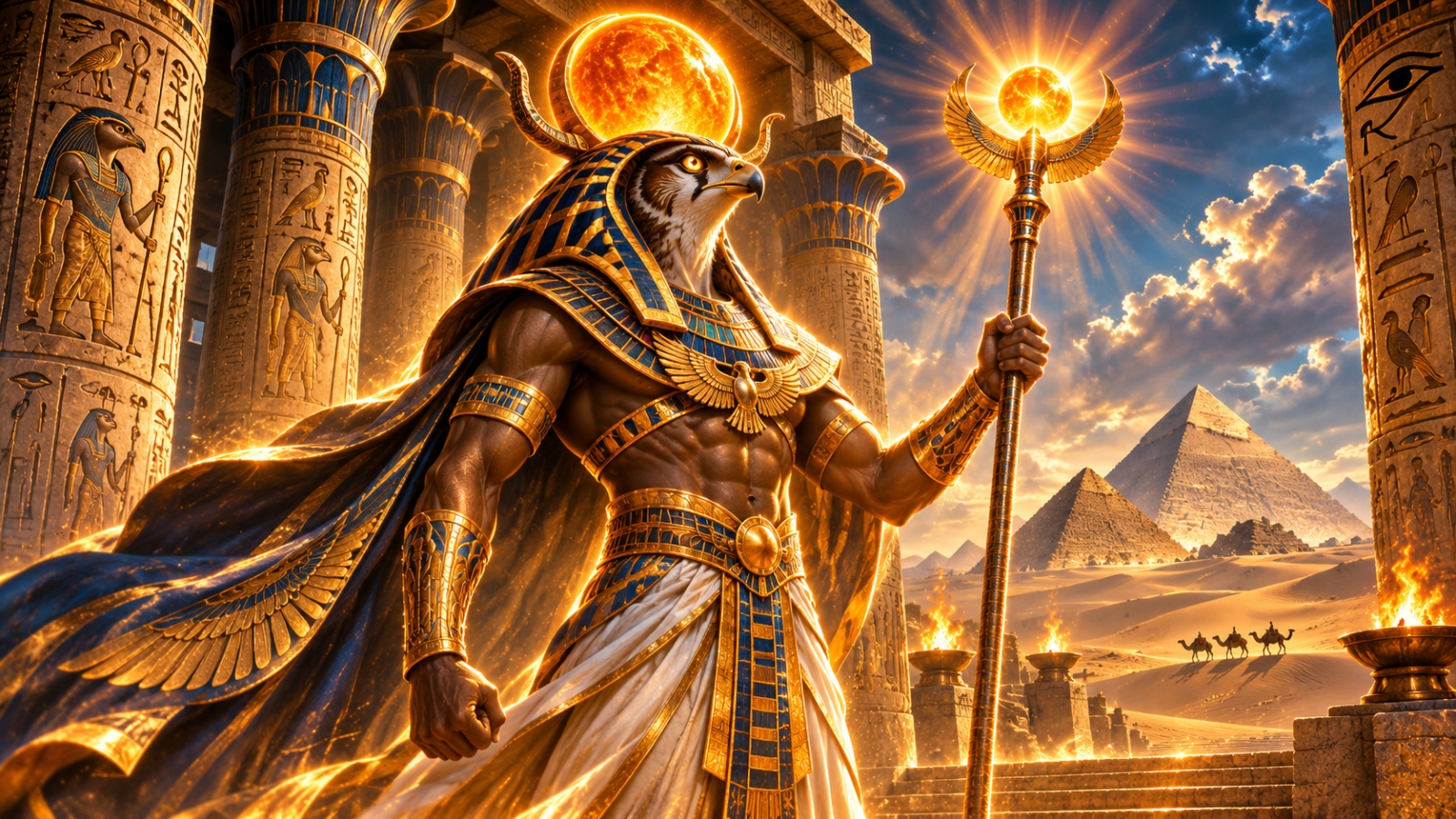
Ra (also written Re) was the ancient Egyptian god of the sun, and for much of Egyptian history the most important god of the state. He was believed to sail across the sky in a day-boat, pass through the underworld (the Duat) in a night-boat, and be reborn each dawn. Kings called themselves his “son”, and from the Fifth Dynasty onward many pharaohs included “Ra” in their royal names.
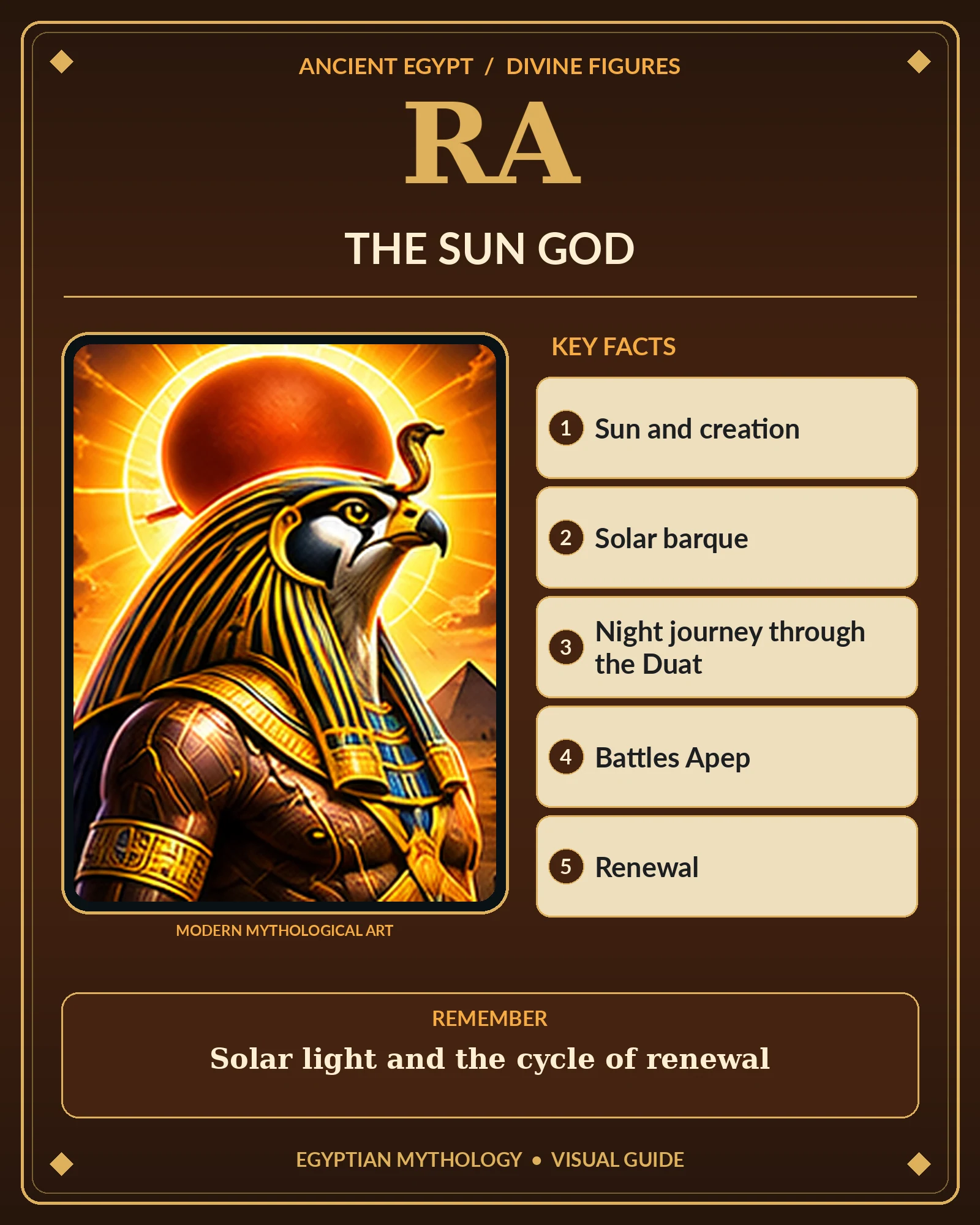
This guide separates what Egyptian sources say about Ra from later interpretation. You will find a fact box, his forms and names, the daily journey, the fight against the serpent Apep, the Eye of Ra story, how he merged into Amun-Ra, his cult centres, a myth vs fact table and ten FAQs with sources.
Ra Quick Fact Box
| Item | Answer |
|---|---|
| Domain | Sun, light, kingship, creation, order |
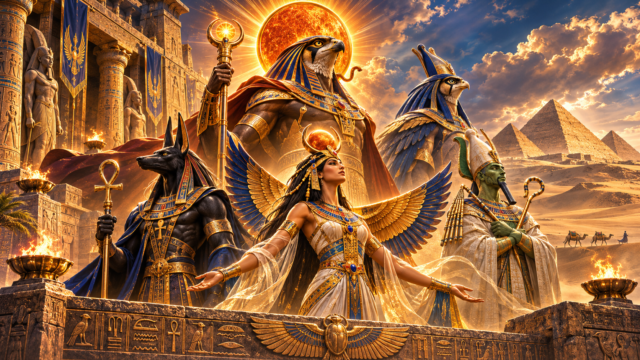
| Appearance | Falcon-headed man with a sun disc and uraeus; also a ram-headed form at night |
| Symbols | Solar disc, uraeus cobra, obelisk, scarab (as Khepri), sun-boat |
| Boats | Mandjet (day boat) and Mesektet (night boat) |
| Cult centre | Iunu, called Heliopolis by the Greeks, near modern Cairo |
| Enemy | Apep (Apophis), serpent of chaos |
| Children (traditions vary) | Shu and Tefnut in the Heliopolitan creation story; Hathor, Sekhmet and others in different texts |
| Merged forms | Amun-Ra, Ra-Horakhty, Khepri-Ra, Atum-Ra |
| Rise to prominence | Old Kingdom, especially from the Fifth Dynasty |
| Role of kings | Pharaoh as “son of Ra” |
Who Is Ra in Egyptian Mythology?
Ra personifies the sun’s life-giving power. Egyptians lived by the Nile and the sun, and a god of daily renewal fitted that world closely. Ra was not only a sky god: texts also make him a creator who rises from the primeval waters, names the world into being and rules gods and humans in a mythical early age.
His main cult centre was Iunu, the “pillar city” the Greeks later called Heliopolis, near today’s northern Cairo. Little of the city survives, but the priesthood there shaped Egyptian theology, including the Ennead, the group of nine gods that begins with Atum. Atum, the creator, was merged with Ra as Atum-Ra, which shows how Egyptians combined deities rather than treating them as rivals.
Story box: Ra’s secret name. One myth tells how Isis, wanting more power for her future son, shaped a serpent from the spit of the aging Ra. It bit him, and only the knowledge of his true name could heal the pain. Ra finally gave up the name, and Isis gained great magical authority. The story is preserved in a New Kingdom papyrus and shows the Egyptian belief that a true name held power.
Forms and Names of Ra
| Form | What it represents |
|---|---|
| Khepri | The rising sun, shown as a scarab beetle |
| Ra (noon form) | The sun at full strength, falcon-headed with a disc |
| Atum | The setting sun and primeval creator, shown as an old man |
| Ra-Horakhty | “Ra, Horus of the two horizons”, a merging with Horus |
| Amun-Ra | The hidden god of Thebes merged with the sun god, king of gods in the New Kingdom |
These forms are best read as aspects of one solar cycle. The scarab image works because the dung beetle rolls a ball and young beetles emerge from it, so Egyptians saw it as a symbol of self-generated life. This is a symbolic reading from texts and art, not a claim that Egyptians misunderstood insect biology.
The Daily Journey: Day Boat, Night Boat and the Duat
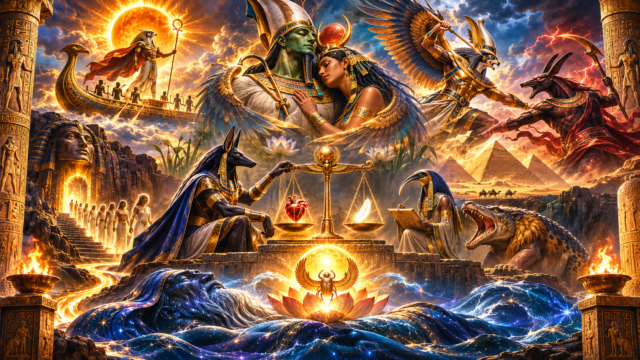
Funerary texts such as the Amduat and the Book of Gates describe Ra’s journey. By day he crosses the sky in the Mandjet. At sunset he enters the western horizon and boards the Mesektet to travel through the twelve hours of night in the Duat. Each hour has its own gates, guardians and dangers, and the blessed dead who follow Ra are warmed by his light as he passes.
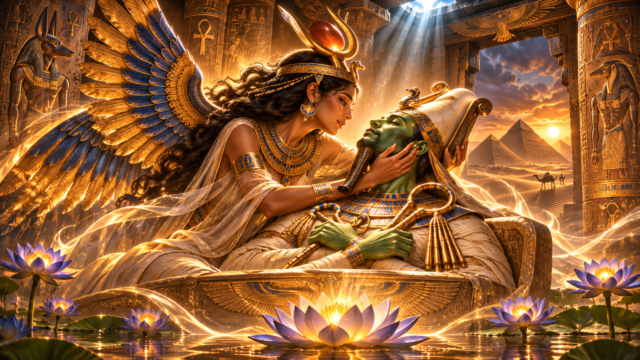
At the deepest point of night Ra meets Osiris, and the two are described as uniting, so that the sun’s power renews the dead and the dead god’s power renews the sun. Near dawn Ra emerges as Khepri, the scarab, and the cycle begins again. For kings, this became a model for the afterlife: to travel with Ra and be reborn with him.
Ra and Apep: The Battle Against Chaos
The great enemy of Ra is Apep (Greek: Apophis), a huge serpent of chaos who attacks the night-boat each journey. Gods such as Set, in a surprising protective role, and Mehen, the coiled serpent who shields the boat, help defeat him. Rituals in temples included destroying wax or ink images of Apep, so that the sun could keep rising.
This fight is not a one-time event but a constant struggle that keeps the world stable. Egyptians called the cosmic order Maat. Ra, as the sun, is order incarnate, and Apep is its opposite. The myth is better understood as a religious explanation of why light returns every morning than as a literal astronomy.
The Eye of Ra and the Tale of the Destruction of Mankind
The Eye of Ra is a powerful, often fierce female aspect of the sun god, identified with goddesses such as Hathor, Sekhmet, Bastet and Tefnut depending on the text. In the myth often called the Destruction of Mankind, Ra is old and humans plot against him. He sends his Eye as the lioness goddess Sekhmet to punish them, and she begins to slaughter. Ra relents, and to stop her he has red-dyed beer spread over the fields. Mistaking it for blood, she drinks, becomes drunk and gentle, and humanity is saved.
The story appears in the Book of the Heavenly Cow, found in royal New Kingdom tombs, and explains why the world has death and why Ra withdrew to the sky. Do not confuse the Eye of Ra with the Eye of Horus: the Eye of Horus is a symbol of healing and wholeness, while the Eye of Ra is a protective, sometimes violent, solar force. See our guide to ancient Egyptian symbols for how to tell them apart.
Amun-Ra: How Ra Merged with Amun
When Thebes became the capital in the Middle and New Kingdoms, its local god Amun, “the hidden one”, rose to national importance. To place him at the head of the gods, priests combined him with Ra as Amun-Ra, “king of the gods”. The great temple of Karnak was built for him, and many New Kingdom pharaohs credited their victories to him.
Amun-Ra is not a different, weaker version of Ra, but an example of how Egyptian theology joined a hidden, universal power (Amun) with a visible one (the sun). For the debate about which god was the strongest, read Who Is the Most Powerful Egyptian God?.
Temples, Obelisks and Sun Temples
Ra’s cult is linked to obelisks and sun temples. An obelisk was a stone version of the ben-ben, the sacred mound on which the first sunlight was thought to fall at creation. In the Fifth Dynasty, several kings built sun temples near their pyramids, including the one at Abu Gurab near Abusir, which had a large open court with a monumental obelisk and an altar in the open air, so the sun’s rays reached it directly.
Much of Heliopolis’s original temple complex is lost, and only an obelisk of Senusret I still stands in the Matariya area. Several other obelisks from the site were later moved elsewhere, and some now stand in cities such as Rome, London and New York, which is a reminder of how far Ra’s symbols travelled.
Ra, Akhenaten and the Aten: Was It the Same Sun?
In the 14th century BCE, Pharaoh Akhenaten promoted the Aten, the visible solar disc, above all other gods. This is sometimes called the first monotheism, but scholars debate that label. The Aten cult grew from older solar theology, including Ra-Horakhty, yet it broke tradition by sidelining other gods. After Akhenaten’s death the old gods returned, and Ra’s cult continued for centuries.
Myth vs Fact: Common Claims About Ra
| Claim | What the evidence shows |
|---|---|
| “Ra was the only Egyptian god.” | Egyptians worshipped many gods; Ra was among the most important, but not the only one. |
| “Ra and Horus are the same.” | They are separate gods that were sometimes merged as Ra-Horakhty. |
| “Ra created everything from nothing.” | Different cities told different creation stories; Heliopolis credited Atum-Ra, and Memphis credited Ptah. |
| “The Eye of Ra is the same as the Eye of Horus.” | They are distinct symbols with different meanings. |
| “Egyptians thought the sun was literally a boat.” | The boat is a religious image, a way to speak about the sun’s journey. |
| “Ra is worshipped today.” | The ancient cult ended; modern interest is scholarly or revivalist. |
Frequently Asked Questions About Ra
Who is Ra in Egyptian mythology?
The sun god and a creator and king of the gods, central to Egyptian religion from the Old Kingdom onward.
What does Ra look like?
Usually a man with a falcon head crowned with a sun disc and cobra. He can also appear as a ram-headed figure at night or as a scarab at dawn.
Who were Ra’s children?
It depends on the tradition. In Heliopolitan texts, Shu and Tefnut descend from Atum-Ra; other texts name Hathor, Sekhmet, Bastet, Maat and Anubis among his children.
What is the Eye of Ra?
A protective, sometimes fierce feminine power that acts for the sun god, identified with goddesses like Hathor and Sekhmet.
Who is Ra’s enemy?
Apep, the serpent of chaos, who attacks the sun-boat during its night journey.
What is the difference between Ra and Amun-Ra?
Ra is the sun god of Heliopolis; Amun-Ra is the combination of Ra with the Theban god Amun, which became the national king of gods in the New Kingdom.
Why were pharaohs called sons of Ra?
It linked royal rule to cosmic order. From the Fifth Dynasty, kings used “Son of Ra” as a title, and the king was expected to maintain Maat on Ra’s behalf.
Did Ra ever die?
Not in the Osiris sense. The sun-god’s nightly journey is a symbolic death and rebirth, but he is renewed each dawn.
Is Ra the same as Surya in Hindu tradition?
No. Both are sun deities, but their myths, rituals and histories are separate. Comparing them helps show how different cultures honoured the sun, not that they are the same god.
Where can I see Ra’s temples today?
Little of Heliopolis remains, but the Senusret I obelisk at Matariya, the Abu Gurab sun temple site near Abusir and the Amun-Ra temples at Karnak give a sense of his cult.
Sources and Further Reading
Last updated: 25 November 2026.
- World History Encyclopedia, “Egyptian Mythology”: worldhistory.org
- Egypt Exploration Society, “Gods of Egypt”: ees.ac.uk
- The Metropolitan Museum of Art, “Divine Egypt”: metmuseum.org
- World History Encyclopedia, “Osiris”: worldhistory.org



















Share Your Opinion
Comments are closed on this post.