 Vista
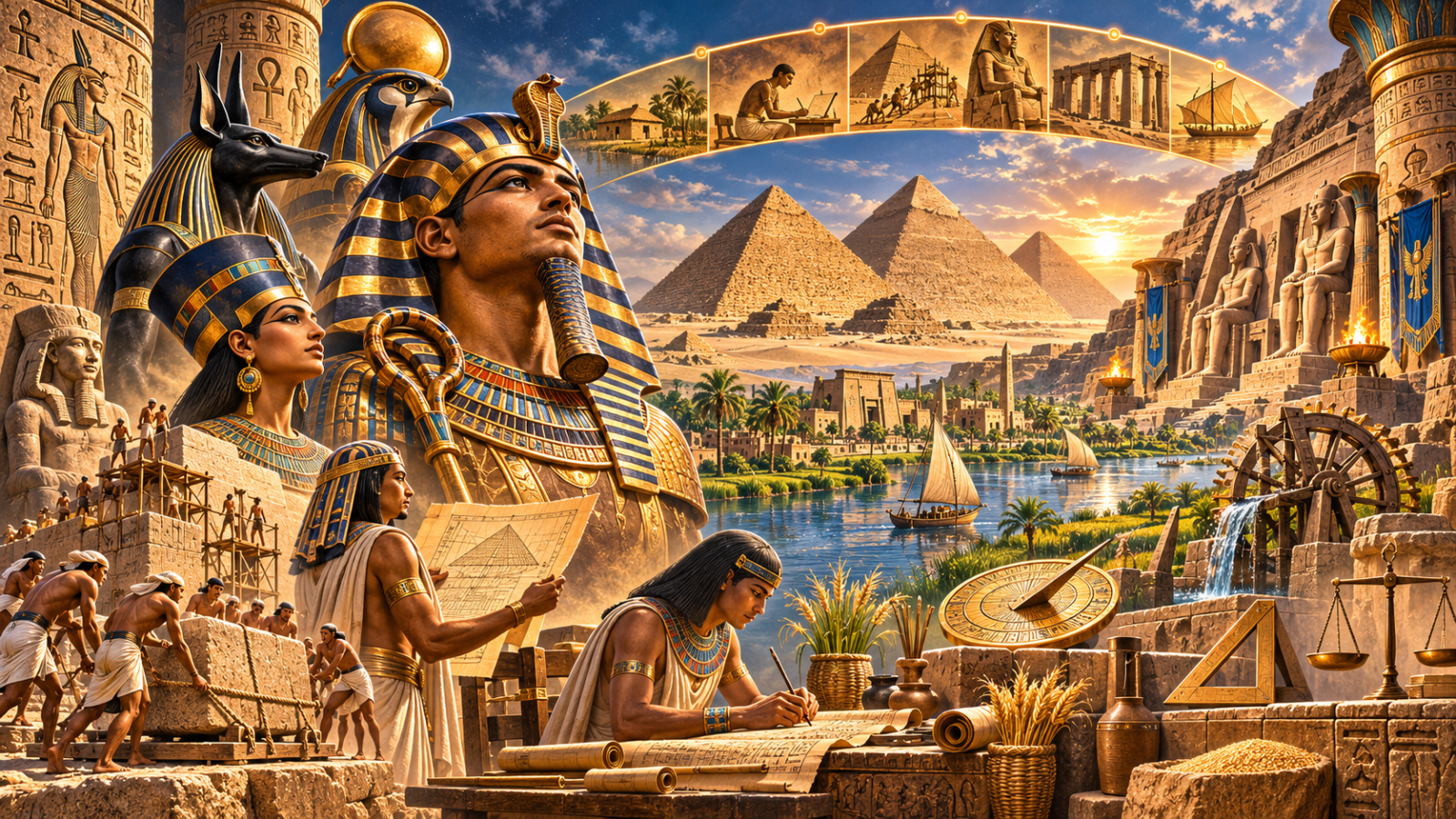
Ancient Egyptian civilization is one of the longest-lasting societies in human history. It grew along the Nile in north-eastern Africa, became a unified kingdom around 3100 BCE, raised the pyramids of Giza, developed hieroglyphic writing and survived until Rome annexed the country in 30 BCE. That is a span of roughly three thousand years.

This guide explains the history of ancient Egypt in plain English. You will find a period-by-period timeline, a table of the most important pharaohs, the discoveries that shaped what we know today, and the inventions and innovations that Egyptians contributed. Every date below is approximate (marked “c.” for circa) because Egyptologists still debate the exact chronology, especially before about 664 BCE.

Ancient Egypt at a Glance: Quick Fact Box
| Topic | Key fact |
|---|---|
| Time span | c. 3100 BCE to 30 BCE (pharaonic and Ptolemaic rule) |
| Location | The Nile Valley and Delta in north-eastern Africa |
| Main capitals | Memphis, Thebes (modern Luxor), Amarna, Pi-Ramesses and Alexandria, at different times |
| Rulers | Pharaohs, grouped by historians into dynasties following the priest Manetho (3rd century BCE) |
| Writing | Hieroglyphic, with the cursive scripts hieratic and demotic |
| Religion | Polytheistic, with a strong focus on kingship, order (ma’at) and the afterlife |
| Famous monuments | Giza pyramids, Karnak, Abu Simbel, the Valley of the Kings |
| End of independent rule | Death of Cleopatra VII in 30 BCE; Egypt became a Roman province |
[OG IMAGE PLACEHOLDER: 1200 x 630 px share image. Suggested concept: Nile at sunrise with the Giza pyramids and the title “Ancient Egyptian Civilization”. Alt text: “Ancient Egyptian civilization history timeline with the Giza pyramids beside the Nile”. To be created separately.]
What Was Ancient Egyptian Civilization?
Ancient Egyptian civilization refers to the culture and state that developed in the Nile Valley after farming communities merged into a single kingdom. The word “pharaoh” comes from the Egyptian title per-aa, meaning “Great House”, which was originally used for the royal palace and only later for the king himself, from the New Kingdom onward.
Historians usually divide the story into long periods: the Predynastic Period before unification, then the Early Dynastic Period, the Old, Middle and New Kingdoms, the “intermediate” periods of fragmentation between them, and finally the Late and Ptolemaic periods. The kingdoms were times of strong central government. The intermediate periods were times when power split between rival rulers or foreign groups.
Why the Nile Made Egypt Possible
The Greek historian Herodotus called Egypt “the gift of the Nile”, and the phrase is still useful. Almost all of the country is desert, but each year the river flooded its banks, leaving a strip of dark, fertile silt. Egyptians called this farmland Kemet, the “Black Land”, and the surrounding desert Deshret, the “Red Land”.
The agricultural year had three seasons: Akhet (the flood), Peret (the growing season) and Shemu (the harvest). Farmers grew emmer wheat, barley and flax, while the river provided fish, papyrus reeds and an easy transport route. Boats could drift north with the current and sail south with the prevailing wind, which helped a long, narrow country stay politically connected. Deserts on both sides and the rapids called cataracts in the south also gave the early kingdom natural protection.
Ancient Egypt Timeline: Major Periods
The table below follows the conventional chronology published by the Egypt Exploration Society for the periods up to 664 BCE. Other reference works differ by a few decades for the later periods and by more for the earliest ones.
| Period | Approximate dates | What defined it |
|---|---|---|
| Predynastic | c. 4400 to 3000 BCE | Farming villages along the Nile, growth of towns and rival chiefdoms (Badarian and Naqada cultures) |
| Early Dynastic | c. 3000 to 2686 BCE | Unified state, first dynasties, early hieroglyphs, royal tombs at Abydos |
| Old Kingdom | c. 2686 to 2160 BCE | “Age of the Pyramids”, strong central rule from Memphis |
| First Intermediate Period | c. 2160 to 2055 BCE | Weak central government, regional rulers |
| Middle Kingdom | c. 2055 to 1650 BCE | Reunification, classical literature, expansion into Nubia |
| Second Intermediate Period | c. 1650 to 1550 BCE | Hyksos rulers of Near Eastern origin controlled the north |
| New Kingdom | c. 1550 to 1069 BCE | Empire, great temples, Valley of the Kings, Hatshepsut, Akhenaten, Tutankhamun, Ramesses II |
| Third Intermediate Period | c. 1069 to 664 BCE | Divided rule, Libyan and Nubian (Kushite) dynasties |
| Late Period | 664 to 332 BCE | Native revival, then Persian rule from 525 BCE |
| Ptolemaic Period | 332 to 30 BCE | Alexander the Great, then Macedonian Greek pharaohs ruling from Alexandria |
Key Events in Order
- c. 3100 BCE: King Narmer is shown wearing the crowns of both Upper and Lower Egypt on the Narmer Palette, which is usually linked with unification.
- c. 2670 BCE: Djoser’s Step Pyramid is built at Saqqara, traditionally credited to the official Imhotep.
- c. 2580 to 2560 BCE: The Great Pyramid of Giza is built for Khufu.
- c. 2055 BCE: Mentuhotep II reunites the country, opening the Middle Kingdom.
- c. 1550 BCE: Ahmose I drives out the Hyksos and the New Kingdom begins.
- 1279 to 1213 BCE: Ramesses II reigns for 66 years; the Battle of Kadesh against the Hittites is fought in his fifth year, and a peace treaty follows around 1258 BCE.
- 525 BCE: Persia conquers Egypt.
- 332 BCE: Alexander the Great takes Egypt; after his death in 323 BCE the Ptolemaic dynasty begins.
- 196 BCE: The decree inscribed on the Rosetta Stone is issued under Ptolemy V.
- 30 BCE: Cleopatra VII dies and Egypt becomes a Roman province.
Famous Pharaohs of Ancient Egypt
Egypt had well over a hundred kings and a handful of ruling queens, but a small group dominates popular history. The table lists ten rulers who show the range of the civilization, from its first king to its last active ruler.
| Ruler | Approximate reign | Best known for |
|---|---|---|
| Narmer | c. 3100 BCE | Appears on the Narmer Palette; traditionally associated with unifying Egypt |
| Djoser | c. 2667 to 2648 BCE | Step Pyramid at Saqqara, designed with Imhotep |
| Khufu | c. 2589 to 2566 BCE | Great Pyramid of Giza |
| Mentuhotep II | Reunified Egypt c. 2055 BCE | Founder of the Middle Kingdom |
| Hatshepsut | c. 1479 to 1458 BCE | Female pharaoh; trading expedition to Punt; temple at Deir el-Bahari |
| Thutmose III | c. 1479 to 1425 BCE | Military campaigns that expanded Egypt’s empire |
| Akhenaten | c. 1353 to 1336 BCE | Promoted the worship of the Aten and founded a new capital at Amarna |
| Tutankhamun | c. 1333 to 1323 BCE | Boy king whose nearly intact tomb was found in 1922 |
| Ramesses II | 1279 to 1213 BCE | Abu Simbel, Battle of Kadesh, peace treaty with the Hittites |
| Cleopatra VII | 51 to 30 BCE | Last active ruler of the Ptolemaic dynasty |
Two points are often misunderstood. First, Hatshepsut ruled as a full pharaoh, not merely as a regent, and shared a long period of rule with her stepson Thutmose III, which is why their reign dates overlap. Second, Cleopatra VII was a member of the Macedonian Greek Ptolemaic dynasty, yet she presented herself as an Egyptian queen and is reported to have been fluent in several languages.
Society, Government and Daily Life
Egyptian society was organized like a pyramid. At the top stood the pharaoh, regarded as a divine king responsible for keeping ma’at, the cosmic order, in balance. Below him were the vizier (chief administrator), priests, military officers and scribes who ran the state. Most people were farmers, who paid taxes in grain and labour, or craftspeople such as stonecutters, potters, weavers and carpenters.
Scribes were essential because the state recorded harvests, taxes and building projects in writing. Learning to read and write took years of training, so literacy was limited to a small part of the population. Women had more legal and economic independence than in many other ancient societies: they could own and inherit property and take part in business, although only men normally held the highest offices.
One popular myth says that slaves built the pyramids. Excavations near Giza have uncovered bakeries, breweries and cemeteries used by the workforce, and most Egyptologists conclude that the labourers were organized, fed and housed by the state, often working in rotating teams. That does not mean the work was easy, and forced labour existed in Egyptian society, but the evidence does not support the film version of whipped slave armies.
Religion and the Afterlife
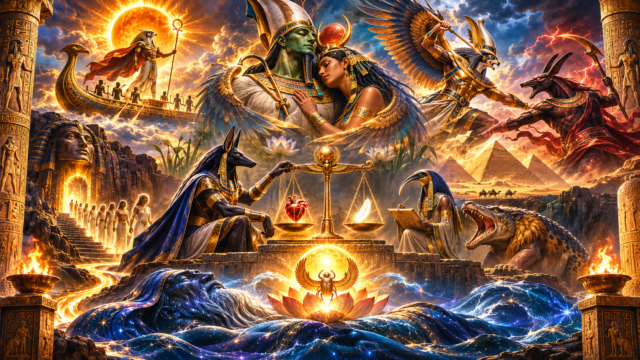
Egyptian religion had hundreds of deities. The sun god Ra, the death god Osiris, his wife Isis, their son Horus and the jackal-headed Anubis were among the most important. Gods were linked to natural forces, kingship and the cycle of death and rebirth, and temples were treated as the homes of the gods rather than as places for public worship.
Belief in an afterlife shaped much of the surviving evidence. Bodies of the wealthy were mummified to preserve them for the next world, tombs were filled with food, furniture and amulets, and funerary texts such as the Book of the Dead gave the dead spells to pass through the underworld. In the best-known scene, the heart of the deceased is weighed against the feather of ma’at; a balanced heart allowed entry to the blessed afterlife.
Pyramids and Monumental Architecture
Pyramid building developed quickly in the Old Kingdom. Djoser’s Step Pyramid at Saqqara, built around 2670 BCE, stacked stone tiers on top of one another. His successors experimented with the shape until the first completed true pyramid, the Red Pyramid of Sneferu, was finished in the early 26th century BCE.
The Great Pyramid of Khufu is the largest of the Giza group. It originally rose to about 146.6 metres (481 feet) and has a base roughly 230 metres wide. Its casing stones are gone, so it now stands about 138.5 metres tall. It is estimated to contain around 2.3 million stone blocks, and it is the only one of the Seven Wonders of the Ancient World that still stands. Two neighbours were built for Khufu’s son Khafre and grandson Menkaure; Menkaure’s pyramid is far smaller at about 66 metres.
Later kings turned to temples and rock-cut tombs. Karnak and Luxor in Thebes, Hatshepsut’s terraced temple at Deir el-Bahari and Ramesses II’s rock temples at Abu Simbel all date to the New Kingdom. If you want to separate evidence from legend about the pyramids, read our guide to Egyptian pyramid mysteries: facts versus myths.
Major Archaeological Discoveries
| Discovery | When | Why it matters |
|---|---|---|
| Narmer Palette | Found at Hierakonpolis, 1897 to 1898 | Carries some of the earliest hieroglyphs and the first known image of a king wearing both crowns |
| Rosetta Stone | Found July 1799; deciphered 1822 | Gave the same decree in Greek, demotic and hieroglyphs, enabling Champollion to read hieroglyphs |
| Tomb of Tutankhamun (KV62) | Steps found 4 November 1922 | Most intact royal tomb found in the Valley of the Kings, with over 5,000 objects |
| Wadi al-Jarf papyri | Early 2010s | Oldest known inscribed papyri, from Khufu’s reign, recording work connected with the Great Pyramid |
The Rosetta Stone and the Reading of Hieroglyphs
For centuries nobody could read hieroglyphs. French soldiers found the Rosetta Stone near the Nile Delta town of Rosetta in July 1799. It carries a priestly decree from 196 BCE issued for Ptolemy V, written in three scripts: hieroglyphic, demotic and Greek. The British took the stone after the French surrender in 1801, and it has been in the British Museum since 1802. Thomas Young made early progress with the royal names in cartouches, and Jean-François Champollion announced his decipherment in Paris in September 1822, showing that hieroglyphs record sounds as well as ideas.
Tutankhamun’s Tomb
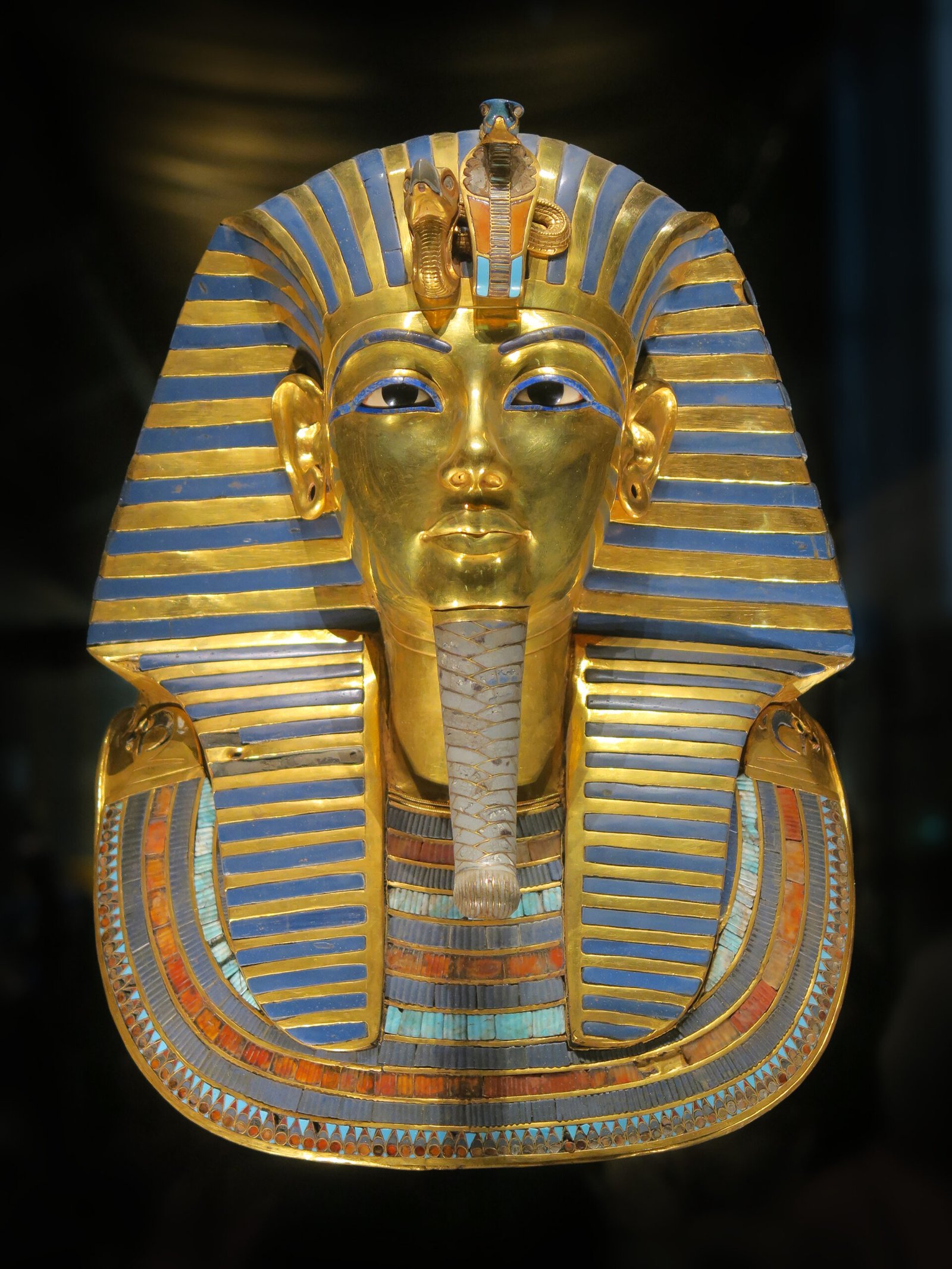
Howard Carter, working for Lord Carnarvon, found the first step of the tomb on 4 November 1922, and he looked through the sealed doorway on 26 November. Tutankhamun was a minor king who reigned only about ten years, but because his tomb escaped the looting that stripped most royal burials, it gave scholars an unmatched picture of royal burial goods, including the famous gold funerary mask.
Papyri from Wadi al-Jarf
At Wadi al-Jarf, an ancient harbour on the Red Sea coast, archaeologists found papyrus rolls dating to the reign of Khufu. They include a logbook kept by an official named Merer about transporting limestone for the Great Pyramid, which makes them rare first-hand administrative records from the age of the pyramid builders.
Ancient Egyptian Inventions and Innovations
It is tempting to say that the Egyptians “invented” everything from paper to the calendar. A more careful statement is that Egypt gives some of the earliest evidence for many technologies, and that several of them spread to Greece and Rome and from there into the modern world. Some ideas, such as writing, also appeared elsewhere at about the same time, notably in Mesopotamia.
| Innovation | What the evidence shows |
|---|---|
| Hieroglyphic writing | Developed around 3200 BCE; the Narmer Palette has some of the earliest examples |
| Papyrus | Made from beaten strips of the papyrus plant and produced in Egypt from as early as about 3000 BCE; exported across the Mediterranean, and the origin of the word “paper” |
| 365-day calendar | Twelve months of 30 days plus five extra days, linked to the yearly rising of the star Sirius and the Nile flood |
| Medicine and surgery | The Edwin Smith Papyrus (c. 1600 BCE) is a surgical text on injuries; the Ebers Papyrus (c. 1550 BCE) is the best-preserved medical text |
| Mathematics and surveying | Scribes used practical arithmetic and geometry to measure fields after floods and to plan buildings |
| Construction methods | Ramps, levers and sleds for moving stone, and obelisks cut from single blocks |
| Mummification | A developed process of drying and wrapping bodies to preserve them |
| Timekeeping | Shadow clocks and water clocks used to mark the hours |
Egyptian medicine mixed practical treatment and magic, and the Ebers Papyrus itself says that magic works together with medicine. The Edwin Smith Papyrus is notable for its methodical approach: it describes the examination, diagnosis, treatment and likely outcome of different injuries.
Decline and End of Ancient Egyptian Civilization
There was no single cause for the end of pharaonic Egypt. After the New Kingdom, power split between rival rulers in the north and the south, and foreign dynasties from Libya and Nubia took the throne. Assyria invaded in the 7th century BCE, a native revival followed, and then Persia conquered the country in 525 BCE. Alexander the Great entered Egypt in 332 BCE, and after his death his general Ptolemy founded a dynasty that ruled for almost three centuries.
Cleopatra VII sided with Mark Antony against Octavian, who defeated them at the Battle of Actium in 31 BCE and entered Alexandria in 30 BCE. Cleopatra died that August, traditionally by suicide, and Egypt became a province of the Roman Empire. Egyptian temples and religion continued under Rome for centuries; the last securely dated hieroglyphic inscription, at Philae, is from 394 CE.
Legacy of Ancient Egypt
Ancient Egypt influenced Greek and Roman art, religion and science, and its monuments have drawn travellers since antiquity. Modern Egyptology began in earnest after the decipherment of hieroglyphs, and it is still changing: new excavations regularly adjust dates, explain how monuments were built and reveal ordinary lives alongside royal history. Treat any single date in a popular article, including this one, as the current best estimate rather than a fixed fact.
[INFORMATION POSTER PLACEHOLDER: vertical infographic titled “Ancient Egypt in 10 Facts”. Suggested content: timeline strip from c. 3100 BCE to 30 BCE, map of the Nile Valley, the ten pharaohs from the table above. Alt text: “Infographic summarising ancient Egyptian history, major periods and famous pharaohs”. To be created separately.]
Frequently Asked Questions About Ancient Egyptian Civilization
How long did ancient Egyptian civilization last?
Counting from the unification of the country around 3100 BCE to the death of Cleopatra VII in 30 BCE, it lasted about 3,000 years. Earlier Predynastic cultures existed along the Nile for well over a thousand years before that.
Who was the first pharaoh of Egypt?
Tradition names Menes, and many scholars identify him with Narmer, whose palette shows him wearing both crowns. The evidence is debated, so it is safest to say that Narmer is the earliest king usually associated with unification.
Who built the pyramids of Giza?
Egyptian workers built them for the Fourth Dynasty kings Khufu, Khafre and Menkaure. Most Egyptologists believe the workforce was an organized state labour force that was housed and fed near the site, not a population of enslaved foreigners.
What is the correct order of the ancient Egyptian kingdoms?
The order is the Early Dynastic Period, Old Kingdom, First Intermediate Period, Middle Kingdom, Second Intermediate Period, New Kingdom, Third Intermediate Period, Late Period and Ptolemaic Period.
Which pharaoh is the most famous?
Tutankhamun is the most famous because of his tomb, but Ramesses II is often called the greatest. He reigned from 1279 to 1213 BCE, the second-longest reign in Egyptian history according to Britannica, and left monuments across the country.
What did the ancient Egyptians invent?
They are credited with early evidence for papyrus paper, a 365-day solar calendar, advanced surgical writing, large-scale stone building methods and developed mummification. Writing and some other ideas also arose elsewhere, so “earliest evidence” is more accurate than “first ever”.
How did the ancient Egyptians write?
They used hieroglyphs for monuments and religious texts, hieratic as a faster cursive script for everyday records, and later demotic. After Alexander’s conquest, Greek was also widely used, which is why the Rosetta Stone has three scripts.
Why was the Nile so important to Egypt?
It supplied water, fertile soil, fish, papyrus and a transport route through an otherwise desert country. The predictable yearly flood let farmers produce surpluses, which supported cities, armies and monumental building.
Who was the last pharaoh of ancient Egypt?
Cleopatra VII is generally regarded as the last active ruler. She reigned from 51 to 30 BCE, after which Egypt was annexed by Rome.
Why did ancient Egyptian civilization end?
It declined through a combination of internal division, repeated foreign invasion and, finally, Roman annexation in 30 BCE. The culture did not vanish overnight, since temples and the Egyptian language continued for centuries under Greek and Roman rule.
Sources and Further Reading
Dates are approximate and follow the sources below; where reference works disagree, the more cautious range is used.
- Egypt Exploration Society, “Chronology of Egypt”: ees.ac.uk
- Art Institute of Chicago, “Ancient Egyptian Chronology” (after Ian Shaw, ed., The Oxford History of Ancient Egypt, 2000): artic.edu
- UCLA Encyclopedia of Egyptology, chronology by Thomas Schneider: uee.ucla.edu
- Encyclopaedia Britannica, “Pyramids of Giza”: britannica.com
- World History Encyclopedia, “Great Pyramid of Giza”: worldhistory.org
- National Geographic, “How were the Pyramids of Giza built?”: nationalgeographic.com
- World History Encyclopedia, “Narmer”: worldhistory.org
- Encyclopaedia Britannica, “Rosetta Stone”: britannica.com
- Smithsonian Magazine, on Champollion’s decipherment: smithsonianmag.com
- Encyclopaedia Britannica, “Tutankhamun”: britannica.com
- Encyclopaedia Britannica, “Ramses II”: britannica.com
- World History Encyclopedia, “Roman Egypt” and “Cleopatra VII”: Roman Egypt, Cleopatra VII
- WorldAtlas, “Ancient Egyptian Inventions That Are Still Used Today”: worldatlas.com






















Share Your Opinion
Comments are closed on this post.