 Vista
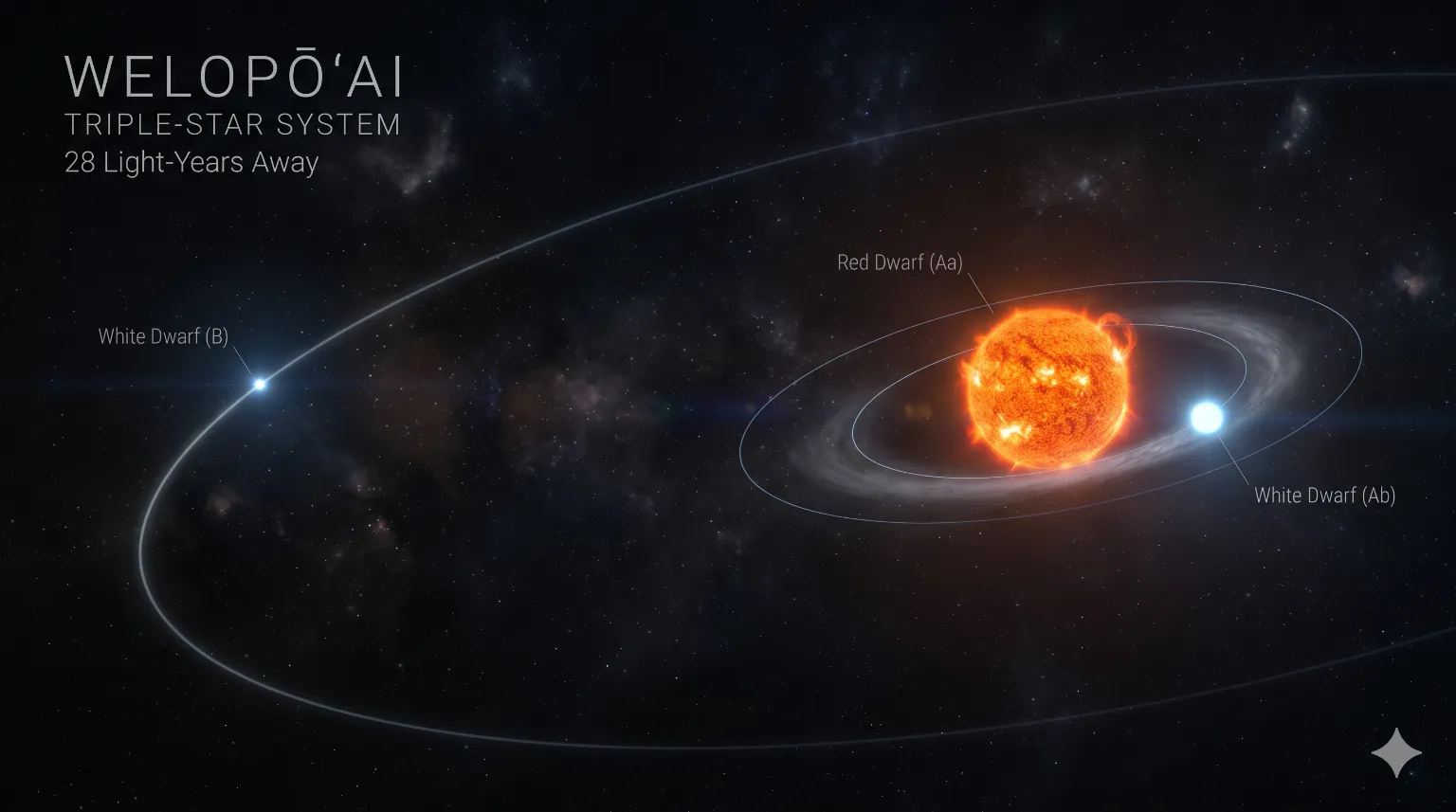
Updated November 25, 2026: Astronomers have identified an unusual stellar family called Welopōʻai, approximately 28 light-years from Earth. A red dwarf and a white dwarf form an inner pair, and another white dwarf belongs to a wider orbit around them. The study, published on November 19, makes this the nearest known triple-star system containing two white dwarfs. The mystery is not simply that three stars share a gravitational system, but that the inner pair appears to have survived a complicated phase of stellar evolution.
Welopōʻai triple star system: quick facts
| Property | What is known |
|---|---|
| Distance | Approximately 28 light-years |
| Inner pair | Welopōʻai Aa, red dwarf; Ab, white dwarf |
| Outer companion | Welopōʻai B, white dwarf |
| Research publication | 19 November 2026 |
| Detection | Spectroscopy and high-resolution imaging |
| Unresolved question | Evolution of the inner orbit through the giant-star phase |
The designation triple-star system means that the three stars are gravitationally associated. It does not mean that there are three stars of equal brightness or that they orbit in a perfect triangle. Welopōʻai is hierarchical: the inner two objects move around their shared center of mass while the third is much farther away. This arrangement helps explain why the system can persist, although the exact orbital geometry still needs further study.
How an exoplanet search revealed a hidden white dwarf
Researchers initially monitored the nearby red dwarf to look for planets. The SPIRou instrument at the Canada-France-Hawaiʻi Telescope measures motion using the Doppler effect: spectral features move toward longer or shorter wavelengths as the star travels away from or toward the observer. A planet can produce a small periodic motion in its host star, but the red dwarf showed velocity changes approaching 16 kilometers per second. The magnitude pointed toward a much heavier companion.
The team then used Gemini North and its high-resolution imaging instrument to detect the faint object near the red dwarf. Combining the two approaches is valuable because brightness alone does not reveal mass. A dim object may be a small ordinary star or a compact stellar remnant. The observed motion constrains the gravitational influence, while imaging helps identify the object. In this case, the evidence supported a white dwarf. The system’s more distant white dwarf had already been recognized, completing the three-member configuration.
What is the difference between a red dwarf and a white dwarf?
A red dwarf is a relatively cool, low-mass star that produces energy through nuclear fusion. Low-mass stars can consume their fuel slowly and remain active for extremely long periods. A white dwarf is a compact remnant left when a star of suitable mass has passed through later evolutionary stages and lost its outer layers. It no longer sustains ordinary hydrogen fusion in its core like a main-sequence star. It radiates stored heat and gradually cools.
Despite its name, a white dwarf is not necessarily the brighter object in a pair. Its surface can be hot but the total radiating area is small. A red dwarf can have a much larger radius while also being faint compared with the Sun. A useful analogy is a small hot object and a much larger cooler one: their total brightness depends on both temperature and area. Astronomers use spectra, luminosity, orbital measurements and stellar models rather than color names alone.
Why the discovery challenges stellar evolution
Before the newly identified white dwarf became a remnant, its progenitor would have expanded as it evolved away from the main sequence. When one member of a close pair grows into a giant, its outer material can interact with its companion. Depending on the separation, masses and evolution, material may transfer between stars, the orbit may shrink, or a merger may take place. The present configuration raises questions about how the inner red dwarf survived and why the resulting separation is larger than some simple evolutionary expectations.
This is not proof that the laws of physics are wrong. It is an observational test for models of interacting stars. A model that explains isolated stellar evolution may need additional treatment of mass loss, orbital changes and three-body gravity when applied to a system like this. Researchers must compare alternative histories against the measured properties rather than declaring a single untested scenario correct.
Could the outer white dwarf change the inner orbit?
In a hierarchical triple, the distant member can exert a small but persistent gravitational influence on the inner binary. If the orbital planes are suitably inclined, long-term interactions known as Kozai-Lidov oscillations can exchange orbital inclination and eccentricity. Eccentricity describes how elongated an orbit is. Such cycles can cause an inner pair to experience different closest approaches over time.
Whether this process substantially affected Welopōʻai depends on its real three-dimensional architecture and past evolution. Observations have not yet established the strength of these cycles. It is therefore better to describe the mechanism as a possible explanation worth testing, not as a confirmed account of how the system formed.
Is a triple star system 28 light-years away dangerous to Earth?
No evidence from the discovery indicates a threat to Earth. A light-year is a unit of distance, about 9.46 trillion kilometers, rather than a measure of a star’s age. At approximately 28 light-years, the system is nearby on a galactic scale but extremely distant for human travel. Its light takes decades to reach our telescopes. The discovery concerns stellar structure and orbital history, not an incoming object or a predicted collision with the Solar System.
FAQs about Welopōʻai
Does it have three suns?
It contains three stars, including two stellar remnants. It is not three Sun-like stars.
Have planets been discovered there?
This study identified a stellar companion; it does not establish that planets exist in the system.
Why does the name look Hawaiian?
It was proposed through a Hawaiian astronomical naming initiative associated with the discovery on Maunakea.
Will our Sun become a white dwarf?
Current stellar evolution models predict that the Sun will ultimately leave a white dwarf after its giant phase, billions of years from now.
Is it the closest triple star system of any kind?
No. The record concerns known triple systems containing multiple white dwarfs.
Conclusion
Welopōʻai gives astronomers a nearby natural laboratory for investigating compact stellar remnants and the evolution of interacting stars. Its unusual architecture is more interesting than the simple number of stars, and future observations may resolve how this stellar family reached its present configuration.
Research: Canada-France-Hawaiʻi Telescope research announcement; Trottier Institute for Research on Exoplanets; Instituto de Astrofísica de Canarias, November 24. Original research: Étienne Artigau and colleagues, Astronomy & Astrophysics, 19 November 2026.
Related reading: James Webb Cassiopeia A Discovery: Supernova Dust Reveals Clues to a Dying Star's Final Hours




























Share Your Opinion
Comments are closed on this post.