 Vista
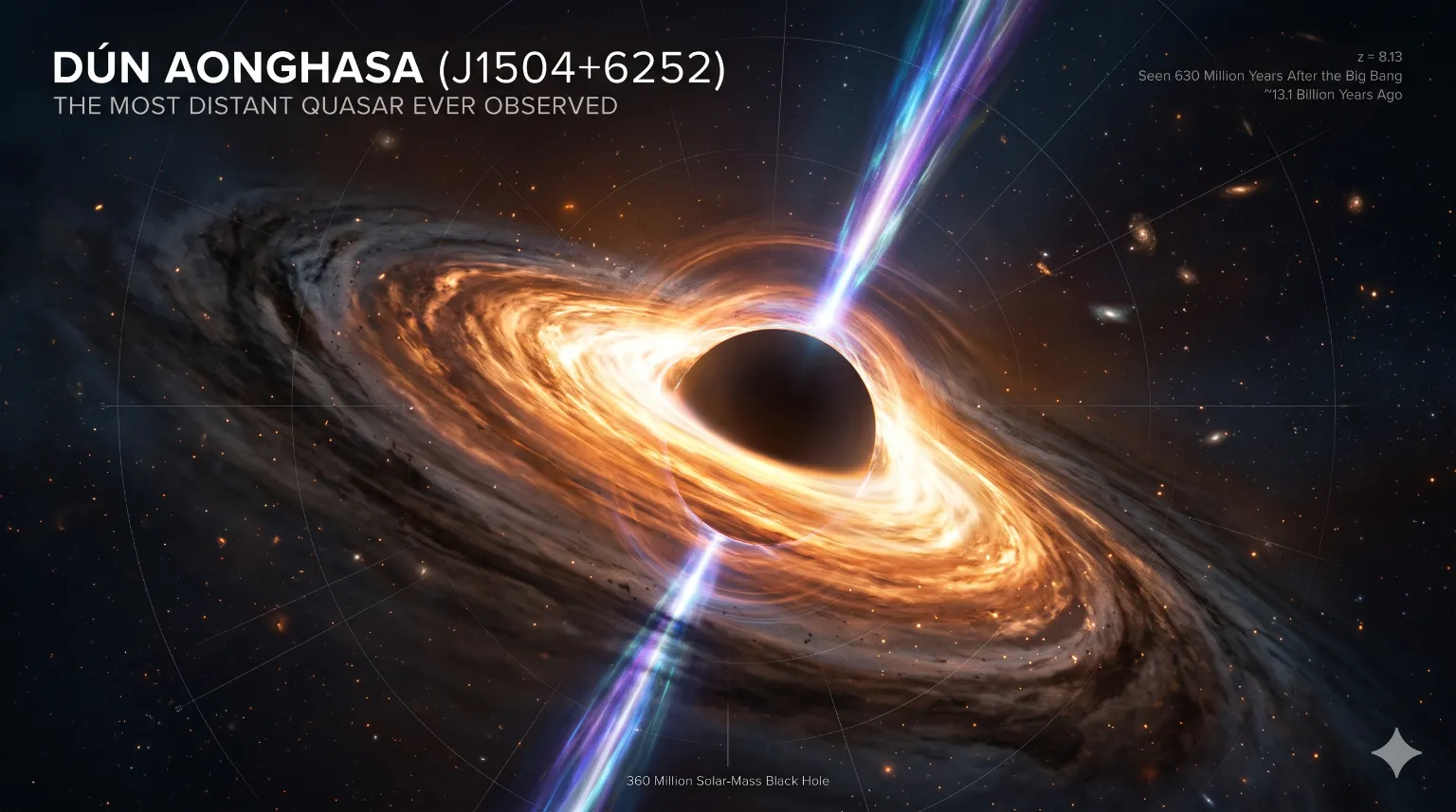
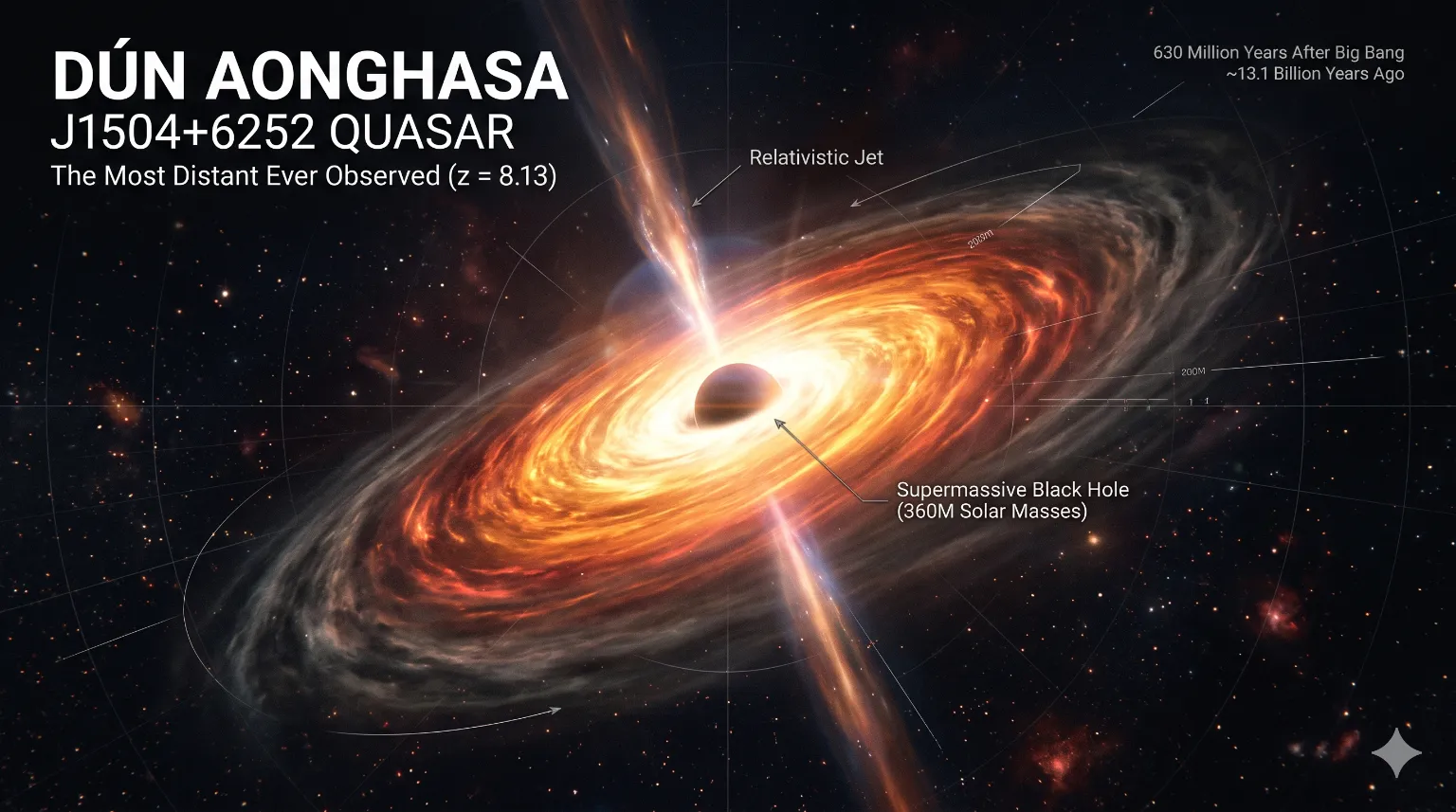
25 November 2026: Astronomers have identified Dún Aonghasa, also catalogued as J1504+6252, as the most distant known quasar at the time of the announcement. Its light comes from an era when the universe was only about 630 million years old. The central black hole has an estimated mass of 360 million Suns. The discovery, announced on 24 November by the Max Planck Institute for Astronomy, makes the rapid assembly of giant black holes a sharper scientific puzzle. It does not mean this is the first black hole ever formed.
Dún Aonghasa quasar: discovery facts
| Property | Finding |
|---|---|
| Catalogue designation | J1504+6252 |
| Redshift | 8.13 |
| Cosmic age at emission | About 630 million years after the Big Bang |
| Estimated black hole mass | 360 million solar masses |
| Initial survey | ESA Euclid Wide Survey |
| Research | Astronomy & Astrophysics 715, A356 |
What is a quasar and why does it shine?
A quasar is an exceptionally luminous active galactic nucleus powered by matter falling towards a supermassive black hole. A black hole itself does not emit ordinary light from inside its event horizon. Outside it, gas can orbit in a turbulent accretion flow, transferring angular momentum and converting gravitational energy into heat and radiation. This region can outshine the galaxy surrounding it. The energy is therefore not evidence that light escapes from within a black hole.
Quasars are useful astronomical beacons. Even when the individual stars of a young galaxy are too faint to resolve, its active nucleus may be bright enough to study across enormous cosmic distances. Not every supermassive black hole is a quasar: the supply of gas and the rate at which it accretes determine how active the surrounding region becomes. An inactive black hole could be much harder to find than a luminous one at the same redshift.
How Euclid and James Webb identified J1504+6252
The object emerged as a candidate in the Euclid Wide Survey. A survey images large portions of the sky and helps astronomers select rare objects whose brightness across different filters matches expectations for distant quasars. A candidate is not automatically a confirmed discovery. Cool foreground stars and other astronomical sources can imitate some of the same colors.
Follow-up observations, including the Large Binocular Telescope and James Webb Space Telescope, established the high redshift. Spectroscopy separates light into wavelengths so that astronomers can recognize features associated with physical processes in the source. The sequence from broad survey to targeted observation is important: several instruments can contribute different kinds of evidence to the same result. Euclid’s ability to cover large sky areas is complementary to Webb’s ability to investigate selected targets in detail.
What does redshift 8.13 mean?
Cosmic expansion stretches the wavelengths of light traveling through the universe. Redshift describes the ratio of observed wavelength to emitted wavelength minus one. At redshift 8.13, a spectral feature arrives with a wavelength about 9.13 times its original value. Light emitted in ultraviolet wavelengths can consequently be observed in infrared wavelengths. This is one reason infrared-sensitive observatories are valuable for exploring early cosmic history.
Redshift is not itself a distance measured in light-years. Converting it into the age of the universe or a cosmological distance requires a model of expansion. The reported 630 million years describes the age of the universe at the epoch we observe, not the present age of the black hole. Nor does it mean the quasar is only 630 million light-years away. Light-travel time, present-day distance and cosmic age are distinct quantities in an expanding universe.
How could a black hole grow so large so early?
One proposed route begins with remnants of early stars. A relatively small black hole seed can gain mass by accreting gas or merging with other black holes. The challenge is time: a seed must undergo a very large amount of growth to reach hundreds of millions of solar masses within the first billion years. The Eddington limit describes a balance between outward radiation pressure and inward gravity under simplified assumptions. It is a useful benchmark rather than an absolute rule for every accretion geometry.
Another possibility is direct collapse, in which a large gas concentration forms a more massive starting black hole without first evolving through an ordinary stellar remnant. A larger seed reduces the amount of subsequent growth required. The reported object is consistent with such a pathway, but its mass alone does not prove the pathway. Its observed accretion rate is relatively modest compared with the benchmark, suggesting that its earlier growth history could have been different.
Researchers can test competing scenarios by finding more quasars, measuring their masses and studying how common they are at different epochs. A single exceptional object provides an important constraint, but population statistics can reveal whether a proposed formation mechanism is frequent enough. Hypothetical primordial black holes are another possible starting point in some models; this discovery is not a detection of one.
Why is the quasar named Dún Aonghasa?
The nickname refers to a prehistoric fort on Inis Mór, Ireland. The site overlooks the Atlantic, an appropriate metaphor for an observation at the frontier of cosmic history. The scientific catalogue designation remains J1504+6252. Readers searching for Dun Aonghasa without accent marks may encounter information about the archaeological site instead, so including quasar or the catalogue identifier helps distinguish the two.
Frequently asked questions
Is Dún Aonghasa the oldest black hole?
The announced record concerns confirmed quasars, not every known black hole or galaxy.
Is it bigger than the Milky Way’s black hole?
Its estimated mass is substantially greater than that of Sagittarius A*, which is a few million solar masses.
Does a quasar threaten Earth?
No threat is indicated by this distant discovery.
Can we see it with a backyard telescope?
Its confirmation required major professional observatories; it is not an ordinary naked-eye object.
Does the discovery disprove the Big Bang?
No. It constrains models of black hole formation within cosmic history.
Conclusion
Dún Aonghasa offers a rare observational window on how rapidly galaxies and their central black holes developed. The next breakthrough may come from finding even earlier examples, not from treating a record as a final answer.
Research sources: Max Planck Institute for Astronomy, 24 November 2026; J. Wolf, S. Belladitta et al., Astronomy & Astrophysics 715, A356 (2026), linked in the institute announcement.
Related reading: James Webb Cassiopeia A Discovery: Supernova Dust Reveals Clues to a Dying Star's Final Hours


























Share Your Opinion
Comments are closed on this post.