 Vista
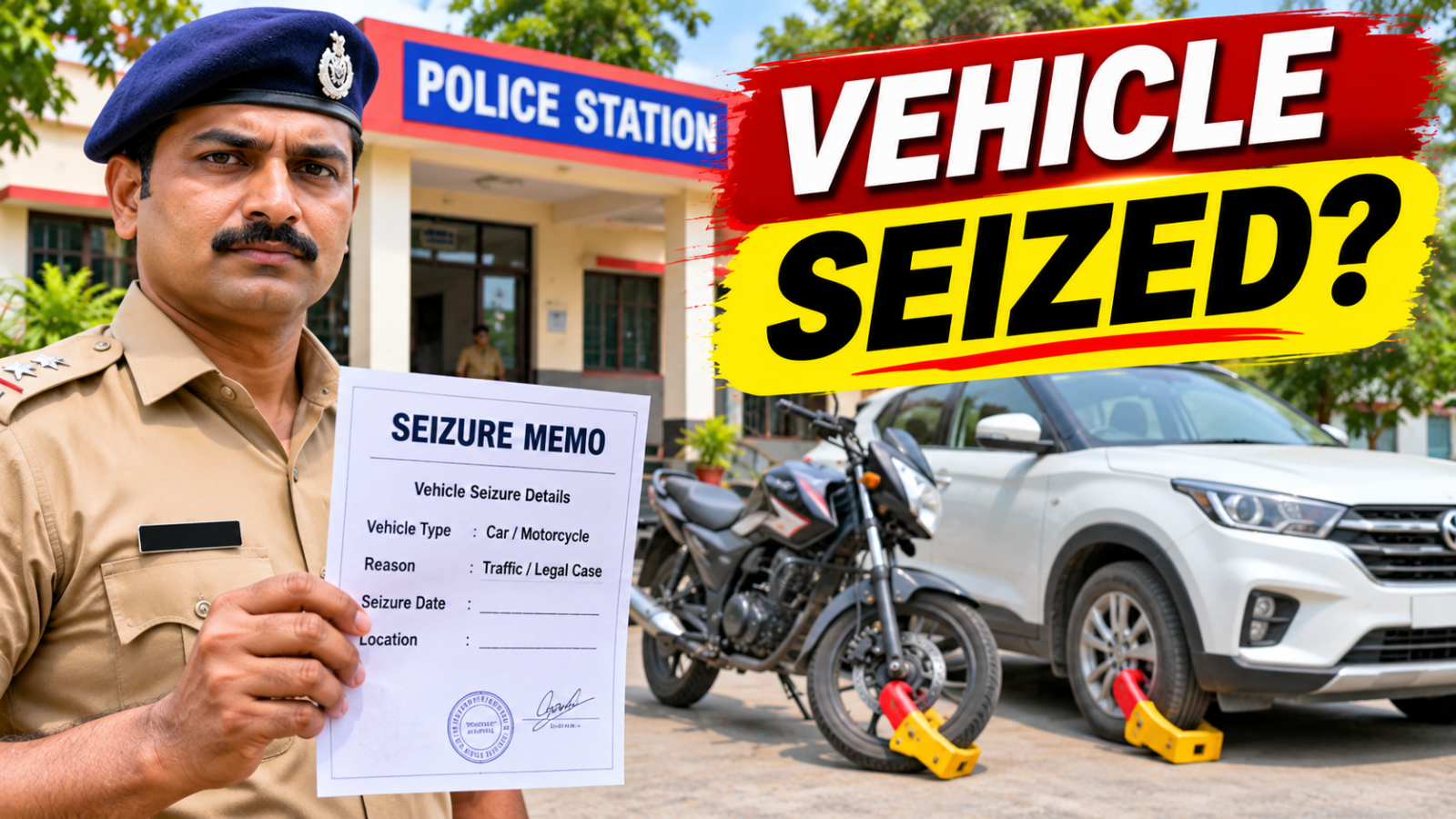
If police have seized your motorcycle or car in India, first establish the legal reason for the seizure, where the vehicle is being kept and which authority is responsible for its release. Ask for the applicable seizure or detention record. A vehicle detained for specified traffic violations may be released by the competent transport authority or authorised officer. A vehicle seized as property in a criminal investigation may require an interim custody order from a court, commonly called superdari or supurdgi. Paying a traffic challan does not automatically release every impounded vehicle.
Legal information reviewed: 24 November 2026 | India
1. What to check immediately after police seize a vehicle
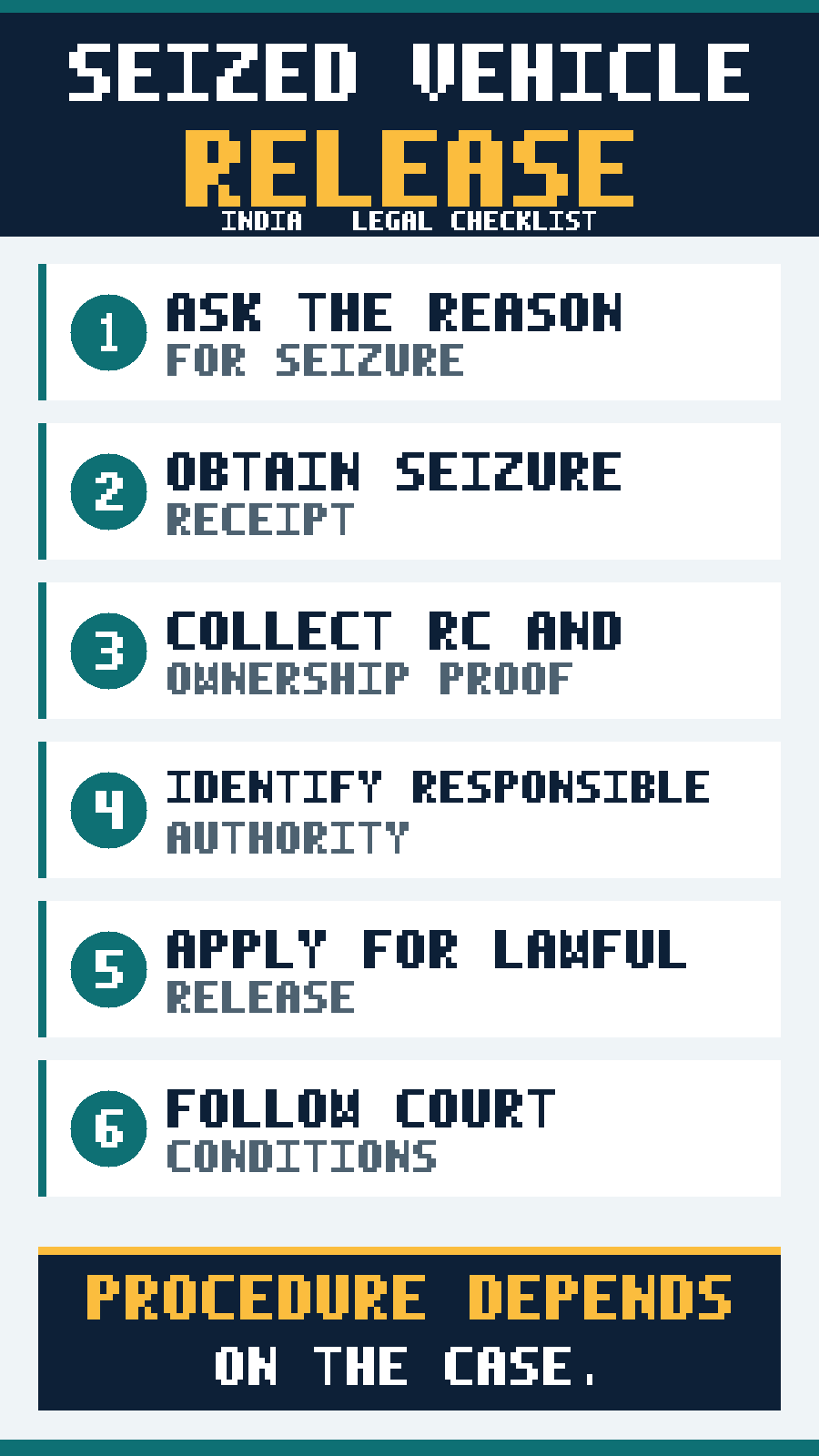
Ask the officer to explain the legal basis of the action. Was the vehicle detained for a licensing, registration or permit issue? Was it towed because of parking restrictions, or seized in connection with an accident, theft or another criminal investigation? These situations can involve different authorities and documents. Ask where the vehicle will be stored and which officer or office maintains its record. Cooperate peacefully and do not attempt to remove the vehicle without permission.
Request the applicable seizure memo, detention receipt, towing record or challan reference. Check that the registration number, date and stated reason are accurate. If the vehicle is connected to an FIR, obtain the case reference and identify the investigating officer and competent court. An impounded driving licence or a dispute over motorcycle keys is not necessarily the same as the seizure of the entire vehicle. If records are not provided, submit a written request to the responsible office and retain its acknowledgement.
2. Traffic police vehicle release under Motor Vehicles Act section 207
Section 207 of the Motor Vehicles Act, 1988 permits police officers or other persons authorised by the state government to detain vehicles in specified circumstances. These include relevant contraventions of driving licence and age requirements under sections 3 and 4, registration requirements under section 39, and specified permit requirements or conditions under section 66. In certain licensing, age or absence-of-permit cases the officer may instead impound the registration certificate under the statutory proviso. Not every traffic offence independently authorises vehicle detention under section 207.
Under section 207(2), the owner or person in charge may apply with relevant documents to the transport authority or an officer authorised by the state government. Following verification, the authority may order release on appropriate conditions. Ask which office has jurisdiction in your state, and what compliance steps or documents are required. Some traffic offences may be compounded under section 200 and applicable state notifications. Check challan details at the official eChallan portal. If the challan is referred to a court, follow its instructions. Payment of a fine or compounding amount does not override a separate seizure order. Request official receipts for any lawful payment and avoid unofficial agents promising guaranteed release.
3. Criminal-case vehicle seizure: BNSS sections 106, 497 and 503
Where a vehicle is seized in a criminal investigation, the Bharatiya Nagarik Suraksha Sanhita (BNSS), 2023 provides a different framework. Section 106 concerns seizure of property suspected to be stolen or linked to circumstances suggesting an offence. The police must promptly report such seizure to the Magistrate with jurisdiction. Section 106(3) also allows police to entrust property to a person against a bond in specified circumstances, for example when continued retention is unnecessary for investigation. The person must comply with subsequent court directions. This is not an unconditional right to release at the police station.
Section 497 deals with proper custody and disposal of property produced before a competent criminal court or Magistrate during investigation, inquiry or trial. Section 503 addresses property whose seizure has been reported to a Magistrate but which has not been produced before a criminal court during an inquiry or trial. Depending on the case, the appropriate judicial authority can decide interim custody or delivery to an entitled claimant. Older cases may still be governed by sections 451 and 457 of the former Criminal Procedure Code under transitional provisions. Ask a lawyer which procedural framework applies to your particular case.
4. Documents required for a vehicle release or superdari application
Prepare the registration certificate (RC), identification and address proof, seizure memo or FIR reference, insurance documents and other evidence showing ownership or lawful entitlement. A purchase invoice or transfer documentation may help where ownership is disputed. Commercial vehicles may require relevant permit, fitness or tax documents. The precise requirements vary with the court, vehicle and reason for detention.
If you bought a second-hand vehicle but the RC is still in the seller’s name, disclose the actual circumstances and provide valid proof of your claim. Where the vehicle is financed, another person has claimed ownership, or an insurer has already settled a theft claim, additional rights may need to be considered. The court may require an affidavit, custody bond, surety or other appropriate security. There is no universal superdari bond amount or document checklist that applies to every case. A valid driving licence and roadworthiness are also necessary if the vehicle is to be driven after release.
5. Sample superdari application for a seized motorcycle or car
Before the competent Court at ___, District ___. Subject: Application for interim custody of seized vehicle. FIR/case number ___, Police Station ___. I, ___, state that vehicle registration number ___, type ___, was seized on ___ in connection with the above case. I am its registered owner/person claiming lawful entitlement, as supported by the attached documents. Continued storage may cause deterioration. I respectfully request interim custody under the applicable legal provision after necessary evidence is preserved. I undertake to comply with all court conditions and produce the vehicle whenever directed. Name, date and signature.
This is an illustrative application, not a prescribed nationwide court form. Adapt it to the actual case, correct statutory section and competent court. Attach supporting evidence and comply with local filing requirements. If the detention is purely under section 207 of the Motor Vehicles Act, use the appropriate administrative release application rather than automatically filing a criminal court petition.
6. How long does release take? The BNSS 14-day and 30-day provisions
Under section 497(2), a description of the property must be prepared within fourteen days of its production before the relevant court or Magistrate. The provision also requires photographs and video where necessary. Section 497(5) provides for an order concerning the property within thirty days after the prescribed description and visual documentation have been completed. The possible outcomes include delivery, confiscation, destruction or other disposal. This is not a guarantee of return within thirty days of the initial seizure.
The Supreme Court’s 2002 decision in Sunderbhai Ambalal Desai v. State of Gujarat emphasised prompt handling of seized property to prevent avoidable deterioration and waste. Courts can consider documentary evidence and appropriate custody conditions instead of unnecessarily retaining vehicles. Special laws governing matters such as illicit mining, excise offences or narcotics may impose additional confiscation procedures or restrictions. Seek case-specific advice where such legislation is involved.
7. Collecting the vehicle after a release order
Take the required authenticated order, identification and executed bond to the responsible police station or storage yard. Verify the vehicle’s condition, accessories and documents at handover. Record discrepancies lawfully and request written acknowledgement. Comply with any restrictions on sale, alteration or production before court. Interim custody does not terminate an FIR or determine criminal liability. Related: Traffic police taking motorcycle keys: rules and complaints.
Frequently asked questions
Will paying my challan automatically release the vehicle?
Not necessarily. Check whether a separate detention or court order must be addressed.
Can I apply without the original RC?
Ask the competent authority about alternative proof and accepted electronic documents.
Is a lawyer compulsory for superdari?
Local filing procedures vary. Legal assistance is useful for disputed or complex cases.
Can I sell a vehicle released on interim custody?
Check the order. Obtain permission where required before transferring or altering it.
Conclusion and sources
Identify the seizure basis and obtain lawful release through the correct authority. References: Motor Vehicles Act, BNSS provisions, Sunderbhai judgment. Eligible people may contact NALSA at 15100 for legal aid guidance.
General legal information, not individual legal advice. Special statutes and local procedures may differ.
For all topics: Where to Complain in India: Police, Courts, Consumer, Banking and Government Legal Help




















Share Your Opinion
Comments are closed on this post.