 Vista
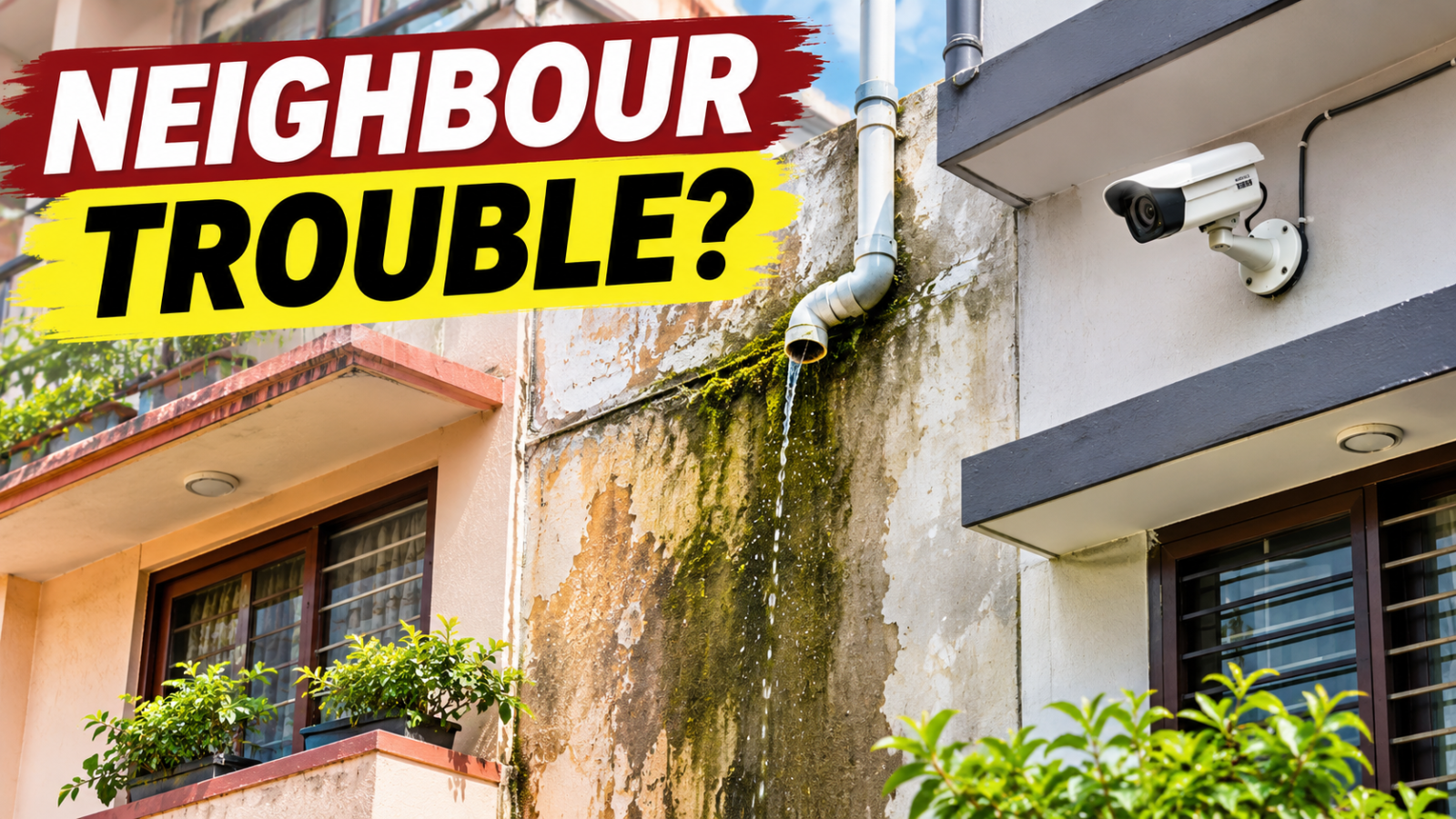
If a neighbour drains dirty water towards your home, causes damp walls, plays loud music at night or points a CCTV camera towards your private space, the right complaint depends on the actual problem. Approach the local civic authority for drainage and sanitation, your residents’ welfare association (RWA) for applicable society issues, the police for threats or offences, and a civil court for unresolved interference with private property rights. Not every neighbour dispute requires an FIR. The following guide explains what evidence to collect and where to seek help in India.
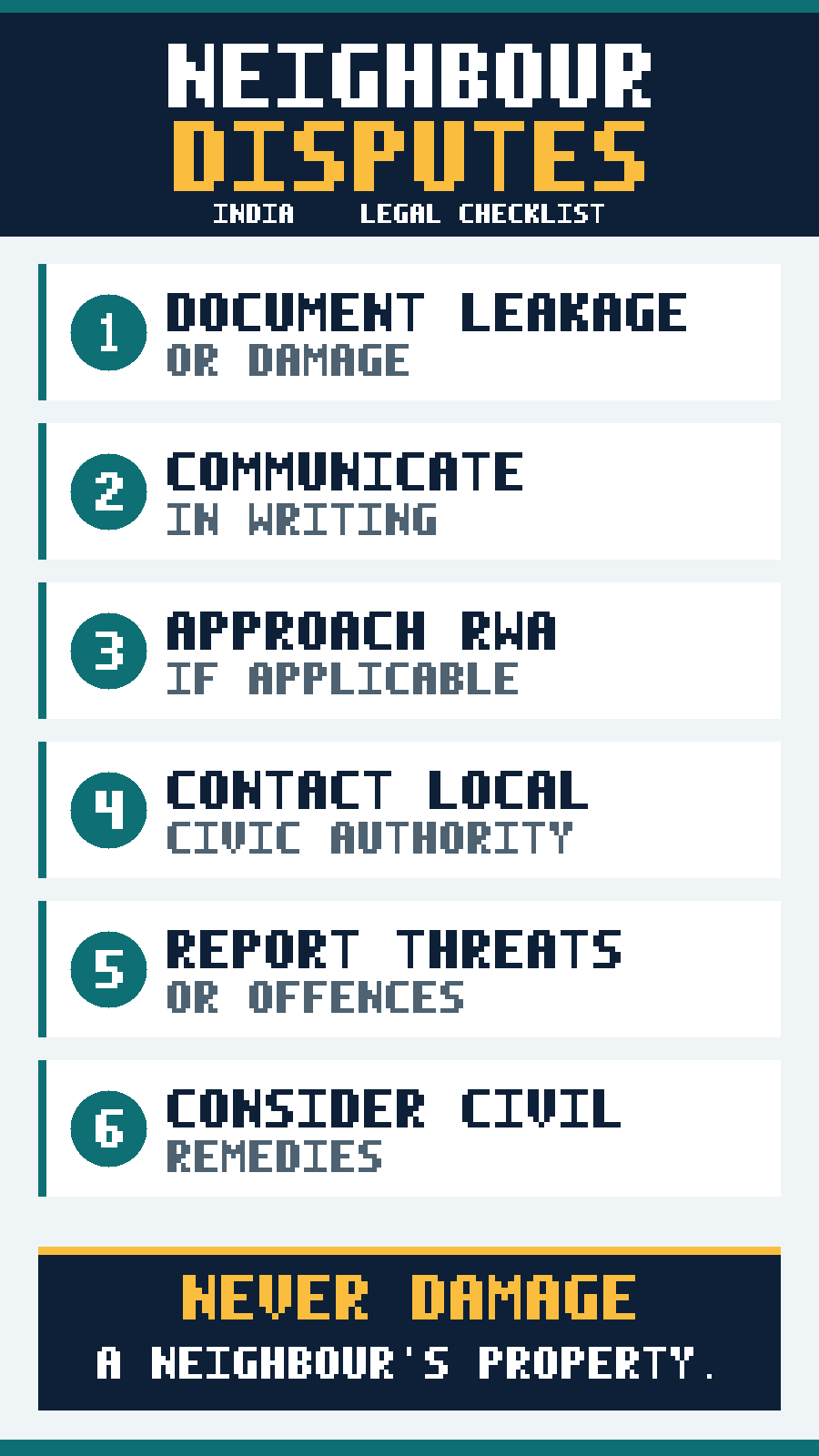
Legal references reviewed: 24 November 2026 | India
1. Neighbour discharging dirty water: municipal complaint
Start by identifying the apparent source of the water. A broken private drain, overflowing public sewer, leaking septic tank and incorrectly directed rainwater pipe may require different remedies. If wastewater is entering a public street, creating stagnant pools or affecting several homes, contact your municipal corporation, municipality or local sanitation department. In villages, approach the gram panchayat and, where necessary, the relevant block-level authority.
Describe the location, source if known, dates, smell, standing water and damage. Include photographs taken lawfully from your property or a public place. Request an inspection and correction of any drainage or sanitation violation. Use the official civic complaint portal or ward office, and keep the acknowledgement number. If the authority says the pipe is private, ask who is responsible for repair and whether any local drainage bylaw applies. Do not block the drain yourself or redirect wastewater onto another person’s property.
2. Water leakage and damp walls from the neighbouring property
Dampness does not prove that a particular neighbour is at fault. The source could be a bathroom pipe, defective terrace waterproofing, a shared service line, rising damp or plumbing inside your own home. An inspection by a qualified plumber or civil engineer can help establish the source, the required repair and an estimate of the damage. Keep dated photographs, the inspection report and invoices. If water has reached electrical fittings or a wall appears structurally unsafe, keep away and seek urgent professional assistance.
In an apartment building, notify the relevant owner, occupier and society management. The responsibility for common pipes may be different from the responsibility for an individual flat’s plumbing. Check the registered bylaws, title documents and applicable state law. A joint inspection with an agreed repair date often works better than repeated arguments. Repairing only the damaged paint may conceal the problem without stopping the leak. If the other party refuses reasonable inspection or repairs, maintain a record of the requests for use in a later complaint.
3. Shared wall disputes and unauthorised construction
A wall that separates two homes is not necessarily jointly owned. Check the sale deed, property map, approved building plan and available boundary records before claiming ownership. Where a neighbour is allegedly extending construction into your land, ask the competent land or revenue authority about official demarcation where applicable. For an urban building regulation violation, approach the municipal building permission or enforcement department.
The municipal authority can examine matters within its statutory building-control powers, but a contested ownership question may require adjudication by a civil court. Avoid demolishing the wall, drilling into a disputed structure or entering the adjoining property without authority. If construction poses immediate danger to occupants or the public, request urgent inspection by the competent authority. See also: Land mutation and demarcation in India.
4. Noisy neighbours at night: police and noise pollution rules
The Noise Pollution (Regulation and Control) Rules, 2000 establish ambient noise limits for designated residential zones of 55 dB(A) Leq during the day and 45 dB(A) Leq at night. Daytime runs from 6 am to 10 pm and nighttime from 10 pm to 6 am. These are ambient standards, not a rule that every brief household sound is an offence. Nighttime use of loudspeakers and public address systems is generally restricted, subject to the specific exceptions in the rules. State governments may permit limited use until midnight on certain notified occasions under prescribed conditions.
Rule 7 allows a complaint to the designated authority when noise exceeds the applicable ambient standard by 10 dB(A) or more, or when nighttime restrictions are violated. Record the dates, duration and nature of the repeated disturbance. A phone sound-meter app may provide an indication but is not a substitute for authoritative measurement. Contact the local police or the authority designated under the noise rules in your state. A society may also have reasonable quiet-hour rules. Distinguish ordinary household activity from persistent unreasonable noise.
5. CCTV privacy: can a neighbour point a camera towards your home?
Installing a security camera to monitor one’s entrance or a shared access area is not automatically illegal. The actual field of view matters. A camera that continuously captures a bedroom, bathroom, private courtyard or intimate activity raises different concerns from one that records a common gate. Request a reasonable adjustment to the angle, privacy masking or limits on recording. If the building has a society, request an authorised review of the field of view rather than trying to access the camera yourself.
Privacy is recognised as an important right in India, and courts have examined whether residential surveillance interferes with another person’s private enjoyment of their property. However, section 66E of the Information Technology Act applies to specified non-consensual images of private bodily areas under privacy-violating circumstances; it does not criminalise every camera facing a neighbour. Section 77 of the Bharatiya Nyaya Sanhita (BNS) may apply where its specific requirements concerning voyeurism are satisfied. Report suspected offences to the police. For an ongoing privacy interference, legal advice on an injunction may be appropriate. Never damage the camera, cut its cable or attempt to obtain unauthorised access.
6. How to complain in writing to an RWA, civic authority or police
Where communication is safe, send a calm written request describing the issue and the remedy sought. An RWA or apartment association can assist within its bylaws but is not a criminal court. Request a joint inspection, a written decision or a maintenance meeting. For sanitation or unlawful construction, send the evidence to the relevant civic department. A useful complaint states your name and contact details, the address concerned, the chronology, the damage and the specific action requested. Retain delivery proof and complaint references.
A private dispute between two owners is not automatically a public nuisance. Where an obstruction or nuisance affects the public or community, BNS section 270 and the Executive Magistrate’s powers under section 152 of the Bharatiya Nagarik Suraksha Sanhita may become relevant, subject to their statutory requirements. If there is a genuine threat, assault or other suspected offence, approach police. Criminal intimidation under BNS section 351 requires the legally specified elements; an ordinary disagreement alone is not sufficient. Call 112 for immediate danger. Do not confront a threatening person alone.
7. Civil remedies, injunctions and mediation
If written requests and appropriate administrative complaints fail, consult a lawyer about mediation, a legal notice or a civil suit. Sections 38 and 39 of the Specific Relief Act, 1963 concern perpetual and mandatory injunctions respectively; depending on the facts, a court may restrain interference or require corrective action. Section 40 permits claims for damages in appropriate injunction suits. An urgent application for interim relief may also be considered where the legal tests are met. An order or damages are not guaranteed. Eligible people can approach their District Legal Services Authority or call the NALSA legal aid helpline at 15100. A written mediated settlement can specify repair costs, work dates and future maintenance.
Frequently asked questions
Can I cut my neighbour’s leaking water pipe?
Do not interfere with another person’s property without lawful authority. Request inspection and appropriate repairs.
Who pays for a damp wall caused by upstairs leakage?
Responsibility depends on the established source, property rights, applicable bylaws and evidence of damage.
Is all noise after 10 pm illegal?
No. The source, applicable limits and specific nighttime restrictions or exceptions must be considered.
Do I need an FIR to request a CCTV angle change?
No. A written request, society inspection or civil remedy may be appropriate; report actual suspected offences separately.
What if the municipal office does not respond?
Follow up using the complaint number and escalate to the relevant senior official or available grievance mechanism.
Conclusion and references
Identify the source, document the problem and choose the correct authority. Avoid retaliation and preserve a written record.
References: CPCB noise rules, BNS, BNSS section 152, Specific Relief Act, NALSA.
General legal information, not individual legal advice. State, municipal and society rules may differ.
For all topics: Where to Complain in India: Police, Courts, Consumer, Banking and Government Legal Help

























Share Your Opinion
Comments are closed on this post.